Save Jeju Now

No War Base on the Island of Peace

  • Home
  • About
    • History
    • 4 Dances of Gangjeong
    • 100 Bows
    • Appeal
    • Partners
    • Board
  • Blog
    • All Posts
    • Petitions
    • Arrests & Imprisonmentuse for all things related to arrests and imprisonment
    • IUCN WCC 2012
      • Appeals & Statements
      • Gangjeong-Related Schedule
      • International Action Week, Sept. 2-9
      • Motion
      • Special Edition Newsletter for the WCC 2012
  • Gallery
    • #7 (no title)
    • #8 (no title)
    • #6 (no title)
  • Press
  • Support
    • Act
    • Donate
    • Visit
  • Downloads
    • Monthly Newsletter
    • Environmental Assessments
    • Reports
  • Language switcher

Tag: international solidarity


  • Farewell Sermon


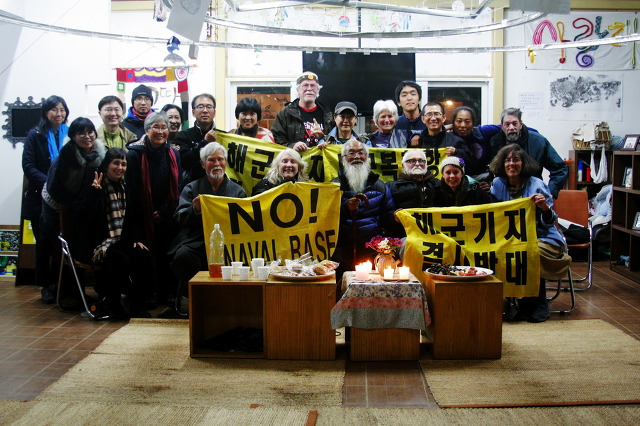
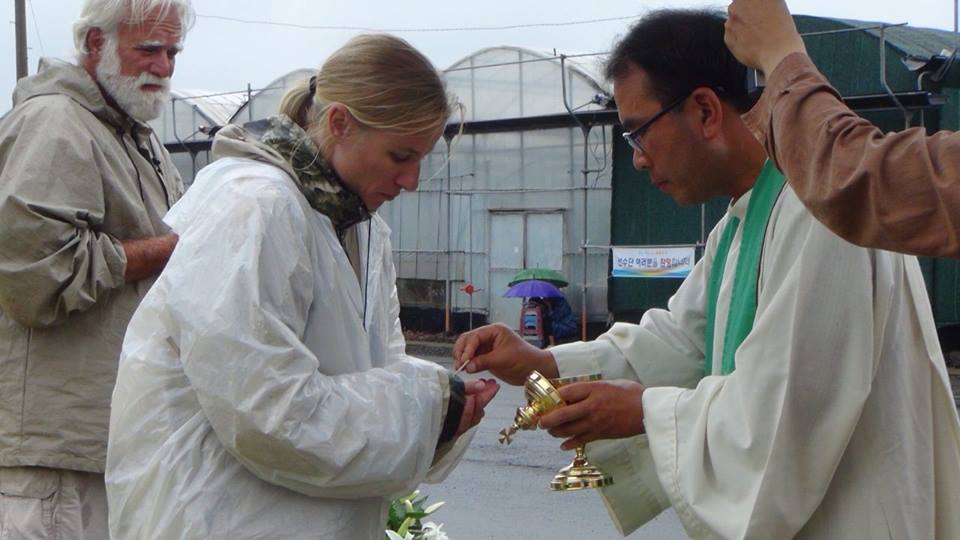
    The writer Frank Cordaro and his companion Jessica Reznicek have lately stayed in Gangjeong for two months, joining every day’s 100 bows and mass in front of gate. Their reports on Gangjeong can be much found here.
    eucharist
    Photo by Pang Eunmi/ Fr. Kim Sung-Hwan gives the Eucharist to Frank Cordaro and Jessica Reznicek in a daily mass in front of the naval base construction gate.

    by Frank Cordaro – Mass at Jeju Navy Base entrance, June 27, 2015

    Dear friends,

    I wish to thank Father Kim for allowing me to talk to you today, as a farewell message after my two month stay with you.

    I want you to know that your daily presence here at the main entrance of this U.S. /South Korean Navy Base, doing the 100 Bow Prayer at 7 a.m. and the Mass, rosary, singing and dancing at 11 a.m. has been one of the most powerful and spiritual experiences of my entire adult life as a Catholic peace and justice activist.

    As a U.S. Catholic Christian I must confess the U.S. Catholic Church lives in a great spiritual darkness under the influence of the American Imperial culture and the great wealth and properties the Institutional Church owns and our bishops manage. Proof of this spiritual darkness can be seen in all the immoral, unjust, and illegal wars and military interventions the U.S. has inflicted on millions of peoples all over the world, including Korea, in my lifetime, with an almost complete capitulation and cooperation from our bishops and Catholic institutions.

    In a country where Catholics have confused the modern crucifiers of Jesus with the Crucified Lord, our sacred liturgies are greatly compromised. We are missing some basic Gospel elements that go beyond the bread and wine, the official spoken words and the ordained priest. I have experienced those missing elements every day, here when we celebrate Mass at the entrance of this Navy Base.

    In all four Gospels, the location of where the story of the Pascal Mystery takes place is central to its meaning. In the Gospels the Jesus story takes place in 1st century occupied Palestine. Here in Gangjeong Village, your Mass, the rosary, singing and dancing take place in an occupied country too — Korea.

    In all four Gospels the city of Jerusalem and its Temple are made contested space when Jesus and his disciples organize a street demonstration – what we call ‘Palm Sunday’ – and Jesus does his direct action witness in the Temple, what we call the ‘Cleansing of the Temple’. Here in Gangjeong Village, you make this Navy Base contested space every time you celebrate Mass, pray the rosary, sing and dance here at the gate.

    In all four Gospels, there is a measure of risk that Jesus and his disciple take for confronting the Imperial culture of their times. This accounts for the secrecy that took place with the Holy Thursday gathering in the upper room that ended with Jesus’ arrest, trial and crucifixion.

    Every time the police carry us off this drive way, they tell us to move voluntarily. They tell us we are breaking the law and that we can be arrested. And this is no empty threat. Over the years of your resisting the building of this Navy Base, many of you have been arrested, some of you have done jail time, sometimes for months, even years.

    When speaking of the real presence of Christ in our Catholic Mass the elements of location, contested space and risk taking are just as important as the bread and wine, the words spoken and an ordained priest. You have all these essential elements every day at the gate and I sense the real presence of Jesus here more than any Mass I have attended in a U.S. parish or Cathedral.

    In today’s first reading from the book of Genesis (Gn 18:1-15), Abraham and Sarah offer hospitality to three strangers. And in act of offering hospitality, they are told something about themselves they did not know, that within a year Sarah will give birth to a son. May I be so bold as one who has enjoyed your hospitality to share with you what I see happening in your ‘Save Jeju Now’ community.

    Your beloved Gureombi Rock that Father Mun and many of you sing so lovingly and longingly about at the gate every day is destroyed, ripped apart under tons and tons of cement. And despite your best efforts, this Navy Base is being built. In fact it is close to completion.

    Your Bishop, Peter Kang said it best, “The destruction of Gureombi Rock is a challenge to the human Civilization and the Creation of God”. And I say, the Navy Base that sits on its broken body is an abomination!

    These days, your community is in deep grief for your loss of the Gureombi Rock and the inevitable completion of the Navy Base and the changes it will bring in its wake.

    Know that grief is the basis for the Prophets’ prophetic imagination found in our scriptures. And it was from the grief of disciples’ loss of Jesus on the cross that their eyes and hearts were open to the resurrection of Jesus and their Easter experience that followed.

    Know also that your struggle is known to many around the world and though you did not save the Gureombi Rock and stop the building of this Navy Base, your continued faithful nonviolent resistance to this god-awful base inspires many peace and justice activists around the world.

    You should know the death of Gureombi Rock need not mean its end, any more than the death of Jesus was the end of his story. You can find a new beginning of what Gureombi Rock means through your continued nonviolent Faithful resistance to this Navy Base.

    My prayer for you is that through the grief you are suffering today, you will move from a community that failed to stop the building of this god-awful Navy Base to a community determined to continue your nonviolent resistance to this Navy Base with the goal of converting the culture of death and Empire that sustains this Navy Base and all the military bases that occupy your country. That you will not stop until all US military bases are gone from your lands and the divide that separates South Korea and North Korea will no longer exist.

    In today’s Gospel reading from Mathew (Mt 8:5-17), a Roman centurion comes to Jesus asking that his servant be healed of a paralyzing, dreadful illness. Today with you, in these last two months I am that Roman centurion asking Jesus to heal my fellow U.S. Christians back home of a paralyzing, dreadful illness!

    I come from the belly of the Beast. The U.S. Empire spends on its military almost as much as the total amount of money all other countries in the world spends on a yearly bases. We have over 600 military bases in over 100 counties in the world. In 1968, Martin Luther King said, “The U.S. is the greatest purveyor of violence in the World”. Since then, it has only gotten worse. This violent and destructive way of living is built on the legacy of the genocide of our Native American peoples and the enslavement of African Americans.

    In my lifetime we have destroyed hundreds of “Gureombi Rocks” beginning with the ongoing pollution of our own lands, air and waters. We are the leading force behind a destructive way of living on the planet that is putting all life at risk. We need to be stopped!

    You can help us heal the paralyzing, dreadful illness that we U.S. Christians suffer by continuing your nonviolent Faithful resistance to this Navy Base and help lead the world in the needed task of disarmament and peace making.

    I assure you, when I return home to the U.S. I will sing of your praises and urge my Catholic Worker and peace activist friends to come to Jeju Island and witness with you, here at the entrance of this god awful Navy Base where the real presence of Jesus can be found and the hope for a disarmed world is made possible.

    (The writing above was a little edited by sunny, a member of village international team)
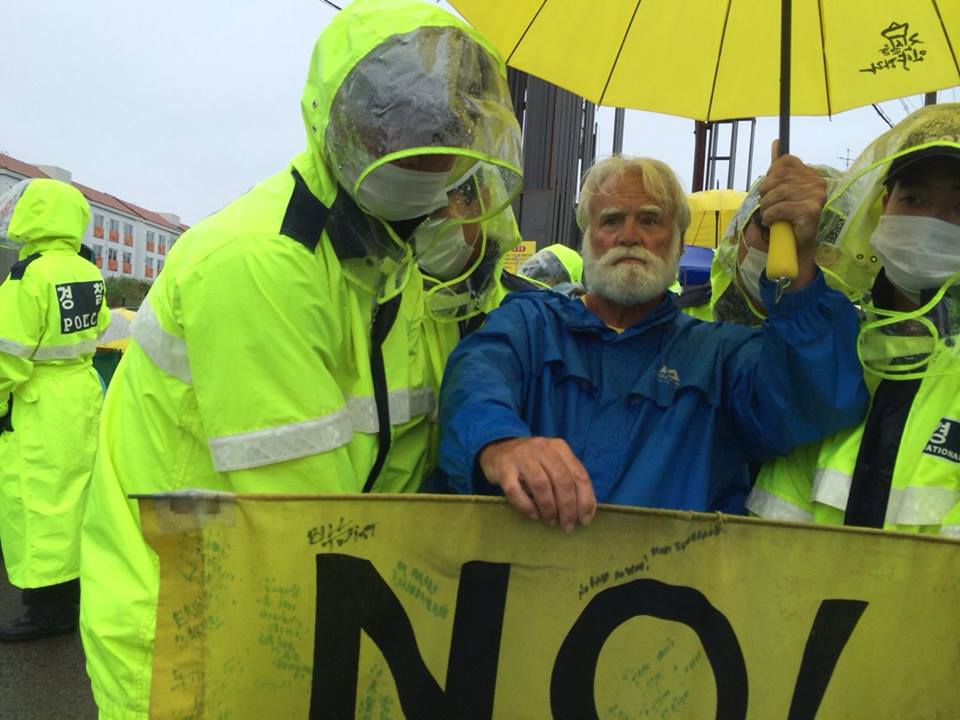
    Frank
    Photo by Pang Eunmi
    Jesse
    Photo by Pang Eunmi


    July 7, 2015

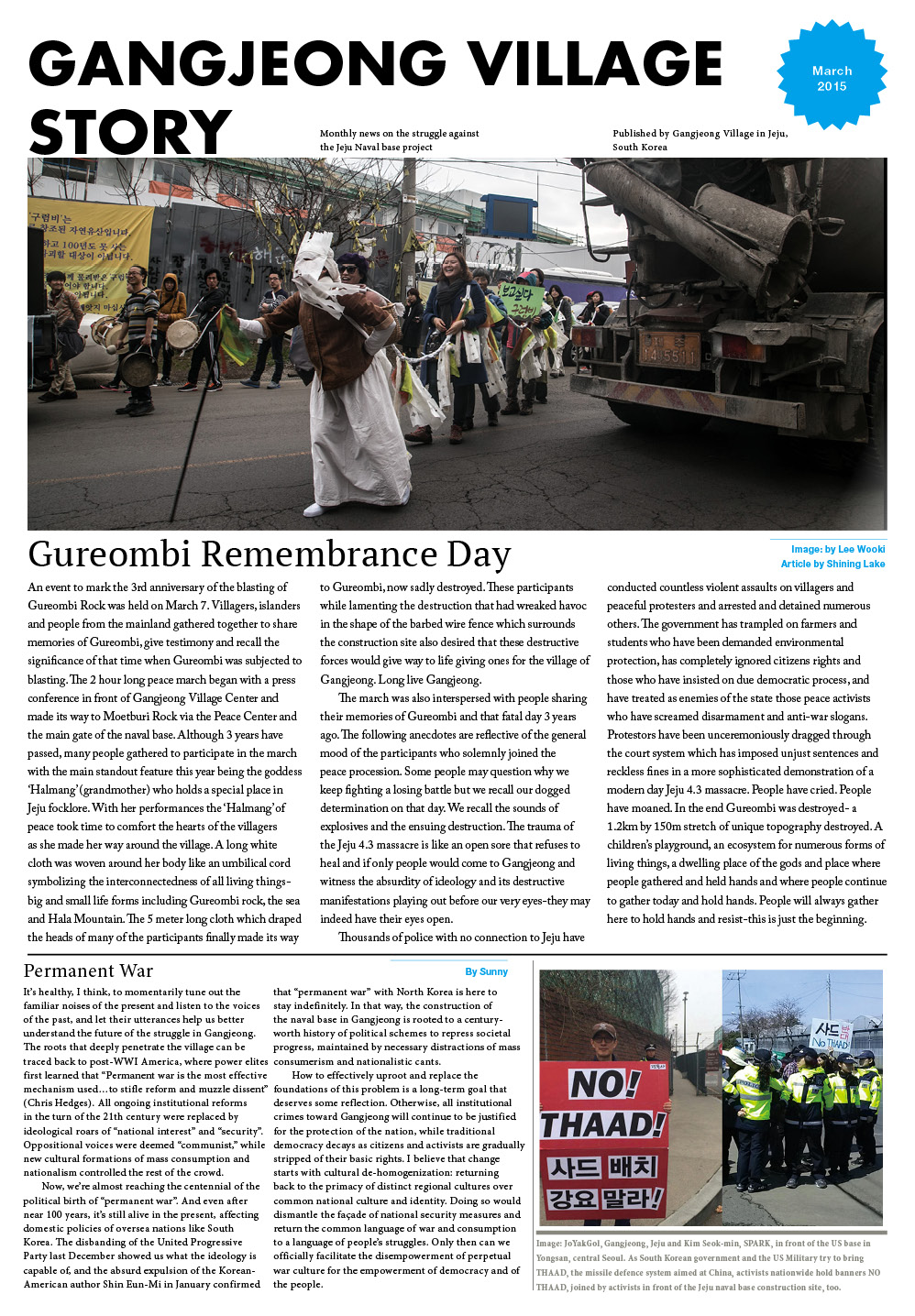
  • Gangjeong Village Story: Monthly Newsletter | March Issue

    In this March Edition:
    Gureombi Remembrance Day, Permanent War, “Gureombi, The Wind is Blowing” travels the world, Women Crossing the DMZ Borders, Protecting Democracy or an Occupying Army? Choosing Arrest Rather than Paying Fines, Human Rights: Forever a Fugitive, Crosscurrents, Interview with Gangjeong Women’s Association leader Jeong Young-sim, Welcoming Grandma Youngdeung, Visit to the US Congress for Jeju 4·3 Solution, Remembering Fukushima and much more!

    Download PDF

    April 8, 2015

  • Gangjeong Village Story: Monthly Newsletter | January 2015 Issue

    In this January 2015 Edition:
    Crackdown on the Village, Cork City Council passes the motion to support Gangjeong, Proposed Petition of Veterans For Peace-Korea Peace Campaign, Damage to Fishermen, Henoko State Violence, Realizing the Island of Peace, Different frontlines for Life and Peace, Interview with a Gangjeong Villager, The Story of Magazi,  Documenting present day Gangjeong, Aotearoa’s Anti-Base Movement trial updates and much more!

    Download PDF

    February 6, 2015

  • Connecting the dots between Bangor and Jeju

    Re-blogged from here

    See also the video by Rodney Herold, ‘ Second Day Walk- Steilacoom to Tacoma‘

    ……………………………………..

    Ground Zero holds mock funeral for the Earth at at Bangor Trident base
    By Leonard Eiger
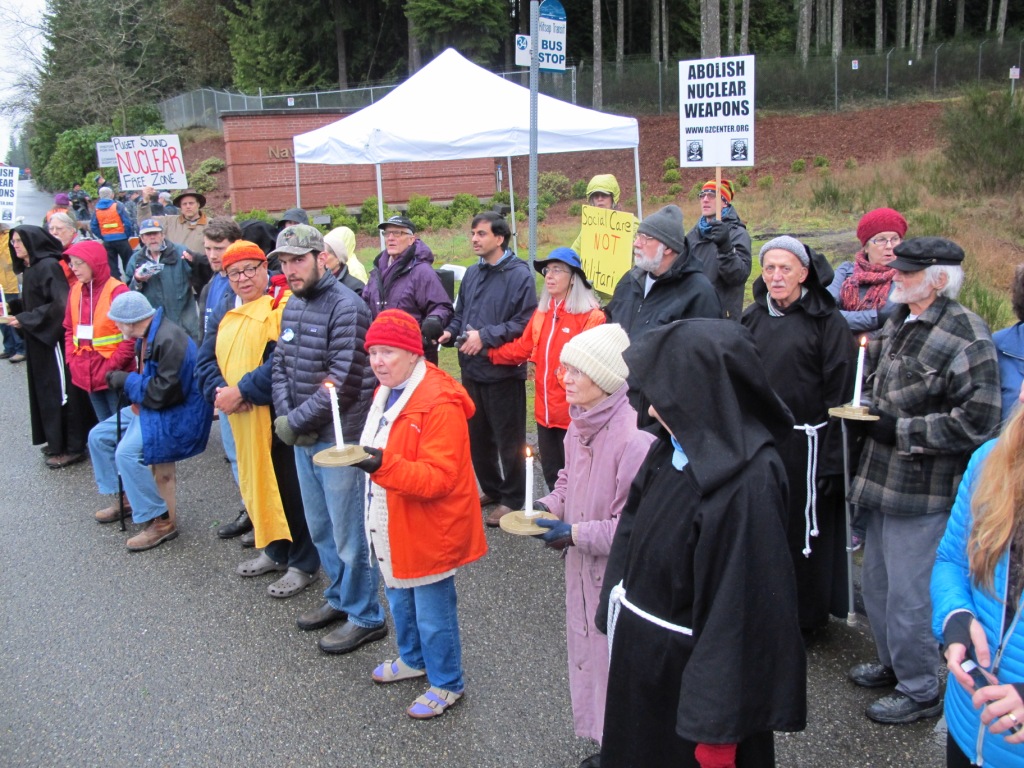
    Over sixty people participated in Ground Zero Center for Nonviolent Action’s annual celebration of Martin Luther King Jr’s life and legacy on Saturday, January 17, 2015. The event concluded with a vigil and nonviolent direct action at Naval Base Kitsap-Bangor in Silverdale, Washington.

    1

    Under the theme “Building the World House,” the day focused on Dr. King’s commitment to nonviolence and his opposition to war and nuclear weapons. Dr. King’s essay “The World House” may very well be the best summation of Dr. King’s teachings.

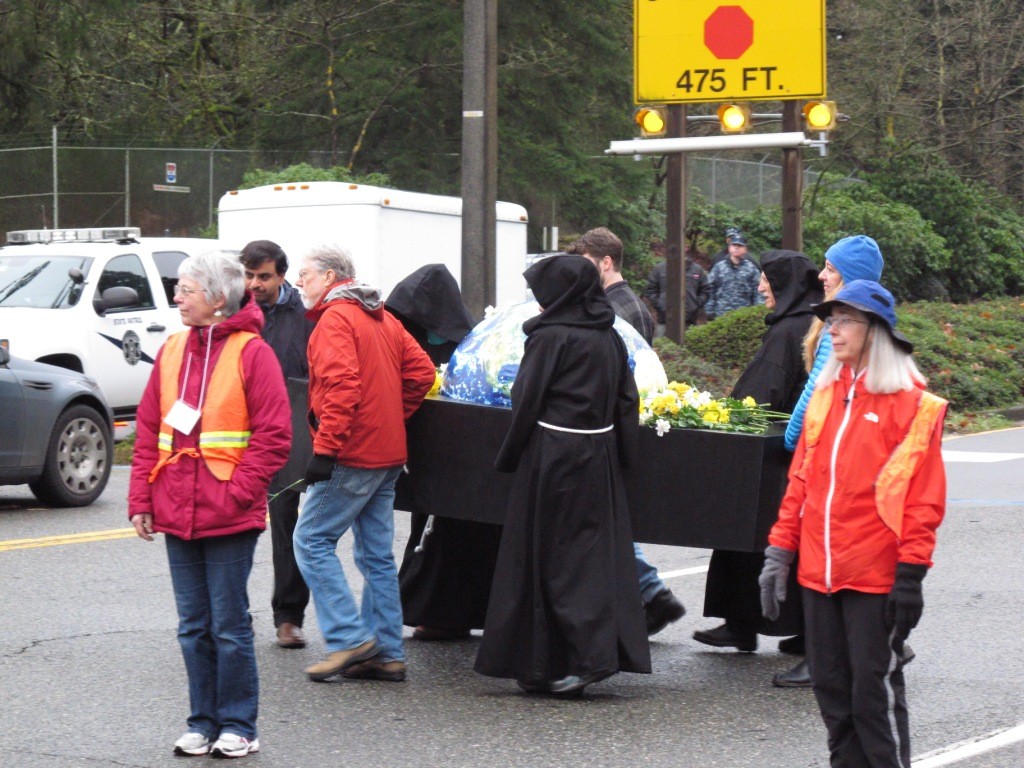
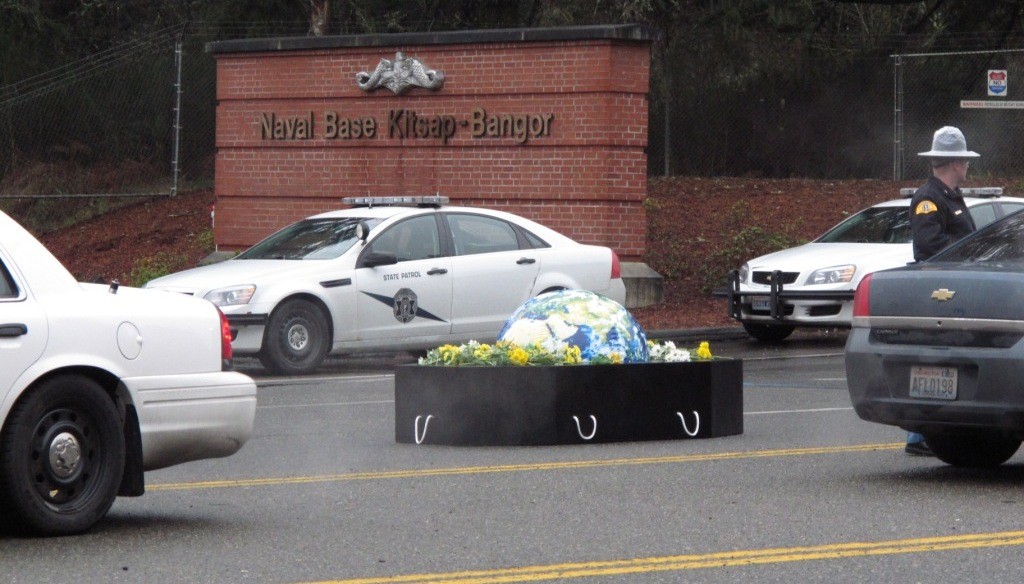
    While some participants maintained a peaceful vigil at the Main Gate to Naval Base Kitsap-Bangor in Silverdale, Washington on Saturday afternoon, others dressed in black monk’s robes carried a coffin containing a globe representing the earth to the side of the road. People walked up to the casket and placed flowers on it, and then another robed participant recited a eulogy, “Mourning the Death of the Earth after Nuclear Annihilation.” A funeral dirge completed the ceremony.

    When the ceremony was finished participants carried the casket onto the roadway, blocking traffic entering the base. Washington State Patrol officers ordered the resisters to move the coffin out of the roadway. They complied, and carried the coffin to the median where they were detained. All received citations for being in the roadway illegally, and then released.

    2

    Those cited were Mary Elder, Seattle, WA; Peter Gallagher, Seattle, WA; Raghav Kaushik, Kirkland, WA; Mona Lee, Seattle, WA; Bernie Meyer, Olympia, WA; Michael Siptroth, Belfair, WA; and Rick Turner, Seattle, Wa;

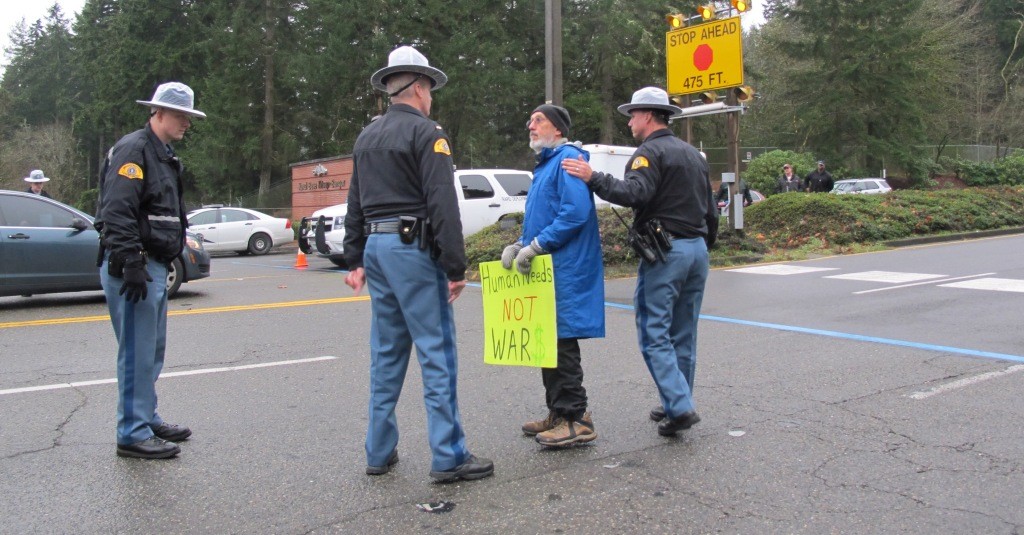
    Following the initial action more protesters entered the roadway and blocked traffic. Gilberto Perez, Bainbridge Island, WA carried a sign calling for no naval base on Jeju Island, Korea. Jonathan Landolfe, Tacoma, WA carried a sign saying “Sea Hawks, Not War Hawks.” Bruce Gagnon, Bath, ME carried a sign saying “Human Needs, NOT WAR$”. All were removed from the roadway by State Patrol and cited for being in the roadway illegally.

    3

    Gagnon, the Coordinator of the Global Network Against Weapons and Nuclear Power in Space, gave the keynote address earlier in the day at Ground Zero Center. Gagnon spoke of the unsustainability of the US Navy’s shipbuilding budget, and how “entitlement” programs including Social Security, Medicare and Medicaid are being defunded in order to fund the newest ships that include a new fleet of ballistic missile submarines. The OHIO Class Replacement Program alone (12 new Trident submarines) will cost an estimated $100 billion.

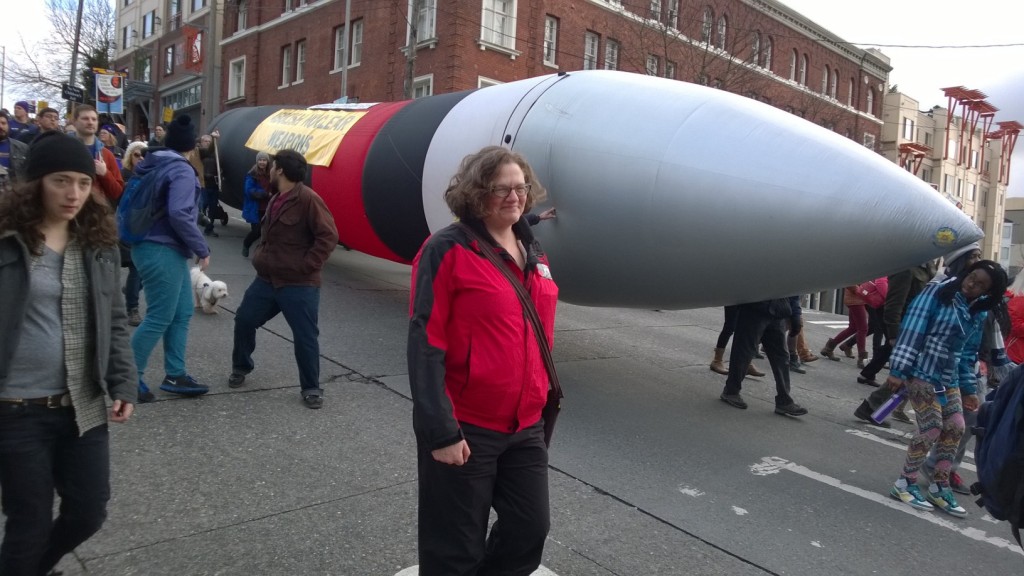
    Members of Ground Zero Center also participated in the Seattle MLK Rally & March on January 19th, carrying a full size inflatable replica of a Trident II D-5 thermonuclear armed missile. Accompanying the missile was a banner with a famous quote by Dr. King: “When scientific power outruns spiritual power, we end up with guided missiles and misguided men.” Participants handed out leaflets with facts on Trident.

    The Trident nuclear weapons system was designed during the height of the Cold War and was predicated on the theory of Strategic Nuclear Deterrence, a doctrine that no longer applies long after the fall of the Berlin Wall. Continued deployment of Trident increases the risk of either accidental or intentional nuclear war, and building a new generation of ballistic missile submarines is increasing global proliferation of nuclear weapons at a time when the nuclear armed powers should be reducing reliance on nuclear weapons and making good faith efforts toward disarmament.

    4

    The Trident submarine base at Bangor, just 20 miles from Seattle, contains the largest concentration of operational nuclear weapons in the US arsenal. Each of the 8 Trident submarines at Bangor carries up to 24 Trident II (D-5) missiles, each capable of being armed with as many as 8 independently targetable thermonuclear warheads. Each nuclear warhead has an explosive force of between 100 and 475 kilotons (up to 30 times the force of the Hiroshima bomb). It has been estimated that by the time the new generation of ballistic missile submarines are put into service, they will represent 70 percent of the nation’s deployed nuclear warheads.

    5

    Ground Zero Center for Nonviolent Action holds three scheduled vigils and actions each year in resistance to Trident and in protest of U.S. nuclear weapons policy. The group is currently engaged in legal actions in Federal court to halt the Navy’s construction of a Second Explosives Handling Wharf at Bangor. Ground Zero is also working with other organizations to de-fund the Navy’s plans for the next generation ballistic missile submarine.

    For over thirty-seven years Ground Zero has engaged in education, training in nonviolence, community building, resistance against Trident and action toward a world without nuclear weapons.

    January 23, 2015

  • Gangjeong Village Story: Monthly Newsletter | December Issue

    In this December Edition:
    Gangjeong Mayor’s message for 2015, Encountering of Nanjing and Jeju’s suffering, Navy plans crackdown on 24 hour sit-in tent, A priest’s getting pushed down by a construction vehicle and the negligence of police, Republic Of Korea Navy Chief involved in corrupt arms purchase, Love is the only answer, tangerine harvest season, The struggle by villagers and Island people to stop the resumption of the construction
    for military residence, Palestine Come and See, Korea loses Father James Sinnott, Christmas Eve in Gangjeong village, Metburi report, United Progressive Party, Introducing Gangjeong struggle through movies, trial updates and much more!

    Download PDF

    January 5, 2015

  • Tacoma priest in wheelchair travels to South Korea to protest naval base


    Re-blogged from here.   To see the related post, see here.


    By Steve Maynard, Nov. 28, 2014


    B
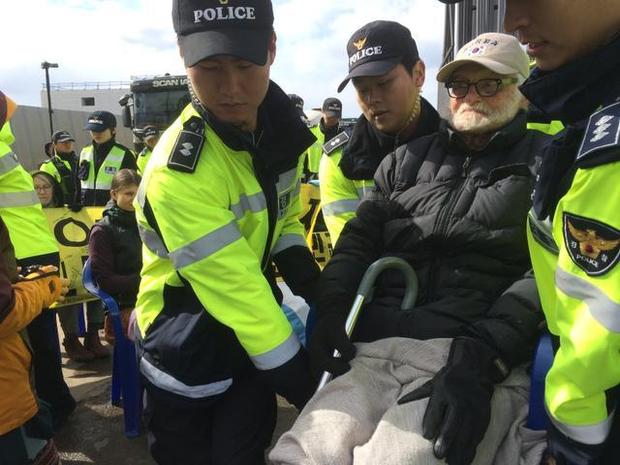
    The Rev. Bill Bichsel, center, is moved from his protest site by police during the Tacoma priest’s trip to South Korea earlier this month. COURTESY OF EUNMI PANG

    The Rev. Bill Bichsel, an 86-year-old Tacoma priest known for his acts of civil disobedience, has returned from a trip to South Korea to protest construction of a naval base there.

    Just three months ago, Bichsel was seriously ill and in the hospital in Tacoma. But his health — while still frail due to a heart condition — improved to the point he was able to make the trip using a wheelchair.

    He said his doctors didn’t try to stop him from traveling.

    “They just shake their heads,” Bichsel said. “They know I’m going so they don’t make a big fuss.”

    For nearly 40 years, the Jesuit priest known as “Bix” has protested against U.S. military programs and weapons. He’s been arrested dozens of times for trespassing during protests and jailed more than a half-dozen times.

    He wasn’t arrested in South Korea, but he realized the 12-day trip could set his health back.

    “I know I could go anytime,” Bichsel said.

    He was weak upon returning Nov. 20, but has gotten stronger since. And he was inspired by the trip.

    Bichsel and nine other people — nearly all from the Puget Sound area — traveled to Jeju Island to commit what he called “acts of civil resistance” against construction of a base by the South Korean Navy. The base has been under construction on the island off the southern tip of Korea for eight years.

    The efforts to stop it has been underway at Gangjeong Village since construction started, Bichsel said. The movement has united Catholics, Buddhists and those of no religious affiliation.

    “It’s the most inspiring, unified resistance that I’ve experienced,” he said.

    Bichsel said residents of the area believe the base will be used to service U.S. Navy ships. Some of those vessels could be armed with missiles as part of a defense system, he said.

    The base is a few hundred miles from China.

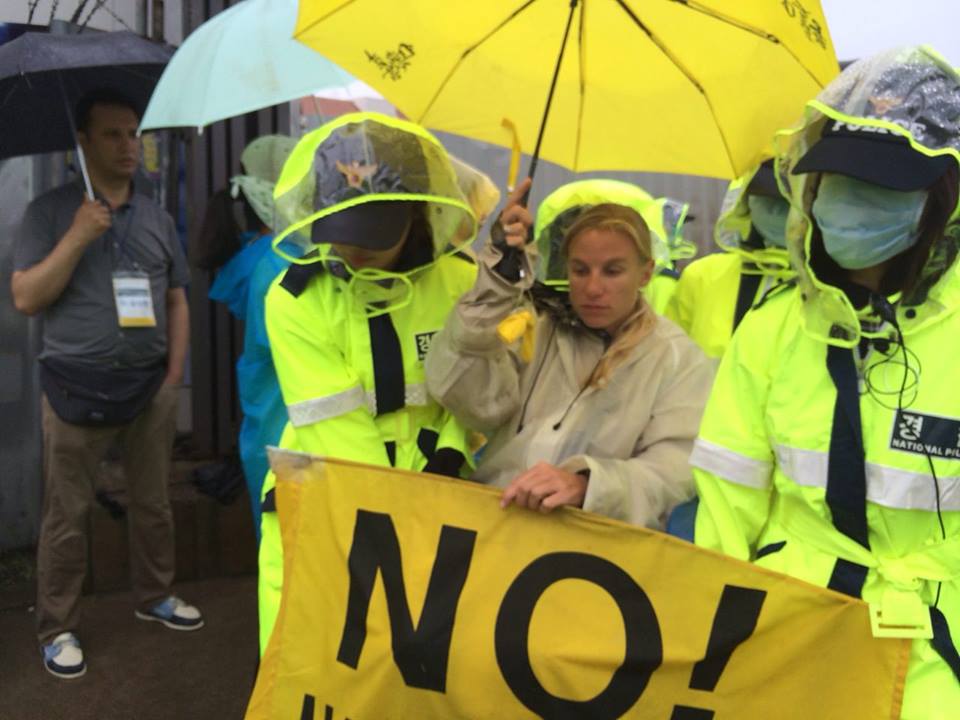
    The group joined other protesters — including Korean Catholic nuns and local villagers — to block cement trucks from entering the base.

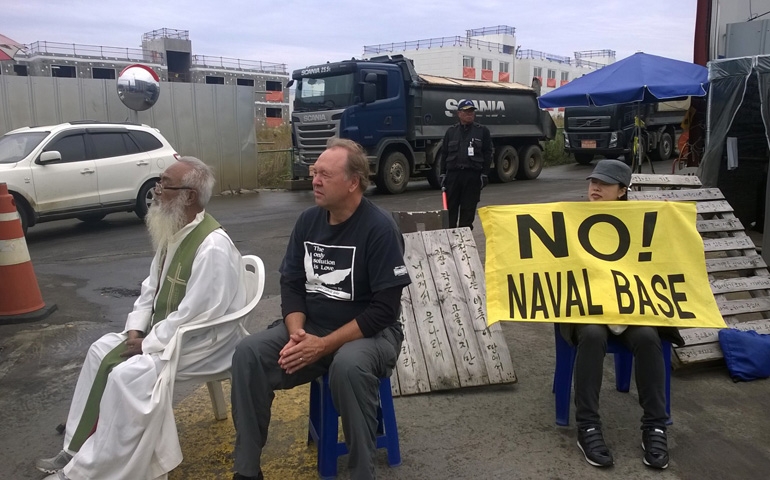
    They sat in chairs in front of the gate. Bichsel sat in a wheelchair. While they blocked the entrance, a priest celebrated the Mass across the street about 50 yards away as part of the resistance.

    The protesters didn’t move until Korean police carried them away so the cement trucks could enter.

    Three police officers picked Bichsel up in his wheelchair four or five times a day and pulled him to the side, he said.

    He and the others would then go back and resume sitting in front of the gate.

    “It’s sort of like a choreography,” said Bichsel, who uses a wheelchair because he can’t walk long distances.

    The protesters, who numbered on average about 20, slowed the trucks but didn’t stop them from entering the base. No one was arrested, Bichsel said.

    He also protested at the Jeju Island base during another trip in September 2013.

    The priest said he’s demonstrating against the “continual militarization of South Korea, as well as our world, through the U.S. military.”

    Local residents “know eventually the base will be built, but that doesn’t stop the villagers from standing up against it,” he said.

    Bichsel, whose trip was financed by donations, said he was inspired by the commitment of Koreans who oppose the base.

    “We get from them just a tremendous sense of faithfulness, living out what you believe, trying to stop the militarization.”

    Bichsel has no immediate plans to return to South Korea. He’s planning his next act of civil disobedience much closer to home Jan. 17.

    That’s when he plans to take part in an annual protest against nuclear weapons at the Navy’s Bangor submarine base on Hood Canal.

    Steve Maynard: 253-597-8647 steve.maynard@thenewstribune.com @TNTstevemaynard


    Read more here: http://www.thenewstribune.com/2014/11/28/3513776_tacoma-priest-in-wheelchair-travels.html?sp=%2F99%2F296%2F&rh=1#storylink=cpy
    December 5, 2014

  • Gangjeong Village Story: Monthly Newsletter | November Issue

    In this November Edition:
    People demand to cut the full 2015 Jeju navy base budget, a shrine under threat of destruction, remembrance day for Yang Yong-Chan, visitors from the US Pacific Northwest, Okinawa trip reflection including recent Okinawa election, Henoko movie viewed in Gangjeong, Prof. Sasha’s presentation on the success of anti-base movements, women’s international solidarity, airborne arsenic dust damaging farming, a visit by a mother of a Sewol victim, two activists injured, trial updates and an introduction of the 12.13 Nanjing massacre event, and more!

    Download PDF

    December 3, 2014

  • Jeju Solidarity Forever

    nine visit
    A photo by Emily Wang

    Re-blogged from here .

    To see more on the visit by nine delegations including Fr. Bix  from the United States, see the Puget Sound Nuclear Weapon Free Zone (Nov. 2014)


    By Bruce Gagnon, November 19, 2014

    The nine person Washington state peace delegation to Jeju Island, South Korea is nearing the end of their solidarity visit.  Last night they held a meeting with villagers and supporters for extended sharing.  Here is a brief report from Emily Wang:

    Yesterday night, we had a really inspiring sharing and dialogue with 9 foreigner visitors including Father Bix. With this chance, they shared their experiences and people here also expressed our thankfulness. We encourage each other in this long struggle and have question to each other. For instance, how to deal with anger, trauma…? What we gonna do if the [Navy] base construction is finally completed etc…?

    This is a wonderful community time.

    See more photos here


    Mira Leslie, one of the delegation who lives in Seattle, writes from Jeju Island:


    In less than 24 hours we will depart Gangjeong village. Jean left this morning. The goodbyes started yesterday. There is tremendous gratitude to us for coming here. In some ways I don’t understand that – hosting and feeding ten people for 10 days is a tremendous task. We have had ‘special meal’ almost everyday – and the regular food at the communal kitchen is delicious – but not too varied. Kimchee varieties, rice and soup- yum. We have been taken to tourist spots including the amazing Buddhist temple grounds and there have been several meetings with key leaders of the movement – each imparting intense information.

    The community of resistance receives support from visitors – it helps them to have people doing 100 bows and blocking the gate during mass-Eucharistic resistance. The sister nuns are a steady presence – rotating through here from diocese throughout Korea. Foreign visitors are embraced warmly. The community is tired, but still very together (from an outsider perspective). For me, this time will be impossible to forget – and I am sure I’ll ruminate on it after leaving.

    How can we to bring this back to our communities – and honor all we have learned?

    The town is decorated with natural images – of peace. Peace Zone, dream catchers, sea creatures, Gureombi rock. We learned yesterday at the stone museum and grounds “the very deep meaning of stone here’ – much of it volcanic. It is building material, fencing, tools, food prep, sinks, toys and games, water vessel, art, music….

    Last night we sat at the peace center with the activists, priests, and a few towns people. Father Bix and I described some of our peace work in the US and then they asked questions to all of us. They had 2-3 sentence bios of each of us that had been translated and printed. At one moment an activist said – everyone sees the damage done to the environment here – but no one can see the deep anger and damage in our hearts. She asked Sonya who works with trauma teams internationally for advice. You could see the reactions – it wasn’t expected – Korean people don’t talk too much about their feelings.

    The village produces lillies for Japan, a sister told me as we walked to the gate today – but many of the lilly greenhouses were destroyed when they started the base. There is still fishing – but it is diminishing as the sea is being altered with destruction of the fragile soft coral reefs, damage from concrete, blasting, construction toxins/waste and later with ship pollution – oil, fuel, human waste.

    We were gifted t-shirts today by the international team. The image is of Jeju island with an open mouthed shark on one end – the shark is in US stars and stripes with the Korean script word ‘Imperialism’.


    jejutige
    A photo by Mira Leslie
    November 26, 2014

  • Living the Eucharist: resisting the destruction of Jeju Island

    Re-blogged from here.

    Laffin1
    Police surround Art Laffin and other activists as they protest at the main entrance of a U.S.-backed Korean naval base on Jeju Island.
    Laffin2
    Fr. Mun Jeong Hyeon, Art Laffin, and another protester during the Mass at the main entrance to the construction site of a U.S.-backed Korean naval base on Jeju Island
    Laffin3
    Construction continues on a U.S.-backed Korean naval base on Jeju Island.


    Art Laffin  |  Nov. 12, 2014

    REFLECTION

    I had the opportunity to travel to Jeju Island off the coast of South Korea in the East China Sea from Oct. 29 to Nov. 4. I  previously spent four days in Manila, Philippines, where I was invited to speak at the first Asia Pacific Dialogue on Human Rights and Respect for the Dignity of Life with the theme: “No Justice Without Life.” I left an amazing community in Manila standing for life and justice and saying “No” to state-sponsored killing. In coming to Jeju Island, I met another extraordinary gathering of people who are saying “Yes” to creation and “No” to the construction of new naval base that is a crime and a sin.

    For several years, I have been closely following this inspiring nonviolent campaign led by local islanders along with priests and sisters to stop the construction of this U.S.-backed Korean naval base on Jeju Island (named the “Island of Peace” by the Korean government).

    UNESCO considers Jeju Island and nearby Beom Island, Moon Island, Seop Island, and Hallasan National Park biosphere reserves. The construction of this base, which is a joint Korean, U.S. and Japanese venture with Samsung as the main contractor, is destroying the beautiful ecosystem of the island as well as the majestic soft coral reefs and surrounding ocean life.

    The ancient Gureombi rock formation no longer exists, having been blasted away two years ago. Inthe March 2014 issue of the Gangjeong Village Story monthly newsletter, the lead article lamented the second anniversary of the destruction of this sacred formation: “For thousands of years, Gureombi has been a playground, a garden, and a mother’s arms, embracing and embraced by the people of Gangjeong. Thus it was perhaps the most painful and sorrowful moment of this 8 year struggle to experience the partial destruction of Gureombi Rock. Still, though we cannot see Gureombi anymore, it lives on in our memories.”

    Ultimately, the U.S. wants to use the base as an outpost to contain China. Peacemakers from the United States, including Bruce Gagnon, Regis Tremblay, David Hartsough, Ann Wright, Jesuit Fr. Bill Bichsel, Nick Mele, Kathy Kelly, Brian Terrell and Michele Naar-Obed, have come here to offer support over the last several years, and the local campaign has been deeply appreciative for this friendship and solidarity.

    Upon arriving in Jeju City, I received a very warm welcome by Fr. Pat Cunningham and the Columban religious community, who offered me hospitality for the night. The next morning, Father Pat and I took as bus to Gangjong Village, about an hour from Jeju City. We arrived just in time for the daily 11 a.m. Mass that occurs directly outside the entrance to the base construction site.

    Father Pat and I joined with other friends, including longtime renowned peacemaker Fr. Mun Jeong Hyeon, who has spent nearly three years in prison for his resistance, in sitting on plastic chairs stretched out across the base entrance. As grace would have it, I also became reacquainted with two of the local organizers whom I had previously met in D.C.: Sung-Hee Choi and Jung Joo.

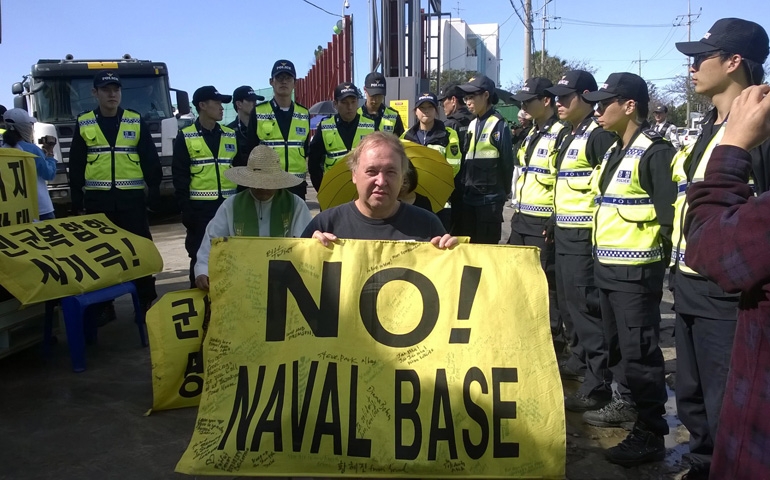
    There were at least eight people from the community sitting in chairs, blocking the center of the entrance. As streams of cement and supply trucks entered and exited the base, police carried those blocking to the side of the entrance. Then the police permitted those forming the blockade to return to the entrance, where they continued the witness. This back-and-forth went on for at least one and a half hours.

    Celebrating Mass and receiving the Eucharist in this context was a very powerful experience. In the face of this monstrous base, which is now halfway complete, the power of eucharistic love, borne out in nonviolent witness, is the means by which true conversion and transformation can occur. Those gathered at the base entrance, along with at least 30 people who also attended the Mass a short distance away, truly believe in miracles and that with God all things are possible.

    Following the Mass, the gathered community prayed the rosary. This was followed by a press conference by the Gangjong Village Association, calling for an end to the expansion of military housing units being built in the village as a result of the new naval base. I then was invited on a tour of the port area of the island, where one can see a panoramic view of the massive base construction.

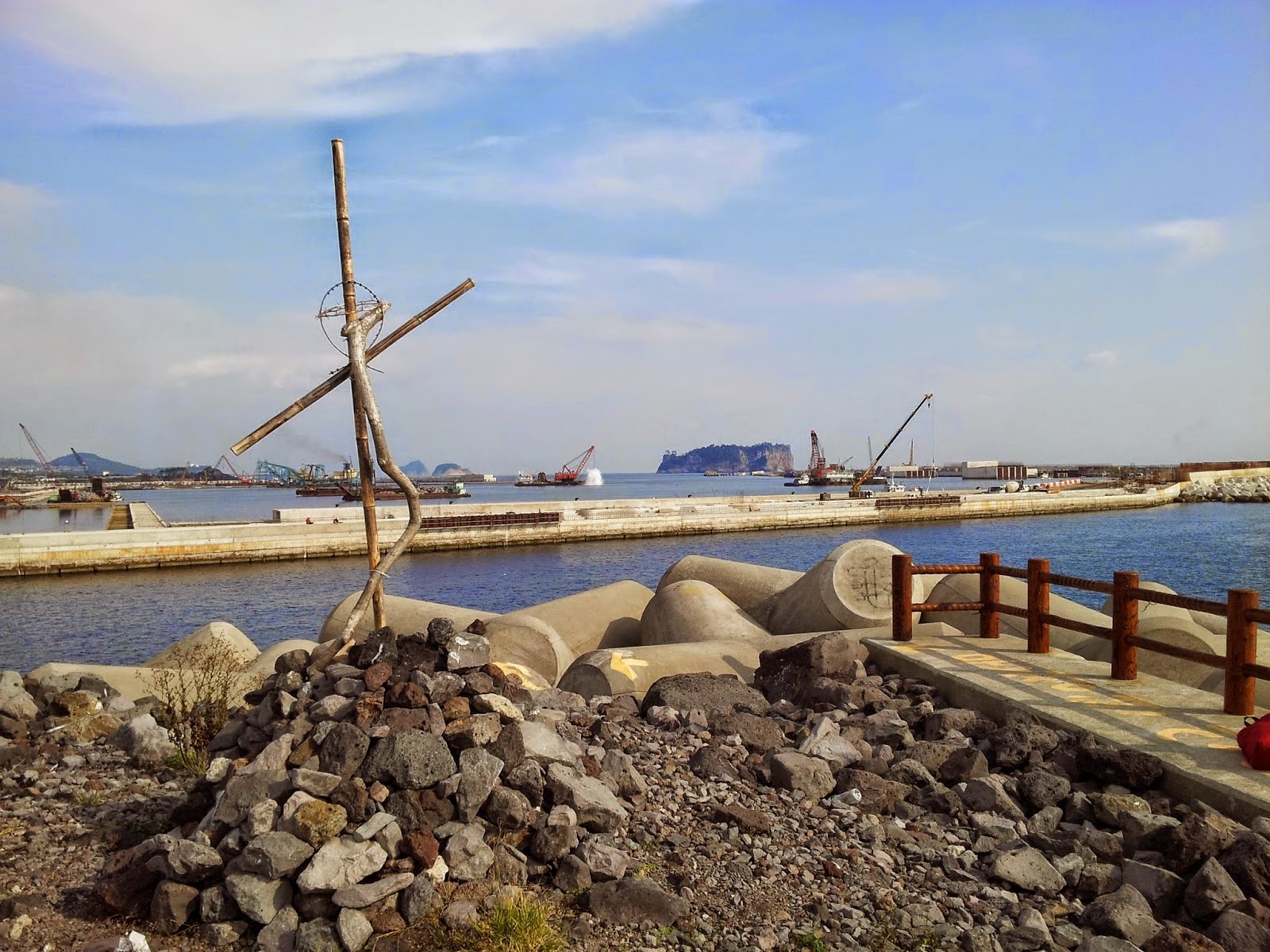
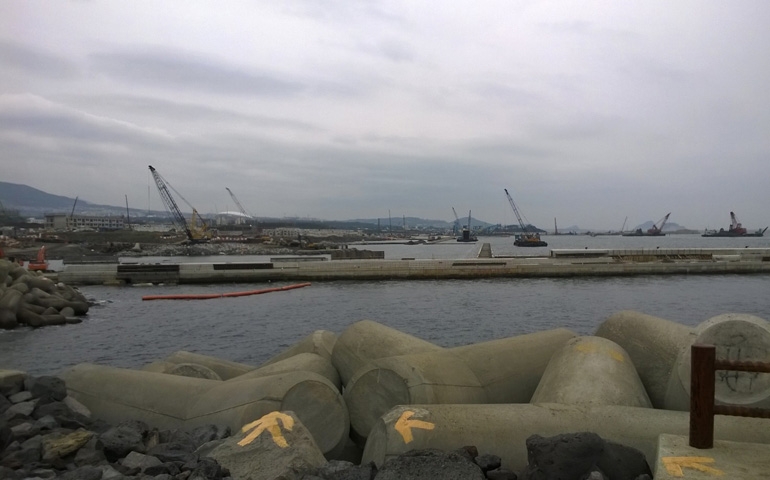
    Cranes are visible everywhere on the site, while in the port, there is constant dredging to accommodate future warships. The Korean government has described the new base as a joint military port complex meant to encourage tourism in the beautiful landscape. Despite this and other attempts to deceive the public about the real purpose for the base, local villagers and their supporters refuse to be duped.

    In the late afternoon, I met Yang Yoon-Mo, a well-known former film critic who has endured long-term imprisonment and hunger strikes for trying to stop the construction of the naval base. He is one of the more than 650 people who have been arrested for saying “No” to the naval base construction. There have also been 550 indictments for resisters, and about 45 people have served jail sentences for their courageous resistance. Yang and several others have set up a new vigil site at another part of the base perimeter where supply trucks are being redirected from the main entrance. Many villagers are upset that these trucks are now diverted through their neighborhood.

    On Nov. 1, All Saints Day, I joined two other friends, Jesuit Fr. Kim Song Hwan and Gayun, in blocking the cement and supplies trucks. Moments after receiving the Eucharist, four police from the base hoisted me in my chair, banner in hand, and carried me over to the side of the road as they had done with Father Kim and Gayun. It was indeed a moving experience in more than one way! Once the traffic cleared, the three of us resumed our positions blocking the main entrance. This would happen two more times, once during the rosary and once when the human chain was formed across the road.

    The Eucharist and the rosary have taken on a whole new meaning for me here as they occur in the context of an act of nonviolent resistance. In the face of this new port of death being constructed, I feel a power here that is far greater, that can truly overcome the idolatrous forces of military violence: the self-emptying, transforming love embodied in a living Eucharist.

    The resiliency of this community is quite remarkable, and they remain deeply committed to a spirited resistance despite overwhelming odds. After the rosary ended, a human chain of about 30 people stretched across the entire entrance to the construction site. As I was still being surrounded by police who had carried me to the side of the entrance, I was handed the mic to lead several songs. I started off with “When the Saints Go Marching In,” which was followed by “Down By the Riverside” and “Seek Peace and Pursue It,” singing with police literally hovering over me as I sat in my chair. Following the human chain, there was an enthusiastic snake dance, then some exuberant dancing. The police, for the most part, let all this go on but continued to move anyone impeding supply vehicles from going into the site.

    On my last day in Gangjeong Village, I joined the blockade at main entrance to the construction site and was carried off four times. After the rosary, I was carried off as I sang “We Shall Not Be Moved.” I later asked Father Kim about the history of having the Mass at the base construction site. He told me that in 2009, Bishop Peter Kang U-il of Jeju Island, chairman of the Catholic Bishops’ Conference of Korea, first celebrated Mass on the land designated to be the base. In 2011, Father Mun initiated having the Mass outside the main entrance of the construction site for the base. Father Kim also shared with me that he is assigned to be part of this nonviolent witness to stop the base construction and has been joined by other Jesuits, including his provincial, in blocking the base entrance.

    My friend Bruce Gagnon, longtime peacemaker and coordinator of the Global Network Against Weapons and Nuclear Power in Space, was the first one to introduce me, as well as countless others, to the nonviolent struggle in Jeju Island to stop construction of a new U.S.-backed naval base. His inspiring peace work has not only included stopping construction of this new base, but campaigning to stop the militarization of space and for the closing of the nearly 1,000 U.S. military bases worldwide. When addressing the struggle on Jeju Island, Bruce makes an important point that bears repeating: This nonviolent campaign to stop the construction of the new naval base on Jeju Island is an important symbol for the international peace movement. It brings together all the issues — militarization, disarmament, the environment and human rights. I couldn’t agree more with him.

    Hopefully, before it’s too late, more people will join and support the courageous people of Gangjeong Village in the struggle to stop the building of this base meant for death and destruction. I encourage people to see Regis Tremblay’s excellent documentary, “The Ghosts of Jeju,” which is the most important resource available about the nonviolent struggle on Jeju Island. For updates about the campaign and ways you can support it, go to savejejunow.org.

    [Art Laffin is a member of the Dorothy Day Catholic Worker in Washington, D.C.]

    November 21, 2014

  • Gangjeong Village Story: Monthly Newsletter | September Issue

    In this September Edition:
    Catholic Conference, anniversary of Catholic solidarity and the fence around Gureombi, International Day of Peace, remembering an Japanese anti-base activist, North East Asia Regional Peace-building Institute, hunger strikes, Okinawa updates, trial updates, international solidarity, and more!

    Download PDF

    October 5, 2014

←Previous Page
1 2 3 4 5 6 7 … 9
Next Page→

© 2025

Save Jeju Now