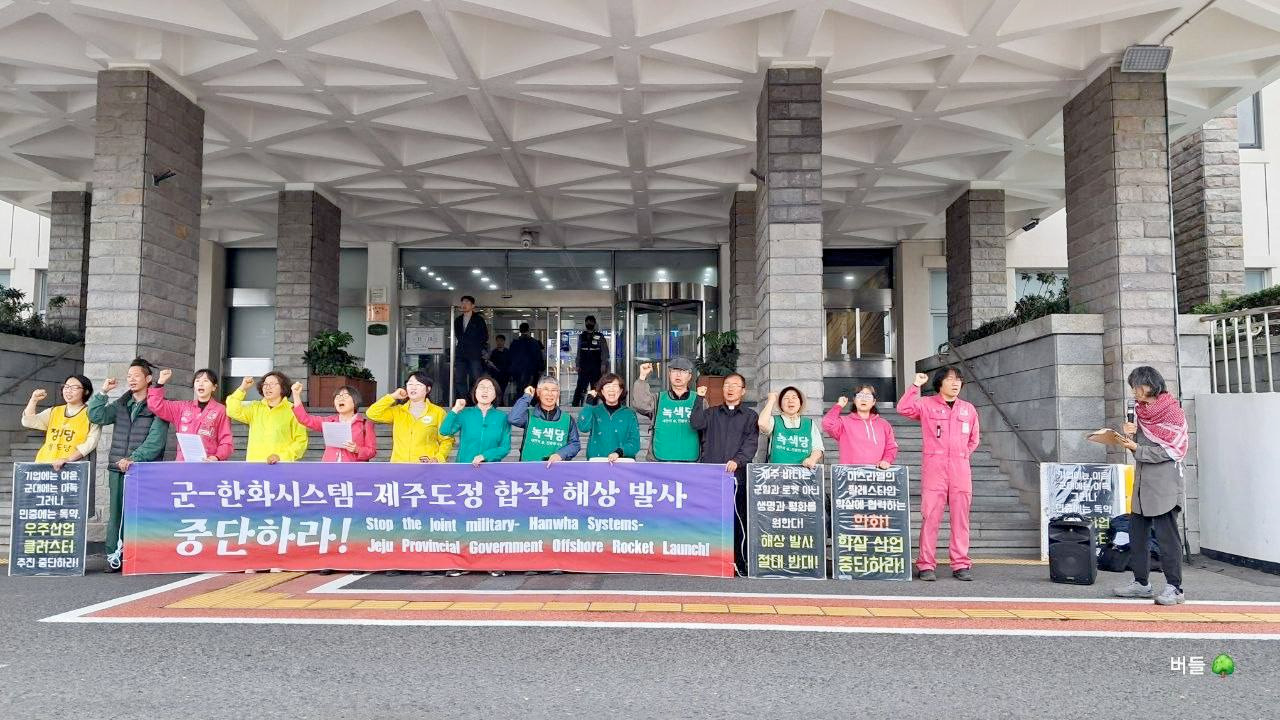
Photo by Beodl
Stop the joint military-Hanwha Systems-Jeju Provincial Government Sea Launch!
The military, Hanwha Systems, and the Jeju Provincial Government plan to conduct a test of Hanwha Systems’ solid-fuel space launch vehicle, carrying a satellite, in the waters off Seogwipo, Jeju—specifically between Gangjeong and Daepo—by the end of April. The domestic and international organizations and individuals listed below believe that this launch will intensify the militarization of Jeju, destroy the local ecosystem and environment, and threaten democracy, and we strongly demand its immediate cancellation.
According to an exclusive report by CBS Nocut News in February, the South Korean military plans to complete approximately 10 rocket launch tests, including this one, by the end of next year. In response, 19 civic groups in Jeju issued a joint statement on February 23, urging the provincial government to provide an explanation and demanding a halt to the sea-based launches.
However, as of ten days before the launch, the Jeju Provincial Government led by Oh Young-hoon had not issued any official statement. Military officials have also avoided providing specific details, stating only that the launch is “related to military capabilities.” This vague remark illustrates how the launch is closely tied to the military, and is therefore carried out without proper public scrutiny.
Nevertheless, the Jeju Provincial Government has been promoting the space industry as a “future growth engine.” Following its designation of 2025 as the “first year of a space industry that residents can tangibly experience,” it has positioned the space industry as a core sector alongside AI and the energy industry. The company that has reaped all manner of benefits of Jeju’s investments in space industries is Hanwha Systems, a manufacturer of weapons of war. Hanwha has entered into business partnerships with Israeli companies and contributed to the massacre of Palestinians, and it continues to boost its stock price through arms exports even amid the U.S. and Israeli war of aggression against Iran.
On December 2nd, 2025, Hanwha Systems completed the construction of Hanwha Space Center, a small satellite manufacturing plant, on the site of the former Tamna University in the Jeju mid-mountain Groundwater Special Management Zone, despite opposition from local residents. This facility is located about a 15-minute drive from the Jeju Naval Base, which serves as a U.S. outpost against China, and a sea-based launch platform has already docked at the Jeju Naval Base and is preparing for launch. The proximity of the two facilities signifies that a structure combining the space industry and military infrastructure is now fully taking shape on Jeju.
Furthermore, the Jeju Provincial Government is promoting “Hawon Techno Campus” industrial complex, which will include a combustion test facility for solid and liquid fuel engines and a test facility for space thrusters. The site is located just 4 km from the Gangjeong Water Source Protection Area, which is located at a river designated as an absolute conservation zone.
In addition, the Jeju Provincial Government, led by Governor Oh Young-hoon, is working to have Jeju designated as a space industry cluster, based on the National Satellite Operations Center which was completed in Gujwa-eup, Jeju, in 2022, as well as Contec Asian Space Park, Asia’s largest private space ground station which was completed in April 2026, along with the Hanwha Space Center which was completed last year. In September 2025, the administration also signed a memorandum of understanding with the Korea Aerospace Administration in connection with the KPS (Korean Satellite Navigation System) development project. The vision is to establish Jeju as one of the four core pillars of Korea’s space industry, alongside South Jeolla Province (launch vehicles), South Gyeongsang Province (satellites), and Daejeon (research), which have already been designated as space industry clusters.
The space industry cluster is not an industry for the future. Rather, it is a scheme that exploits the future of the majority of the people. It destroys water and soil environments—the lifeline of local residents—and undermines the foundations of peace, human rights, and democracy by making the local economy dependent on space and arms companies.
It is also important to note that these sea-based launches take place in a regulatory vacuum. There is no system in place for conducting environmental impact assessments for such launches, and there is a complete lack of consideration for the fatal harm that can impact marine ecosystems and air quality. Furthermore, it is highly likely that fishermen will not receive adequate compensation for the losses incurred due to the suspension of their fishing operations. Such damages have been repeatedly covered up.
Furthermore, as this launch marks the fourth test of a solid-fuel space launch vehicle, its connection to missile technology cannot be ruled out, as it goes beyond a simple satellite launch. This is because solid-fuel space launch vehicles share the same rocket technology as intercontinental ballistic missiles.
As seen in the U.S. and Israeli war of aggression against Iran and Iran’s response, military bases, weapons production facilities, satellite ground stations, and AI data infrastructure are all priority targets in times of war. The space industry, including maritime launches, is not a future growth industry but a means of incorporating regions into war infrastructure.
We are concerned that the maritime launch off the coast of Jeju will transform Jeju, the “Island of Peace,” into a military stronghold and threaten local ecosystems and the lives of residents. Furthermore, we are deeply concerned about the adverse effects this launch will have on global peace. Accordingly, we strongly urge the military, Hanwha, and the Jeju Provincial Government to halt the maritime launch.
Furthermore, we declare that we will continue to monitor and resist this trend—not only in Jeju but around the world—where the military and weapons manufacturers are joining forces under the guise of the space industry, in order to protect the lives of the people and democracy.
The Jeju Provincial Government, the South Korean military, and Hanwha Systems must immediately halt the sea-based launch, which will intensify the militarization of Jeju and transform the “Island of Peace” into a war infrastructure.
April 20th, 2026
A total of 883 Korea and international individuals and organizations
(including 140 organizations)
……………………………………………………….
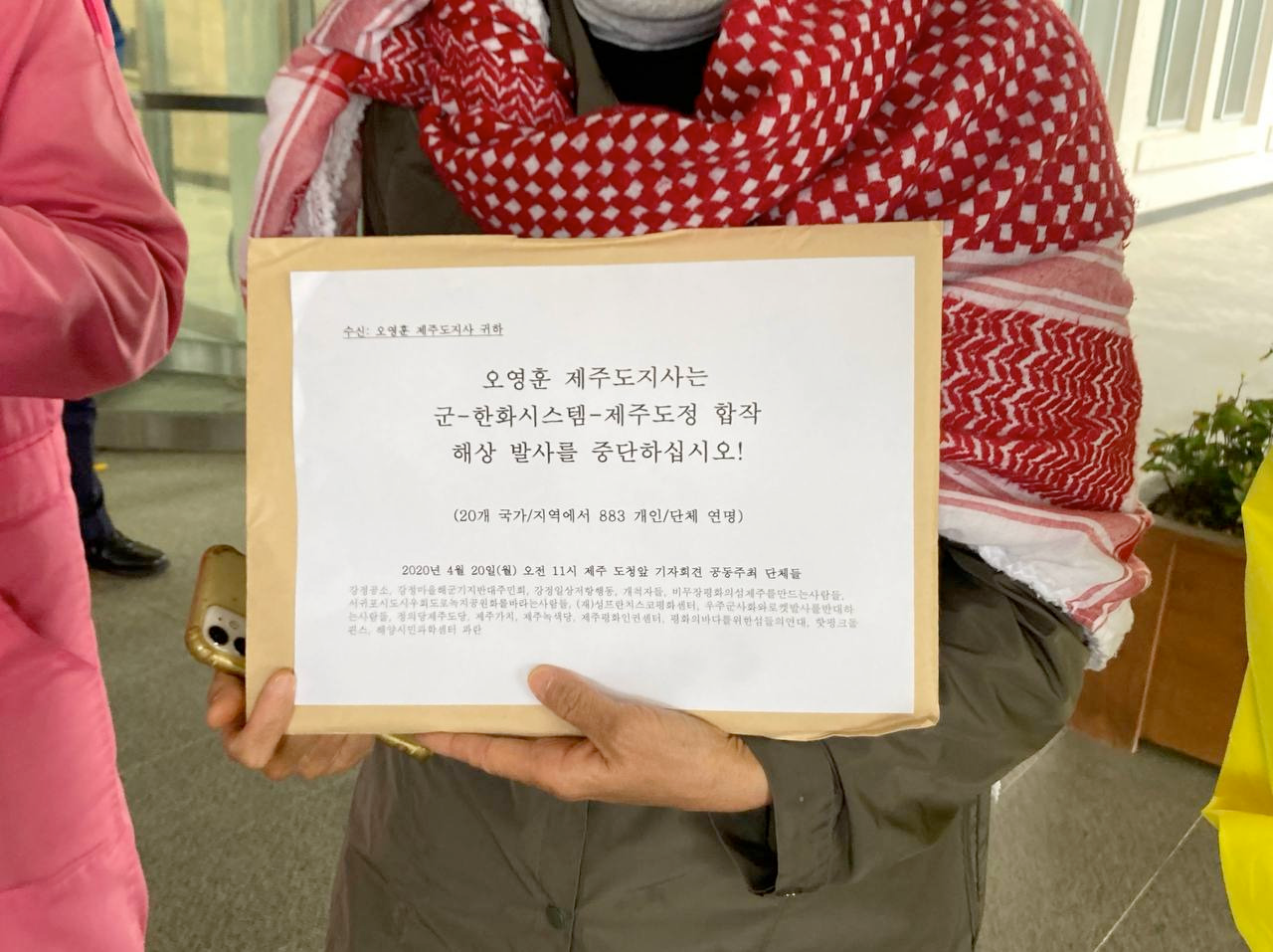
From April 13th to 19th, the Jeju Green Party, the Jeju Provincial Chapter of the Justice Party, and People Opposing Space Militarization and Rocket Launches collected signatures for the petition called “Stop the joint military-Hanwha Systems-Jeju Provincial Government Sea Launch!” It was in four languages of Korean, English, Japanese, and Chinese.
On Monday, April 20, at 11:00 a.m.,15 co-organizing groups held a press conference in front of the Jeju Provincial Government Building and submitted a summary of the petition results, a statement in four languages, and a list of signatories in four languages to the Jeju Provincial Government, addressed to Governor Oh Young-hoon. Shin Hyo-seop, an official from the Space Mobility Division, promised to deliver the materials to Jeju Governor Oh Young-hoon. Please refer to the document tabs on the left for the petition in four languages and the list of signatories for each language.
The organizations and individuals who signed the petition are based in a total of 20 countries and regions, including Japan, Taiwan, the Philippines, Myanmar, Malaysia, Nepal, Guam, Hong Kong, Hawaii, the United States, Sweden, the United Kingdom, Finland, Hungary, Norway, Canada, Germany, Australia, and New Zealand, in addition to South Korea.
Many signatories called for an end to offshore rocket launches and the militarization of Jeju Island in the petition, and included messages expressing their hopes for peace in Northeast Asia and the world. (Included in the “Documents” tab for each language.)
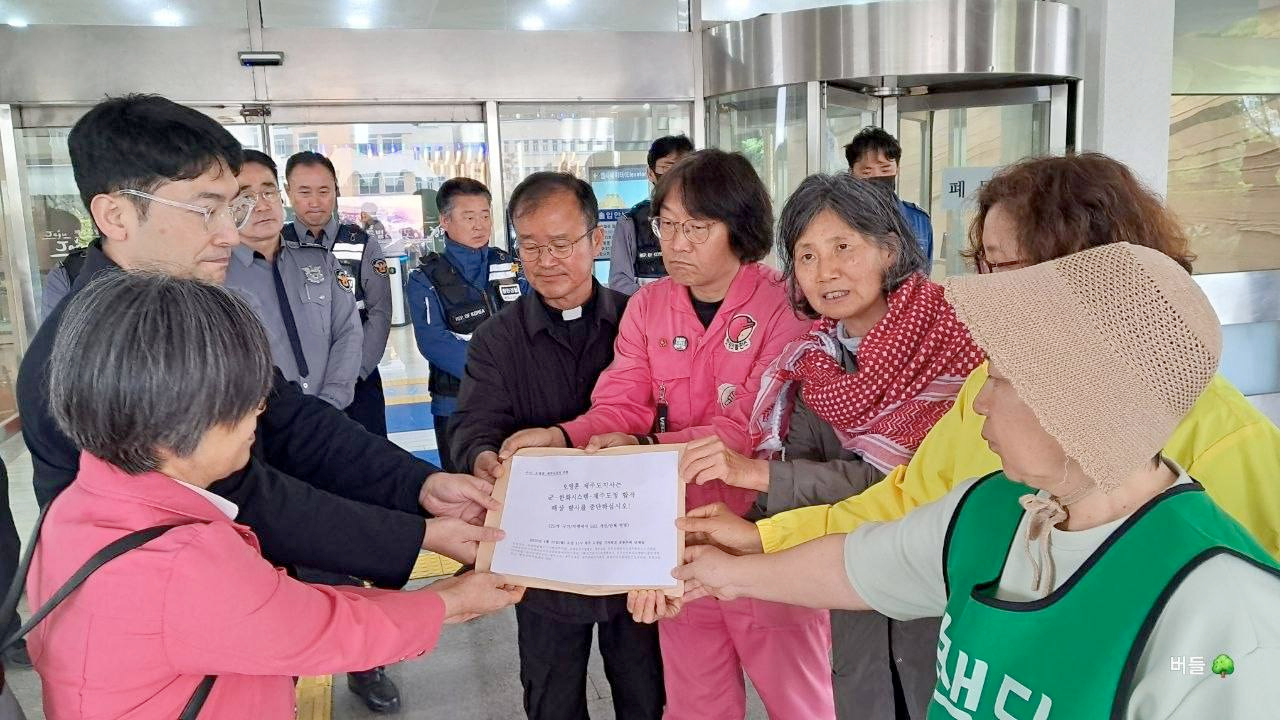
Photos by Hwang Hyun-Jin