Re-blogged from here. To see the related post, see here.
By Steve Maynard, Nov. 28, 2014
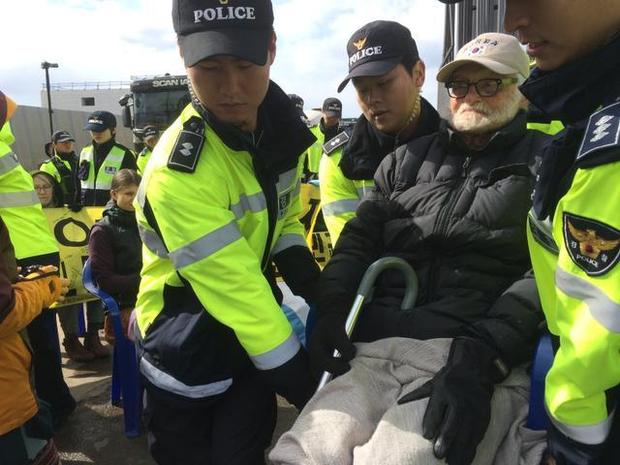
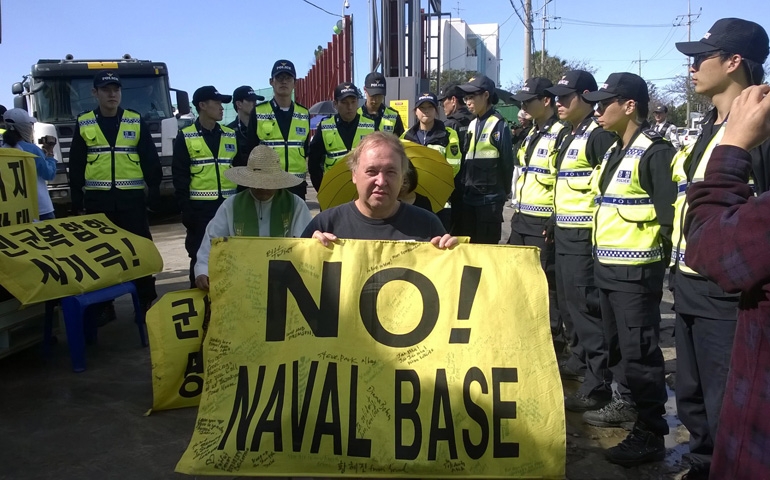
The Rev. Bill Bichsel, center, is moved from his protest site by police during the Tacoma priest’s trip to South Korea earlier this month. COURTESY OF EUNMI PANG
The Rev. Bill Bichsel, an 86-year-old Tacoma priest known for his acts of civil disobedience, has returned from a trip to South Korea to protest construction of a naval base there.
Just three months ago, Bichsel was seriously ill and in the hospital in Tacoma. But his health — while still frail due to a heart condition — improved to the point he was able to make the trip using a wheelchair.
He said his doctors didn’t try to stop him from traveling.
“They just shake their heads,” Bichsel said. “They know I’m going so they don’t make a big fuss.”
For nearly 40 years, the Jesuit priest known as “Bix” has protested against U.S. military programs and weapons. He’s been arrested dozens of times for trespassing during protests and jailed more than a half-dozen times.
He wasn’t arrested in South Korea, but he realized the 12-day trip could set his health back.
“I know I could go anytime,” Bichsel said.
He was weak upon returning Nov. 20, but has gotten stronger since. And he was inspired by the trip.
Bichsel and nine other people — nearly all from the Puget Sound area — traveled to Jeju Island to commit what he called “acts of civil resistance” against construction of a base by the South Korean Navy. The base has been under construction on the island off the southern tip of Korea for eight years.
The efforts to stop it has been underway at Gangjeong Village since construction started, Bichsel said. The movement has united Catholics, Buddhists and those of no religious affiliation.
“It’s the most inspiring, unified resistance that I’ve experienced,” he said.
Bichsel said residents of the area believe the base will be used to service U.S. Navy ships. Some of those vessels could be armed with missiles as part of a defense system, he said.
The base is a few hundred miles from China.
The group joined other protesters — including Korean Catholic nuns and local villagers — to block cement trucks from entering the base.
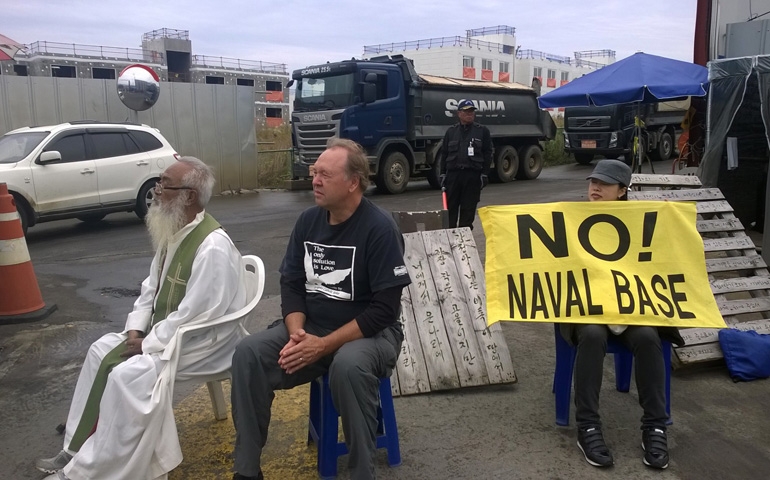
They sat in chairs in front of the gate. Bichsel sat in a wheelchair. While they blocked the entrance, a priest celebrated the Mass across the street about 50 yards away as part of the resistance.
The protesters didn’t move until Korean police carried them away so the cement trucks could enter.
Three police officers picked Bichsel up in his wheelchair four or five times a day and pulled him to the side, he said.
He and the others would then go back and resume sitting in front of the gate.
“It’s sort of like a choreography,” said Bichsel, who uses a wheelchair because he can’t walk long distances.
The protesters, who numbered on average about 20, slowed the trucks but didn’t stop them from entering the base. No one was arrested, Bichsel said.
He also protested at the Jeju Island base during another trip in September 2013.
The priest said he’s demonstrating against the “continual militarization of South Korea, as well as our world, through the U.S. military.”
Local residents “know eventually the base will be built, but that doesn’t stop the villagers from standing up against it,” he said.
Bichsel, whose trip was financed by donations, said he was inspired by the commitment of Koreans who oppose the base.
“We get from them just a tremendous sense of faithfulness, living out what you believe, trying to stop the militarization.”
Bichsel has no immediate plans to return to South Korea. He’s planning his next act of civil disobedience much closer to home Jan. 17.
That’s when he plans to take part in an annual protest against nuclear weapons at the Navy’s Bangor submarine base on Hood Canal.
In this November Edition:
People demand to cut the full 2015 Jeju navy base budget, a shrine under threat of destruction, remembrance day for Yang Yong-Chan, visitors from the US Pacific Northwest, Okinawa trip reflection including recent Okinawa election, Henoko movie viewed in Gangjeong, Prof. Sasha’s presentation on the success of anti-base movements, women’s international solidarity, airborne arsenic dust damaging farming, a visit by a mother of a Sewol victim, two activists injured, trial updates and an introduction of the 12.13 Nanjing massacre event, and more!
In the past, Jeju as a colony of Japan was forced to be militarized by Japanese Imperial military. Alddreu Airfield in Jeju was originally developed in 1926-30 during the Japanese Imperial period. The base was used to support the Japanese forces’ invasion into China. During World War II, the base was used for training of Kamikaze pilots and by the end of the war it housed 2500 naval aviation troops and 25 aircraft in hardened aircraft shelters (Wikipidia).
To begin the historical dialogue between Nanjing and Jeju, we can at least trace back to the year of 1937 when Nanjing Massacre took place. In 1937 before Japanese Imperial military occupied Nanjing City and conducted massacre on December 13th, the Nanjing people’s suffering of war had already begun since the air-attack by Japanese fighter jets began in August until December 1937. Many of those fighter jets took off from Jeju’s Alddreu Airfield. More killing was committed due to the function of Alddreu.
#Current situation
A new base is being constructed in Jeju again, and this time it was somehow forced by both Korea and US government, and then somehow passively accepted by Jeju people themselves due to the issue of national security and economic growth, a sad path in which the people of Okinawa have also gone down.
Jeju has been the historical base provider, but we could hardly find any information that has been carried out to reflect on the militarization history of Jeju and the impact it had on its people. Not surprisingly, the suffering and the post-trauma of Nanjing, China, or in a bigger picture, North East Asia has not been seriously considered as a related issue to Jeju.
In Nanjing, it is clear to see this year that the history and territory dispute between China and Japan becomes sharper and more emotional (China-Japan’s relation has become worse especially since the “purchasing Senkaku/Diaoyu Island” policy was launched in 2012). The China’s legislative body set December 13th as a national memorial day to commemorate the victims of Nanjing Massacre as a response to the Japanese government’s denial on this historical event.
It was said that designating a national Memorial Day is a peaceful and wise action rather than conflicting militarily. However, through all these incidents, we can sense the created atmosphere has led both sides to be stricter to their way of nationalism and militarism. As a result the new Jeju Naval Base among many other new base projects in our region.
#Invitation
We invite you to commemorate the 77th year of the Nanjing Massacre, not in Nanjing but in Jeju, with a different lenses to reflect the history, present time, and our future.
We invite you to feel the pain of Nanjing and Jeju, and to witness the encountering of two kinds of suffering.
We invite you to draw a more peaceful future of Jeju, North East Asia, and the world together.
Come to join us!
<the 6th Symposium for Declaration on The Demilitarized Island of Peace >
In commemoration of the 77th year of Nanjing Massacre
Seeing Nanjing in China from Alddreu Airfield in Jeju
Time: Saturday December 13th 2014
Session 1 Commemoration Ceremony: At 2 PM, Alddreu Airfield)
– Tribute poem (by Poet, Kim Suyeol), Tribute song by Singer, Choi Sangdon, Memorial Service
Session 2 Symposium: At 3 PM, Seminar room of Daejeong NH Bank
– Cho Seongyun (Professor of Jeju University Sociology Department) ‘Nangjing in the history of Alddreu’
– Seo Seung ( Professor of Ritsumeikan University) ‘Nanjing Massacre and Japanese Militarism’
– Emily Wang (International Peace Activist) ‘Seeing Nanjing from Gangjeong’
– Park Chan Sik (Historian/the director of truth finding team of April 3rd Peace Foundation) ‘Value of Peace in the history of Jeju’
By bus: 1) From Jeju-si, take bus No. 755, 750-1~4 2) From Seogwipo-si, take bus No.755, 780
= Get off at the stop, Daejeong NH Bank
Co Host Group: People for the Demilitarized Jeju Island of Peace, Inter Island Solidarity for Peace Korea Committee, Gangjeong Peace School
Support Group: Jeju Federation of Environment movement, Seogwipo Citizen’s Alliance, Gangjeong Village Association, Gangjeong Village International Team,
The Frontiers, hotpinkdolphins, Peace Wind, Jeju Peace&Human Rights Center, Martyr Yang Yongchan Memorial Foundation
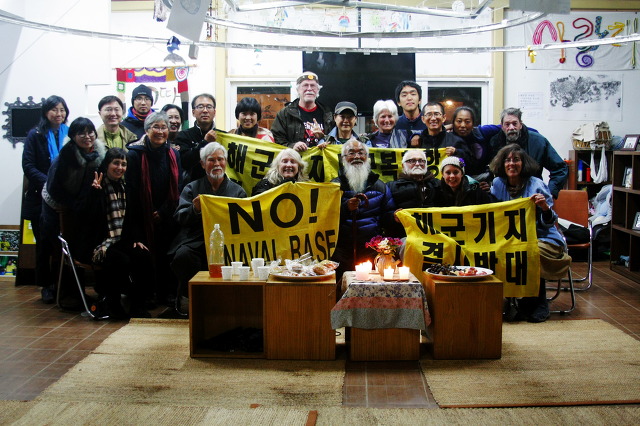
The nine person Washington state peace delegation to Jeju Island, South Korea is nearing the end of their solidarity visit. Last night they held a meeting with villagers and supporters for extended sharing. Here is a brief report from Emily Wang:
Yesterday night, we had a really inspiring sharing and dialogue with 9 foreigner visitors including Father Bix. With this chance, they shared their experiences and people here also expressed our thankfulness. We encourage each other in this long struggle and have question to each other. For instance, how to deal with anger, trauma…? What we gonna do if the [Navy] base construction is finally completed etc…?
Mira Leslie, one of the delegation who lives in Seattle, writes from Jeju Island:
In less than 24 hours we will depart Gangjeong village. Jean left this morning. The goodbyes started yesterday. There is tremendous gratitude to us for coming here. In some ways I don’t understand that – hosting and feeding ten people for 10 days is a tremendous task. We have had ‘special meal’ almost everyday – and the regular food at the communal kitchen is delicious – but not too varied. Kimchee varieties, rice and soup- yum. We have been taken to tourist spots including the amazing Buddhist temple grounds and there have been several meetings with key leaders of the movement – each imparting intense information.
The community of resistance receives support from visitors – it helps them to have people doing 100 bows and blocking the gate during mass-Eucharistic resistance. The sister nuns are a steady presence – rotating through here from diocese throughout Korea. Foreign visitors are embraced warmly. The community is tired, but still very together (from an outsider perspective). For me, this time will be impossible to forget – and I am sure I’ll ruminate on it after leaving.
How can we to bring this back to our communities – and honor all we have learned?
The town is decorated with natural images – of peace. Peace Zone, dream catchers, sea creatures, Gureombi rock. We learned yesterday at the stone museum and grounds “the very deep meaning of stone here’ – much of it volcanic. It is building material, fencing, tools, food prep, sinks, toys and games, water vessel, art, music….
Last night we sat at the peace center with the activists, priests, and a few towns people. Father Bix and I described some of our peace work in the US and then they asked questions to all of us. They had 2-3 sentence bios of each of us that had been translated and printed. At one moment an activist said – everyone sees the damage done to the environment here – but no one can see the deep anger and damage in our hearts. She asked Sonya who works with trauma teams internationally for advice. You could see the reactions – it wasn’t expected – Korean people don’t talk too much about their feelings.
The village produces lillies for Japan, a sister told me as we walked to the gate today – but many of the lilly greenhouses were destroyed when they started the base. There is still fishing – but it is diminishing as the sea is being altered with destruction of the fragile soft coral reefs, damage from concrete, blasting, construction toxins/waste and later with ship pollution – oil, fuel, human waste.
We were gifted t-shirts today by the international team. The image is of Jeju island with an open mouthed shark on one end – the shark is in US stars and stripes with the Korean script word ‘Imperialism’.
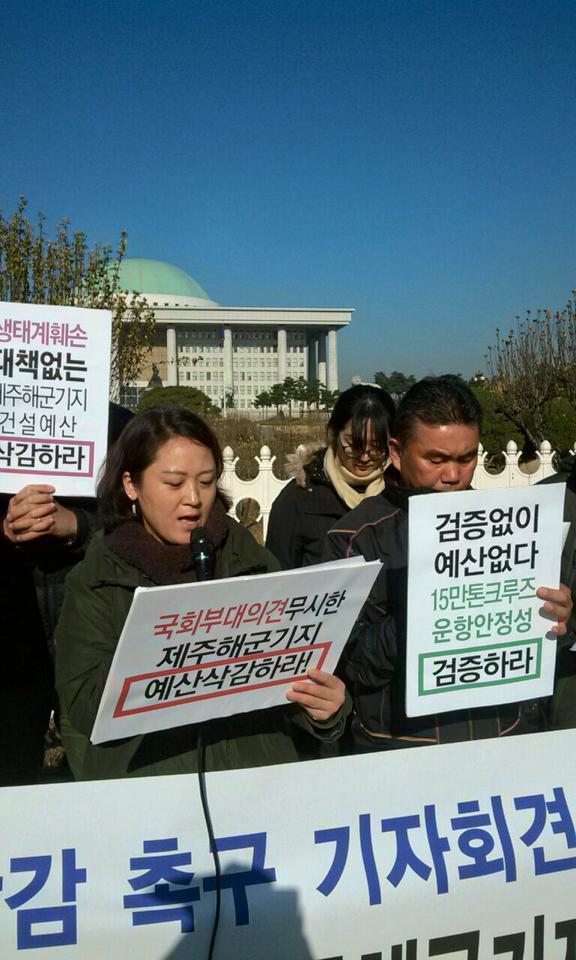
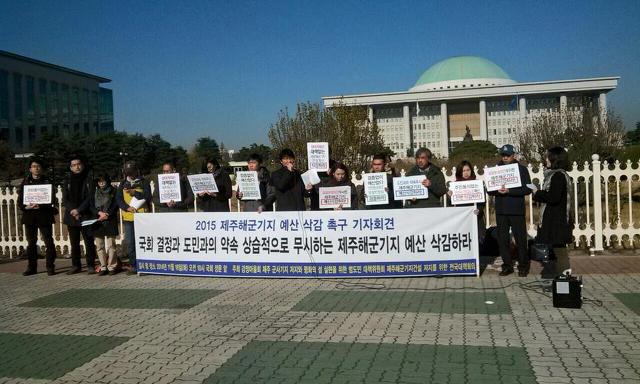
On Nov. 18, 2014, activists gathered in front of the National Assembly in Seoul to demand the whole cut of the 2015 Jeju naval base construction budget . Mr. Choi Yong-Beom, co-vice mayor of the Gangjeong village association (right in the photo) joined the press conference, representing the village (photo by a press conference participant)
A press conference to demand the whole cut of the 2015 Jeju naval base construction budget, in front of the ROK National Assembly, Seoul, on Nov. 18, 2014 (Photo by a press conference participant)
On Nov. 18, the Gangjeong village association, Jeju Pan-Island Committee for the Stop of Military Base and for the Realization of Peace Island, and National Network of Korean Civil Society for Opposing to the Naval Base in Jeju Island officially demanded the National Assembly to cut the 2015 Jeju naval base budget of 298 billion won (about $290 million USD) filed by the Government. In their opinion statement, the groups claimed that the Government has habitually ignored National Assembly decisions and promises with the Island people (See the below sources)
The seven reasons to the cut the 2015 Jeju naval base budget
(* Only big titles were translated here. Each details are currently available only in Korean in the below sources)
_Violation of the 2014 budget collateral conditions given by the National Assembly
_Need to reexamine the safety matter of 150,000 ton cruise navigation
_Harbor construction without the measures on environment contamination
_Stagnation on the executive results and annual transfer possibility
_Invalid Jeju naval base project
_Continued human rights infringement and government negligence on conflicts
Proposals by the Gangjeong village association and civic society
There should be an inquiry on the responsibility of the Ministry and navy’s habitual violation of National Assembly collateral conditions.
There should be the prompt stop of military housing building that amplifies conflicts. There should be the whole cut of 9,819,000,000 KRW (about $ 9 million USD) construction budget; of 347,000,000 KRW (about $300,000 USD) supervision cost; and of 36,442,000,000 KRW (about 30 million USD) purchase cost for military apartment.
In relation to entry & exit of the military-related vehicles, the construction budget for 19.5 billion KRW (about $ 18 million USD) for the entry road of which its building has not been agreed with villagers should be frozen until measures for noise and environment matters are prepared for.
Also there should be the cut of harbor & bay facility construction cost of 96.4 billion won (about $ 90 million USD); of land facility construction cost of 112 billion KRW (about $110 million USD); of harbor & bay supervision cost of 2.3 billion won (about $2 million USD); and land supervision cost of 2.3 billion won(about $2 million USD), with an inquiry on the responsibility of the supervising committee’s poor management, as well as a demand that the execution of construction budget should not be done unless there is preparation for the measures on the protection of ecology system and soft corals.
In the project promotion budget, there should be the whole cut of about 11 million KRW (about $10,000 USD) for the events such as local residents-invitation events, visitor-welcome events, conflict-management activities. And in the indirect cost, there should be the cut of about 36.5 million KRW (about $ 30,000 USD) for the public relation material production (booklets, leaflets & other materials) and newspaper advertisement. Those budgets bring concern that they could stir up conflicts as the navy makes unilateral public relation, justifying the Jeju naval base project.
The problem of location selection was proved again. Following the destruction of seven caissons – huge concrete structures for the breakwater installed on the maritime of the Jeju naval base construction site- by the typhoon Bolaven in 2012, three caissons were also pushed or slanted down by the typhoon Neoguri ( with the maximum wind speed 19.5 m/s ) in 2014. Fundamental examination on the matter is necessary.
To resolve the conflict on the Jeju civilian-military complex port, the should-be–clearly-examined in the truth investigation raised by the current Won Hee-Ryong Island government (See the Oct. newsletter, Page 1) are the propriety matter of the village general meeting (* which was manipulated by the navy) at the time of the invitation of the Jeju naval base project; validity matter of environment impact assessment; propriety matter of annulment of absolute preservation area not to mention validity matter of location selection; layout errors in relation to the safety matter of 150,000 ton cruise navigation; and suspicion on the data manipulation raised in the process of simulation and the substance of external pressure. To resolve those matters, the Government and National Assembly should be responsible to act.
Before more construction progress, there should be through verification on the reason of the postponement of layout change on the west side jetty and safety matter of 150,000 ton cruise navigation. Also there should be a prompt environment and legal examination whether the planned sea route (changed) can properly work as the Jeju naval base sea route.
Further, there should be total reexamination on the location and military validity as there is a big concern that the Jeju naval base is fundamentally to be used as an outpost for the ROK-US-Japan trilateral military missile defense and naval cooperation targeting China and is to aggregate nuclear arms cost and military confrontation in the Northeast Asia.
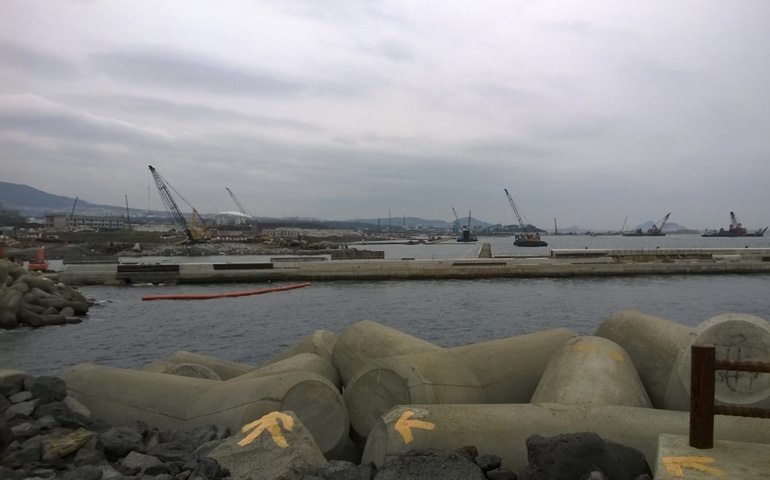
Police surround Art Laffin and other activists as they protest at the main entrance of a U.S.-backed Korean naval base on Jeju Island.Fr. Mun Jeong Hyeon, Art Laffin, and another protester during the Mass at the main entrance to the construction site of a U.S.-backed Korean naval base on Jeju IslandConstruction continues on a U.S.-backed Korean naval base on Jeju Island.
I had the opportunity to travel to Jeju Island off the coast of South Korea in the East China Sea from Oct. 29 to Nov. 4. I previously spent four days in Manila, Philippines, where I was invited to speak at the first Asia Pacific Dialogue on Human Rights and Respect for the Dignity of Life with the theme: “No Justice Without Life.” I left an amazing community in Manila standing for life and justice and saying “No” to state-sponsored killing. In coming to Jeju Island, I met another extraordinary gathering of people who are saying “Yes” to creation and “No” to the construction of new naval base that is a crime and a sin.
For several years, I have been closely following this inspiring nonviolent campaign led by local islanders along with priests and sisters to stop the construction of this U.S.-backed Korean naval base on Jeju Island (named the “Island of Peace” by the Korean government).
UNESCO considers Jeju Island and nearby Beom Island, Moon Island, Seop Island, and Hallasan National Park biosphere reserves. The construction of this base, which is a joint Korean, U.S. and Japanese venture with Samsung as the main contractor, is destroying the beautiful ecosystem of the island as well as the majestic soft coral reefs and surrounding ocean life.
The ancient Gureombi rock formation no longer exists, having been blasted away two years ago. Inthe March 2014 issue of the Gangjeong Village Story monthly newsletter, the lead article lamented the second anniversary of the destruction of this sacred formation: “For thousands of years, Gureombi has been a playground, a garden, and a mother’s arms, embracing and embraced by the people of Gangjeong. Thus it was perhaps the most painful and sorrowful moment of this 8 year struggle to experience the partial destruction of Gureombi Rock. Still, though we cannot see Gureombi anymore, it lives on in our memories.”
Ultimately, the U.S. wants to use the base as an outpost to contain China. Peacemakers from the United States, including Bruce Gagnon, Regis Tremblay, David Hartsough, Ann Wright, Jesuit Fr. Bill Bichsel, Nick Mele, Kathy Kelly, Brian Terrell and Michele Naar-Obed, have come here to offer support over the last several years, and the local campaign has been deeply appreciative for this friendship and solidarity.
Upon arriving in Jeju City, I received a very warm welcome by Fr. Pat Cunningham and the Columban religious community, who offered me hospitality for the night. The next morning, Father Pat and I took as bus to Gangjong Village, about an hour from Jeju City. We arrived just in time for the daily 11 a.m. Mass that occurs directly outside the entrance to the base construction site.
Father Pat and I joined with other friends, including longtime renowned peacemaker Fr. Mun Jeong Hyeon, who has spent nearly three years in prison for his resistance, in sitting on plastic chairs stretched out across the base entrance. As grace would have it, I also became reacquainted with two of the local organizers whom I had previously met in D.C.: Sung-Hee Choi and Jung Joo.
There were at least eight people from the community sitting in chairs, blocking the center of the entrance. As streams of cement and supply trucks entered and exited the base, police carried those blocking to the side of the entrance. Then the police permitted those forming the blockade to return to the entrance, where they continued the witness. This back-and-forth went on for at least one and a half hours.
Celebrating Mass and receiving the Eucharist in this context was a very powerful experience. In the face of this monstrous base, which is now halfway complete, the power of eucharistic love, borne out in nonviolent witness, is the means by which true conversion and transformation can occur. Those gathered at the base entrance, along with at least 30 people who also attended the Mass a short distance away, truly believe in miracles and that with God all things are possible.
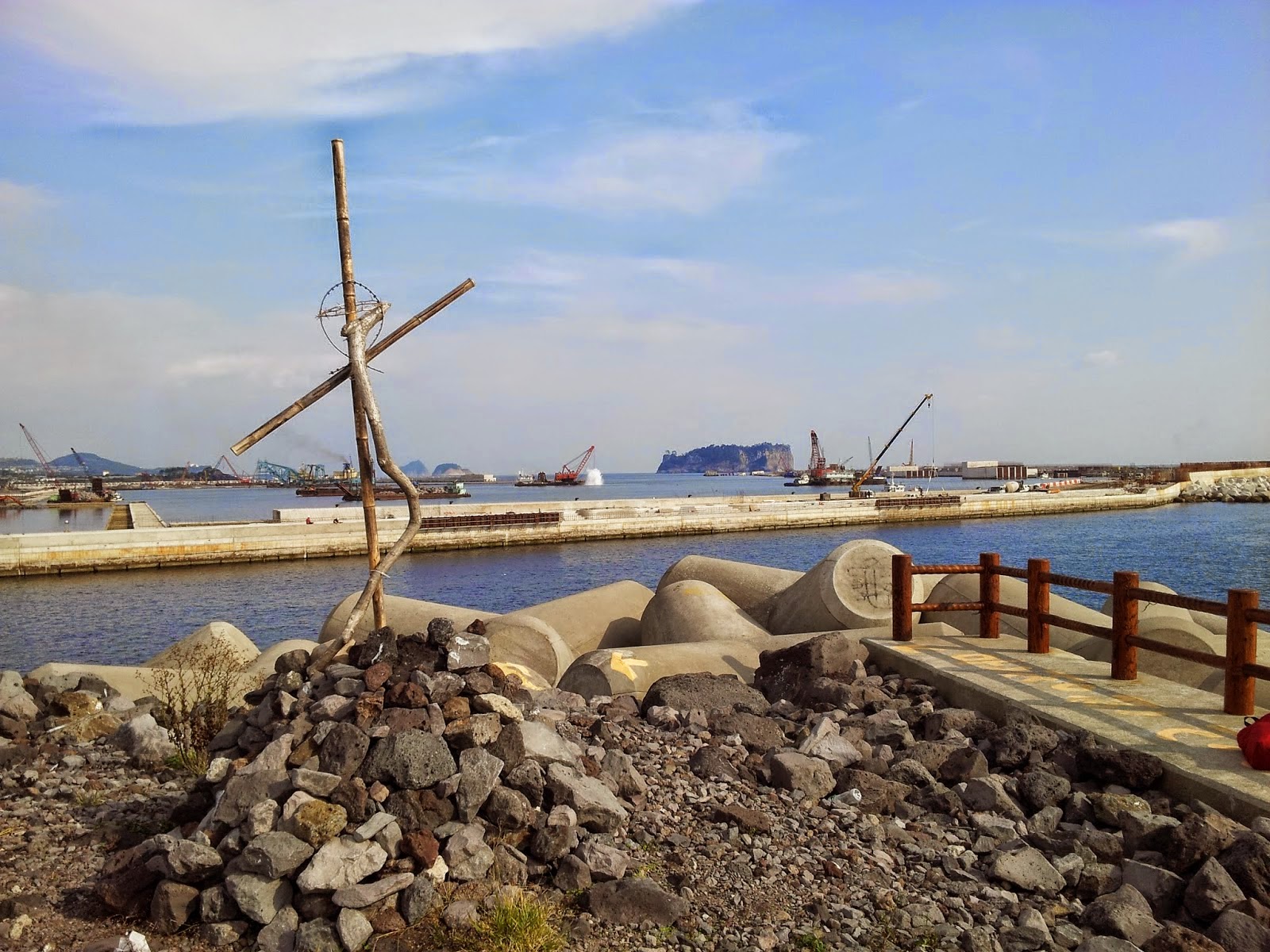
Following the Mass, the gathered community prayed the rosary. This was followed by a press conference by the Gangjong Village Association, calling for an end to the expansion of military housing units being built in the village as a result of the new naval base. I then was invited on a tour of the port area of the island, where one can see a panoramic view of the massive base construction.
Cranes are visible everywhere on the site, while in the port, there is constant dredging to accommodate future warships. The Korean government has described the new base as a joint military port complex meant to encourage tourism in the beautiful landscape. Despite this and other attempts to deceive the public about the real purpose for the base, local villagers and their supporters refuse to be duped.
In the late afternoon, I met Yang Yoon-Mo, a well-known former film critic who has endured long-term imprisonment and hunger strikes for trying to stop the construction of the naval base. He is one of the more than 650 people who have been arrested for saying “No” to the naval base construction. There have also been 550 indictments for resisters, and about 45 people have served jail sentences for their courageous resistance. Yang and several others have set up a new vigil site at another part of the base perimeter where supply trucks are being redirected from the main entrance. Many villagers are upset that these trucks are now diverted through their neighborhood.
On Nov. 1, All Saints Day, I joined two other friends, Jesuit Fr. Kim Song Hwan and Gayun, in blocking the cement and supplies trucks. Moments after receiving the Eucharist, four police from the base hoisted me in my chair, banner in hand, and carried me over to the side of the road as they had done with Father Kim and Gayun. It was indeed a moving experience in more than one way! Once the traffic cleared, the three of us resumed our positions blocking the main entrance. This would happen two more times, once during the rosary and once when the human chain was formed across the road.
The Eucharist and the rosary have taken on a whole new meaning for me here as they occur in the context of an act of nonviolent resistance. In the face of this new port of death being constructed, I feel a power here that is far greater, that can truly overcome the idolatrous forces of military violence: the self-emptying, transforming love embodied in a living Eucharist.
The resiliency of this community is quite remarkable, and they remain deeply committed to a spirited resistance despite overwhelming odds. After the rosary ended, a human chain of about 30 people stretched across the entire entrance to the construction site. As I was still being surrounded by police who had carried me to the side of the entrance, I was handed the mic to lead several songs. I started off with “When the Saints Go Marching In,” which was followed by “Down By the Riverside” and “Seek Peace and Pursue It,” singing with police literally hovering over me as I sat in my chair. Following the human chain, there was an enthusiastic snake dance, then some exuberant dancing. The police, for the most part, let all this go on but continued to move anyone impeding supply vehicles from going into the site.
On my last day in Gangjeong Village, I joined the blockade at main entrance to the construction site and was carried off four times. After the rosary, I was carried off as I sang “We Shall Not Be Moved.” I later asked Father Kim about the history of having the Mass at the base construction site. He told me that in 2009, Bishop Peter Kang U-il of Jeju Island, chairman of the Catholic Bishops’ Conference of Korea, first celebrated Mass on the land designated to be the base. In 2011, Father Mun initiated having the Mass outside the main entrance of the construction site for the base. Father Kim also shared with me that he is assigned to be part of this nonviolent witness to stop the base construction and has been joined by other Jesuits, including his provincial, in blocking the base entrance.
My friend Bruce Gagnon, longtime peacemaker and coordinator of the Global Network Against Weapons and Nuclear Power in Space, was the first one to introduce me, as well as countless others, to the nonviolent struggle in Jeju Island to stop construction of a new U.S.-backed naval base. His inspiring peace work has not only included stopping construction of this new base, but campaigning to stop the militarization of space and for the closing of the nearly 1,000 U.S. military bases worldwide. When addressing the struggle on Jeju Island, Bruce makes an important point that bears repeating: This nonviolent campaign to stop the construction of the new naval base on Jeju Island is an important symbol for the international peace movement. It brings together all the issues — militarization, disarmament, the environment and human rights. I couldn’t agree more with him.
Hopefully, before it’s too late, more people will join and support the courageous people of Gangjeong Village in the struggle to stop the building of this base meant for death and destruction. I encourage people to see Regis Tremblay’s excellent documentary, “The Ghosts of Jeju,” which is the most important resource available about the nonviolent struggle on Jeju Island. For updates about the campaign and ways you can support it, go to savejejunow.org.
[Art Laffin is a member of the Dorothy Day Catholic Worker in Washington, D.C.]
In this October Edition:
Villagers’ opposition to military housing, villagers skeptic over the Island governor’s proposal on truth investigation, Sister Soh Stella becoming the 1st Korean nun to get the court sentence, people’s free speech being blocked in the CBD, international solidarity, sea contamination due to damaged caissons, Chossudovsky and nation-ruing SCM, Gashiri peace festival, Keep Space for Peace week, trial updates and more.
In this September Edition:
Catholic Conference, anniversary of Catholic solidarity and the fence around Gureombi, International Day of Peace, remembering an Japanese anti-base activist, North East Asia Regional Peace-building Institute, hunger strikes, Okinawa updates, trial updates, international solidarity, and more!
On Sep 20th, there’s a mass gathering in Henoko, Okinawa to protest against the military base construction and the violence conducted by the coast guard in order to enforce the military base construction. Gangjeong villagers and activists also participated directly in the gathering in Henoko to show our friendship and support to the Okinawa struggle for peace.
Gathering in Henoko beach on Sep 20thGangjeong villager, uncle JungHwan, and one of the Gangjeong peace activists was holding the banner written “Jeju, Okinawa, Taiwan to be the Demilitarized Peace Island” in the Henoko Gathering. Photo forwarded by TakahashiGathering in Henoko Beach on Sep 20th. Photo forwarded by TakahashiGathering on Henoko Beach on Sep 20th. Photo forwarded by Takahashi
A solidarity message was delivered from Gangjeong Village Association, Gangjeong Peace Keepers, Gangjeong International Team, and Inter-Islands Solidarity for Peace Team to Henoko. Here’s the solidarity message:
—
We people in Gangjeong are eager to express our outrageous anger to what’s going on in Henoko, Okinawa. We have watched many of photos and videos of the violent action conducted by the coast guard of Okinawa against the innocent peace activists.
It’s not a crime to defend the nature, peace, and be-loved hometown but it’s doubtlessly a crime to defend the base construction plan no matter how it is legal or illegal in the law system under a state. The action of the coast guards in Henoko seem to us the military itself but the enemy target is the peace-loving civilians who they declared to protect for.
It’s a lie that the military and military base protect people. It must be a real ironic lie for Okinawan who have learned the painful lesson to be a base islands under the war.
We have learned from our Okinawa friends that the nightmare of war experiences and state violence in Okinawa has been extended through the long-lasting existence of military bases, just like the enforcement of the naval base here has reminded many the nightmare of 43 and the history of forced militarization of Jeju by the Imperial Japan government. We are both together standing on the top of the uneven historical trauma and probably again the crossroad of the war.
We people in Gangjeong want to make a possible new way together with you.
Just like the thing we pray every day in Gangjeong during our struggling that the world peace will begin from our small village, so does Henoko. We people in Gangjeong request the cancelation of Henoko Bases, not only in Henoko, but all the military facilities in Okinawa islands while we are also struggling here to make Jeju a real DMZ peace island.
Henoko friends, you are in our heart in our daily struggle. Our solidarity for you is really from many Okinawa friends’ inspiring friendship for us. Peace is our way.
2014 Sep 19th in Gangjeong
Gangjeong Village Association, Gangjeong Peace Keepers, Gangjeong International Team, and Inter-Islands Solidarity for Peace Team
Inter-Island Solidarity for Peace Team’s hand-made banner written “Jeju, Okinawa, Taiwan to be the Demilitarized Peace Island” has been hang up in the booth in Henoko, Okinawa by the visiting group from Gangjeong, Jeju. Photo by Director Cho SungBong
Peace for the Sea International Peace Camp, aimed to build up the inter-island solidarity for peace among three islands, Okinawa, Taiwan, and Jeju, in East Asia has been successfully held from Aug 3rd to 6th in Gangjeong village, Jeju Island with around 50 participants from Indonesia, Hawaii, Australia, New Zealand, Japan, Spain, Unites States, Korea, not to mention Okinawa, Taiwan, and Jeju.
On Aug 3rd, participants visited Jeju 43 Peace Park to get the basic introduction of the traumatic history of Jeju island.
Presentation about Nuclear Issue in TaiwanOkinawa’s presentationParticipation in the Human Chain activity and sing the beautiful songs by Peace Camp participants.Ocean Activities
On the morning secession from Aug 4th-6th, people learned and exchanged the different stories on Okinawa, Jeju, and Taiwan following the different topics on each days. Every day, the presenters from Okinawa, Taiwan and Jeju brought us their different but connected island stories. And in the last day, we even have the Peace activist from Hawaii to present one of the most representative case of the evilness of the US militarism in Hawaii. And through the volunteering discussion in the late night of Aug 5th and part of the time in morning secession on Aug 6th, the peace camp participants made the common statement and presented it in Japanese, Chinese, Korean, and English language in the press conference during the Daily Human Chain Time in front of the Naval Base Construction gate with the shouting in 4 languages of NO Base, No Violence, No Killing, No War, No Nukes, No Destruction of Nature.
The following is the statement by the Peace Camp participants.
—-
“Peace for the Sea, From the Islands to the World”
Statement by Korean and Overseas Delegates to the 2014 Peace for the Sea International Peace Camp
We have gathered here in Gangjeong Village as witnesses of conscience who have also formed new bonds of friendship. We are peacemakers from across four different continents who have gathered to help promote inter-island solidarity among Okinawa, Taiwan, and Jeju. As part of our “Peace for the Sea” International Peace Camp, we feel moved to join together to issue this statement of solidarity.
We believe that the building of this naval base is wrong and a clear violation of local and international law. As members of the global community who love Korea, we are appalled that the construction of this naval base is poised to destroy the fragile ecology of an island renowned throughout the world for its natural beauty and geological significance. The projected impact of this base would forever change the character of the island and could potentially cripple Jeju’s thriving tourist economy. We emphasize in the strongest terms that militarizing this island stands to ruin Jeju’s pristine environment with toxic pollution, and would dishonor the island’s character as a sacred island of peace and a place of collective healing from historical trauma.
Here in Jeju, we are furthermore inspired by the courage and integrity of those who have long opposed militarism and state violence in Okinawa and Taiwan and on other islands in East Asia. We share parallel backgrounds and many common experiences, and we stand in solidarity as we engage in a common struggle against anti-democratic militarism.
We also share a close kinship with the sea, and we embrace our duty to protect the right to peaceful oceans, which is our common human inheritance.
We therefore challenge the manifestations of state violence on Okinawa, Taiwan and Jeju. Given that reducing military tensions in Northeast Asia is essential to promoting peace throughout the world, all three islands must be demilitarized and restored to their former long-standing existence as peaceful communities at the maritime crossroads of Northeast Asia. For the sake of a more secure future in the region and for the world, we urgently call for a newly Demilitarized Peace Area without military bases in Okinawa, Taiwan and Jeju.
This statement was written collaboratively among all of the participants of the International Peace Camp.
August 6, 2014
—————-
In the afternoon from Aug 4-6, the ocean activities had been carried out in the Gangjeong port, Gangjeong river and Gangjeong sea. The activities includes having fun in the Gangjeong river, swimming and riding the kayaks in the sea, Peace Demonstration in the sea…
Peace Camp participants held the sign of “DMZ Peace Island”
In the night, the peace festivals were held. In the first day’s “Welcoming night”, Gangjeong villagers, Go, GwonIl, the vice mayor of Gangjeong, and Jeong YoungHee, the chairwoman of Gangjeong anti-base committee gave the welcoming speech to these domestic and international peace delegates. In the second day’s “Cultural Night”, people learned and enjoyed the Gangjeong, Okinawa, and Indonesia traditional dances. And in the movie night, we watched the Gangjeong documentary–“Gureombi, the Wind is blowing” and had the dialogue with Director Cho, SungBo. In the last night, the music concert was held and the closing speech had been done by the other Gangjeong vice mayor Mr. Choi, Yong-Beom and the video message from the Jeju Bishop Mr. Kang U-Il to the Peace Camp participants. Through these festival nights, people got time to exchange and share our cultures from different islands and areas and some also use this time to give the solidarity to the palatine people who is now suffering by war.
All the participants in this peace camp are the precious presents who make the inter-island solidarity for peace be on the way of realization. We exchange our promise not to let one struggle alone against militarism. And the 2nd, and 3rd Peace Camp in Okinawa and Taiwan are under preparation.