In this this July and August Special Edition:
The Pope visits Korea, more caissons broken by typhoons, World Council of Churches calls for a stop to the base, special section on the 2014 Grand March, special section on the 2014 Peace for the Sea Camp, update on Milyang, Emergency Jeju DMZ forum, youth camps in Gangjeong, Gangjeong housing co-op, prison updates, trial updates, international solidarity, and more!
At the time, Gangjeong’s struggle was also brought before the assembly as an issue to be discussed in the official statements released each time by the WCC. The public issues committee and the WCC delegates which had the delegated authority to choose which issues would appear in official statements, voted to choose Gangjeong. Gangjeong and its supporters were overjoyed, however due to unresolved issues, there was not time to finish and release the official statement by the end of the assembly and it was pushed back to July 2014 when the WCC central committee would meet again to resolve remaining issues.
The World Council of Churches central committee, meeting in Geneva, Switzerland, 2-8 July 2014, therefore calls on member churches and related ministries and networks to:
[…] 8. Oppose the expansion of military bases, nuclear forces and missile defences in Asia or targeting Asia, and raise awareness of public resistance to such military expansion including the new naval base at Gangjeong Village on Jeju Island, Republic of Korea.
Please spread this great news around and encourage those you know in WCC related churches, networks and ministries, to join in this new mandate of the WCC!
The Gangjeong international team has requested toAustralian Anti-Bases Campaign Coalitionfor an article inJune 2014 newsletter. The excerpts from the long version was put in the 2nd page of it. We put the whole article here as it provides much information. Thanks to Julie Marlow and friends in the Australian Anti-Bases Campaign to take time on the article.
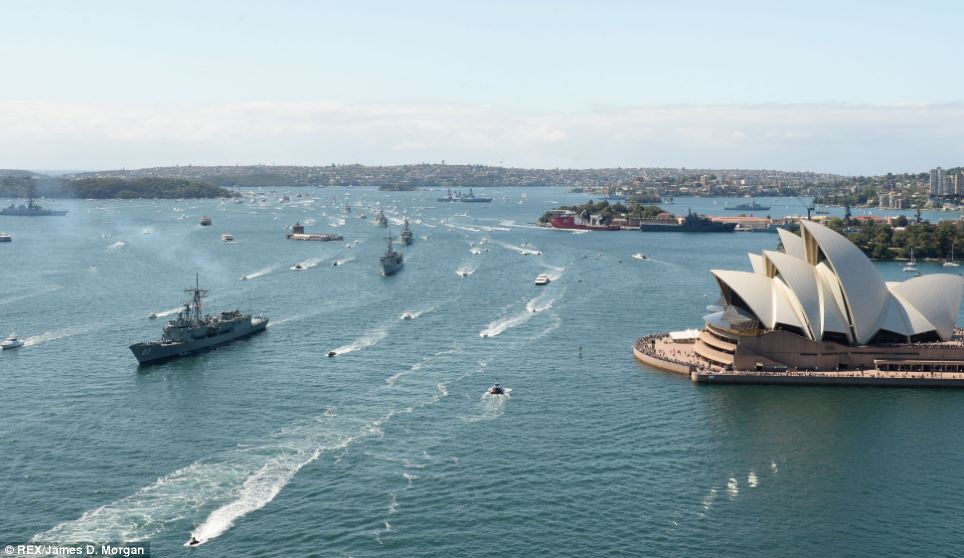
Won Hee-Ryong, a conservative and right wing, and a new Island governor(who was elected on June 4 and started his term on July 1)has written a reply to the Gangjeong Village Association’s question on the possibility of realization of civilian-military complex port on May 24 that he thinks co-existence of civilian and military port is possible, making examples of Sydney, San Diego, Manhattan, and Rome. His whole short answer was:
“As I know, there are examples of big ports such as Sydney, San Diego, Manhattan, Rome etc that use dock facilities where civilian and military are located next to each other. Especially, in case of Sydneyy, I heard that there is an example of using navy-only dock pier facility when 150,000 ton cruise ship enters[..]If there is any part that civilian-military port is not properly working, it should be fixed.”
His answer is very much in line with the South Korean governments and navy propaganda that deceives people. The navy used to make sugar-coat words on the Jeju naval base project (A so called ‘Civilian-Military Complex port for Tour Beauty’ in another title), projecting false illusion on the ecological conservation and economic development with the base project)
The truth is that 95% of the base-building budget comes from the ROK Ministry of National Defense (which makes the port, in fact, a pure military port); that many UNESCO soft corals have been dying with the base building; that the construction will only benefit big corporations like Samsung; and that the port will be a home to US Nuclear aircraft carriers and Aegis Destroyer etc…, let alone two 150,000 cruises that the gov. has advertised for the future prospect of the base use (It has been already disclosed that the base layout fits to the US nuclear aircraft carriers.. and the layout will never properly work for such big cruise. Yet. the Gov. still pretends and lies as if it would work)
Sydney Harbour: an unlikely exemplar of military/civilian cooperation
Won Hee-ryong, Jeju’s new Governor, has stated that Sydney Harbour is an example of a port comfortably combining civilian and military uses. This is highly debatable, particularly on past and present environmental evidence.
The new Governor also has suggested that the big cruise lines enjoy an accommodating relationship with Sydney Harbour’s naval base. This is simply wrong. The Royal Australian Navy (RAN) has made clear that guaranteed access to its terminals by cruise ships is incompatible with the ‘primacy’ of naval operations.
Sydney Harbour has been a naval base since 1788, when Britain’s Royal Navy first arrived and hoisted the British flag. The harbour’s colonial history is tragic, with its Indigenous people largely displaced within a few generations, many murdered or dead of introduced diseases.
A more recent disaster—Sydney Harbour’s dioxin contamination— also has a strong military component. Australian-produced Agent Orange, manufactured by Union Carbide at a site on the western reaches of the harbour, was sold to the US and Australian armed forces for chemical warfare during the Vietnam-America War. Carcinogenic and teratogenic dioxins, originating from the Union Carbide site, now extensively contaminate the harbour’s marine life and sediment, and will continue to do so for decades. Since 2006, commercial fishing in the harbour has been banned and recreational fishers are warned not to eat fish caught in its western waters, and to strictly limit what they eat of their catches in other areas.
Sydney Harbour’s sad history belies the claim made by Won Hee-ryong. So does the nature of Australia’s current military build-up. Most of the build-up is in the north of the country and along the west coast, following recommendations of the government’s 2012 Force Posture Review, developed in sympathy with the USA’s Global Force Posture Review. Nonetheless, Sydney and the east coast are not being spared. Naval activities in the harbour are increasing and these activities are resource-greedy and polluting. It is hard to see how such activities can easily dovetail with civilian uses of the port.
Sydney Harbour, home port for Australia’s newest and biggest warships
The most conspicuous military presence in Sydney Harbour is the Garden Island defence precinct, comprising the RAN’s Fleet East Base and facilities of arms corporations, Thales Australia in particular. Fleet East Base is Australia’s principle east coast naval base. Thales, providing extensive maintenance and other services to the base, operates Australia’s largest dry dock, which artificially connects Garden Island to the mainland. Other corporations have a presence on the base, such as the Naval Ship Management (Australia) Pty Ltd, a joint venture between UGL and Babcock.
Fleet East Base is the home port for at least 12 of Australia’s larger warshipshttps://www.navy.gov.au/establishments/fleet-base-east. The latest to arrive is Australia’s biggest ever warship, the 27, 000-tonne, 230-meter long ‘Nuship Canberra’, an amphibious assault ship called a Landing Helicopter Dock (LHD).
Under strong pressure from the US military, with which Australian armed forces are becoming ever more deeply integrated, the RAN is rapidly expanding. Garden Island’s share in the expansion is a substantial revamp to accommodate more large vessels, including a second LHD and three Air Warfare Destroyers (AWDs) equipped with Aegis Combat Systems (sister ships to the US AWDs to be docked at Jeju). Sydney’s AWD and LHD training and sustainment facilities are costing $170.2 million. Favoured status of Defence means legislative environmental approval for this work is not required.
The navy is also considering using Fleet Base East as a supplementary home port for the planned expanded submarine fleet.
Foreign, especially allied, warships are frequent visitors to Sydney, and given the US military’s so-called re-balance to the Asia-Pacific, likely to become more frequent. These vessels require berthing and servicing at Garden Island, adding to its environmental footprint. Further, despite the City of Sydney’s status as a nuclear-free zone, nuclear-powered and unconfirmed nuclear armed US Navy ships arrive without compunction. Years of protest by peace, anti-nuclear and green groups has been of no avail.
Increased naval operations at Garden Island as well as infrastructure upgrades inevitably add to existing pollution and disturbance of contaminated sediment. The NSW Government’s recent $21-million harbour decontamination project included attempts to clean up sediment around Garden Island. However, “heavy metal contamination in soils and shallow sediments around the [Garden Island] precinct” continues to be reported
Commercial/military clash over use of ship terminals
Berths at the Garden Island naval base are among the most accessible in the port, and the RAN keeps a jealous grip on them. Contrary to the suggestion by Jeju’s new Governor, RAN shares its berths with the commercial sector very reluctantly and on an ad hoc, temporary basis.
Today’s huge cruise ships are too tall to pass under Sydney Harbour Bridge. Since 2007, the cruise industry, the fastest growing segment of Australian tourism (and admittedly an environmentally undesirable industry), has been calling for guaranteed access to the navy’s terminals. In 2012, the Australian Government directed the navy to make available three berths to passenger ships per year, but this arrangement does not meet demand and is bound to stop as soon as the next procurement of naval vessels arrives.
In its April 2013 review of cruise ship access to Garden Island, the Department of Defence concluded: “The current and future naval capability requirements at Garden Island are essentially incompatible over the longer term except on the existing ad hoc arrangements that we are following. The provision of the guaranteed shared access sought by the cruise industry would impact on the primacy of the naval operations from Fleet Base East.”http://www.aph.gov.au/parliamentary_business/committees/house_of_representatives_committees.html?url=pwc/cpofitout/report%202/chapter5.htm
Conclusion
Sydney and eastern Australia is a climate change hotspot. Sea levels are rising and the East Australian Current is strengthening. Larger storm surges are predicted, as is the possibility of a southward shift of tropical cyclones.
Such hotspots are proliferating throughout the Asia-Pacific. Climate change is the outstanding security risk of the region, indeed the world. The environmental destructiveness that is caused by the construction of the Jeju Naval Base and, to a lesser extent by naval upgrades in Sydney, demonstrates that the military expansionism of the US and its allies ROK and Australia, can only compound the crisis that is facing our planet.
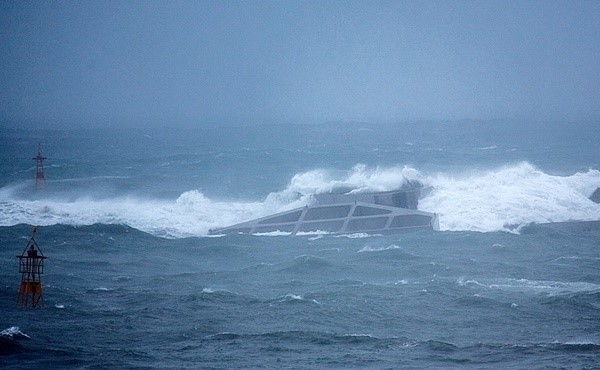
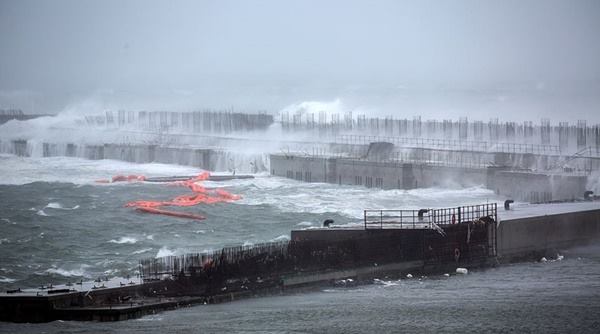
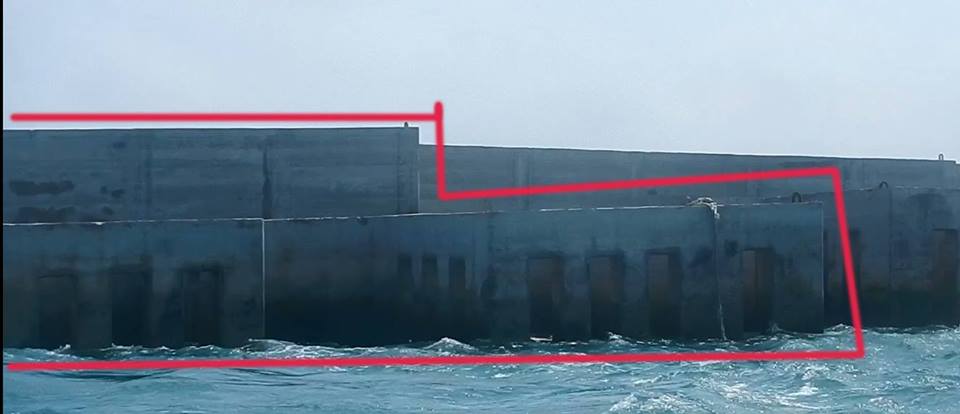
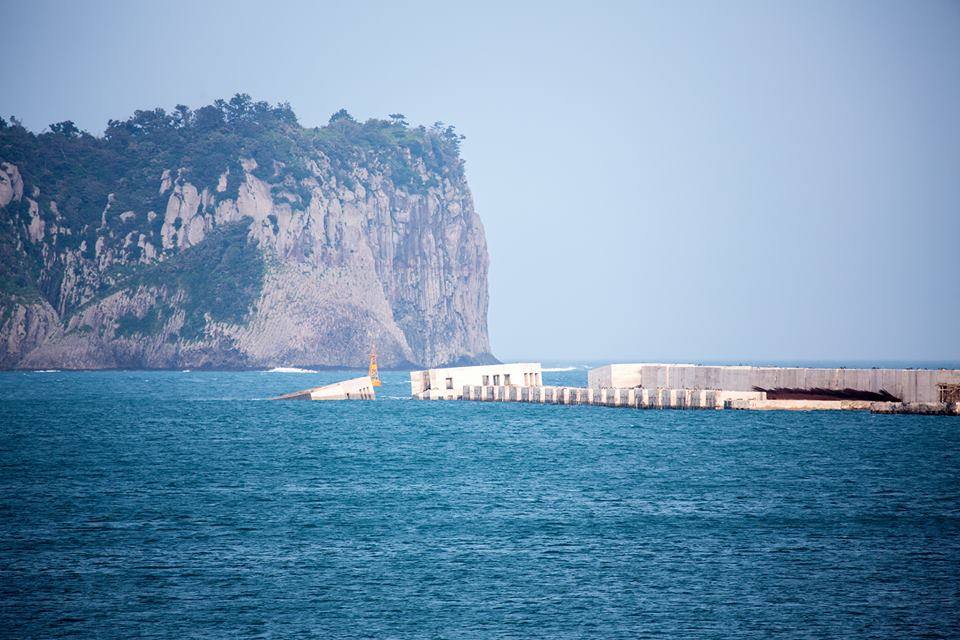
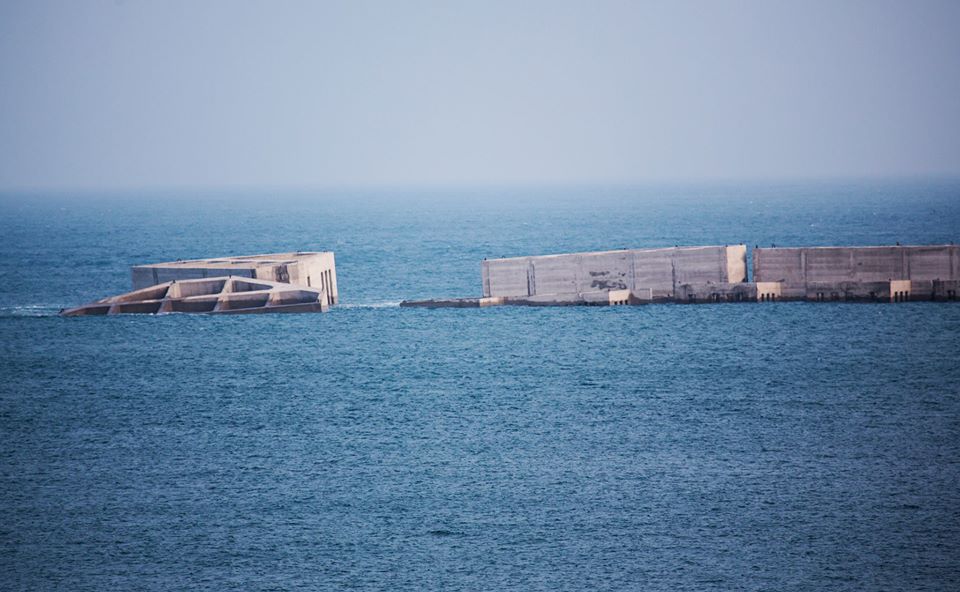
Photo by Dir Cho Sung-Bong , which is told to be taken around 6 pm on July 9. For more photos, see here.Photo by Dir Cho Sung-Bong (1, 2) , which is told to be taken around 6 pm on July 9. For more photos, see here.
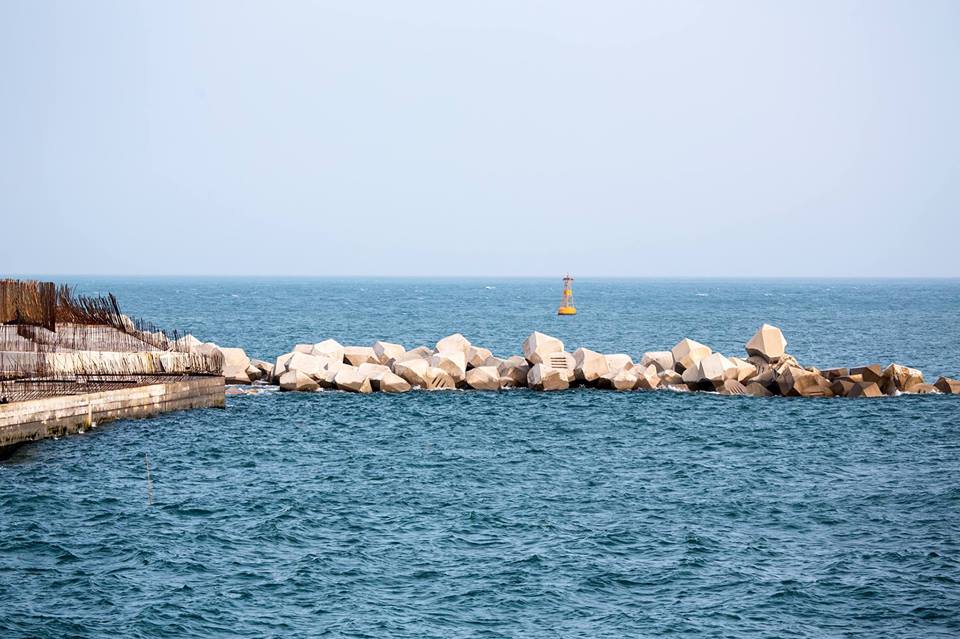
If you remember the seven destroyed caissons (*a caisson is a huge concrete structure for building breakwater) by the big typhoons in 2012, you will also remember how unreliable the caisson construction has been; how wrong the base location is as the village is located on the very way of typhoon; how dumbfounding is waste of people’s tax for war base; and how the sea has been polluted by the navy who has illegally destroyed those seven without any environmental concern… Here are a few words (excerpted) by some witness who are observing another damage on caissons by a medium typhoon that hit Jeju on July 9…
…………………………………………
‘It is the 1st typhoon since the [navy’s] caisson construction in the area of South breakwater, an area operated by the Samsung C & T.’ (By Kim Kook Nam, peace keeper, July 9)
‘Neoguri, the 1st level typhoon in Okinawa has become weaken into the 2nd level when it affected the Jeju Island. [..]’ (By Go Gwon-Il, co-vice mayor, July 9)
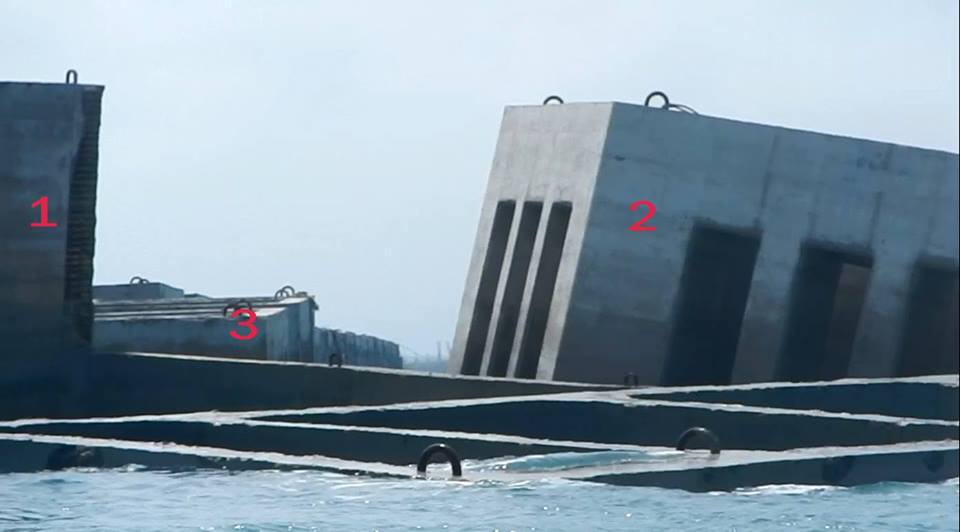
‘Due to the typhoon Neoguri influence, two caissons at the end of the naval base (currently built) south breakwater were completely separated. A one-story caisson at the end of south breakwater, which is barely exposed on the sea surface, is slant, as well, while the two caissons next to it become separated from the existing ones with the great gap from those and looking slant, too. It is likely to take lots of time for those to be restored..” (By Fr. Kim Sung-Hwan, July 10, 8:30am)
‘According to Koh Sung-Shik, Yonhap news reporter who inquired to the naval base project committee, the 1st caisson has been filled with about 40% inside while the 2nd with 100%[..] There seems no way except for smashing those. Steel rods in those became all crooked with the concern of getting rusty in the sea water.. (By Go Gwon-Il, co-vice mayor, in the morning of July 10)
The naval base project committee got tens of billions of damage by total destruction of seven caissons when the typhoon Denvin and Bolaben hit the Jeju in 2012. At the time, the navy said, “The naval base caisson is laid out to stand against big typhoon every 50 years.” (Jeju Sori, July 9)
”The damaged caissons shown from the land is No. 1 and 2. But when I accessed to the site, today, the No. 3, following 1, 2, became slant, too, toward the Beom Island(Tiger Island) about 15 degree. The last picture is the front of No. 3. ( Writing and photos By Kim Kook Nam, Peace Keeper, on July 10)’ (See also Yonhap News, July 10)
‘1. Three caissons in the south breakwater were damaged and distorted. Though the size is different, each costs from 1.5 to 3 billion KRW. It is our tax.
2. The same scene with No. 1, taken from the Moetppuri,[ the eastern tip of the base project]
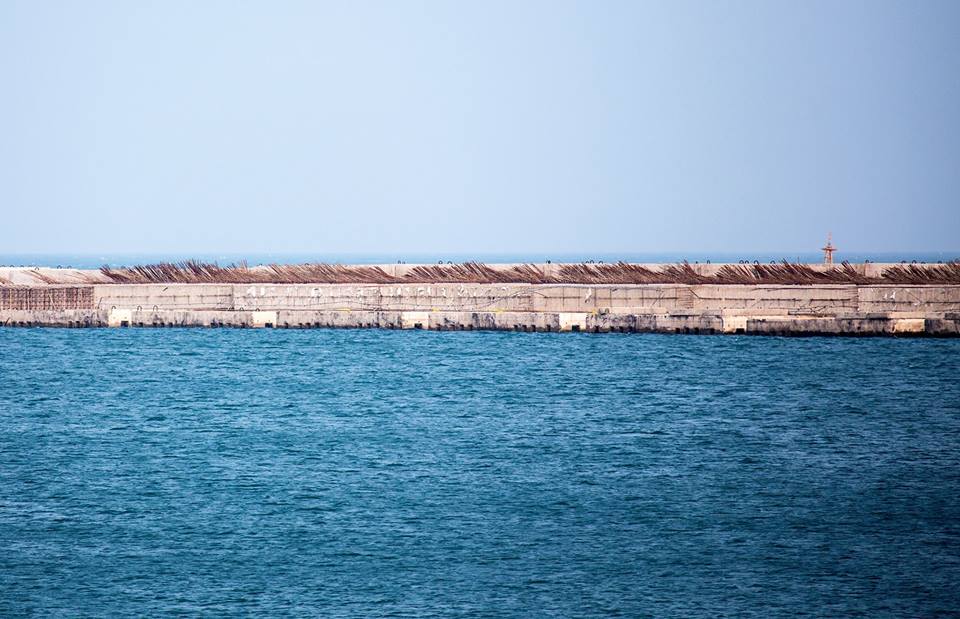
3. All steel rods along the south breakwater became to be laid
4. Same with tetra pods that have been piled up at the end of the east breakwater.
The villagers used to say,
“The Gangjeong Sea will settle what we cannot do with our struggle.”
(Writing and photos by Cho Sung-Bong, July 10. For more photos by Dir. Cho, see here. )
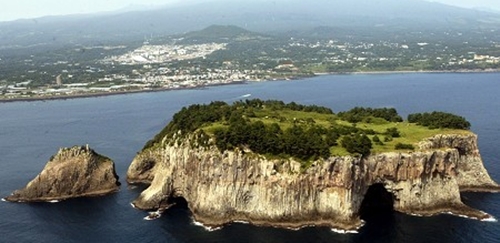
A Jeju media reminds the words of Yang Hong-Chan, the chairman of the villagers’ anti-base commitee in the earliest period of the struggle: “Do you know why there is no tree in the sunny south side on the top of the Beom Island? It is because the sea wave even over rides the top of it during big typhoons. How there can a base be built up in such location? ( Jeju Internet News, July 10)
Photos by Dir Cho Sung-Bong. For more photos, go to here.
“As the people who oppose the Gangjeong naval base construction(destruction), Jeju, by now, we have practiced opposition to the naval base project, living with the Gangjeong villagers. Through peaceful methods, we have resisted to the barbarity and violence of the Jeju naval base construction while looking for solidarity with the Jeju Islanders, nationwide citizens and peace-loving people in the world. [..]
Above all, [we] declaring not to pay fines- a legal punishment which is accumulated by our practice, state to face against it with our prison labor.
Second, we will not stop opposition struggle against the naval base project even after prison labor and will more heighten the degree of our struggle taking solidarity with all the people fighting against capital.
Third, for the peace of the North East Asia and Earth that is imminently being threatened, we will more gather our power into peace movement in solidarity with the peace activists in the world facing against the United States’s world domination strategy.
We go to the Jeju Prison today. They shall never fail our will to oppose the Jeju naval base project that pushes the future of the Jeju with never just but mean ways. We will resolutely resist till the day when the Jeju naval base construction is stopped.
(Excerpt from the statement by Lee Jong-Hwa, Park Seung-Ho, ‘People opposing to the naval base project, Gangjeong, go toward the Jeju Prison, July 3, 2014)
“We will set up the type for struggle.”
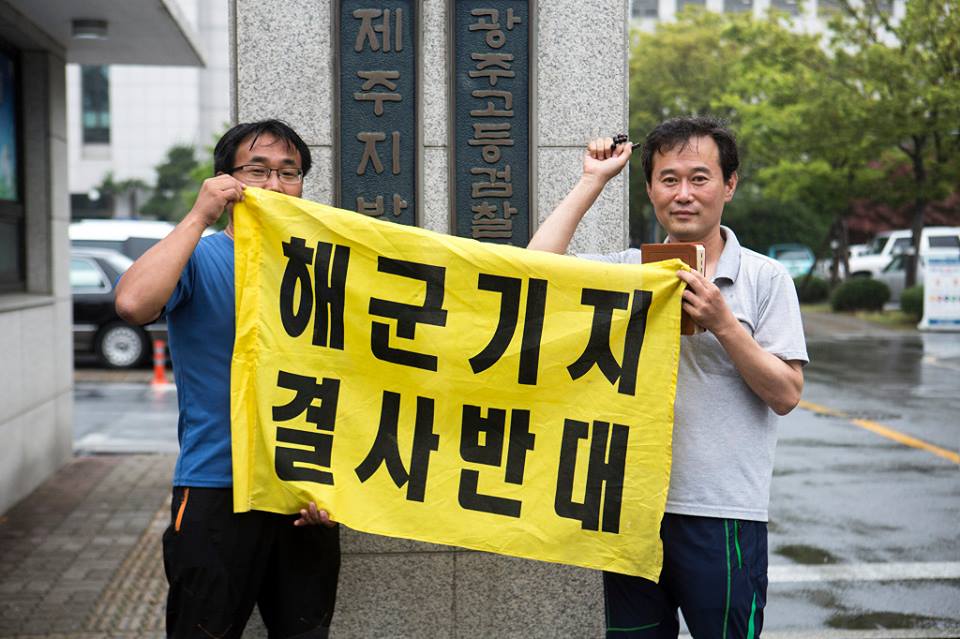
Today on July 3, two Gangjeong peace keepers, Lee Jong-Hwa (48, See the page 3 of here) and Park Seung-Ho (47), refusing to fines, volunteered to be present in the Jeju Prosecutor Office around 6:15 pm. They are to be imprisoned in the Jeju Prison by their will.
The two have been arrested in front of the naval base project committee building complex in June 2012. The two were charged of obstruction of business, while added by another minor charges such as insult.
Each of them is determined to be imprisoned for one or two months.
In this month’s issue:
Soft corals of Gangjeong dying, Jeju after the elections, Sydney Harbor, Solidarity with Okinawa for the Battle of Okinawa, police disturb Catholic mass, village bus gets painted, nonviolent direct action workshop in Gangjeong, remembering the Korean war, noisy construction, prison updates, trial updates, international solidarity, and more!
We, people who fight against naval base construction in Gangjeong village, Jeju Island, South Korea, want to stand together with Okinawa people on June 23rd to memorize, to reflect and to feel the pain and shame together that how we humans allowed ourselves to walk on the way of war preparation and to dehumanize each other under the war.
We don’t want this kind of tragedies to be repeated. However, we recognize that now the atmosphere in East Asia is very similar with that before WW2. Under the US strategy of Asia pivot, our island, Jeju, is also being further militarized, which means the value of Island of World Peace gained over the pain of 43 has been reversed by the nationalism, US militarism, and a long tradition of difficulties as the border islands. Your island, Okinawa, not to mention the long struggle against the US bases, is also facing the new tide of militarization even by the Japan Self-Defense Force, which indicates the painful lessons which supposed to be learned from the WW2 and battle of Okinawa have been diluted by the nationalism, US militarism, and a long tradition of difficulties as the border islands too.
We recognize your effort to stand up against war in the memorable day on June 23rd as here in Jeju, we also don’t want our historical lessons to be twisted. If we Jeju islanders choose the way of development with military base and feel the necessity for national security, we are alarmed that we might already be on the way which led to the experiences of Battle of Okinawa.
Some argue that Jeju Naval Base is not US Base, but we are aware that US militarism trickily makes a use on the nationalism as we couldn’t yet overcome lots of disputed islands in our region. Under both US militarism and our nationalism, our islands, Jeju and Okinawa, are overwhelmed by double centers, US and our own center governments, to defend for. We are alarmed that could lead to the result of another present experience of Battle of Okinawa, a more complex mode with double centers. We appreciate your continuous effort to remind the war memory on the date of 6/23. The peace wind today already blow to our village, and we want to blow this peace wind to all the coner of our island.
Base is Base. There’s no difference between your base and our base because there’s no difference between your peace and our peace. The peaceful lives which we want to sustain in our island is the same with yours. That’s why we are in solidarity with your peace action, and we also want to actively invite you to come to our beautiful Gangjeong village, Jeju Island anytime, especially on this August 3-6 to join to the Peace for the Sea International Peace Camp building not only solidarity but also action plan for peace in our region.
Gangjeong International Team
Inter-Peace Islands Solidarity Team
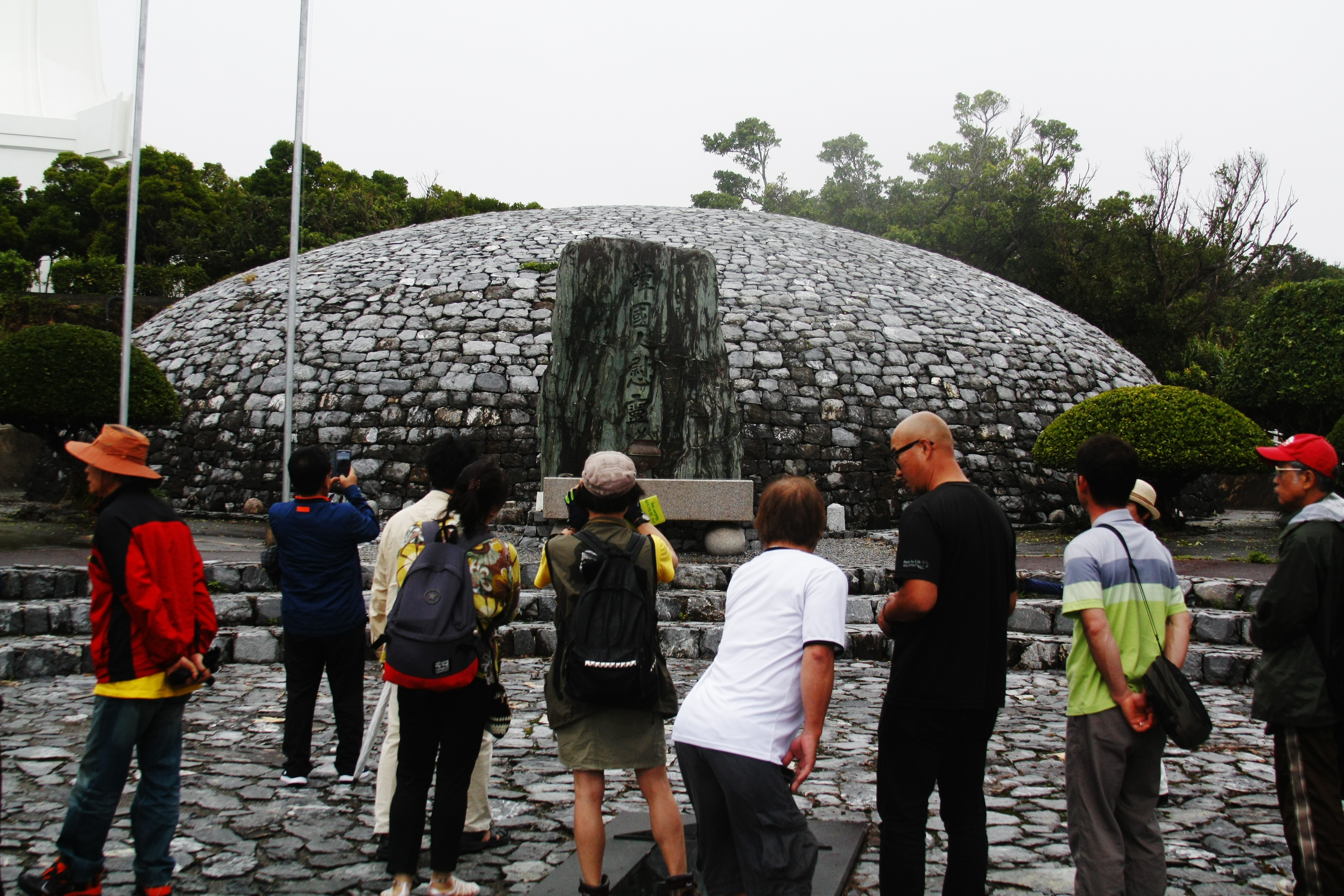
Gangjeong people visited Okinawa Peace Memorial Park to learn about the War-experience and history of Okinawa
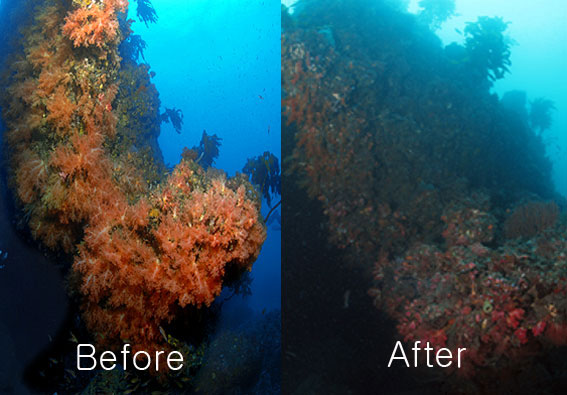
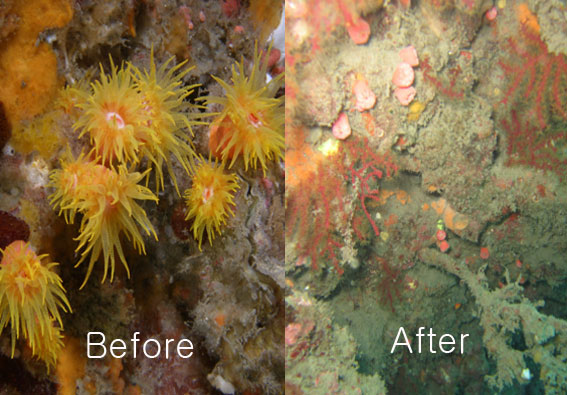
Soft corals seriously were damaged in two years in violation of the EIA: The base construction should be immediately stopped!
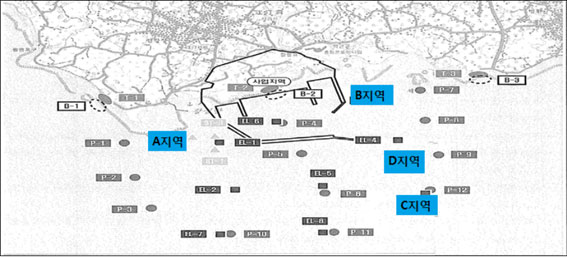
Before (2012) and AFTER (2014): Serious damage has occurred in soft corals in the directly impacted areas due to the Jeju naval-base construction. Source provided by people’s team by the result of monitoring from June 11 to 13, 2014Before (2012) and AFTER (2014): Serious damage has occurred in soft corals in the directly impacted areas due to the Jeju naval-base construction. Source provided by people’s team by the result of monitoring from June 11 to 13, 2014The sites that people monitored this time. A is the area of a light house and B is the area of the Seogeon Island.
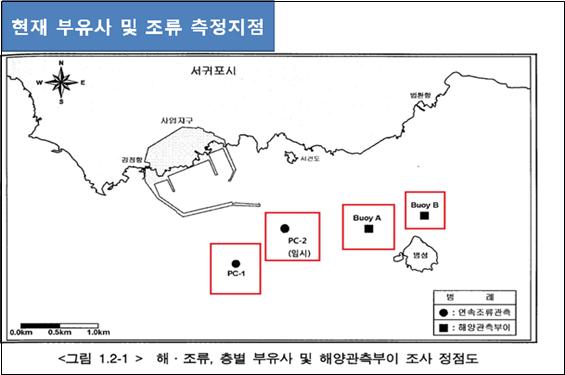
The wrong sites the ROK navy has conducted monitoring. Compare it from the image above.
On June 18, the widely reported in Korean media was the result of the international workshop to investigate on the impact on Jeju sea soft corals caused by the naval base construction, which was a follow-up of the ‘International Symposium on the Conservation of Soft Corals in Asia-Pacific: Impact of Military Bases on Soft Coral Communities,’ National Assembly seminar hall, Seoul, June 10.
The whole workshop and site investigation (June 11 to 13) was organized by the Gangjeong Village Association, Jeju Pan-Island Committee for Stop of Military Base and for Realization of Peace, National Network of Korean Civil Society for Opposing to the Naval Base in Jeju Island, and Office of Jang Hana, National Assembly Woman .
The task force team on the monitoring of the soft corals in the Jeju naval base construction area included Dr. James E. Maragos, U.S Fish and Wildlife Service, a member of the soft coral expert group, IUCN; Dr. Simon Ellis, Marine and Environmental Research Institute of Pohnpei; Dr. Abe Mariko, The Nature Conservation Society of Japan; Office of Jang Hana; Green Korea United; PSPD (People’s Solidarity for Participatory Democracy); Gangjeong Village Association; and specialist divers.
The team pointed out above all that the navy’s post-environmental impact assessment has been conducted in the wrong sites.
The ROK navy has assessed in its ‘post environmental impact assessment result report,’ that there is ‘no impact due to naval base [construction] in the numbers of soft coral species, density of floating stuffs, and change of current etc., since the 2009 EIA and its following period of post-EIA (2011 to the current)
The team, however, pointed out that the navy’s ‘post-EIA result report shows the navy has not processed on the monitoring on soft corals and measuring on current & floating material in the areas of the Gangjeong lighthouse and Seogeon Island, which are located within the 4~500 m or there about from the [currently built] naval base breakwaters and within the direct impact zones due to the naval base construction.
The team reported from their own investigation that ‘in the areas directly impacted by the naval base construction, a symptom of the maritime environment change that seriously threatens the soft coral habitats is found.’ According to them, the changed environment is VERY WORRISOME, compared to the period in Aug. 2012 when the maritime construction has not been taken in earnest, yet.
Simon Elise who has monitored the same areas, visiting Jeju in 2012, pointed out that ‘the expansion and the increment of the sediments that are filed up on soft corals interrupt their feeding activities. Not only that, it seems that the ROK navy is not properly carrying out its role enough even though management on the sediments is necessary because they are the threatening element for their poison effect.’ (* translation from Korean media)
.According to the team, the current in those areas has weaken like a lake [even though the monitoring was carried out in the period when the current is the strongest] The experts say that the weakened currents bring concern about the coral ecology as soft corals have habits to take feeding activities by expanding themselves when current is strong.
Following the monitoring, Yoon Sang-Hoon, Green Korea United claimed:
“The species that are protected by law is in crisis. We demand the stop of construction(destruction) and accurate investigation above all..
Shin Yong-In, a law professor of the Jeju University reminds that the naval base construction is processed with conditions attached:
“Shouldn’t the construction(destruction) be stopped and re-examined when natural memorial is damaged? Isn’t the reason why the Ministry of Environment and Cultural Heritage of Administration of Korea exist? Just for the pretext that the naval base is a national security project, the rest problem has been indulged. If you look at the current EIA, there should be no damage on soft corals.”
The Kookmin TV on June 17 is one of the media that reported on the people’s monitoring activity, its results and their evaluations. You can watch experts’ diving, sea condition and Simon Elise’s won words, here.
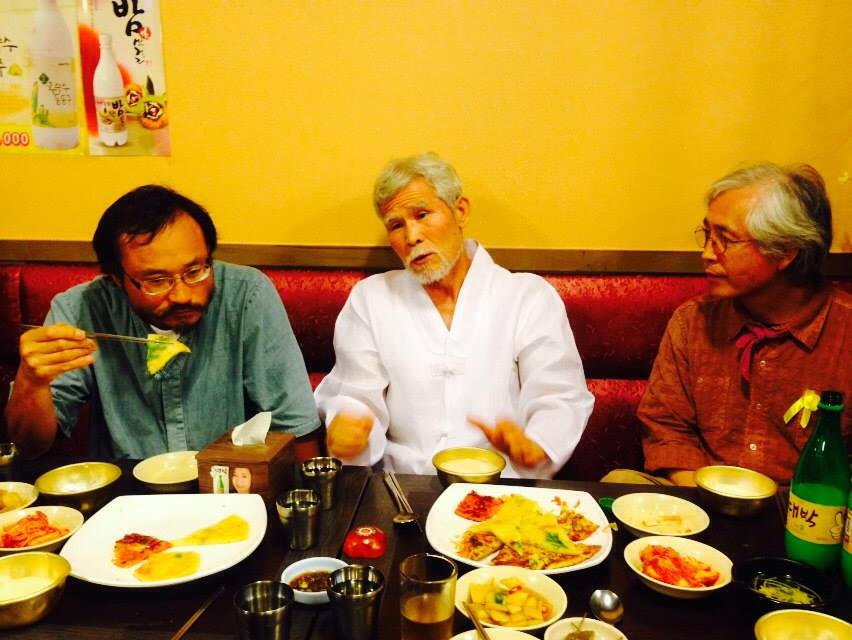
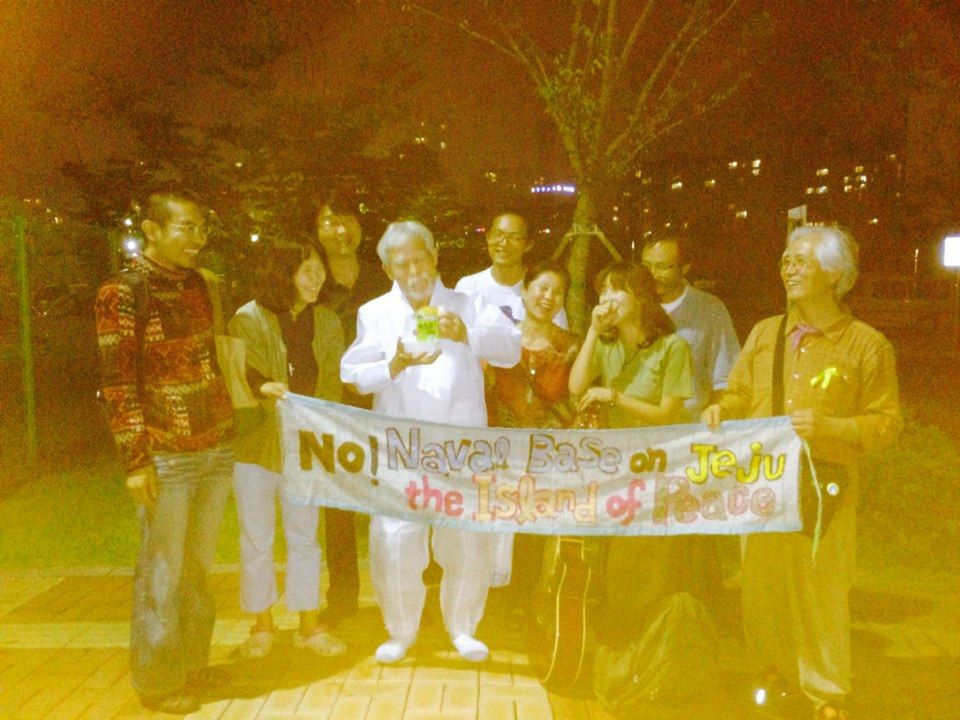
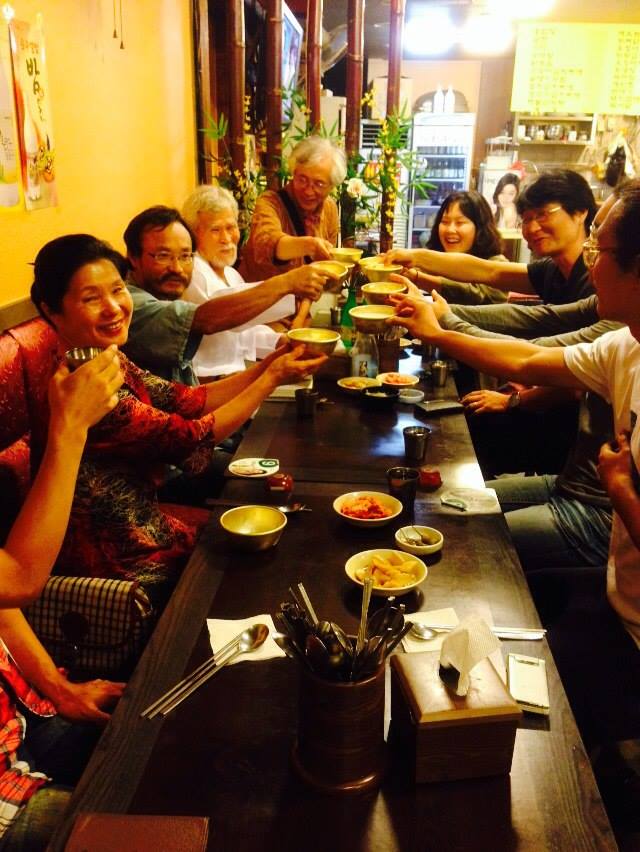
Quaker peace defender Oh Cheol-Geun, well known among Gangjeong supporters for his 500 days of “3 Steps-1 Bow” ritual protest around the construction site, has been released from prison. He was imprisoned voluntarily on May 26 after refusing to pay fines related to to his protests against the Jeju naval base. Friends and supporters met him outside the prison and then went together to eat and celebrate. Pictures by Park Suk-Jin
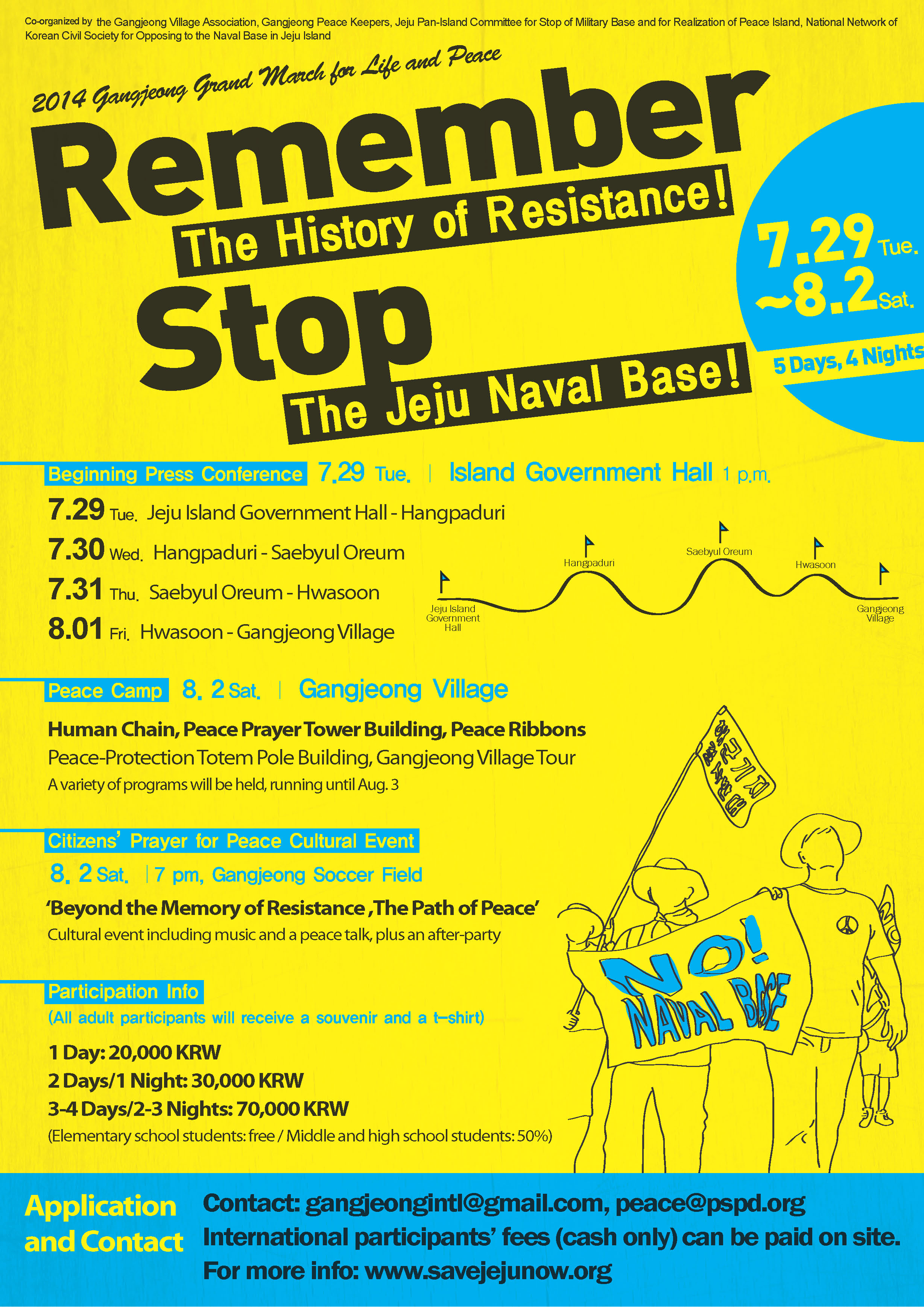
The official English poster for the 2014 Grand March for Life and Peace
The time for the annual Gangjeong Grand March for Life and Peace is almost here! From July 29 to August 2, Gangjeong friends and supporters will march across Jeju from Jeju City to Gangjeong. Then in Gangjeong there will be a festival and celebration.
Join us! Internationals are welcome! See the poster above for details and contact us at gangjeongintl@gmail.com & peace@pspd.org for info! It will be very helpful if you inform your participation to us through email in advance for the logistics purpose though your participation fee can be paid in the march site.
For the international friends who can physically join the march: For more concrete guide, please see the below. Any peace flags and talents that you may bring and share with the marchers would surely encourage the villagers and activists here. Thanks for joining us in march!
For the international friends who cannot physically join the march: Even though you may not be able to physically join the 2014 Gangjeong Grand March for Life and Peace, you may join us by sending us international solidarity messages(up to 100 words)/photos/videos through gangjeongintl@gmail.comby no later than July 23. As in 2012 and 2013, the village international team thankfully receives solidarity messages from the friends in the world upon the 2014 Grand March for Life and Peace which is followed by the Peace for the Sea International Peace Camp(Aug. 3 to 6), and boosted by other campaigns like writing a letter to Pope campaign . All the messages you send will be publicly shared. Please check the solidarity messages collected in 2012 (Click here) and 2013(Click here) . We want to let you know how Kang Dong-Kyun, ex-mayor of the Gangjeong village, has much appreciated all your messages, sitting and reading all the translated messages printed in 20 pages, with awe and gratitude, without moving for a while. None of your messages will go in vain. We also want to display some of your messages with translation in the Village Peace Center where many villagers and activists always gather. Thanks for encouraging us.
………………………………. Guide to 2014 March……………………………….
1. Accommodation and meal:
Tent and food are provided during march but you may bring your personal tent and/or sleeping bag(s). Please bring your personal washing tool (tooth brush, tooth paste, shampoo, towel etc) , You may also bring jacket, umbrella etc.
2. Brief scheduleJuly 29 (Tues.):
Please gather across the main gate of the Jeju Island government hall by noon. If you join march in the middle of it, please contact Jungjoo (English,010-8560-3734), Emily (Chinese, 010-6469-9413 ), and Dongseok(Japanese, 010-9334-0933) for information.
Aug. 1 (Fri.):
There will be a Peace Bus in the Jeju airport at 2 pm. The bus directly goes to the village where there will be events (see the below) Once arrived in the village around 5 pm, there will be a Great gathering for people’s talk in the Gangjeong soccer field from 8 to 9 pm. Then movie night after it.
(* 6-7 pm: dinner 7-9 pm: Great gathering for people’s talks (Maningongdonghoe)
9:30 pm ~ : Movie night with Yang Yoon-Mo and Grace)
Aug. 2 (Sat.):
In the morning, there will be various program such as peace mass and human chain. From 7 pm, there will be a Cultural Event for the Stop of the Jeju Naval Base Project and Citizens’ Prayer for Peace in the Gangjeong Soccer Field.
(* 9-11 am: Gangjeong village tour
11 am -12 pm: Life and peace mass
12-1 pm: Human chain, Peace ribbons
1-2 pm: Lunch
2-6 pm: Peace prayer tower building, Peace-Protection Totemic Pole building, Writing wishes, peace prayer ceremony, Ieodo-ro Peace Market, Treasure-search (peace book village team), water play in the Gangjeong stream(watermelon party)
6-7 pm dinner
7-9 pm Cultural Event for the Stop of the Jeju Naval Base Project and for Peace Prayer )
Aug. 3 (Sun.):
Breakfast together at 8 am. You may join Seeding Flowers, Wish tower-building. The official events end on Aug. 2. Therefore Aug. 3 program is optional.
3. Schedule in detail
July 29(Tues.):Jeju Island Government Hall-A small park in the Halla University four way intersection- A Funeral House, Hagwi Agricultural Cooperative(Nonghyup)-Youngmowon-Gosungri Sports Field-HangpaduriJuly 30(Wed.): Hangpaduri-Yusooamri Small Park-Saemangreu Research and Training Institute-Saebyul Oreum(Oreum-climbing. Please notice that there is no bathroom here)
Aug. 1 (Fri.):Hwasoon Beach-Andeok Valley-A Small Park-Cheonje Fall-International Convention Center-Yakcheon Temple-Gangjeong Soccer Field (Arriving around 5 pm)
4. Guide on the Peace Bus (At 2 pm, Aug. 1, Jeju Airport): The bus directly goes to the village to join the events that start 7 pm on the day. If you need to use this bus, Please contact gangjeongintl@gmail.com andpeace@pspd.org in advance for the reservation of the bus seats! It is mandatory!
5. Elementary school studentsFor the elementary school students, participation fee is free but a t-shirt should be purchased at the price of 10,000 KRW. Please contact gangjeongintl@gmail.com and peace@pspd.org in advance.
6. Support for the participation feeFor the participants who come from the outside of the Jeju and join more than three nights four days, 20,000 KRW of participation fee will be supported.