Save Jeju Now

No War Base on the Island of Peace

  • Home
  • About
    • History
    • 4 Dances of Gangjeong
    • 100 Bows
    • Appeal
    • Partners
    • Board
  • Blog
    • All Posts
    • Petitions
    • Arrests & Imprisonmentuse for all things related to arrests and imprisonment
    • IUCN WCC 2012
      • Appeals & Statements
      • Gangjeong-Related Schedule
      • International Action Week, Sept. 2-9
      • Motion
      • Special Edition Newsletter for the WCC 2012
  • Gallery
    • #7 (no title)
    • #8 (no title)
    • #6 (no title)
  • Press
  • Support
    • Act
    • Donate
    • Visit
  • Downloads
    • Monthly Newsletter
    • Environmental Assessments
    • Reports
  • Language switcher
  • The Stations of the Cross on Jeju

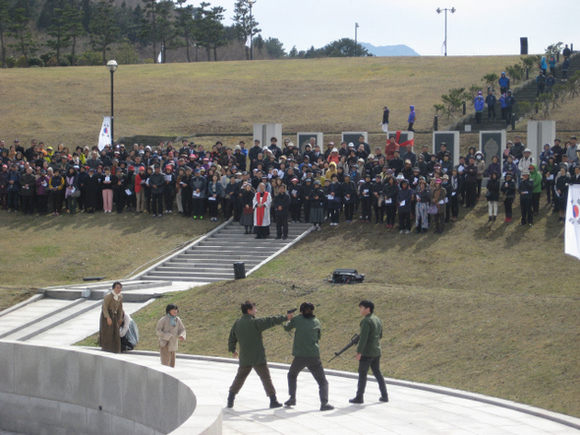
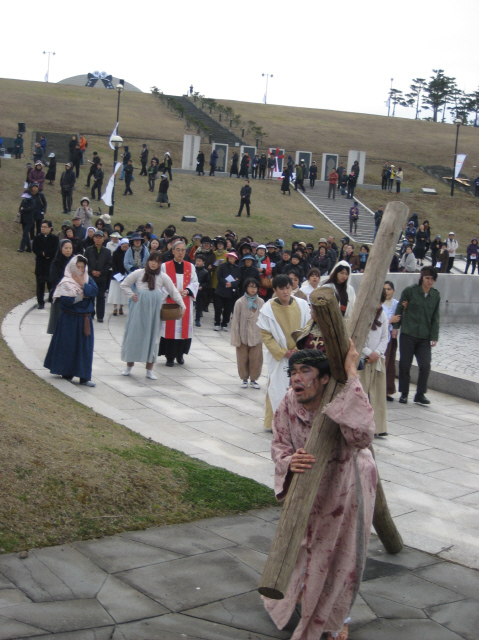
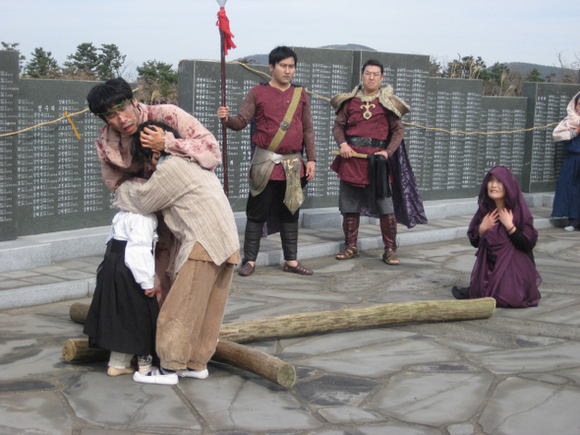
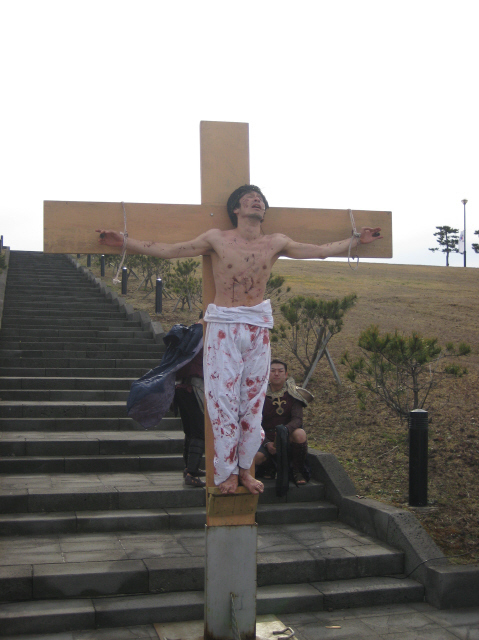
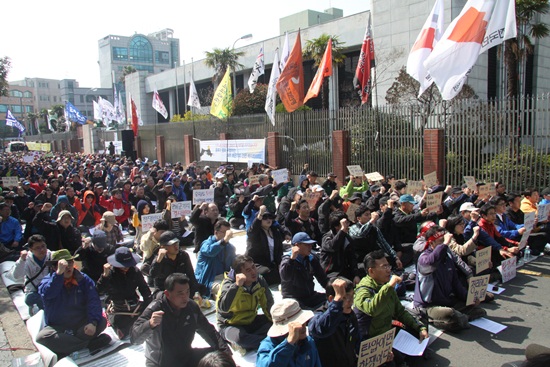
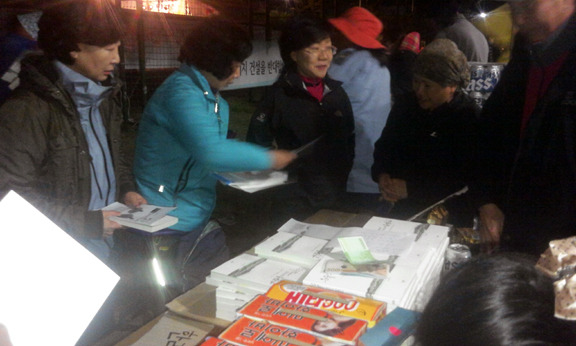
    Remembering the sufferings of April 3rd massacre. . .These are scenes from a performance held just before Easter on Mar. 29 at Jeju April 3 Peace Park. Members of the Catholic Youth Pastoral Committee enacted the Stations of the Cross, followed by Jesus Christ before his crucifixion. The site commemorates the victims of the Apr. 3 Jeju massacre, which started in 1948. . . . Bishop Peter Kang U-il and many Catholics of Jeju island attended this performance on Good Friday during the Passion week (Post by Regina Pyon)

    Re-post from Hankyoreh, April 4, 2013


    1

    Scenes from a performance held just before Easter on Mar. 29 at Jeju April 3 Peace Park. Members of the Catholic Youth Pastoral Committee enacted the Stations of the Cross, followed by Jesus Christ before his crucifixion. The site commemorates the victims of the Apr. 3 Jeju massacre, which started in 1948. (by Cho Yeon-hyun, religion correspondent)

    2

    3

    4

    April 5, 2013

  • “We will build a peace barricade in the Gangjeong village,” People’s joint statement for the succession of the Jeju 4.3 uprising spirit

    The below is a translation of the Korean statement on April 1. See here.

    To see the programs of events during the remembering period of the Jeju 4.3 uprising, see here.

    Image
    Campaign image made by 3 organizations upon the 65th anniversary of 4.3. The signs read: ‘Flower for peace instead gun and sword, now…’ ‘Succession of the Jeju 4.3 uprising spirit! Revocation of the Jeju naval base project!’ and ‘Yes, ‘True Peace.’ Now!’


    People’s joint statement on April 1


    For the succession of the Jeju 4.3 uprising spirit:

    “We will build a peace barricade in the Gangjeong village.”


    The coming April 3rd is a day when the painful memory of the Jeju is revived.

    First of all, we express our hearts to cherish the memory of numerous lives that have fallen down without names in Jeju 65 years ago.

    The Jeju 4·3 is a history of uprising against wrong power.

    Now the history of 4·3 should be transformed into a new history for human rights and peace.

    However, upon the 65th anniversary of 4·3, it is questionable whether true peace is sprouting in the Korean society. The recent political situation surrounding the Korean peninsula has not been transformed into the era of Peace. The situation is running up into confrontation phase for the word of ‘war’ as to being spoken in everybody’s lips.

    Gangjeong is already 4▪3.

    By wrong state power, even basic democracy has been violated. .

    Under the pretense of so called ‘national security,’ numerous peace has been broken and beaten.

    As if it is not enough that more than 600 Gangjeong villagers and peace activists are dealt as if they are ‘criminals,’ [the state power] is barring people’s just struggle with ‘bombs of fines.”

    True peace should be blossomed by peaceful methods.

    To save peace with guns and swords is ultimately to destroy peace.

    We resolutely oppose that [the state power] builds a military stronghold not the peace stronghold zone and that [the Jeju] become a powder magazine of the northeast Asia.

    We urge to Park Geun-Hye government.

    We strongly oppose the solo play and self-righteousness of the Park Geun-Hye government who only repeats its position that it would complete the Jeju naval base in a suitable time while it lays aside its tasks on the settlements on conflicts.

    What is needed in Jeju is ‘the peace as it is now,’ not ‘the 2nd Hawai’i’ that the government of Park Geun-Hye promotes.

    Please stop the naval base construction in Gangjeong if you think of true peace.

    You should stop the wrong naval base construction if you concern about residents’ conflicts and are to truly settle conflicts.

    We urge to the Island governor, Woo Keun-Min.

    You, Woo Keun-Min Island governor has said that you would wipe off the Gangjeong villagers’ tears upon your being elected as an Island governor. .

    .

    However, Woo Keun-Min Island governor could not stop the Gangjeong villagers’ tears by now.

    Not to mention siding with the Gangjeong villagers, he became to side with various illegality, shortcut method, and law-evasiveness that have occurred during the Jeju naval base construction. He should be clearly aware that he is making the villagers bleed with bloody tears.

    Woo Keun-Min, the Island governor, should actively step for the stop of the Jeju naval base construction if he properly thinks of the future of the Jeju, now.


    We appeal to the citizens.

    The struggle against the naval base in Gangjeong is not finished yet. The cry for peace will not stop.

    The Jeju naval base construction is not the end and it is merely a start of the militarization of the Jeju Island that would be extended into air force base and supply bases.

    We will start the practical camapign for peace to revive the Jeju as the Island of Peace and herb of Peace, not as the Island for the cold war, confrontation, and war-preparation.

    The Gangjeong villagers, civic society groups, and peace and human rights activists will resist and take solidarity to stop the Jeju naval base construction.

    We will also gather our power and wisdom with the Gangjeong villagers and Jeju Island people so that the Gangjeong village can be transformed into the village of Life and Peace not into the powder magazine that threatens the Peace of the northeast Asia.

    The various social fields will make effort for the Gangjeong village to be the stronghold of the peace movement by building barricade of peace in the Gangjeong village

    As it is the cry of the not-succumbing history 65 years, we will make solidarity to the end.

    Please be with us.


    April 1, 2013


    Gangjeong Village Association

    Jeju pan-Island Committee for the Stop of Military Base and for the Realization of Peace Island

    The National Network of Korean Civil Society for Opposing to the Naval Base in Jeju Island


    April 2, 2013

  • A formal US Air force bombing range transformed into a Peace Ecological Park

    ¸ÅÇ⸮ ½Ä¸ñÀÏ Çà»ç
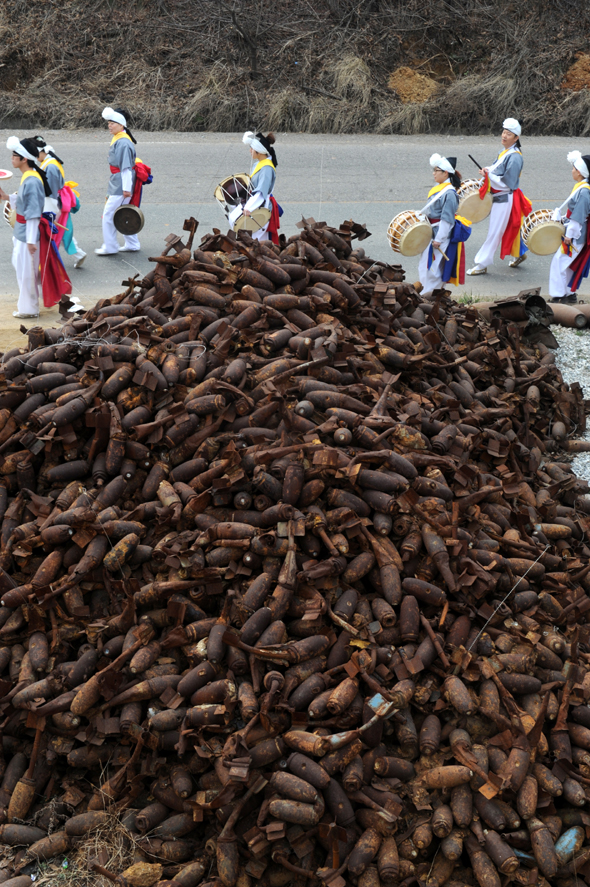
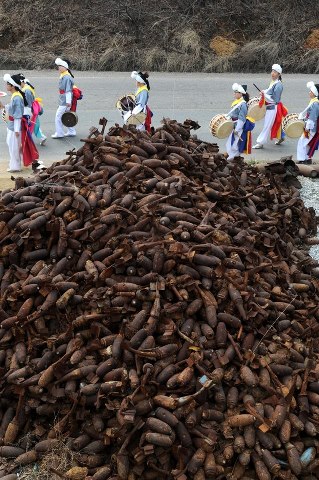
    Photo by Kang Jae-Hoon, Hankyoreh, March 31, 2013)


    Dreaming of Peace Ecological Park. . .Plum tree planting ceremony being held on March 30 at Maehyang-Ri, Hwasong, Gyonggi province, formal US Air force bombing range. . . Residents have stacked the shells of the bombs in front of the residents’ committee office that were collected in the sea and the residential area. . .Hwasong city decided to create eco peace park in this tragic land and planted about 5,000 plum trees wishing the village be filled with the scent of plum tree as the name of the village Maehyang means. . . It is located in the western coast of Korean peninsula, about one and half hours ride south from Seoul. . ..Residents have suffered extremely from numerous damages more than 54 years from Maehang-ri US bombing and shooting range(Kooni Range) until it was closed in 2005. . .Little media coverage. . .However, in 2000 and 2001, there was a nationwide protest to shut down this range . .This photo titled ‘This Moment’ is special edition of full page photo of Hangyoreh newspaper this morning on April 1.

    (See Hankyoreh, March 31, 2013)

    (Post by Regina Pyon)

    April 2, 2013

  • Up and Close: Interview with Oliver Stone on Jeju

    “On March 28, 2013, Olive Stone sat for an interview with me at the American University in Washington, D.C. Paul Michaud and Lucas Stewart filmed it and did an great job.”

    short clip from the upcoming documentary about Jeju by Regis Trembley

    Watch Here.

    April 2, 2013

  • Update on the political prisoners as of March 31, 2013

    Breaking Update on April 2:  Mr. Park Sung-Soo (Dungree) was suddenly released as of April 1. He had strongly refused that people pay fine for him. But without his opinions consulted in advance, some anonymous person(s) paid his fines of 1,400,000 won on behalf of him on April 1 and he was released on the day. It was informed later that the unknown person(s) did it, reading media, from the kind heart to help him. Mr. Park Sung-Soo expressed both of his sorriness and thanks to the person(s).  Mr. Park Sung-Soo left for the main land and would stay there for a while as his family member is sick.

    Thanks so much to the friends who have sent solidarity messages for him. We would send all your solidarity messages sent to him by now through email to him.  From now on, please send support letters only to Yang Yoon-Mo who hits his 62nd prison day as of April 2, 2013. 


    …………………………………….

    See also Bruce Gagnon’s Organizing Notes, March 31, 2013

    Yang Yoon-Mo and Park Sung-Soo (Dungree) hit 60th day and 7th day each in the Jeju prison as of March 31, 2013.


    Yang Yoon-Mo (No. 301)

    161 Jeju Prison Ora-2 dong, Jeju City,

    Jeju, the Peace Island, Korea

    Photo by Cho Sung-Bong


    Park Sung-Soo (No. 738)

    161 Jeju Prison Ora-2 dong, Jeju City,

    Jeju, the Peace Island, Korea

    Photo by Lee Wooki


    You may use internet letter(See the bottom of the link) to send letters to them. But if you concern that your letters would not arrive fast (Mr. Park Sung-Soo will be released around April 21) or are uncomfortable for your personnel information to be exposed to the ROK government, you may send your letters through email to the gangjeongintl@gmail.com.

    The Village International team will collect and deliver your email letters to them with the information of your  name (or nick name), state, country (no specific address needed).

    Thanks.

    Free all the political prisoners! 

    Stop the oppression of tremendous fines! 

    Stop the construction!


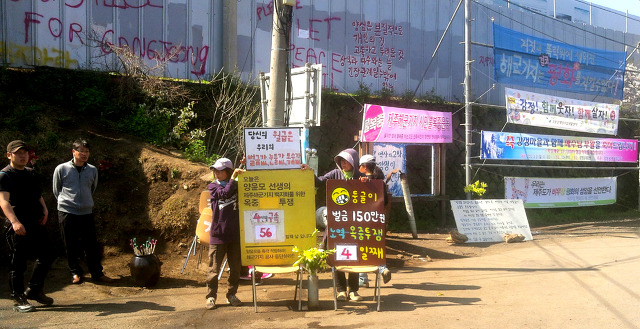
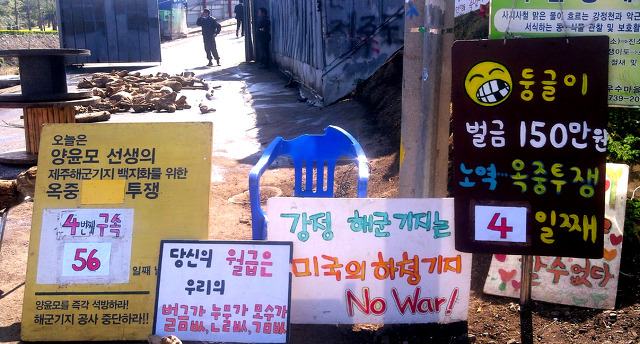
    People holding signs in front of the naval base project building complex as of March 28, 2013.
    ‘Today is Yang Yoon-Mo’s 7th day prison struggle to revoke the Jeju naval base project. His 4th time imprisonment and 5[7]th day in jail,’ ‘Your wage is the price of our fines, tears and lives,’ ‘The naval base in Gangjeong is the US sub-contract base_No War!,’ ‘Dungree hits 4th day in prison struggle laboring instead paying 1,500,000 KRW fines.’ Signs in front of the Jeju naval base project committee building as of March 28, 2013.
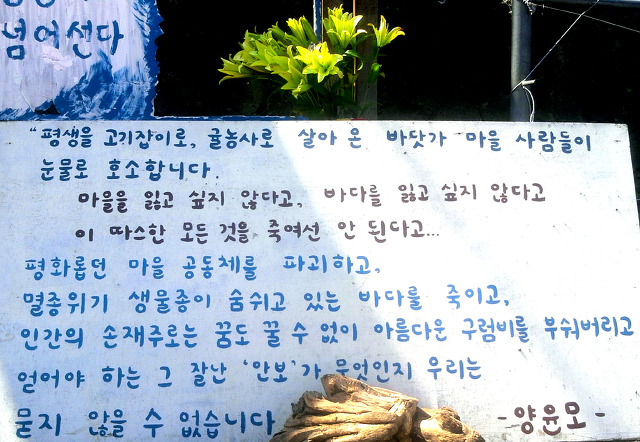
    ‘The coast village people who have made living by fishing and tangerine farming appeal to you with tear that they don’t want to lose the village, that you should not kill all of those warm things. We cannot but ask what is such high horse ‘security’ that destroys a peaceful village community, that kills a sea where endangered species breath, and that is gotten by breaking the beautiful Gureombi Rock that human being cannot even dream only with their hand skills.
    _Yang Yoon-Mo’
    March 31, 2013

  • Workers connect 4•3 and Gangjeong

    audience
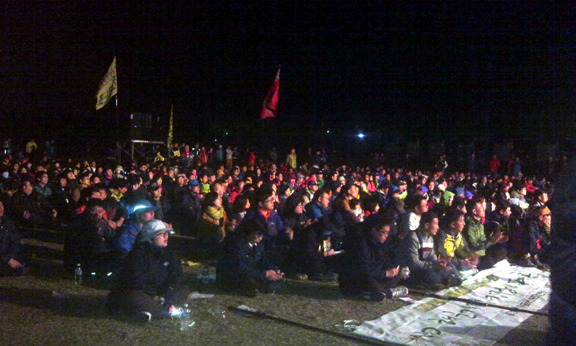
    Succession of the spirit of the Jeju 4•3 uprising! ‘Workers’ Peace Cultural festival,’ March 30, 2013.

    It has been more than a decade that the Korean Confederation of Trade Unions visited the Island for the remembrance of 4•3 every year. It was this year, too.  And it has been years that the organization visited the Gangjeong village to express their support and solidarity to the people there in opposition to the Jeju naval base construction. The workers are aware that Gangjeong is the very site of the 2nd 4•3.

    The KCTU states in its press release. You can see its longer Korean script, here:

    ‘The Jeju 4.3 uprising is the Jeju Island people’s resistance and uprising that occurred by the starting point of police firing incident on March 1, 1947 under the division and U.S. Army Military Government ruling after the liberation of Korea. Since the armed group of the Jeju branch of the Workers Party of South Korea rose up on April 3rd, 1948, numerous people were sacrificed in the Jeju Island during the process of armed conflicts between the armed group and subjugation army and of the latter’s subjugation process, until the restriction areas in the Halla Mt. were totally opened on Sept. 21, 1954.

    This year when the Cease Fire Agreement of the cold war and confrontation system hits 60th anniversary, and today when war crisis is  higher than ever in the Korean peninsula, along with the above, we are to gather the workers’ resolution to succeed the spirit of the Jeju 4•3 people’s uprising and to realize complete peace and homeland unification.

    No war! Starting from the Jeju Island, we are to fully fill 2013 with the outcry of the workers in every place of nation from the Halla Mt. to Baekdu Mt, based on our powerful will and resolution for peace and unification.’

    Stop the oppression on the unions!

    Abolish the structured lay-off on the irregular workers!

    Total revocation of the Jeju naval base project!

    Sisa
    Image source: Sisa Jeju, March 31/ In his solidarity speech, Mayor Kang Dong-Kyun stated that even though 65 years have passed since the occurrence of the Jeju 4•3, state violence is continuing and the Jeju naval base project, so called a national security policy, is being enforced without people’s support.


    The program was:

    Succeession of the spirit of the Jeju 4•3 uprising! Peace Pilgrim

    _ Date/ time:  10:30 am to 6 pm, March 30, Sat., 2013

    _Venue: Jeju areas (Pilgrim on the remains of the Jeju 4•3 uprising)


    Succession of the spirit of the Jeju 4•3 uprising! Workers’ Peace Cultural festival

    _ Date/ time: 8 pm to 9 pm, March 30, Sat., 2013

    _Venue: Entrance of the Gangjeong Village (Village scoccer field)


    Succession of the spirit of the Jeju 4•3 uprising! Nationwide Workers’ rally

    _Date/ time: At 2pm, March 31, Sun

    _Venue: In front of the Jeju City Hall (march to Gwandeokjeong)


    Workers’ Peace Cultural festival in the Gangjeong village(made by Peace Nomad)

    The event was composed of people’s speeches, songs, and dances. One of the songs in the video is titled

    “A Sleepless Island in the South,” (lyric and composition by Ahn Chi-Hwan), which is the song on the tragedy of 4•3

    book-seling
    The people in Gangjeong raised some struggle funds by selling books to the workers. The book, titled, “Peace blossoming in Tears,”  published last year, is  on the 17 villagers’ life stories written by 17 writers. It is a great book that helps people understand the life and struggle of the villagers.


    March 31, 2013

  • Why Women Must End the Korean War

    Re-posted from the Foreign Policy in Focus

    By Christine Ahn, March 8, 2013
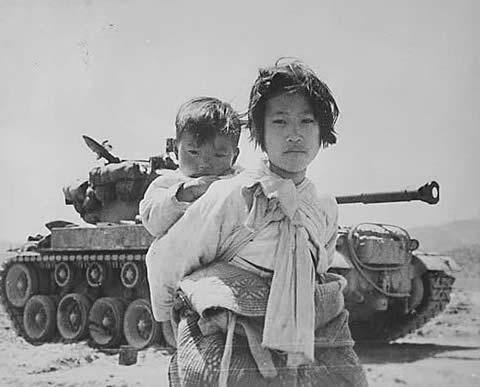
    korean-war-international-womens-day

    As women around the world gather to celebrate International Women’s Day, a light needs to be shone upon the Korean peninsula where a tinderbox situation is about to erupt into a full-blown military conflict.

    In response to the U.S.-led UN Security Council sanctions against North Korea for testing its third nuclear weapon last month, the DPRK has threatened to both nullify the 1953 armistice agreement that halted the Korean War and preemptively strike the United States. The North Korean foreign ministry said in a statement: “Since the United States is about to ignite a nuclear war, we will be exercising our right to preemptive nuclear attack against the headquarters of the aggressor in order to protect our supreme interest.”

    While escalations of tension are nothing new, what they are revealing is that a major game changer is needed to break the silent stalemate between the United States and North Korea. And it’s going to take more than Dennis Rodman’s trip to North Korea. It will require the United States to take greater responsibility and leadership to end the Korean War, as well as a feminist, anti-militarist approach to achieve peace and justice on the Korean peninsula.

    Why the U.S. Must Take Responsibility to End the Korean War

    In 1948, after the close of the Second World War, the United States, with a nod of agreement from the Soviet Union, divided the Korean peninsula. During the war, the United States led the United Nations Command in waging a brutal scorched earth air bombing campaign across the Korean peninsula, particularly in the north, where U.S. bombs leveled 80 percent of northern cities and destroyed agricultural dams—actions considered war crimes under the Fourth Geneva Convention ratified that year.

    The Korean War was incredibly vicious. More bombs were dropped in Korea than on all of Europe during World War II, and U.S. President Harry Truman threatened to drop another atomic bomb. And it was during the Korean War that napalm was first used against civilians. Within three months of the war’s outset, 57,000 Korean children were missing and half a million homes were damaged or destroyed.

    One year into the war, U.S. Major General Emmett O’Donnell Jr. testified before the Senate, “I would say that the entire, almost the entire Korean Peninsula is just a terrible mess. Everything is destroyed. There is nothing standing worthy of the name…There were no more targets in Korea.”

    It wasn’t until some 4 million people had been killed that the Korean War came to an unresolved end on July 27, 1953 with a temporary armistice signed by the United States, North Korea, and China. South Korea was not a signatory because it had ceded military power to General Douglas MacArthur. A permanent peace agreement has never materialized, which means the war is technically still on. Sixty years later, the Demilitarized Zone (DMZ) remains the world’s most heavily militarized border, with South Korean, North Korean, and U.S. troops poised for war amid over 1.2 million landmines.

    We are facing, once again, perilous times as tensions escalate in the Asia-Pacific. Most western governments and the mainstream media point to North Korea’s third nuclear test and perceived belligerence as the cause of the escalation when in fact there are two major initiatives fueling this militarized response.

    First is the so-called “pivot.” In 2011, the Obama administration announced a plan to transfer significant military resources to Asia and the Pacific, including expanding bases, surveillance, and equipment. The Pentagon has committed to deploying 60 percent of its air and naval forces to the region, including sending U.S. troops to Vietnam, the Philippines, and Australia. Without a doubt, the “pivot” is exacerbating tensions in a region that has still not resolved conflicts from the last century.

    Second are the perennial U.S-ROK joint military exercises against North Korea. North Korea justifiably views these war games as acts of provocation. The annual U.S.-ROK “Key Resolve/Foal Eagle” war games, usually staged in March, and “Ulchi Freedom Guardian” in August typically last for months and involve tens of thousands of U.S. troops and hundreds of thousands of South Korean troops. In the exercises, U.S. Army, Navy, Air Force, Marine, and Space Command forces simulate overthrowing North Korea’s leadership, occupying Pyongyang, and reunifying the peninsula under U.S. and South Korean control.

    When I think about the impact of all this militarization, I think about the elderly rice farmers in Pyongtaek who used their bodies to defend their community from being bulldozed to accommodate the expansion of a U.S. military base. I think about the tangerine farmers and women sea divers of Gangjeong village on Jeju island struggling day and night to stop the construction of a U.S.-backed Korean naval base. This is what the militarization of the Korean peninsula looks like, and the only road to peace runs through Washington.

    Why women’s leadership is crucial

    Women’s organizing to end the Korean War is strategic for three key reasons.

    First, the war has a disproportionate impact on the lives of women. As feminists, we know that nationalism, patriarchy, and militarism intersect. The militarization of the peninsula naturally leads to greater masculinization of society, which increases violence against women, including sexual violence by U.S. servicemen and the reallocation of resources from social welfare towards the military. But the partition also has very real consequences for North Korean women, especially those seeking a better life outside of North Korea.

    According to estimates by aid workers, 80 to 90 percent of female refugees from North Korea are trafficking victims. At a women’s circle in South Korea, one 19-year-old escapee talked of being raped four times during her journey—once by the Korean Chinese man who promised to find her work in China, a second time by the Chinese man who hid her from the authorities, a third time by the South Korean coyote who brought her into the country, and a fourth time by the South Korean CIA. This she had to endure so she could survive.

    Second, given our relationships with our families, children, and community, women have a reality check that is seldom there for men. Not only can women can bring into greater focus the experience of women and girls in militarized societies and armed conflict, we can provide crucial insights into the day-to-day consequences of the ongoing war on peoples’ lives.

    Finally, the deadlocked situation calls for game changers. As a group of people outside the structures of power, we have to use our ingenuity to go beyond conventional paths outlined and dominated by patriarchal institutions. Women are not cowed by limited notions of solutions; we use our imagination and creativity to break through repressive structures.

    Lights on the Water

    Once, in the fall of 2009, I woke up in the middle of the night. Instead of continuing to toss and turn, I decided to switch on my computer. On the homepage of the New York Times read the headline, “North Korea Opens Dam Flow, Sweeping Away 6 in the South.” North Korea had lifted the floodgates of a dam on the Imjin River, sending a tidal wave south and killing six South Koreans, including an 8-year-old boy. The water level had doubled, which meant North Korea’s farms could flood and wipe out the season’s harvest. To avert this perilous situation, North Korea allegedly released the water without any advance notice.

    This is so ridiculous, I thought to myself. Why can’t these two countries — that speak the same language, eat the same food, and share over two millennia of history — just communicate? Why couldn’t Kim Jong Il just have picked up the phone and given South Korean leader Lee Myung-bak a heads up?

    After being thoroughly depressed about the situation of the two Koreas, I finally fell back to sleep. And then I had the most vivid dream, which I’ve held onto as hope for the future of a united Korea. In my dream, I was wading in a river alongside other Koreans. It was before the break of dawn and we were anxiously waiting for Koreans from the north. And just over the crest of the horizon, a light glowed. It was a group of people holding candles wading down the river. As we met in the river, there was an overabundance of joy and intense embrace. But I kept going forward up the river, bypassing this emotional scene to find the source. I came upon a ceremony of women huddled around a huge kettle stirring thick black liquid and pouring ladles of it into little pails carried by children. It was at that moment when I awoke and realized, aha, it will take Korean women on the peninsula and throughout the Diaspora to bring about peace and reunification for Korea.

    Now I have no idea what was in that black liquid, but what I do know is that peace and reunification on the Korean peninsula must be advocated without supporting any particular nation-state. We don’t want the reunification of two highly patriarchal, militaristic societies. Our immediate task is to talk about the unfinished war’s militarization of the Korean peninsula and the consequent violence against women, children, and the future. We need to confront head-on the military buildup that is destroying livelihoods, communities, and the natural world.

    So what can we do? We are powerless in the face of the military industrial complex, and we are cynical in the face of over 60 years of unfinished war. I don’t have the solutions, but I do have some dreams.

    Imagine if people severed the barbed wires along the DMZ and transformed it into an ecological park. Imagine if the elderly could board a bus that would take them to visit their families in cities in the north, like Kaesong, Nampo, or Pyongyang. Imagine if the resources allocated to buying drones or to launch a satellite were instead spent on education, childcare, or support for single mothers. Imagine if North Korean farmers could access all the materials they needed to yield abundant harvests.

    Central to all of this is ending the Korean War, with the United States signing a peace treaty with North Korea. But it will take more than signing a document to end over half a century of enmity and mistrust—it will take a new approach to achieving security. This is why it will take women’s leadership, because women realize that genuine security means having health, education, and freedom to live without fear and want. From Ireland to Liberia, women have stood up to end violence and conflict. We can and must do the same for Korea.
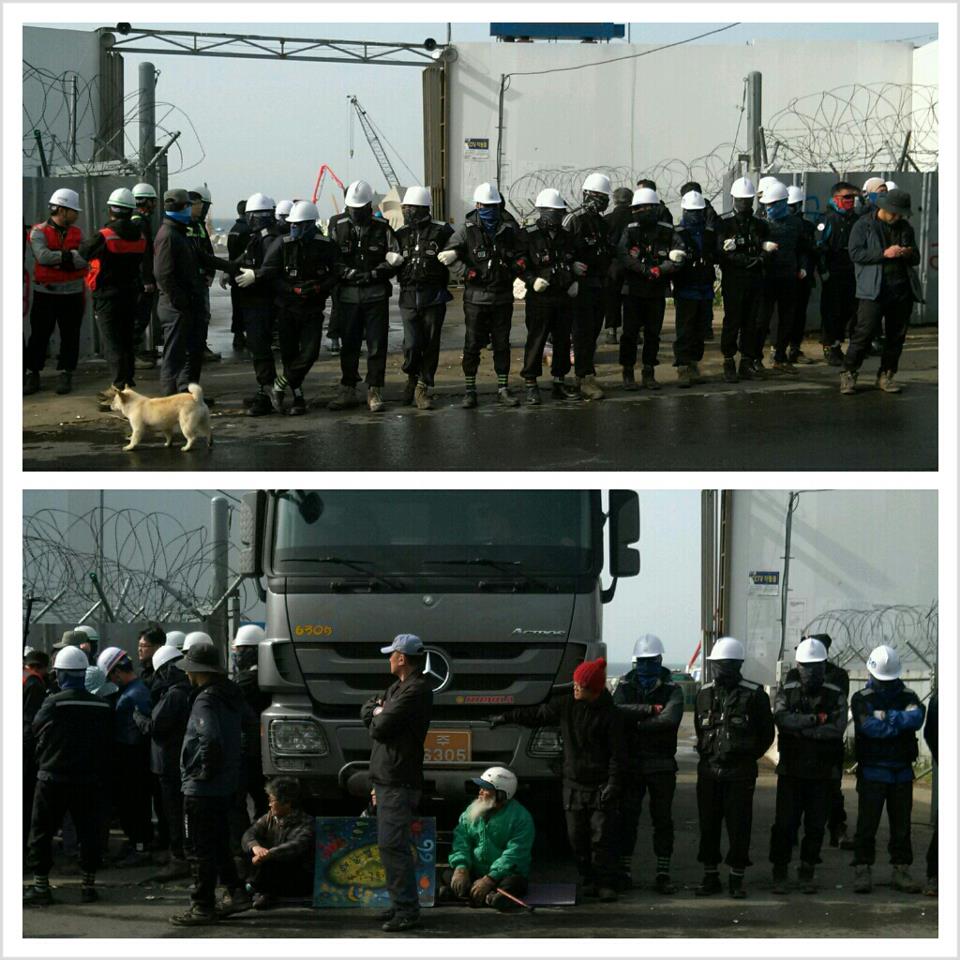
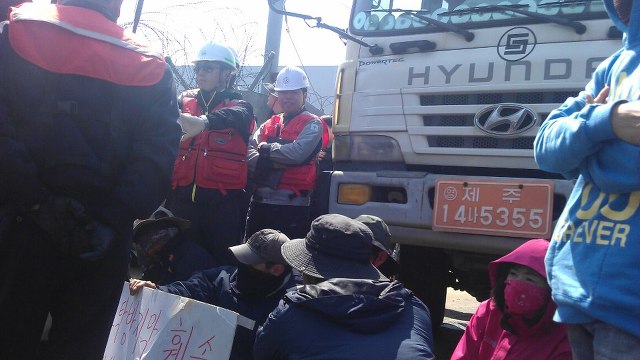
    March 31, 2013

  • Two reverends Joining the suffering of Yang Yoon-Mo and Gureombi Rock

    1-1
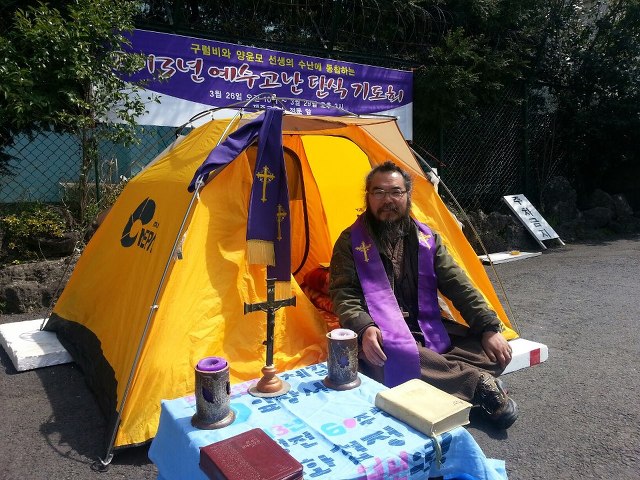
    Rev. Kim Hong-Sool, Busan SPARK/ Image provided by Rev. Kim Hee-Yong. For more photos, see here.

    Rev. Kim Hong-Sool, representative of Busan, SPARK, and Rev. Kim Hee-Yong, Gwangju, have taken a fast prayer meeting in solidarity with the sufferings of Prof. Yang Yoon-Mo and Gureombi Rock in front of the Jeju prison from March 26 to 29, 2013, during the Passion week according to the Christian faith before Easter.

    1-2
    Rev. Kim Hee-Yong, Gwangju (Image provided by Rev. Kim Hee-Yong)
    Pat Cunningham, a Columban Father said on March 26, “A wonderful expression of solidarity with Prof. Yang as he begins the recovery process back to full health! I pray this week as we remember the sufferings and deep humiliation that Jesus suffered at the hands of his oppressors and the subsequent humiliation of being put on trial and executed as a common criminal despite being an innocent man we pray that no more violence and injustice will be visited on the brave peace makers in Gangjeong village! As people of hope and people of the resurrection we pray that justice will flow like a mighty stream once again and that the village of Gangjeong will return to its rightful custodians-the villagers and not the navy!”

    It is told that, when the two visited Prof. Yang Yoon-Mo on the last day, Yang said to them, “I have been lonely to be alone, but was encouraged to hear that you were suffering with me outside. Let’s please gather power together.”

    In the press conference ending their fasts, they demanded release of the political prisoners for opposition activities against the Jeju naval base construction, retraction of fine sentence, and construction stop.

    In their statement to the citizens and Island people, they stated that it is the crucifixion of this era that there are the imprisonments of the villagers and peace activists who have peacefully made efforts to stop the naval base construction in Gangjoeng and the reality that a community that has lived peacefully from its ancestors is moaning.

    They explained that “From the heart to join the pain of the Gureombi Rock though it is a small gesture, we came here to the site of suffering, the Jeju Prison, where Yang Yoon-Mo has carried out decisive action with 52 days’ fast.”

    They scolded that “the war is a monster feeding itself with human blood. The humiliating activity to hand over here to the battle field of another country is a shameful deed that is nothing to do with peace and development. The naval base that is constructed destroying the nature and community is not self-reliant defense but [Korea] will be a consumption country for the war material–production corporations and their trash site.”

    Yonhap news-two revs
    Press conference ending the four days fast and prayer for the stop of Jeju military base and for the release of Prof. Yang. . .”War cannot be justified for any reasons nor any causes. . .as it is a monster living as eating human blood.” From the left, Rev. Kim Hong-sul, representative of Busan SPARK, and Rev. Kim Hee-yong, representative of Gwangju Citizen Center. . .They have fasted in a tent in front of Jeju prison for the past 4 days from March 26 during the Passion week. (image/ caption provided by Regina Pyon)

    Saying on Park Sung-Soo (38), a peace activist that chose a prison labor rather than fines of 1,500,000 KRW, that “a dedicated activist has entered the prison choosing hardships,” they urged to release all the prisoners and retract heavy fine sentences.

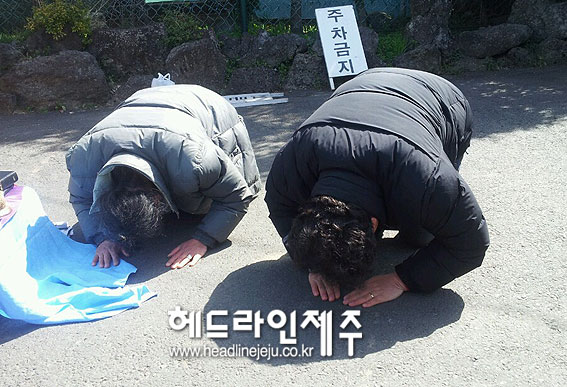
    They bowed saying that “more than 70 % of the Northwest Youth League that massacred people during the Jeju 4·3 were Christians. Even though we are not representing them, we would like to pay bows of repentance to the Jeju Island people and Gangjeong villagers from the heart to repent our sins.”

    bows
    Two reverends bow on March 29 (Image source: Headline Jeju, March 29, 2013)

    In their ending prayer, mayor Knag Dong-Kyun and chairman Go Gwon-Il joined the event.

    제주_소리_2
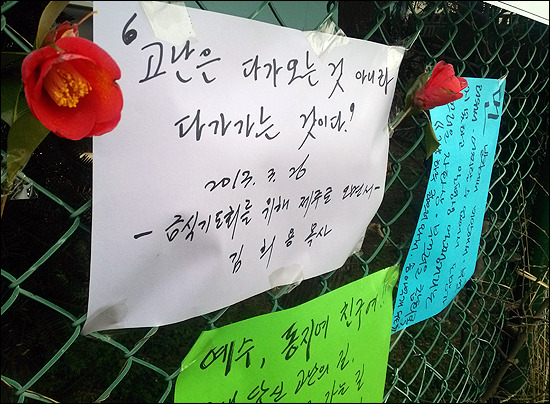
    ‘Trouble is not coming to us but it is for our approaching to it_by Rev. Kim Hee-Yong, March 26, 2013.’  Messages on the wire fence of the Jeju prison (Image source: Jeju Sori, March 26, 2013)

    (Summary by Regina Pyon and Sung-Hee Choi)

    March 30, 2013

  • Leave us for farming!: Villagers succeed to dissipate the navy presentation on the military residential housing project

    Seogwip
    Image source: Seogwipo Daily Newspaper, March 26, 2013

    “Even though the naval base construction has not been completed, the navy is again raging wind with the matter of the military residence house in the Gangjeong village. The naval base would bring lots of conflicts such as radar base, helipad, powder magazine, training facilities, military airport, and more and more military residential house projects..”

    How does the navy push the projects that accompany the large size land expropriation again when the tears of the Gangjeong villagers have not been dried yet for already large size land expropriation to build the naval base!

    If it is a society where the powerless’ rights are repeatedly violated, even though the land expropriation is legal by the Act on Acquisition of and Compensation for Land, ETC. for Public Works, it is a society that has lost its justice.’

    (Translated quotation from the statement by the Gangjeong Village Association, March 25, 2013: Source)

    In July 2012, the government expropriated 132,460 ㎡ for the whole base project land area of 277,604 ㎡. At the time, 64 among 103 landowners had refused to sell their lands to the navy.
    The expropriated lands included the best floriculture export complex in Korea. The government has acknowledged the Gangjeong floriculture export complex as the best floriculture–specialized production area in 2009 and 2010-the only Jeju region that got two years’ continuous honor on it by the central government.
    The expropriated complex was 49,500 ㎡, more than 42 % of the whole Gangjeong floriculture complex (115,500 ㎡). See the source.  For on the matter of the  injustice on the land expropriation, as a whole, please come by later. 

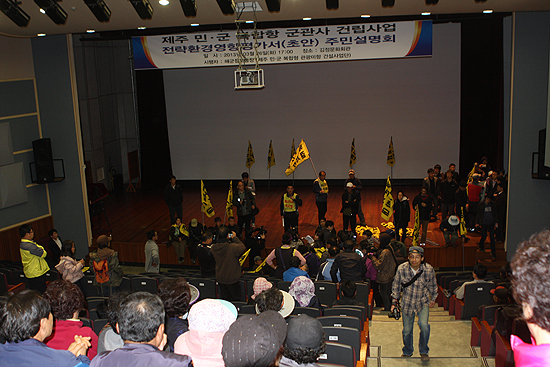
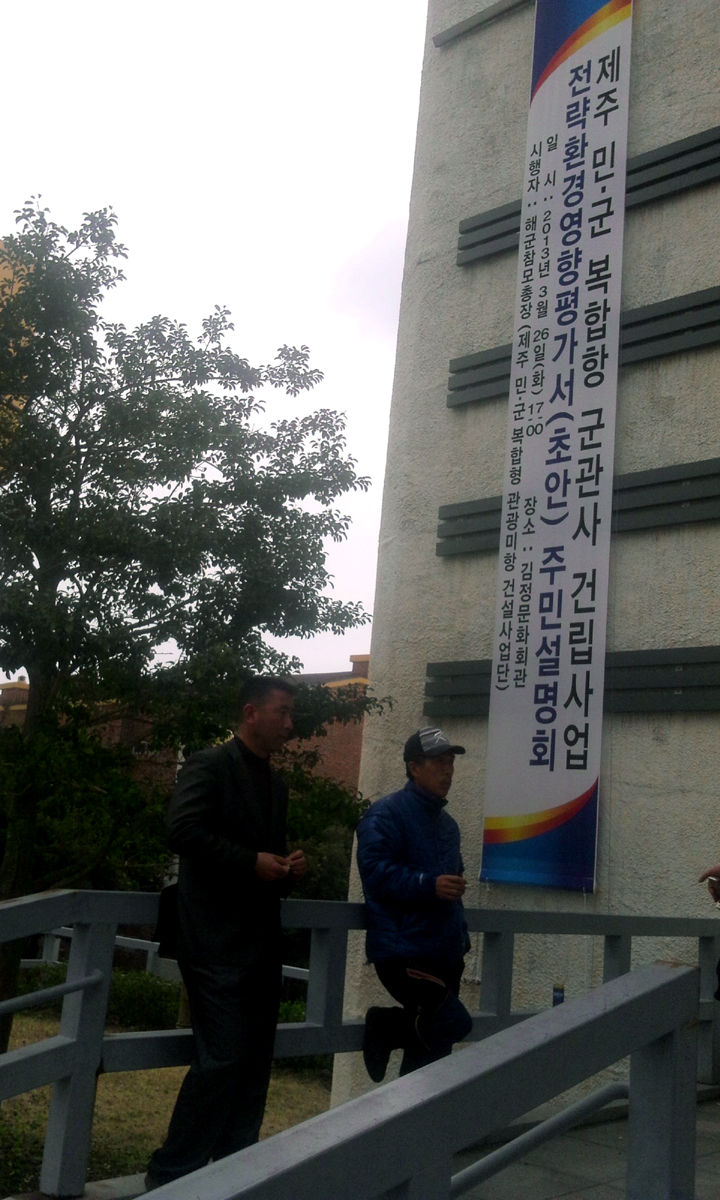
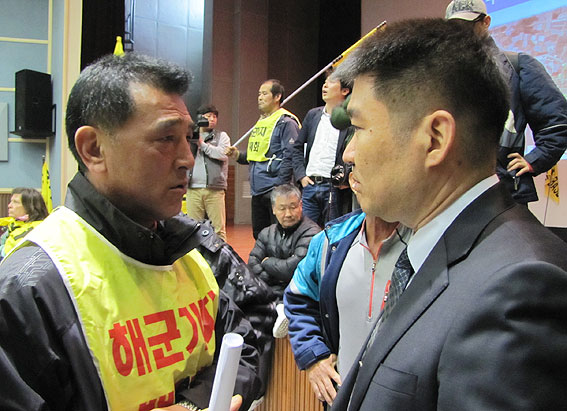
    The navy planned to hold a presentation on the military residence housing project in the KimJung Culture Hall, Seogwipo City at 5 pm on March 26, 2013, but it was dissipated again in 10 minutes by about 100 Gangjeong villagers and peace keepers who stormed into the hall.

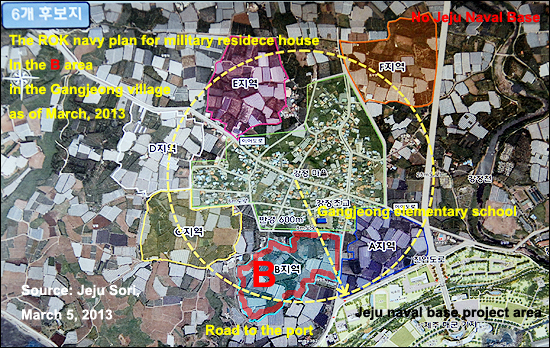
    The villagers have already dissipated its hearing on May 29 and June 15, 2012. The navy plans to build an apartment of about 616 households in the 99,500 ㎡ in the B area by 2015. For that, they planned to build 384 households first in about 594,000 ㎡ there. The B area is composed of more than 60% rice paddies and fields, the best farming field of the village.

    WEB_Jeju-Sori-March-5
    See the source

    The villagers strongly denounced the navy saying “we did not receive an official letter from you,” “It is nothing but to say that we, villagers should die if you rob of our farming lands,” “Does it make sense that the navy who has said that it would co-exist with the local residents is to trample down us again by unilaterally holding a presentation?”

    Despite that, the navy made a woman to hold a mike and speak that ‘the presentation starts now,’ bringing tremendous fury from the villagers and peace keepers. Eventually, the navy could not but acknowledge that the presentation was dissipated in 10 minutes.  The navy is told  to have originally thought that it would finish in 30 minutes.

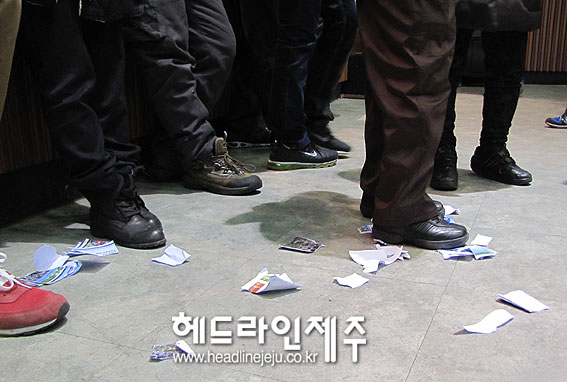
    torn paper
    Image: headline Jeju, March 26, 2013/ The navy’s presentation material was torn by the villagers.

    The villagers and peace keepers made a strong unity again to stop the military base to enter into their Peace Island, to inherit the descendent the nature, culture, and history of the ‘Il-Gangjeong: The best village,’ of more than 450 years old in Jeju. Watch the video made by the Peace Nomad that made it on behalf of  Dungree, the video maker who was jailed on March 25. (Source)


    ‘It reminds me 2007 when the Gangjeong village was chosen as a naval base construction area. At the time the navy drove the naval base construction project, [falsely] asserting that the villagers decided to install it even though the navy did not have any necessary reason to do it.” [..] It is a 65th anniversary of the 4.3 period again in a week. If the navy pushes the Jeju society with division and conflict again to enforce the military residential house in the Gangjeong village, the 4.3 spirits will never forgive them.” (Translated quotation from Prof. Shin Yong-In, Professor of the Law School, Jeju University: Source) You can see some photos of March 26 here and here. Here, two people are introduced. Here is a navy commander, Soong Moo-Jin (right in the photo)

    Web_Song-MooJin
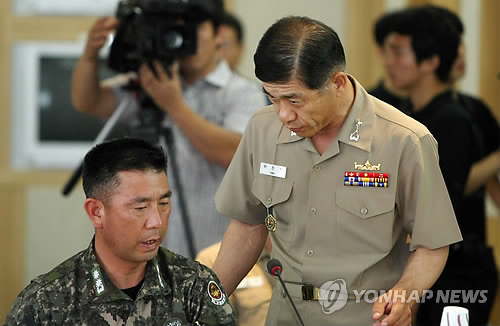
    Song Moo-Jin (left in the photo), the navy commander, employed in the naval base project appeared in the presentation on march 26.

    After the Korean Presidential election on Dec. 19, 2012, some navy strategist have been (re)employed to take dividing strategies against the villagers. One of them is a man called Song Moo-Jin, who was in chrage of planning in the naval base project committee in the earlier period and now a navy commander.

    He has entered the village in the beginning period of struggle, 2007 and had a role to decoy some villagers, eventually breaking the community. At the time, he was a lieutenant commander but  a commander, now, after a service in the SSU (special salvation unit). His works included the followup of the Cheonan ship incident. It was coincident that the navy presentation and the 3rd anniversary of the Cheonan ship incident was on the same day. But is it just coincident? Wasn’t the navy planning to mislead people to remind the patriotism, blah, blah?

    Song in Yonhap news
    Image source: Yonhap News, 2012/ Song Moo-Jin (left in the photo)

    Video maker Dungree has made a video on his returning to the village on Jan. 24.  See here. In the video, villagers are strongly criticizing him as soon as they saw he was stepping into the village. In the video, a man of dark green jumper. Song has greatly denounced by people when he sneaked into the Korean facebook called, “Gangjeong people” and made a pro-base propaganda on March 3, 2012. He was soon removed out from the group. Here is another navy.

    The person in the right of the photo is a Captain Yoon Seok-Han. He was one of the representatives of the government side in the 3rd contact group meeting on Sept. 14, 2013, during the 2012 WCC Jeju from Sept. 6 to 15, 2012. You can see his face better in the video. He was the one who made remarkable remarks that ‘it is not right that the Gangjeong village and government talk on an equal position.” It was a remark that thoroughly ignores local autonomy and democracy. ( See related Korean script)

    강 _윤
    Image source: Headline Jeju, March 26, 2013

    Both men were in civilian costumes. There were no pro-base side personnel who were in the military costume. There appeared also a man from the Daelim Industry who was often it working hat and cloth.

    probase
    Pro-base people after the presentation was dissipated on March 26, 2013


    2. In the Gangjeong filed, the struggles by Catholic fathers and activists went on.

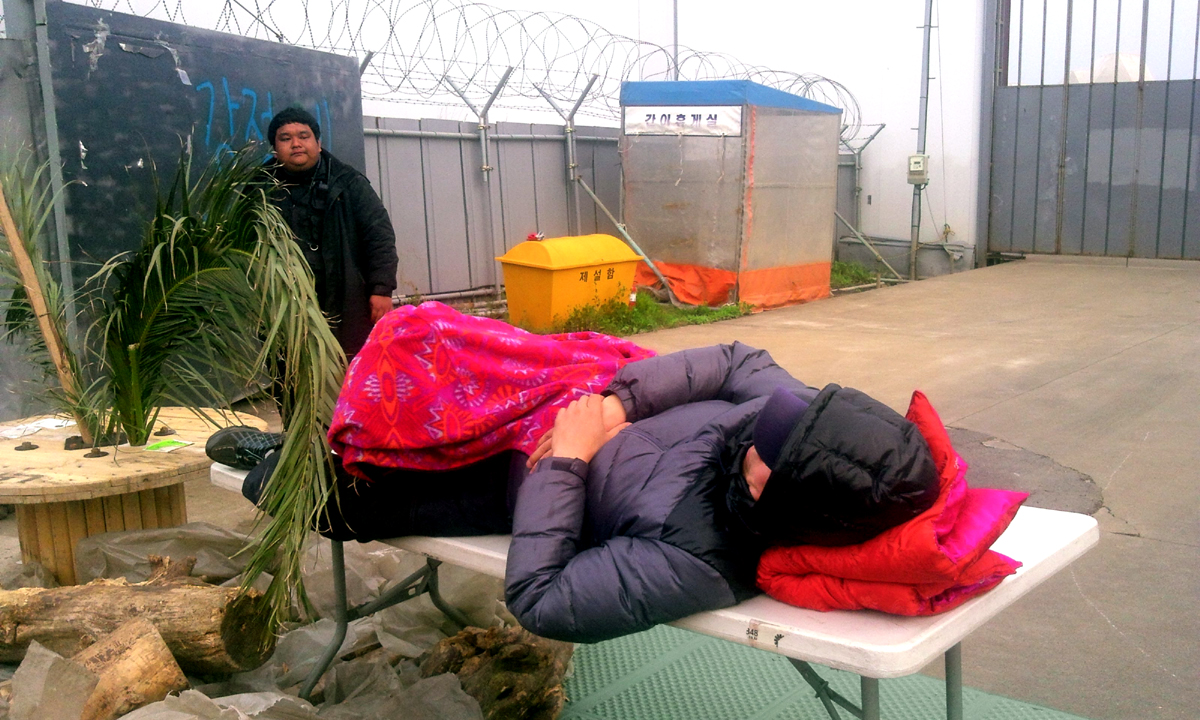
    When most people went to the navy’s presentation for protest, Fr. Mun kept the main gate. The main gate opened again on the World Water day, March 22. The people have now to keep both gates in front of the naval base project building complexes and main gate.

    Web-Fr-Mun2
    Fr. Mun kept a main gate from the entry of construction trucks, March 26, 2013
    Web-Fr-Kim
    Fr. Kim Jeong-Wook replaced Fr. Mun Jeong –Hyeon.
    Web-Dungree2
    A picket made for Dungree, 4th day of his imprisonment as of March 28

    The entry/exit of construction trucks went on even in the night.

    March 28, 2013

  • Report from UK: Benjamin Monnet’s SOAS Speech

    Ben1
    Image: UK Gangjeong solidarity Team


    Report on Benjamin Monnet’ s SOAS speech on March 21

    By Andrew, UK Gangjeong solidarity team


    This month SOAS (School of Oriental and African Studies) University of London, hosted Benjamin Monnet to talk about the struggle against the Jeju naval base, sponsored by the ‘Save Jeju Island’ student society. Benj, as he is known to his many friends, lived in Gangjeong village for ten months, joining the resisting the naval base and bringing the issue to the attention of international media. He was a valued and loved member of the village peace community, but last year was deported suddenly, violently and illegally by a South Korean government clearly worried by his non-violent acts to defend the Gureombi from detonation.

    He arrived in London from his hometown in France the day before his talk and came straight to SOAS, meeting other students involved in the ‘Save Jeju Island’ society. Immediately he was engaging with students, inviting them to the event and helping our team put posters around the student union. A real ‘hands on’ guest speaker! We shared a delicious Indian curry provided free by Hari Krishna devotees on the campus. Benj, who is now based in Nepal, said the food made him feel at home.

    Ben 4
    Image: UK Gangjeong solidarity team

    The talk the next day was attended by twenty five students, from the UK, South Korea, Japan, Norway, Italy and Tahiti. Benj’s desire was to ‘generate some inspiration’, and he did so speaking in his warm, calm French accent. But behind this softly spoken man there is a strong passion for justice, and for harmony among all people and nature. There is anger too at the destruction and injustice taking place at Gangjeong. He showed film of the navy’s ramming of Save Our Seas team kayaks, in which he narrowly missed being killed ( * See the English article, here), and described, when asked by audience members, the events leading up to the deportation that has separated him from his partner, and the people and place he loves. But he was careful to not make himself the focus of a talk about that is fundamentally about the struggle against greed and militarism. He is uncomfortable with the ‘activist’ label – “I’m not sure what I am, but I know I am human and I have a heart”. Without saying it directly, he was challenging the audience to examine their own hearts in relation to the Gangjeong issue.

    Video by Jeju Sori TV on March 8, 2012


    Benj is keen from the outset that his talk should be a dialogue, not a monologue, and encourages a relaxed atmosphere where people are free to contribute and question. Many students express despair about the ongoing construction. ‘Is it really possible to stop the base?’ ‘What about all the work that’s already completed?’ He dismisses the defeatism behind such questions with a smile. ‘Of course it’s possible. Where there’s a will there’s a way – but we need your help. Don’t worry about the work that’s already done, that can be removed. Korean people work fast!’

    Ben 2
    Image: UK Gangjeong solidarity team

    There is a lively discussion about North Korea, but Benj makes sure people know that the base is related to China. He says that in terms of kilo wattage, the US will have the equivalent of 12,000 Hiroshima bombs on Jeju Island. ‘One was enough, huh?’ A Korean student expresses strong support for the naval base as he thinks it is about self defence. Benj listens patiently and respectfully, but then challenges the student. ‘If I point a gun at your head, is that self defence? Is this how you should treat your neighbour?’ It’s a response that he makes several times when he meets young Koreans in London who have the same view about national defence. ‘Some people are a bit shocked when I pretend to hold a gun to their head’ he remarks, ‘but sometimes we need to shock people. Some people are sleeping, and they need to be woken up!’

    Many people were reluctant to leave after the event, and stayed continuing discussions. Benj warmly suggested everyone go together for dinner, so ten of us went to ‘Naru’, a Korean restaurant near the university. We enjoyed making new friendships over delicious food. Being with many Korean students, and engaging with the friendly staff made Benj visibly happy. ‘Oh I’ve missed the energy of Korean people!’ he said, beaming with a big smile.

    Ben 3
    Image: UK Gangjeong solidarity team

    Unfortunately his planned visit to Wales to meet with British peace campaigner Angie Zelter, who was also arrested with Benj at the time of his deportation, and who is now barred from entering South Korea, could not go ahead due to heavy snow. Benji used his extra time in London to meet with an independent film maker, who had attended his talk, and who is working on a documentary on South Korea. He also made contact with a professor in another UK university who was keen to invite Benj to speak about the Jeju naval base. While at SOAS we met political rapper ‘Lowkey’, who asked lots of questions about the situation in Jeju, and the US military in South Korea, and took away Gangjeong Village news letters.
    On a personal level, I was happy to spend more time Benj and deepen our friendship. We had lots of interesting discussions, and some pretty funny ones too. Over another Korean dinner, and some very good makkoli, we celebrated the great news that Yang Yoon Mo had ended this 52 day hunger strike in jail, and agreed this should encourage us to work harder for the ‘Free Yang Yoon Mo’ campaign.

    It was great to have Benji with us in London. He definitely generated inspiration, and he continues the fight for Gangjeong, waking people up so they might join us.

    Ben 5
    Image: UK Gangjeong solidarity team


    (Thanks so much, UK Gnagjeong solidarity team for the report and photos)

    March 27, 2013

←Previous Page
1 … 21 22 23 24 25 26 27 28 29 30 31 … 48
Next Page→

© 2025

Save Jeju Now