In this month’s issue:
Protesters refuse fines; go to prison, article by Kathy Kelly, updates on the Pope’s visit, reports from Okinawa and Yonaguni, Tour of Gangjeong’s sacred sites, ocean protest, trial updates, international solidarity, and more!
In this month’s issue:
Yang Yoon-Mo Free at last, April 3rd Remembrances, 4 catholics arrested, letter from David Hartsough, Trial Updates, Peace for the Sea Camp, Peace Book Cafe anniversary, international solidarity, and more!
In this month’s issue:
Government’s “development” plan, Catholics concerend about Pope’s Korea visit, Anniversary of Gureombi blasting, Solidarity from Benj and Global Network, Visting dancers, a play about Gangjeong, environmental destruction reports, another Gangjeong wedding, and more!
The Gangjeong Village Story monthly newsletter has undergone a redesign for 2014! Thanks to the help of the designers at Everyday Practice for their great assistance. In addition to the fresh new look, the online PDF version available here is now easier to read. The old version was designed only for print but this new version is designed for both! Enjoy!
In this month’s issue:
Gangjeong elects a new mayor, letter writing campaign to Pope Francis starts, Solidarity updates from Henoko/Okinawa and Odisha/India, Solidarity from Hawaii, Gangjeong Peace School, Entry Ban Lifted, Letter to Yang Yoon-Mo, trial updates, and more!
In this month’s issue:
City of Berkeley passes Gangjeong Resolution, 2014 base budget issues, Love letter from Afghanistan, Milyang solidarity, Gangjeong Crochet Project, Solidarity from Germany, trial updates, and more!
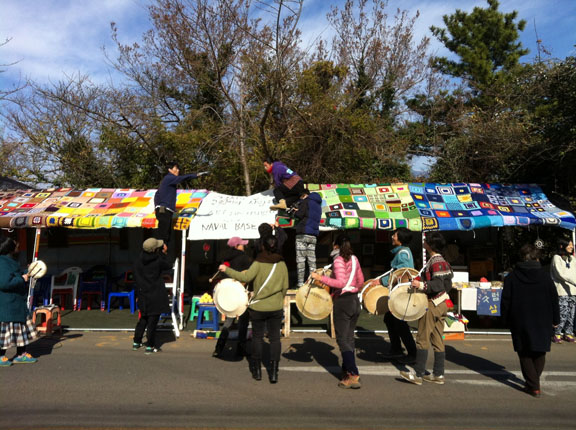
Gangjeong villagers and activists decorate the streets with colorful woolen squares knitted by supporters of the anti-base struggle. Traditional drummers play in the foreground.
I recently spoke with two members of Veterans for Peace, who had become involved with Korea issues in only the past few years. Each of them came to know Korea through their support for the Gangjeong villagers who have been battling, for nearly eight years straight, construction of a huge, high-tech navy base being built on their Jeju-Island coastline. Both men said that before Jeju, their work with northeast Asia was Japan-centered, and that “no one ever talked about Korea.” But through their engagement with Gangjeong, they have learned about the April 3 massacre, about the unending Korean War, about the unprecedented tonnage of bombs that the U.S. levied upon the Korean people in the early 1950s, and about modern Korean history, in general. Today, they recognize that the Korean War was certainly as consequential in U.S. history as the war in Vietnam. It now perplexes them that Korea had been effectively erased from the books.
The sad truth is, the vast majority of even the most progressive Americans know very little about Korea, let alone that the U.S. has been at war with it for the past 60 years. Many don’t even know where Korea is. This absurd knowledge void presents a challenge so daunting for those working toward unification, that nothing short of alchemy would seem to hold any promise for peace on the peninsula.
On the other hand, it appears that the tragedy unfolding at Gangjeong village might offer just the sort of alchemy that could conjure Korea into the wider consciousness. Ecumenical groups, environmental groups, artists, lawyers, social workers, peace-studies groups, student groups, indigenous-rights groups, and food-sovereignty groups have all passed through the tiny village whose fame is now of global proportion. Numerous articles on the villagers’ plight have been published in Europe, South America, the Asia-Pacific and the U.S. Last summer, I was at the San Francisco airport with Gangjeong’s charismatic Mayor Kang Dong-kyun on his first foray outside of northeast Asia, when a woman behind him in line said, “Aren’t you Mayor Kang? From Gangjeong village?” It turned out she had studied Gangjeong as part of a peace-studies program in Virginia, and recognized him from internet videos. Little Gangjeong has put Korea “on the map” and affirms that the Korean War is indeed alive and well.
Then, in fall of 2013, the City of Berkeley, California, was the first city in the world to formally declare its support of the Gangjeong villagers in the form of a resolution opposing the navy base. Shortly thereafter, in Madison, Wisconsin, the National Board of Veterans for Peace passed a similar resolution to “Stop the Second U.S. Assault on Jeju Island.” The document not only describes what is at stake if the base project is allowed to proceed, but also gives historical context, such as the 1948 genocide on Jeju and how the ever-increasing militarization of Korea violates the 1953 Armistice. It reads like an overview of modern Korean history vis a vis the United States.
One of the most poetic declarations in support of the Jeju struggle was made by a group of Afghani peace activists based in Kabul who have established a Skype relationship with their counterparts in Gangjeong. They write: “We are confident that if ordinary Chinese or North Koreans ever gave you trouble, you would have tea with them, using your imagination and citizen diplomacy to calm the troubles, non-violent paths which are far more effective and kind, and a far better use of tax-payer money (it takes no tax-payer money to drink tea!) than the multi-million premises, personnel and war equipment.”
The global draw of the Gangjeong village struggle owes much to the fact that the land, water, heritage and culture at stake have already garnered international recognition. Gangjeong’s culture and environment have earned UNESCO designations. It is one of Korea’s few remaining traditional, indigenous villages; it contains some of Korea’s best farms and richest soil, its purest water and its haenyo diver tradition; its coast was home to Korea’s only pod of dolphins and one of the world’s finest, soft-coral forests (now being dredged); and its 1,900 residents practice authentic local democracy.
True, all these elements attract an international crowd. But the most enduring appeal of the humble village sits squarely in its remarkable community spirit. The community is comprised of an eclectic mix of villagers, clergy and Seoul activists, who strategize and carry out campaign after campaign. There are cooks, videographers, and kayakers who monitor environmental violations by construction crews. There are people setting up for “Hundred Bows” every morning, or for a music concert in the evening. There are people manning the Peace Center, ready to welcome new arrivals disembarked off the public bus steps away. There are people printing up information pamphlets to disseminate at any one of the big, international conventions that regularly take place on Jeju. It is no exaggeration to say that the village is as fueled on dynamic love as it is by donation.
Most recently, there have been scores of knitters – yes, knitters! – sitting crosslegged in the Peace Center for hours at a time, lashing together enormous woolen quilts in rainbow hues, out of over a thousand knitted squares sent to them by supporters from all over Korea. December 2013 in Gangjeong saw the streets festooned with the quilts, and even the skeletal trees were given cheery, colorful “sweaters” that fit snugly over their trunks and branches. The sight of this whimsical riot of color splashed across winter’s dreary landscape, in contrast with the phalanxes of stern and smooth-faced cops who robotically pull away every protestor from blocking cement trucks, is indeed chilling — yet somehow, transcendent. Even an atheist once commented that life in Gangjeong was the closest one could come to living with God. Maybe that’s why, when visitors return to their own countries, either voluntarily or through deportation, they are compelled, almost evangelically, to “spread the word” through events, writing articles, and making films. Something special is going on in Gangjeong.
But it wasn’t always this way. Initially, the villagers were highly suspicious of outsiders, particularly those from the Korean mainland. They carried the trauma of the April 3, 1948 massacre in living memory, when the South Korean army, under U.S. orders, unleashed wholesale terror on the island and murdered at least a third of the population. Understandably, the South Korean government’s announcement that their village would be the site for a navy base only reinforced their mistrust of outsiders. In those beginning years, the Gangjeong villagers battled alone, in total obscurity. But at a certain point, with everything at stake, they had no choice but to embrace the support of mainlanders who seemed authentically sincere. One such mainlander was artist Sung-hee Choi, board member of the Global Network Against Weapons and Nuclear Power in Space and the pivotal person in exposing the struggle internationally. She started a blog, No base stories of Korea, in December 2008 which first introduced Gangjeong outside of Korea in 2009. Choi moved to Gangjeong in 2010 and has been there ever since.
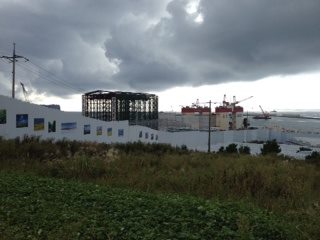
Today, almost eight years since the announcement of the base project, the Gangjeong coastline is unrecognizable, carpeted with enormous stacked cement forms of varying shapes and sizes that resemble a giant’s erector set. The 86 species of seaweed and over 500 species of mollusks – once food for the village – have all but perished. The sea is no longer a clear dark blue, but grayish brown. Gargantuan concrete cubes called “caissons,” 10 stories high apiece, sit on the ocean floor where biodiverse coral habitats once thrived. On land, an enormous rebar mold for manufacturing the caissons looms hideously over the horizon. The rumbling and scraping sounds of construction fill the air night and day. The base is slated to start operation in 2015.
To add insult to injury, resistance leaders are jailed for months on end, often caught in a revolving door of multiple prison sentences. Currently, three beloved individuals languish unjustly behind bars: 22-year-old Kim Eun-hye, Brother Park Do-hyun, and film critic Yang Yoon-mo, who has been incarcerated for about a year.
Depression and suicidal tendencies have skyrocketed in Gangjeong, according to the Jeju media. Women weep in the streets. Often, there are scant visitors to boost morale (and the visitors really do make a positive difference). During the winter when it’s off-season for tourists, they feel alone and helpless against the cranes, dredges and cops of the transnational defense industry’s destructive juggernaut.
Community Creativity
Someone once asked Gangjeong Mayor Kang Dong-kyun, “What keeps you going?” He said, “Knowing that this is not just for me, not just for my children, or my children’s children, or for my ancestors. It is for world peace.” But Mayor Kang left out a key component as to how the villagers have maintained their resilience for as long as they have: through dance. As silly as it may sound, a series of four wacky dances that celebrate Gangjeong has served as an indispensable catharsis ritual that ends each day. The villagers will also spontaneously break out into the Gangjeong dances when times get tough, such as what happened upon the tearful announcement at the IUCN convention that a resolution to stop base construction had been defeated. It’s how they let off steam so they can keep going.
In a certain sense, Gangjeong uses creativity as a weapon in psychic self-defense. Once the villagers mounted a film festival of anti-war videos directly in the gaze of a row of riot cops surrounding the base. It is as if, for every harsh blow, every broken bone, every dead dolphin, every prison sentence, and every fine levied upon them, they emerge with a surprising rejoinder of equal, positive force. Recently they lined the village streets with six-foot high stacks of books, 30,000 in all, creating both political art and a library al fresco — a stunning visual juxtaposition against the squadrons of police.
The Gandhi-esque villagers seem to have captured the hearts and imaginations of the world. When a former attorney with the Clinton administration came to Gangjeong, he marveled, “In the face of brutal opposition, they display only grace and persistence.” When a German IUCN bioethicist spent several days in the village, he remarked, “their joy is infectious.” When a Hollywood film director was asked what he liked best about his visit to Gangjeong, he said, “The dancing.” At the core of such astonishing creativity is – again — the community. Perhaps this is the alchemy that can heal all of Korea.
One could say that the villagers have metamorphosed Gangjeong into a premiere destination for political tourism. Gangjeong is an excellent place for foreigners starting at a zero knowledge base, to learn about Korea’s place in history and in the region. And the benefits are reciprocal; while visitors learn about Korea, they invariably take their lessons home and spread the information, which, in turn, supports the movement. Professor Rob Fletcher gave a seminar at Costa Rica’s University for Peace on the base struggle. Victoria Tauli-Corpuz, one of the original drafters of the United Nations Declaration on the Rights of Indigenous People, has been in communication with villagers about staking out their identities as indigenous Tamna (which could lead to advantages through processes at the UN). British attorney Harry Jonas wrote a case history of Gangjeong as an example of how legal constructs violate what he calls “natural justice.” Such developments have given new hope to villagers who have lost all faith in their own government.
As a result of such exchanges, villagers have become extraordinarily sophisticated about other Asia-Pacific islands also under assault by militarization and the Pentagon’s “Pacific Pivot.” Solidarity has been built with Taiwan, Okinawa, Guam, Hawaii, and elsewhere. Now, when President Park Geun-hye echoes her father’s dream of turning Jeju into “Korea’s Hawaii,” a tourist mecca complete with navy base, the villagers steadfastly oppose. They do not want to see militarization kill all life in their sea, as it did in Pearl Harbor, which is now a toxic Superfund site. Like all indigenous people, they know that without their natural resources, they die — economically, culturally, spiritually.
Recently, an American pragmatist looked out at the machines bulldozing the coast and said to me, in a defeated tone, “You’re not going to stop the base.” He’s likely right. But maybe I’m not looking only for linear cause-and-effect results – like I used to. The way of life here has connected me with my own humanity and the humanity of others. Just as its residents have transformed this physically disfigured place into a village of spiritual beauty, I, too, have been transformed. And I know many others who have been similarly changed. Gangjeong is like the Chinese character that means not only “crisis,” but also “opportunity.”
Koohan Paik, who was raised in Korea during the Park Chung-Hee era, is a journalist, media educator, and Campaign Director of the Asia-Pacific program at the International Forum on Globalization. In 2011 and 2013, she helped to organize the Moana Nui conference in Honolulu, which brought together international activists, scholars, politicians and artists to consolidate Asia-Pacific discourse as it relates to geopolitics, resource depletion, human rights and global trade. She is the co-author of “The Superferry Chronicles: Hawaii’s Uprising Against Militarism, Commercialism and the Desecration of the Earth,” and has written on militarism in the Asia-Pacific for The Nation, Progressive, and other publications.
*Reblogged posts do not necessarily reflect the opinions or views of Save Jeju Now
Dr. Song Kang-Ho who has been imprisoned for his opposing activities against the Jeju naval base project for the 3rd time was released on bail on Nov. 29, after 151 prison days. On Nov. 27, the court made a decision of bail on Br. Park Do-Hyun and Dr. Song Kang-Ho. Both had been illegally and unjustly arrested together on July 1, this year. Both refused to be bailed out as the court decision was seemingly too intentionally late and it would not stop them their opposing activities. However, as people strongly urged Dr. Song to be released from jail and paid bailing fee on be half of him without his knowledge, he was eventually released.
Dr. Song Kang-Ho was briefly imprisoned for two weeks in 2011 and jailed again in 2012. In his second imprisonment last year, he lived in jail for 181 days. He leads the Save Our Sea Team, a citizens’ monitoring team opposing the naval base project.
Photo fwd by Save Jeju Now/ Dr. Song Kang-Ho who was released on Nov. 29 was welcomed by his wife, Ms. Cho Jeong-Rae and Fr. Mun Jeong-Hyeon.Photo by Choi Hye-Young/ Dr. Song Kang-Ho welcomed in the people’s daily candle vigil in the village Peace Center on Nov. 29Photo by Choi Hye-YoungPhoto by Choi Hye-Young
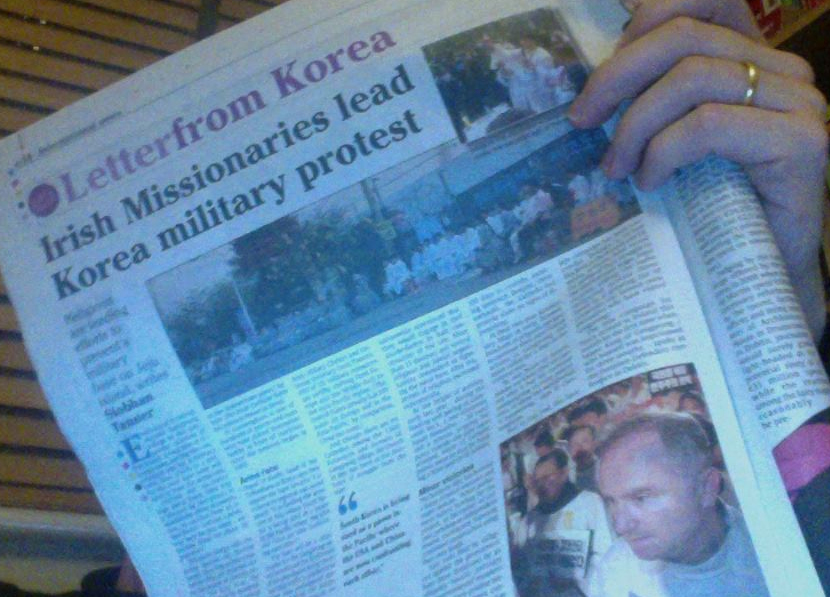
Re-blogged from here: The Irish Catholic, 2013. Irish Missionaries lead Korea military protest(Fwd by John Whipple). Though it does not necessarily reflect Save Jeju Now’s own view, the re-blogged article is helpful to glance on the degree of international solidarity opposing the Jeju naval base project. The role of Catholics worldwide, especially Irish Catholic’s, represented by Fr. Pat Cunningham, is remarkable.
Regarding the number of the Catholics in the village, Paco Booyah, a member of the Village International Team writes: ‘There are several villagers who are Catholics. But not many. Also because of the Catholics’ brave and strong actions, there are several villagers who have considering becoming catholic. There are more protestants than Catholics among the villagers though. And actually a majority of the villagers are Buddhist. Many villagers also believe traditional Jeju shamanism.’
Irish Missionaries lead Korea military protest
Religious are leading efforts to prevent a military base on Jeju island, writes Siobhan Tanner
Religious who gathered for the anniversary Mass on Jeju.
Every day at 11 o’clock outside Gangjeong village on the spectacular coastline of Jeju island, a long line of cement trucks, serving the construction site for a military naval base, grinds to a halt. For the next hour none will enter or leave the compound.
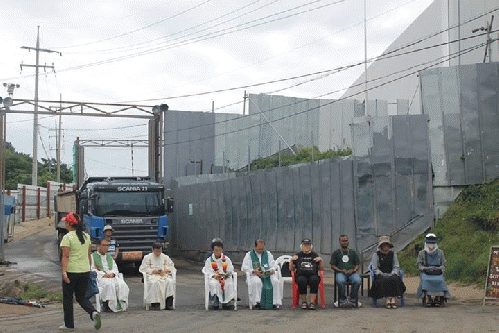
Outside the six-metre high metal fence, their way is blocked by two priests in windblown white vestments. One, on rotation from an island parish – and one, a Jesuit, sent here for this cause – are holding Mass for about 20 protesters.
When the liturgy ends, the group spreads out, holding hands. They sing protest songs before they are drowned out by the sound of starting engines. The hour is up. The trucks, flanked by hundreds of police, army and private security (up to 600-strong, reports one observer) break forcibly and easily through the human chain, arresting some and scattering others.
This is the daily show witnessed by Colomban missionary, Fr Pat Cunningham, who has become increasingly radical since coming to South Korea in 1992.
Deportation
He has been threatened with deportation for protesting a massive military naval base on the pristine Unesco-protected island of Jeju, 50 kilometres south of the Korean peninsula. More than 130,000 police and army personnel have been sent to supress the opposition since 2011. “Surveillance is so huge down there and anyone who criticises the base is ‘red-brushed’ and labelled a North-Korean sympathiser in the mainstream press,” he tells The Irish Catholic from his mission house in Seoul.
Fr Cunningham is one of hundreds of priests and nuns who have placed themselves bodily in front of machines since the protests began in 2007.
Arms race
Donal O’ Keefe, head of the Colombans in Korea says they oppose the base because it is a threat to regional and world peace. “It is fuelling the arms race in Asia where South Korea is being used as a pawn in the Pacific where the USA and China are now confronting each other.”
The base will be a catastrophe for the Gangjeong environment and the livelihoods of the population living there; warship traffic is predicted to drive nine endangered species, including the bottle-nosed dolphin, towards extinction.
Due to be finished by primary contractors Samsung in 2014, the base will be contracted by the US to house 7,000 marines and 20 warships, including aircraft carriers, nuclear submarines and destroyers armed with ballistic missiles which will patrol the East China Sea.
Koohan Paik, campaign director of a forum on Globalisation’s Asia-Pacific programme says Jeju is just one island in a growing constellation of geostrategic points that are being militarised as part of President Obama’s ‘Pacific Pivot’, a major initiative announced late in 2011 to counter a rising China. According to separate statements by then Secretary of State Hillary Clinton and Defense Secretary Leon Panetta, 60% of US military resources are swiftly shifting from Europe and the Middle East to the Asia-Pacific region. (The United States already has 219 bases on foreign soil in the Asia-Pacific; by comparison, China has none.)
And though there are no Catholics among the 1,500 fishermen and farmers of Gangjeong village, the Church in Jeju has been at the forefront of struggle from the start.
Hunger strike
When the governor of Jeju (since ousted) agreed to accept the naval base on the island province in 2007, local priests went on a hunger strike and their bishop, Peter Kang U-il, wrote an open letter to South Korea’s president urging a referendum on the plan.
The Jesuits too waded into the battle early, sending priests from the mainland – four of whom were imprisoned for sentences ranging from one month to three.
Then, two years ago, the Church in Korea made a bold political move when clergy nationwide announced that they would engage in civil disobedience to halt construction of the site. More than 15 dioceses and several religious and justice organisations committed to fighting the naval base. After this, arrests of religious increased exponentially.
At the height of activity early last year – during the blasting and paving of Gureombi Rock, a one-kilometre basalt formation – 20 nuns and a priests, praying for peace outside the gate were arrested, while 13 Catholic priests went on trial for holding a Mass and sit-in protest.
Minor victories
The battle for Jeju has become a litany of minor victories and major defeats. When parliament halted funding for the project, in December of last year, pending an independent review, contractors Samsung continued construction using their own funds.
Law suits filed by villagers against the government have been dismissed by an allegedly hostile judiciary and environmental monitors report that once-pristine water sources have been contaminated while dredging has started to kill the underwater coral.
Meanwhile, the penal crackdown on activists has increased.
Three months ago, Brother Park Do-Hyun and Dr Sang Kang-Ho, members of Save Our Seas, were arrested while monitoring the dredging of the sea-bed which was being done without environmental protection measures.
Both men have passed 100 days in custody, awaiting sentence. Despite, these setbacks, the Catholic-led protests show no signs of diminishing.
At their two-year anniversary Mass in early October, hundreds of religious pledged to continue their non-violent actions in Gangjeong and again called for a stop to the construction.
“In our heart of hearts, maybe we know that we cannot stop it but we continue campaigning to raise awareness, to show the world what is happening,” says Fr Cunningham.
And to this end, the Save Jeju campaign has been successful. Despite a virtual blackout in the Korean and US media, activists have raised the profile of their struggle to the international stage, most recently adding the name Hollywood director Oliver Stone to a growing list of celebrities and famous commentators who have visited Gangjeong.
The Jeju campaign for Peace arrived in Ireland this month for the first time when Mayor Kang of Gangjeong – who himself was imprisoned for three months – spoke at the Frontline Defenders conference in Dublin.
– See more at: http://www.irishcatholic.ie/article/irish-missionaries-lead-korea-military-protest#sthash.Osd7LLh3.dpuf
In this month’s issue:
100,000 Books arrive in Gangjeong for the creative transformation to a “book village”, National Assembly inspections on the base, Solidarity from Italy and Western Europe, Gangjeong at the Busan WCC Assembly 2013, Trial updates, outrageous imprisonments, police disrupt prohibit catholic Eucharist and more!
Two years ago when I visited Gangjeong village on Jeju Island, South Korea, the one-half mile ancient, solid volcanic slab of a spiritual and cultural rock known as Gureombi was still intact. The marine environment that had made Jeju Island one of the World Heritage Sites was still thriving with sea life. The government of South Korea had moved some equipment to be used for construction of a controversial naval base for Aegis missile destroyers and the US missile defense system. This would be a new military port in a country filled with US and South Korean military installations, but one that would be just a little bit closer to China–a new naval base that would symbolize the US pivot toward Asia and the Pacific.
Plane loads of protesters from the mainland of South Korea were flying to Jeju to join villagers to prevent the construction of the naval base. Hundreds of internationals came to add their words of solidarity and to take back the story of a tiny village challenging the might of the governments of the United States and South Korea in their quest for greater militarization of both societies.
Two years ago, trucks carrying materials for the new naval base to be built on the rocks were delayed or stopped by protesters. NO BASE supporters climbed on top of high cranes and chained themselves to heavy pieces of equipment to stop construction of the base.
I returned this week to Jeju Island in solidarity with the people of the village of Gangjeong who did not want their home turned into a military encampment that would destroy their way of life. Yet, despite seven years of opposition and struggle, the naval base and its harbor have been substantially constructed. Hundreds of thousands of tons of stone have been dumped on corals to make the breakwaters for the harbor. Thousands of massive concrete structures are on the shore. Two giant structures have been erected in the water that produce cassions for the massive breakwater that might protect the military harbor from typhoons. The beautiful rocks of Gureombi have been broken apart and the area filled with concrete. It is an environmental disaster.
This week, the edge of a typhoon hit Jeju Island. Many here in the village of Gangjeong were praying for a strong storm that would severely damage the naval base as happened last year that caused over $35 million in damage to the project. Perhaps Mother Nature would intervene to stop the construction when humans were unable to do so.
Many activists who opposed the base have gone to jail in the past two years. 5 are currently in jail. Earlier this week, two more were sentenced to lengthy terms in prison- a young 22 year old woman received a sentence of 8 months and a 72 year old was sentenced to 6 months. A filmmaker has been in prison for 253 days and two others for 103 days each. A trial for two more is scheduled for this week. The South Korean government crackdown on protest of the naval base has been strong.
Yet every day, a group of activists continue their challenges to the base–some challenges are spiritual and others are physical. On the spiritual side, at 7amthey gather outside the gate of the base and do 100 deep bows, each with a phrase set to music to remind participants of the importance of their mission. At11am, Catholic priests, nuns and lay persons lead a Mass at the gates. Masses have been conducted thee each day for over 740 days.
Following the Mass, for the next hour the group blockades the main gate of the naval base stopping trucks filled with concrete and other materials from entering the base and preventing empty trucks from leaving the base. The activists believe a disruption of an hour’s work in the building of the base is useful and important.
Special events are marked with larger mobilizations. In August, 2013, many walked for six days around Jeju Island and one thousand people participated in the Grand March for Life and Peace and the Human Chain to encircle the base. Noted film maker Oliver Stone joined in the march. When asked about his opposition to the base Stone said, “This base will host US Aegis missile destroyers, aircraft carriers, nuclear submarines. It’s part of Obama’s Pacific pivot…put in place to threaten China…We have to stop this. All this is leading up to a war, and I’ve seen war in Asia. I do not want another war.”[1]
Tension in Gangjeong village is high. Families have split on support or opposition to the base. Those in the village and in the provincial government who were paid off by the South Korean Navy not to oppose the base, as two other communities on Jeju Island had done, are in disfavor with many in the village. Having been defeated twice, the Navy decided to have a major campaign to influence the decision makers in the province and Gangjeong village. Decision makers succumbed to the temptations of fully paid trips to Hawaii, Australia and Singapore and other special benefits. Farmers in the village were pressured into selling their lands with the threat that if they didn’t accept the price offered by the Navy, the lands would be taken anyway and much lower compensation given in that case.
The lessons of Jeju Island are stark. The US military pivot to Asia and the Pacific will be disastrous for many areas—bases in Okinawa where the US wants to build a runway into the South China Sea over pristine corals, home to the dugong manatee; in Pagan, an island in the Northern Marianas where the US wants to use as a bombing range as it did for decades on the Hawaiian island of Kahoolawe and the Puerto Rican Island of Viequez; and in Guam where the Marines want to have an artillery range in an environmentally protected area.
With the pivot, the United States has increased its military exercises in the area. Current American military exercises with South Korea and Japan have triggered the North Korean government to put its military on alert and warned that these exercises could have “disastrous consequences.”
China is upset about US-Philippines military exercises in the South China Sea.
The Japanese people are angry that the US is urging the government of Japan to renounce the “No War” article of their constitution so the US will have another financial ally in wars of choice.
So far, just as the US pivot to the Middle East twelve years ago destabilized the region, the US pivot to Asia seems to already be having the same dangerous effect.
About the Author: Ann Wright served 29 years in the US Army/Army Reserves and retired as a Colonel. She was a US diplomat for 16 years and served in Nicaragua, Grenada, Somalia, Uzbekistan, Kyrgyzstan, Sierra Leone, Micronesia, Afghanistan and Mongolia. She resigned in March, 2003 in opposition to the war on Iraq.