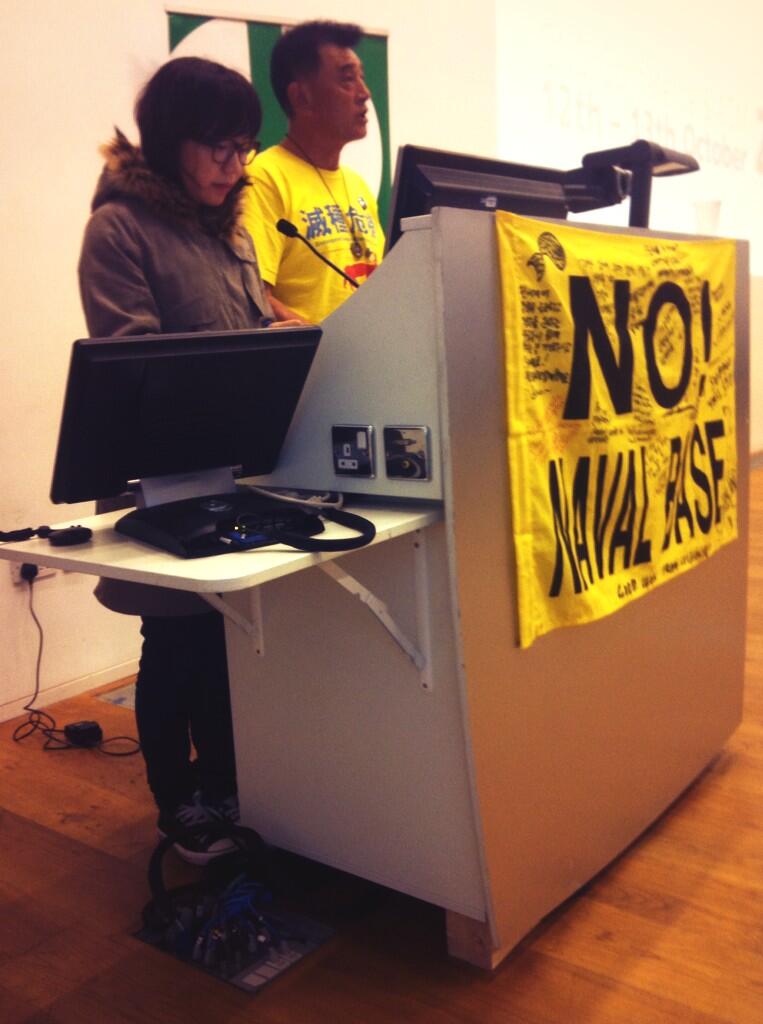
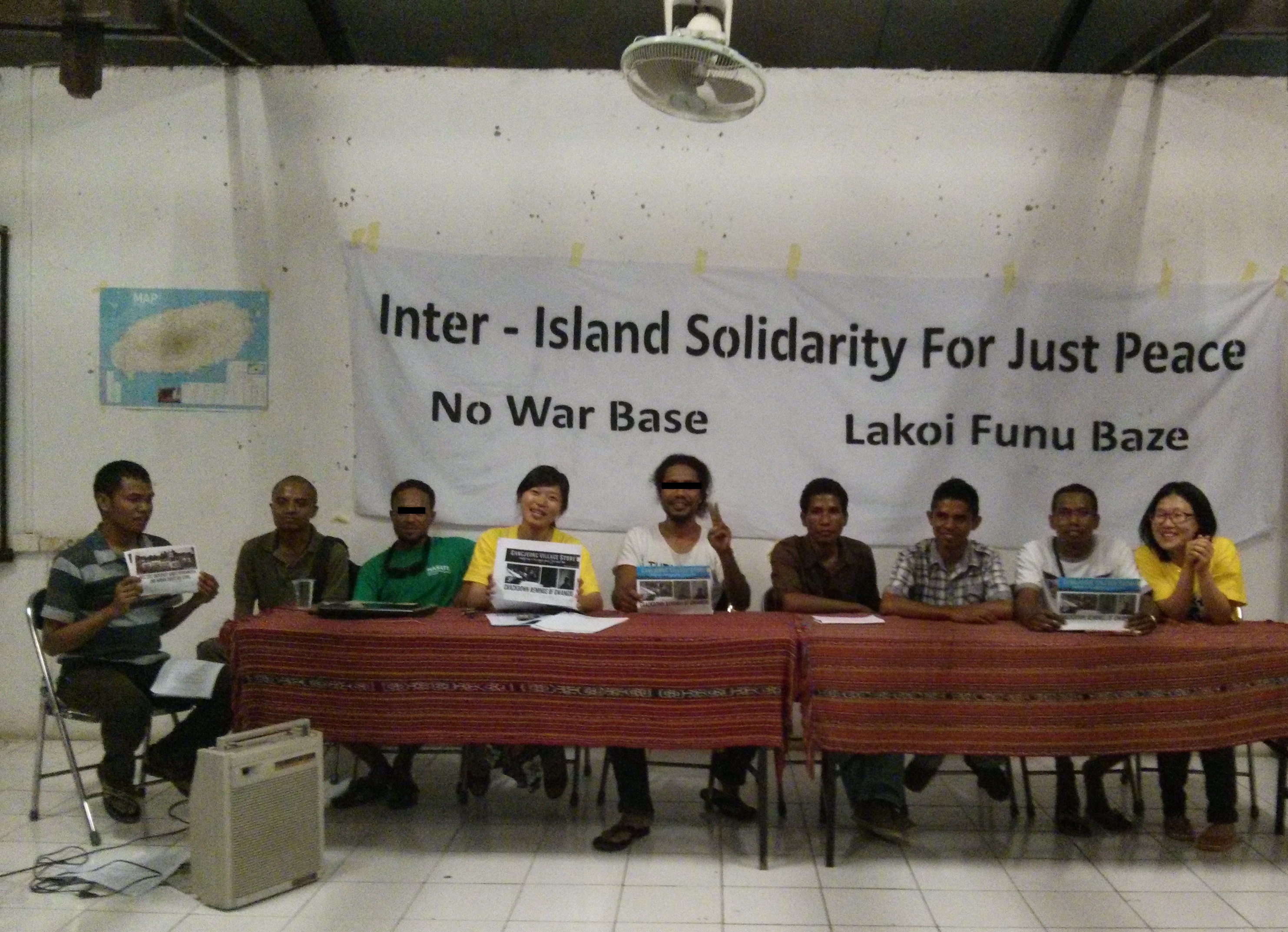
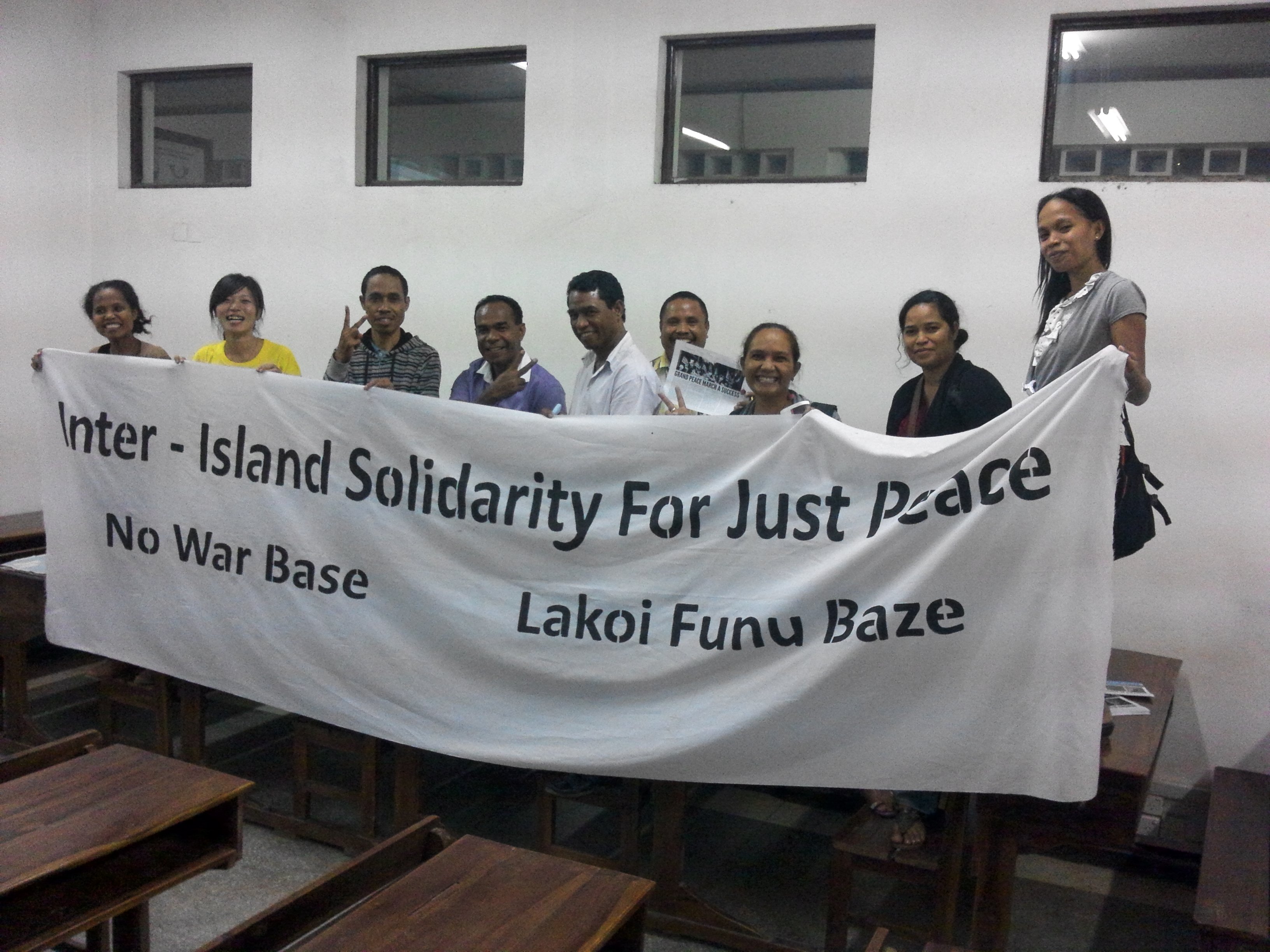
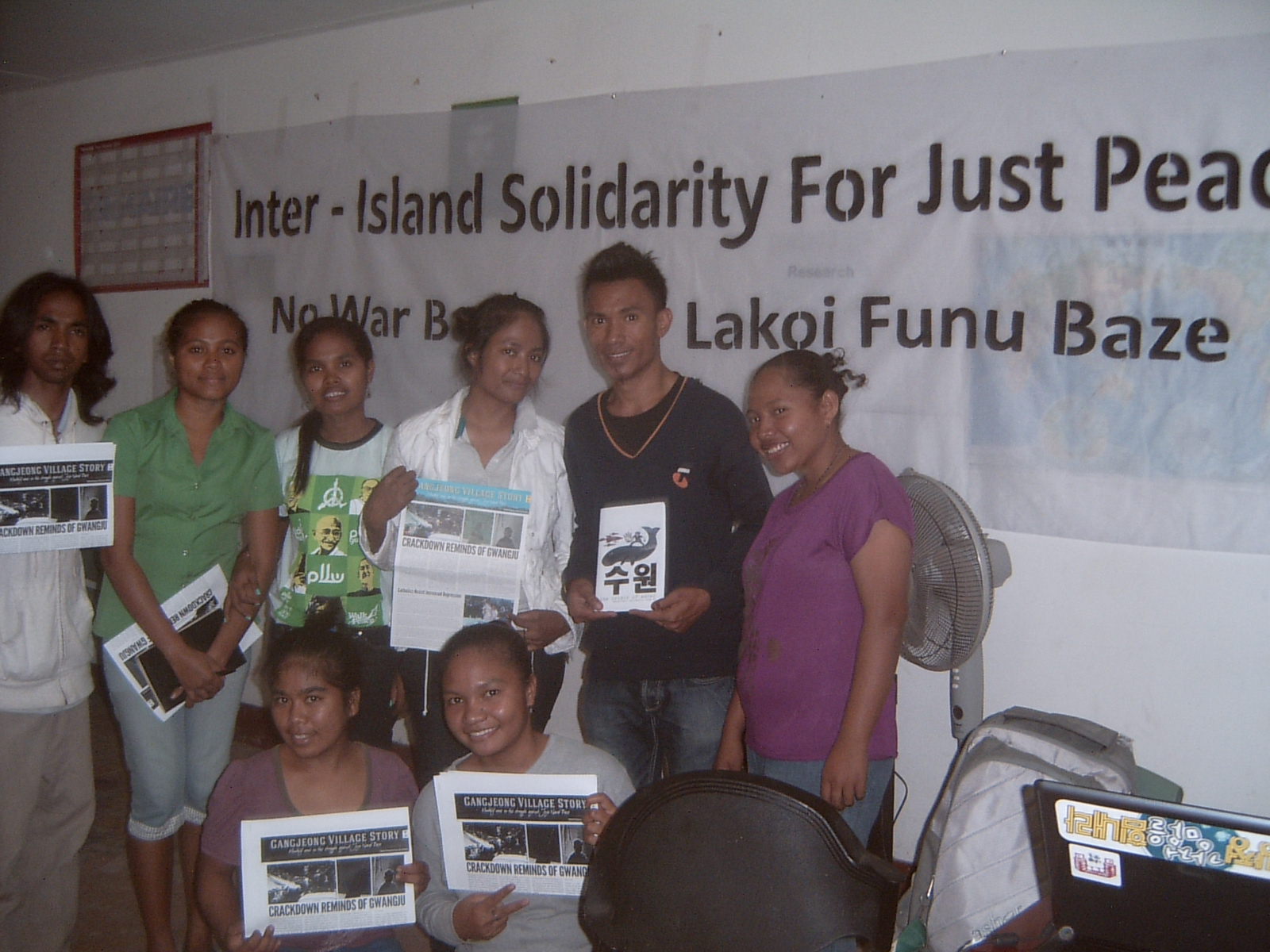
From Oct. 8 to 17, 2013, Gangjeong village mayor has joined the Human Rights defenders’ forum in Dublin, Ireland, as well as traveled London, Leeds and Paris etc. Thanks so much to the organizers of his speech trip in Ireland, UK, and France.
I am Dong-Kyun Kang, the Mayor of a small village called Gangjeong in Jeju. I am so grateful for this opportunity to speak to you. It’s very meaningful. So far, I’ve heard many stories from around the world which make me very scared and worried for our descendants.
Given that fresh spring water is such a precious and scarce resource on Jeju island, the 450 year old village of Gangjeong situated in the southern part of the island was always the envy of other villages as its possession of an abundant spring water supply which always flowed freely ensured it was always ranked first among Jeju’s villages. During the construction of the naval base, many international activists have visited Gangjeong and others in the process have been denied entry and deported. Other peace activists have been prevented from leaving the country. I’m keenly aware and saddened that many have suffered from many forms of repression and for their sacrifice I feel so grateful and promise to stand with you in solidarity.
You’ve now seen that in recent history there have been two major events in Korea – in 1948 and 1950. As you are aware there was the major upheaval of the 1950 Korean War which broke out in June 25 – a tumultuous national tragedy. One could be forgiven for thinking that this was a family feud that led to the country being divided but the reality was that the war was the result of an ideological battle between the major powers at the time and Korea was its victim. This continues until the present time.
The April 3, 1948 Jeju uprising led to the brutal suppression of the population by state security forces which resulted in the massacre of the islanders of Jeju and behind the slaughter was the US government, the self-proclaimed keeper of the peace! A conservative estimate puts the number who died from the mass killings at over 30,000 out of a population of 280,000 people at that time.
Fortunately, in 2005 President Roh apologized on behalf of the state to the people of Jeju and acknowledged for the very first time the states brutal suppression and massacre of the people of Jeju. He went on to declare Jeju as an ‘island of world peace’. Peace can only be sustained through peaceful means. Peace obtained through force and violent means is not sustainable and in time will be forced to surrender to a larger force or power. However, I believe that dialogue and mutual understanding between people who work together in mutual respect to build a sustainable future is the key to a sustainable peace.
The location of Korea positioned in the middle of the Pacific Ocean and particularly the strategic location of Jeju Island is key to understanding its strategic importance to the world’s major powers. However, behind the construction of the naval base in Jeju is the US government. Will Jeju genuinely remain an island of peace or an island of military bases heightening tensions between the world’s major powers? This is a central question that needs addressing.
The naval base project is a national security project. I think one defines genuine national policy as seeking to put the interests of its citizens and their happiness and genuine well-being first and foremost. Likewise national security is not only about the state’s administration and its military but should seek to ensure genuine human security for all its citizens. Genuine national policy and national security should seek to secure the confidence and trust of all its citizens which in turn forms the true pillar and foundation for its policies. Working together hand in hand with the people should be the central tenet of its policies.
Aside from the naval base construction creating the strong possibility of a situation of crisis for Korea and Jeju into the future, the village community of Gangjeong is being destroyed with its people being evicted. With the construction of the naval base the navy claims that the national security of the state is its primary objective followed by the economic development of the region and its third objective – the navy and residents coexisting in mutual cooperation and to the benefit of all. However, the construction of the naval base rather than enhancing and bolstering national security will have the opposite effect of increasing already existing tensions between global powers in the region resulting in Jeju being caught in the crosshairs of conflict in the future. How therefore can the building of a naval base bolster regional economic development in such a tense and dangerous environment?
The state in implementing its policies should first consult the people who will likely be impacted the most and endeavour to seek the consent of its citizens through due process which is the most important consideration and an important building block of any democratic society. Even with the project underway listening courteously to and reflecting on the opinions of the other is surely important in trying to achieve real cooperation. The need for transparency in implementing state projects is paramount. However, the naval base has been enforced from the beginning without any consultation on the decision making process and devoid of any semblance of transparency leaving the Gangjeong villagers in the dark about what was going on. Those villagers opposed to the base are in the process of having their lands expropriated without any dialogue or due process of consultation. The villagers are completely perplexed and dismayed by the conflict that has arisen in their village with the naval base decision having separated families and divided parents with siblings becoming enemies and yesterday’s friends becoming today’s enemies resulting in the collapse of the community.
Fully aware of the stark implications of proceeding with plans to build the base the central government and navy planned and designed the base together with the backing of the US government. As a means of promoting the base and quashing any form of dissent, protestors have been treated with great hostility and denounced as leftists and North Korean sympathizers by the military. The brutal enforcement of the base with complete disrespect and arrogance has resulted in the military losing whatever respect it may once have had.
Together with the mobilization of the police and state power is the major issue of the lack of due legal process and the arrests of over 700 activists, charges having been filed against 400 activists with 25 cases of activists having been imprisoned to date. There has to be a fair way to resolve such conflicts but the legal system and court process has failed to provide this. With the full power of the police state brought to bear on villagers and activists alike it is undeniable that people will get hurt as they are literally being dragged away like animals battered and bruised. However the courageous and brave efforts of so many over the course of a 7 year long struggle are not in vain but are the source of a precious groundwork that is the basis for a bright future for Gangjeong and Korea alike. These continuing efforts will continue to bear fruit long into the future. The majestic natural environment of Jeju is commonly referred to as beauty inherited from the gods and is home to the UNESCO Biosphere Reserve and three UNESCO World Natural Heritage sites. In 2012 The New Wonders Foundation voted Jeju Island as one of the 7 Natural Wonders of the World. In September 2012 the World Conservation Congress opened in Jeju where it was hoped that it would promote the international consensus of Jeju as a ‘World Environmental Capital City’. However, this ideal is being undermined by the destruction of the environment caused by the building of the naval base which is a grave threat to genuine national security.
Some concluding remarks.
The 7 year long struggle has left many exhausted and bruised after enduring much pain and suffering along the way. There have been moments of despair but the determination to struggle and defend our village and home and pass it on to future generations has been the enduring legacy and mainstay of the struggle and has been a sacred calling. A new hope springs from the end of despair. This new hope comes from people seeking their true human fulfilment as beings living in harmony with nature, living together in peace.
Instead of Jeju being designated an island of military installations we will work to ensure that it will be known as an island of peace, an island of natural beauty and conservation. Also, together with all the villagers of Gangjeong and the people of Jeju we truly desire that global citizens and true lovers of nature and world peace will have the freedom to gather in this beautiful place without the impediment of a ghastly and ugly military base which aggravates existing tensions between global powers. Therefore, what I truly wish is for everyone around the world to sing the peace song of Gangjeong and to keep it in their hearts. Ladies and Gentlemen, Please join together in solidarity and help us.
Please help us! No Naval Base! Thanks so much for your attention.
*Reblogged posts do not necessarily reflect the opinions or views of Save Jeju Now
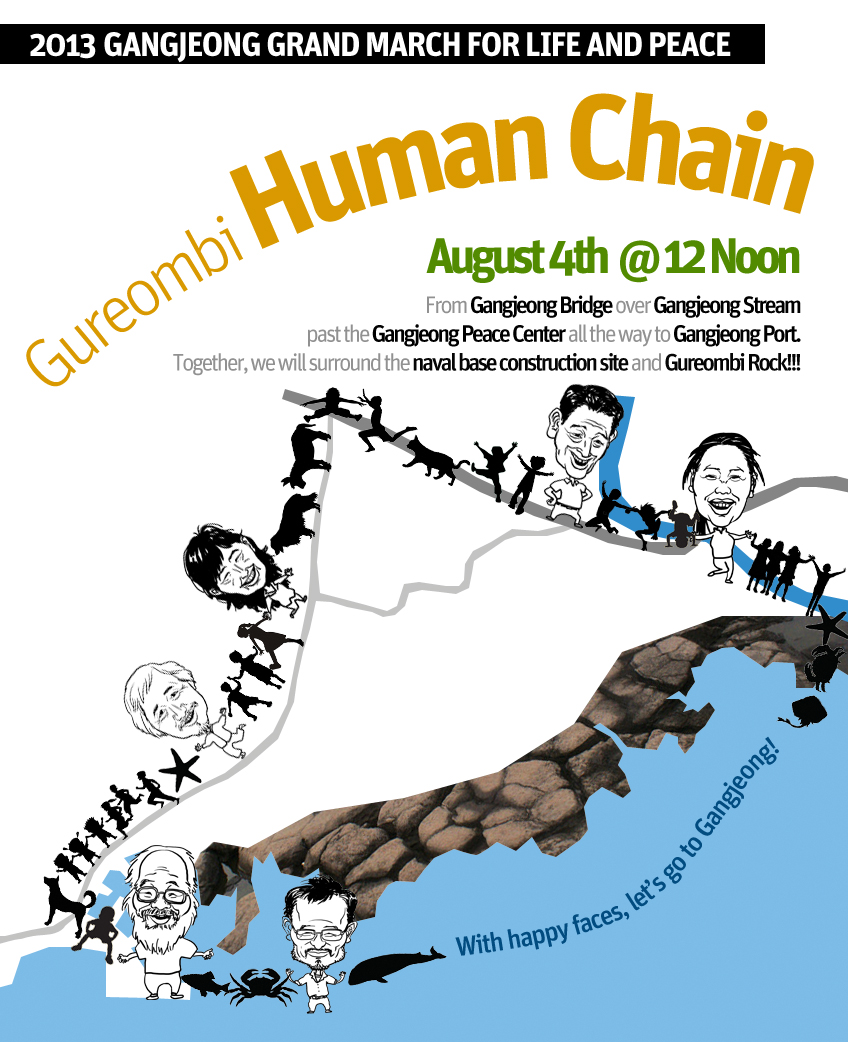
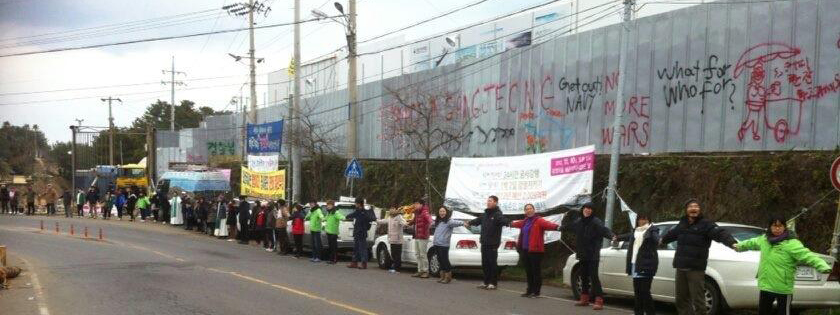
We so thank for all the international solidarity messages for 2013 Grand March for the Life and Peace of Gangjeong and Gureombi Human Chain. Though late, here are collected international solidarity messages. We especially express our gratitude to the international peace activists who have been unjustly denied entries to Korea for their support for our struggle opposing the building of the Jeju naval base but sent warm and strong messages of support. Some of them such as Nagaya Yukiko collected her friends’ messages as well with Korean translations. We also thank translators, Jo Yak Gol and Park Youn-Ae, Park Jin-Hwan for kindly helping or volunteering translations. We also thank friends such as Amy Woolam Echevera who gathered signs for us from the friends all over the world. And friends in the UK and Australia for having solidarity actions for us. If there are any missed messages here though you have sent us, please let us know (gangjeongintl@gmail.com) . Thank again for all your warm friendship and support.
Kitty Axelson-Berry (USA)
Your sea is our sea, your soil is our soil, your protest is our protest, and may we always remember that and real-ize that. All of my best wishes for a world at peace, with the security that only peace can provide.
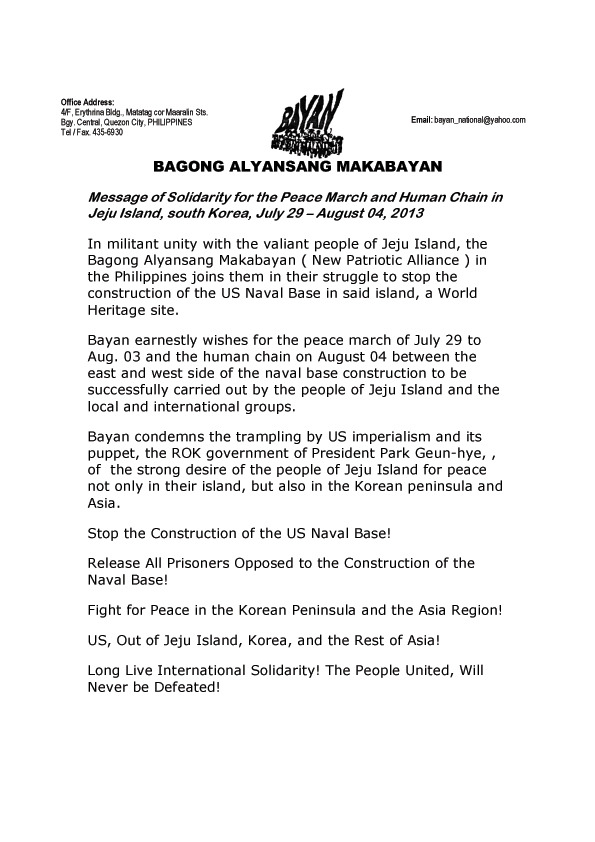
In militant unity with the valiant people of Jeju Island, the Bagong Alyansang Makabayan ( New Patriotic Alliance ) in the Philippines joins them in their struggle to stop the construction of the US Naval Base in said island, a World Heritage site.
Bayan earnestly wishes for the peace march of July 29 to Aug. 03 and the human chain on August 04 between the east and west side of the naval base construction to be successfully carried out by the people of Jeju Island and the local and international groups.
Bayan condemns the trampling by US imperialism and its puppet, the ROK government of President Park Geun-hye, of the strong desire of the people of Jeju Island for peace not only in their island, but also in the Korean peninsula and Asia.
Stop the Construction of the US Naval Base! Release All Prisoners Opposed to the Construction of the Naval Base! Fight for Peace in the Korean Peninsula and the Asia Region! US Out of Jeju Island, Korea, and the Rest of Asia! Long Live International Solidarity! The People United, Will Never be Defeated!
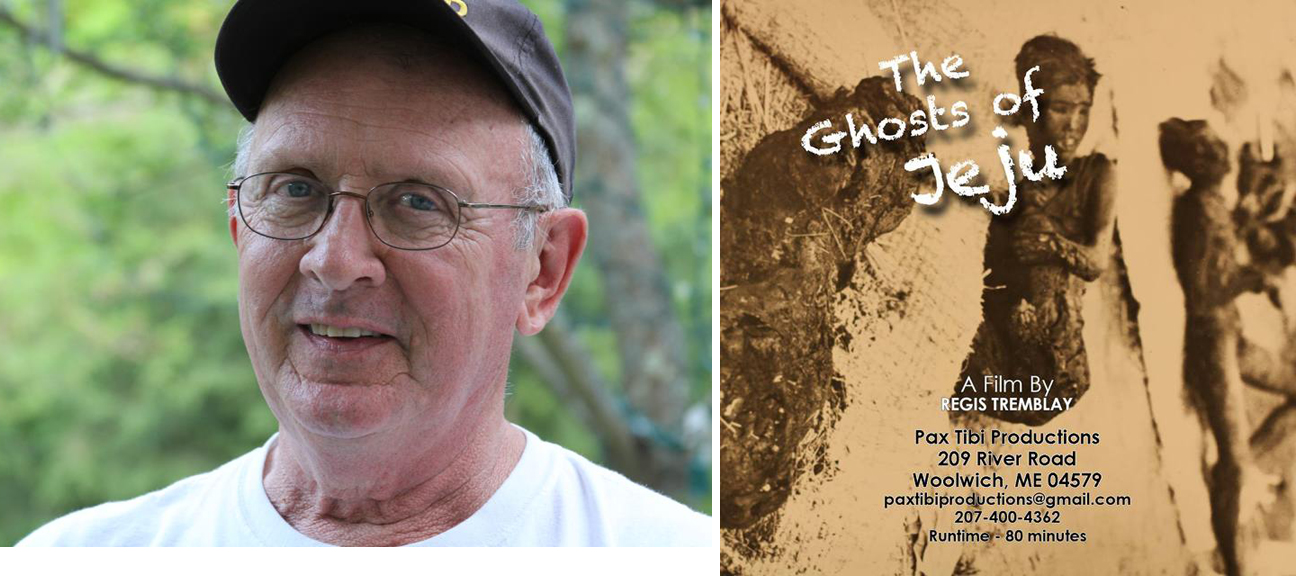
I am writing to you from the National Green Party’s Annual Gathering here in the US. Last night I showed the film The Ghosts of Jeju to some of the people and they were very moved. I know I speak for the Green Party members that I know all over the US and the Green Party Peace Network that I started with another Green, we are behind your struggle and are so saddened and angered by both what has and is now going on in Jeju. We send our thoughts, prayers, strength and love to you all in your continued struggle and will continue to show and pass on this wonderful film that Regis Trembly did from his visit in Jeju. You are in our hearts and souls. Stay strong and safe. Love, jacqui [Maine].
Hi you all, It’s a long distance, I live in a far away country. Moreover I am no longer able to participate in a walk. But my heart, my spirit is with you. I hope you stlll can hold on against all odds – there’s a chance peace will come – if many of us all over the world keep struggling to obtain it. Peaceful greetings Bernard De Witte, Belgium
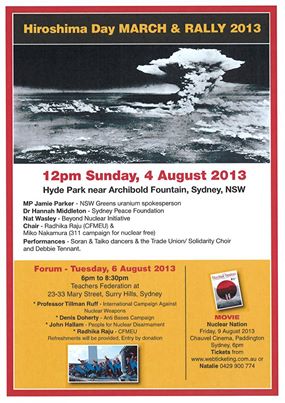
We the people gathered in Sydney, Australia for the Hiroshima Day Rally on Aug 4. 2013 condemn the Government of the Republic of Korea for building the Korea-US naval base on Jeju the island of peace. This new base will further threaten the peace of the Northern Pacific area.The construction of the base is an act of environmental and cultural vandalism.We support the struggle of the people of Jeju to protect their island.We stand with you today Aug 4, 2013 as you join hands to encircle the construction site. We wish you every success. Hope all went well! Peace From Sydney Denis Doherty and Radhika Raju
Hello friends of Jeju Island, we are having a march and rally on 4 August 2013 and will be speaking about the issues you ate facing in Jeju Island! in solidarity – The Hiroshima Day Council Sydney.
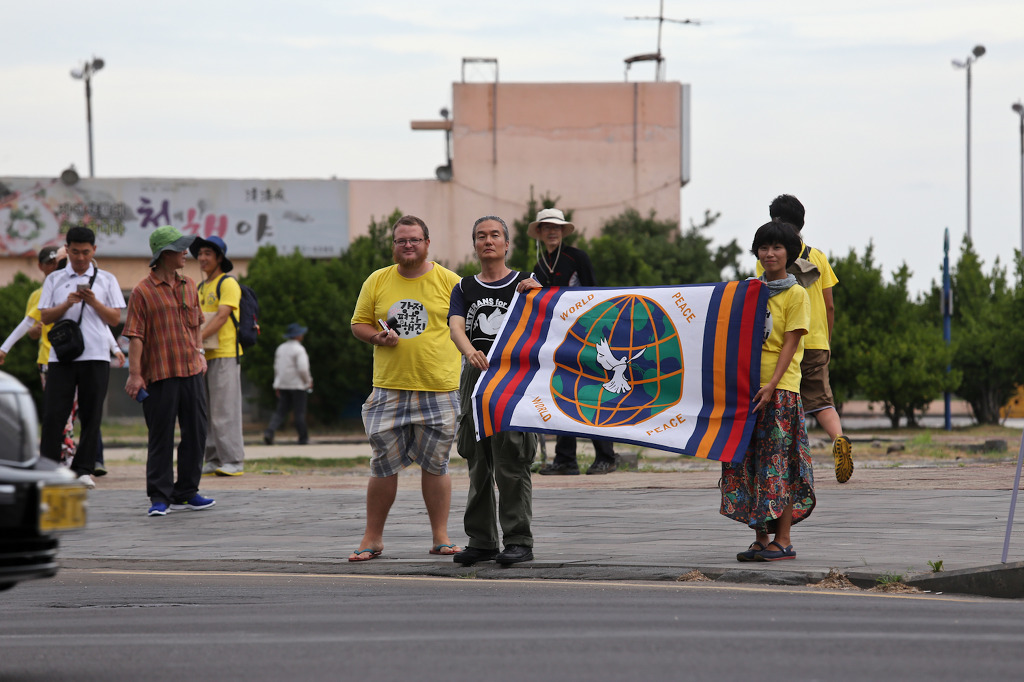
Kristin Douglas sent us a world peace flag to represent her. The Gangjeong village international team members are holding it during the Life and Peace march on Aug. 3 (Photo by Lee Wooki)
Amy Woolam Echeverria Dear Friends,
My name is Amy Woolam Echeverria and I am a colleague of Columban Fr. Pat Cunningham. For quite some time we have been following the situation in Jeju through Pat’s updates which have informed our advocacy efforts for peace here in the U.S. We hope you receive the attached international letter of solidarity in time for your events on August 4.
Please know of our ongoing concern and work to accompany you in your struggle for peace.
If we can be of support in any way, please let us know.
In peace and solidarity,
Amy Woolam Echeverria
Amy Woolam Echeverria
International Justice, Peace, and Integrity of Creation Coordinator
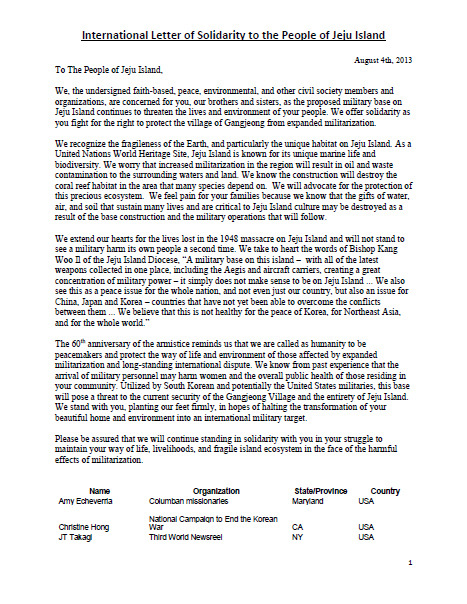
International Letter of Solidarity to the People of Jeju Island
August 4th, 2013
To The People of Jeju Island,
We, the undersigned faith-based, peace, environmental, and other civil society members and organizations, are concerned for you, our brothers and sisters, as the proposed military base on Jeju Island continues to threaten the lives and environment of your people. We offer solidarity as you fight for the right to protect the village of Gangjeong from expanded militarization. We recognize the fragileness of the Earth, and particularly the unique habitat on Jeju Island. As a United Nations World Heritage Site, Jeju Island is known for its unique marine life and biodiversity. We worry that increased militarization in the region will result in oil and waste contamination to the surrounding waters and land. We know the construction will destroy the coral reef habitat in the area that many species depend on. We will advocate for the protection of this precious ecosystem. We feel pain for your families because we know that the gifts of water, air, and soil that sustain many lives and are critical to Jeju Island culture may be destroyed as a result of the base construction and the military operations that will follow. We extend our hearts for the lives lost in the 1948 massacre on Jeju Island and will not stand to see a military harm its own people a second time. We take to heart the words of Bishop Kang Woo Il of the Jeju Island Diocese, “A military base on this island – with all of the latest weapons collected in one place, including the Aegis and aircraft carriers, creating a great concentration of military power – it simply does not make sense to be on Jeju Island … We also see this as a peace issue for the whole nation, and not even just our country, but also an issue for China, Japan and Korea – countries that have not yet been able to overcome the conflicts between them … We believe that this is not healthy for the peace of Korea, for Northeast Asia, and for the whole world.” The 60th anniversary of the armistice reminds us that we are called as humanity to be peacemakers and protect the way of life and environment of those affected by expanded militarization and long-standing international dispute. We know from past experience that the arrival of military personnel may harm women and the overall public health of those residing in your community. Utilized by South Korean and potentially the United States militaries, this base will pose a threat to the current security of the Gangjeong Village and the entirety of Jeju Island. We stand with you, planting our feet firmly, in hopes of halting the transformation of your beautiful home and environment into an international military target. Please be assured that we will continue standing in solidarity with you in your struggle to maintain your way of life, livelihoods, and fragile island ecosystem in the face of the harmful effects of militarization.
International Letter of Solidarity to the People of Jeju Island
Name/ Organization/ State,Province/Country
-Amy Echeverria Columban missionaries, Maryland. USA -Christine Hong, National Campaign to End the Korean War, CA USA -JT Takagi Third World Newsreel, NY USA _Monica Kim University at Albany, SUNY New York, USA _Dorothy Ogle, National Campaign to End the Korean War, Colorado USA _George Ogle, National Campaign to End the Korean War Colorado USA _Joe Ring CA USA _Koohan Paik International Forum on Globalization California USA _Ramsay Liem Boston College MA USA _Khanh Pham Viet Unity _Daniel Kim New York.United States of America _Haeyoung Kim University of Chicago IL United States _Elaine H. Kim Asian American Studies UC Berkeley California USA _Sarah Park SOOBAK California United States _Sooyoung New York USA _Namhee Lee, ASCK (Alliance of Scholars Concered about Korea), CA USA _Juyeon Rhee, Nodutdol for Korean Community Development New Jersey U.S.A _김수복 6.15 공동선언실천해외위 뉴욕 NJ 미국 _Ki Yom Sun-Yoga New York United States _M.Brinton Lykes Center for Human Rights & Intl Justice, _Boston College MA USA _Catherine M Mooney MA United States _Nan Kim, Alliance of Scholars Concerned about Korea (ASCK) Wisconsin US _Jodi Kim CA USA _Jinsoo An UC Berkeley CA USA _Byung C Kang, All saint Episcopal Church In Great NECK, NY New York USA _Terry K. Park CA USA _Deanna Wolf Columban Center for Advocacy and Outreach MD USA _Jennifer Kim Chicago, IL USA _Mike Dodd Columban Fathers NE USA _Gerald Wilmsen Columbans Wisconsin USA _Victoria Compton Office for the Missions, Diocese of Springfield in IL Illinois USA _Will Donahue, Columban Center for Advocacy and Outreach IL USA _Maria Torres TX Estados Unidos _Tracy M Oberle, Columban Fathers-Columban Center for Advocacy and Outreach MICHIGAN United States _Kristie B Vollentine Pontifical Mission Societies LA USA _Father ‘Rick LaBrecque Catholic Diocese of Charleston South Carolina USA _Alice Sather MN USA _Connor Duffy Pennsylvania United States _Martin Witchger, Washington, D.C. United States _Charles Haddox Texas United States _Kadey Wright Tx United States _John Nuelle, United States Catholic Mission _Association Washington DC USA _Jan Gregorcich School sisters of Notre Dame Wisconsin USA _Rev. Robert E. Mosher Columban Fathers Texas USA _Charles Rue Columban Mission NSW Australia _Ray SCANLON Columbans Victoria Australia _Albert Utzig St. Mary’s Catholic Church California USA _Frank Carroll Columban Fathers MA USA _Brother Jim Moore Conventual Franciscan Friars Maryland USA _Deacon Greg Kovalesky St. Paul Catholic Church Tampa, Florida USA _nelson belizario st simon stock parish _kevin cawley Cawley Family NY United States _Serafina Vuda Columban Fathers California United States _Eli McCarthy Conference of Major Superiors of Men MD USA _Pat Cunningham Columban JPIC Korea Seoul Korea _Elizabeth Nye, Columban Center for Advocacy and Outreach, Washington, D.C. United States _Teresa Vyhanek Minnesota USA _John Kerr Province of the Immaculate Conception Pennsylvania U.S. _Thomas Kim KPI CA _Mary Ellen Dowling New York USA _thomas glennon Nebraska united states _John Converset JPIC Office, Comboni Missionaries NJ USA _Fr Peter O’Neill Missionary Society of St Columban Hsinchu City Taiwan _Ronald Miranda Illinois USA _Ronald Miranda Illinois USA _youngho jeju korea _Linda Dimmock Alabama USA _Rick V Elefano St. Gerard Family Life Center Philippines _William Schmitt Columban Fathers Nebraska U.S.A. _Provincial Council of the Clerics of St. Viator Illinois United States _Br. Michael Gosch Clerics of St. Viator (Viatorians) IL US _Ann Scholz Maryland USA _Richard Steinhilber Columban Fathers Nebraska USA _Fr. Chuck Lintz Columban Mission Society Rhode Island U.S.A. _Gerry G Lee Maryknoll Office for Global Concerns DC USA _Luke Patterson New York United States _thomas glennon Nebraska usa _Ellen Teague Columban JPIC UK London England _Charles Haddox Texas United States _Katie Michigan United States _William J. Morton, SSC Columban Border Ministries Texas USA _ Sainiana Tamatawale Columban Lay Missionary Suva FIji Islands _Chloe Schwabe, Columban Center for Advocacy and Outreach District of Columbia USA –>Click the link for Korean translation and all 5 page letter copies ( Korean translation by Jo Yak Gol)
Josh Fisher(USA)
I lived on Jeju-do for two years and fell in love with the island. To learn that the fight for the sanctity of Jeju-do is still ongoing is distressing. Here in Chicago, I am thousands of miles away from the picket lines I’d rather be standing on. In order to do my part, I’ve decided to rerelease the original performance of Build Your Base. This was performed in the Gangjeong Village Hall on June 26, 2010.
Friends of Gangjeong in the city of Birmingham, United Kingdom (UK)
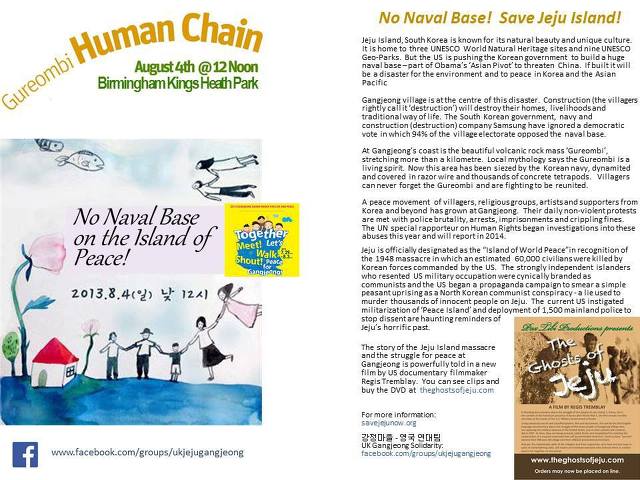
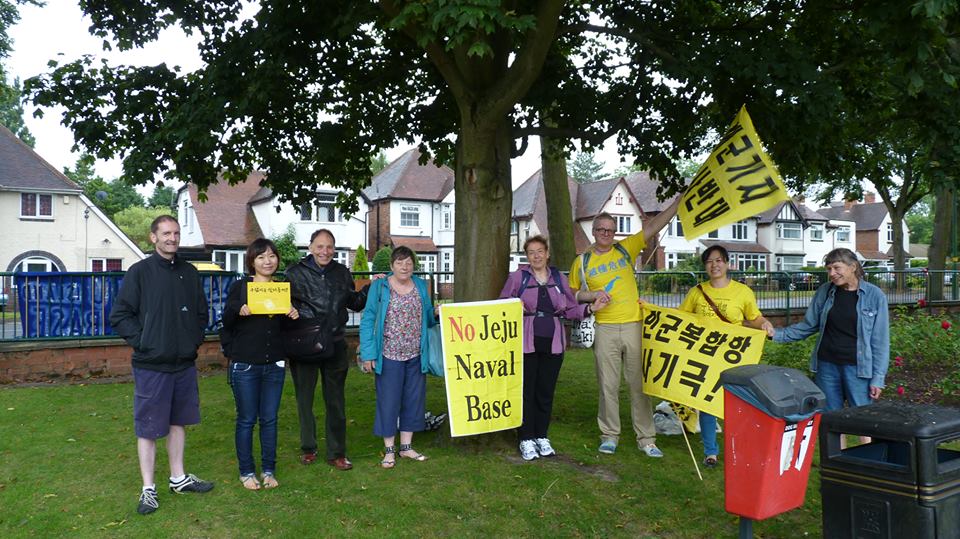
1. Friends of Gangjeong in the city of Birmingham, United Kingdom are organising a human chain and picnic on Sunday 4 August. Here is the leaflet (to be double sided) we will be giving to the public. (Andrew, UK)
2. To the beautiful people of Gangjeong, your struggle for peace is endlessly inspiring. It’s a joy to see daily photos from the Grand March for Peace. Here in the UK there will be a human chain event for Gangjeong in the city of Birmingham on Sunday 4th. (Andrew, UK)
I write this message of solidarity from Darwin, Australia where local activists are beginning to expand their efforts to protest the US deployment of 2,500 Marines as part of Obama’s “pivot” into the region.
Before I came here I was in the Philippines and visited the former US Navy base at Subic Bay. I learned that about 5 US warships each week are coming back into that port.
My thoughts are with Gangjeong village as you prepare to begin the peace march and human chain. I send you my heartfelt greetings and wish I could be there with you.
Please know that your story of peace, love, and respect for nature is spreading around the world. You are not alone.
Blessing to you all. We join hands with you.
In peace,
Bruce K. Gagnon
Coordinator Global Network Against Weapons & Nuclear Power in Space Brunswick, ME
‘In 2010 i swam around Jeju to raise environmental awareness. Seeing Jeju from the sea makes you realise how much habitat destruction and inappropriate deelopment has already occurred. Sadly, the only clean water i swam through in ALL OF JEJU was at Gangjeong. It breaks my heart to see this development continue. I wish i could be with you all on Jeju to join the walk and hold hands in solidarity and support. Thank you for not giving up.
A solidarity message from Sakota Hidefumi(46) who was denied entry to Korea on Aug 26, 2011, with his 6-year-old son and Yamaguchi Yukiko(56), a AWC organizer in Kansai region. Mr. Sakota Hidefumi is a peace activist and Korean language translator from Japan.
Dear, Gangjeong villagers and peace activists. I support your struggle. And I oppose the construction of the Jeju naval base by Korean government. Your struggle is justice. Samsung’s comstruction and Police crackdown is injustice. I demand immediate release of wrongfully imprisoned people, and Korean government must lift the entry ban on foreign activists.
I am sending my solidarity message to you with Gangjeong struggle in my mind. I am so regretful that I cannot participate in your creative actions due to Korean government’s unjust entry ban. However, I believe that we can do a lot of things to spread Gangjeong voice against Jeju naval base into the world. Let’s continue to fight for our freedom and all people’s liberation from the oppression of military base. Your struggle is our struggle.
Name: Ikeda Takane (AWC-Japan) Denied entry to Korea and sent back to Japan on Jan 26, 2012.
This is Leon from the environmental network Kalikasan PNE in the Philippines. [I was at the] International Conference on US Strategic Pivot to Asia-Pacific Militarism, Intervention and War in Manila last July.
Hope we’re not too late to send you our solidarity statement in time for the human chain. Wishing you a successful action and we’re looking forward to working with you on the bases campaign! Leon Dulce National Campaign Coordinator Kalikasan-People’s Network for the Environment http://www.kalikasan.orghttp://kathangkatotohanan.wordpress.com ……………………………………………………………….
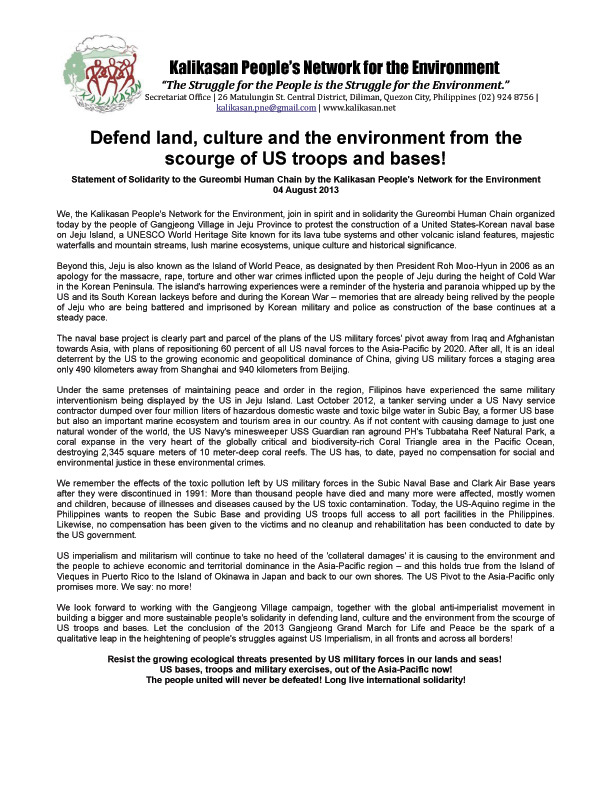
Kalikasan People’s Network for the Environment “The Struggle for the People is the Struggle for the Environment.” National Secretariat Office 26 Matulungin St. Central District, Diliman, Quezon City, Philippines (02) 924 8756 | kalikasan.pne@gmail.com | www.kalikasan.net
Defend land, culture and the environment from the scourge of US troops and bases!
Statement of Solidarity to the Gureombi Human Chain
by the Kalikasan People’s Network for the Environment
04 August 2013
We, the Kalikasan People’s Network for the Environment, join in spirit and in solidarity the Gureombi Human Chain organized today by the people of Gangjeong Village in Jeju Province to protest the construction of a United States-Korean naval base on Jeju Island, a UNESCO World Heritage Site known for its lava tube systems and other volcanic island features, majestic waterfalls and mountain streams, lush marine ecosystems, unique culture and historical significance. Beyond this, Jeju is also known as the Island of World Peace, as designated by then President Roh Moo-Hyun in 2006 as an apology for the massacre, rape, torture and other war crimes inflicted upon the people of Jeju during the height of Cold War in the Korean Peninsula. The island’s harrowing experiences were a reminder of the hysteria and paranoia whipped up by the US and its South Korean lackeys before and during the Korean War – memories that are already being relived by the people of Jeju who are being battered and imprisoned by Korean military and police as construction of the base continues at a steady pace. The naval base project is clearly part and parcel of the plans of the US military forces’ pivot away from Iraq and Afghanistan towards Asia, with plans of repositioning 60 percent of all US naval forces to the Asia-Pacific by 2020. After all, It is an ideal deterrent by the US to the growing economic and geopolitical dominance of China, giving US military forces a staging area only 490 kilometers away from Shanghai and 940 kilometers from Beijing. Under the same pretenses of maintaining peace and order in the region, Filipinos have experienced the same military interventionism being displayed by the US in Jeju Island. Last October 2012, a tanker serving under a US Navy service contractor dumped over four million liters of hazardous domestic waste and toxic bilge water in Subic Bay, a former US base but also an important marine ecosystem and tourism area in our country. As if not content with causing damage to just one natural wonder of the world, the US Navy’s minesweeper USS Guardian ran aground PH’s Tubbataha Reef Natural Park, a coral expanse in the very heart of the globally critical and biodiversity-rich Coral Triangle area in the Pacific Ocean, destroying 2,345 square meters of 10 meter-deep coral reefs. The US has, to date, payed no compensation for social and environmental justice in these environmental crimes. We remember the effects of the toxic pollution left by US military forces in the Subic Naval Base and Clark Air Base years after they were discontinued in 1991: More than thousand people have died and many more were affected, mostly women and children, because of illnesses and diseases caused by the US toxic contamination. Today, the US-Aquino regime in the Philippines wants to reopen the Subic Base and providing US troops full access to all port facilities in the Philippines. Likewise, no compensation has been given to the victims and no cleanup and rehabilitation has been conducted to date by the US government. US imperialism and militarism will continue to take no heed of the ‘collateral damages’ it is causing to the environment and the people to achieve economic and territorial dominance in the Asia-Pacific region – and this holds true from the Island of Vieques in Puerto Rico to the Island of Okinawa in Japan and back to our own shores. The US Pivot to the Asia-Pacific only promises more. We say: no more! We look forward to working with the Gangjeong Village campaign, together with the global anti-imperialist movement in building a bigger and more sustainable people’s solidarity in defending land, culture and the environment from the scourge of US troops and bases. Let the conclusion of the 2013 Gangjeong Grand March for Life and Peace be the spark of a qualitative leap in the heightening of people’s struggles against US Imperialism, in all fronts and across all borders! Resist the growing ecological threats presented by US military forces in our lands and seas! US bases, troops and military exercises, out of the Asia-Pacific now! The people united will never be defeated! Long live international solidarity! (Source) –> Click the link for Korean translation (Korean translation by Park Youn-Ae)
Tarak Kauff (USA)
Tark Kauff was forcefully and violently denied entry along with Eliot Adams and Mike Hastie on March 14, 2012. For more info on it, click here. Despite such ordeal, here is his warm message.
Solidarity for the Gangjeong Peach March from Veterans for Peace. Many of us here in the states have been incredibly inspired and moved by the intensity, courage and long unceasing commitment of your struggle to resist U.S. and South Korean militarism at the expense of your island and people. You set an example of sacrifice for many of us. I was turned away from Jeju Island once, if I can I will try again as soon as possible. I want to learn from you all and stand in real solidarity with you all. I feel like you are family that I need to see. All power to you in the struggle. In the meantime I am sending a t-shirt and a hat and maybe something else if I can get it together.
Peace, justice and love,
Tarak
Tarak Kauff
Board of Directors
Veterans For Peace
“Treat the earth well: it was not given to you by your parents, it was loaned to you by your children. We do not inherit the Earth from our ancestors, we borrow it from our children.”
The Korea Policy Institute sends our deepest gratitude for your incredibly courageous and persistent efforts to resist the further militarization of your village and Jeju Island. For years now, across the pacific ocean, we have been watching and learning about your struggle. Whether on Facebook or hearing directly from Gangjeong villagers such as Jeong Young-hee or Mayor Kang Dong-kyun, or traveling ourselves to Gangjeong, we have been moved and encouraged by what you have created and continue to build in your resistance.
This year marks the 60th anniversary of the signing of the Armistice Agreement. We know that an unended Korean War due to the absence of a permanent peace treaty is what justifies the further militarization of the Korean peninsula, and as a consequence Jeju Island. Your struggle to halt this militarization, to protect your 400-year old village, Gureombi, and the natural beauty which makes Jeju Island paradise island, is truly valiant.
We are inspired by your unwillingness to accept injustice, despite the daily brutal violence you endure, including imprisonment and heavy fines. Your fearlessness in the face of all of this is a true testament to the selfless human spirit that is willing to sacrifice for justice, to protect the environment, and preserve the precious resources we have today for future generations.
Please know we are with you and will continue to write and spread the word about your struggle. You are not alone. We are with you every step of the way.
I feel honored to have come to know you, peace activists of Gangjeong, because you have shown me so much–about the hope and dream for a peaceful world and about your unwavering courage and passion to keep working to make it happen. You are the ones whose words of peace have wings to fly all over the world! Your struggle is our struggle. We must stop the insanity of war! Keep Jeju the Island of Peace!
Greetings to you brave people in your struggle to save Gangjeong. Thank you for your courage and tireless efforts to protect the environment and your traditions. You are an inspiration to the whole world.
You have inspired me to devote much of my life to making banners here in Maine for groups fighting for peace and justice, the environment, and other causes I want to support,
I would return to struggle with you, but know that I would not be allowed into your country again.
I am attaching some images that I made that you might like to use.
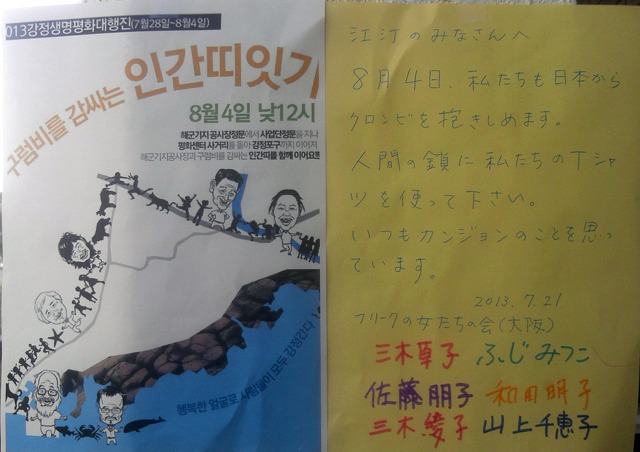
Last summer, I visited Gureombi rock right after a typhoon hit. So I couldn’t see the real, exquisite Gureombi that other people told me about. But, Gangjeong villagers explained to me how peaceful the rock was before the construction, how fun it was for kids to play at, and how rich and fertile the sea was. Fishing was so easy… Let’s take back the peaceful days. For that, I am sending my solidarity heart from Japan. I will be with you. Location: Kyoto, Japan Name: Minami Mamoru
Nagaya Yukiko and other AWC Japan activists including those who were denied entry
Nagaya Yukiko (Yamaguchi Yukiko) from the Japan AWC was unlawfully denied entry to Korea on Aug 26, 2011 along with Sakota Hidefumi and Sakota’s son. They were translators and were stuck and illegally held at the airport for 3 days and deported back to Japan on Aug 28. They tried to use their rights to file a formal objection, but the Korean Immigration told lies, saying there is no such a process in Korea. You can read the full report of the case in here. Afterwards, Nagaya Yukiko started protest in front of the Korean embassy in Osaka and other places on every Wednesday. She has strongly protested Korean government’s unlawful denial of her entry and Jeju naval base construction. We thank Nagaya Yukiko for her continuous efforts to put solidarity messages together and translate them into Korean language.
I am sending my solidarity message to all the comrades who walked around the Jeju island and arrived Gangjeong village. I cannot forget the grand nature where river and sea meets in Gangjeong that I saw two years ago. I heard that Gureombi is a warm rock. I also cannot forget the scene where children played games, becamed tired and fell asleep on the rock while grown-ups were holding protest gathering. I want to send my utmost respect and solidarity heart to Gangjeong villagers and peace activists who have repetedly been arrested and imprisoned for such a long time to defend their life ground, Gureombi rock and the sea. Korean government is opressing and destroying because it is afraid. So that’s why we have to strengthen and broaden our solidarity in spite of any interference. And with the power of solidarity, we will kick out US military bases from Asia and put an end to the Korean-US-Japan military ruling system! Location: Kyoto, Japan Name: Nagaya Yukiko (Yamaguchi Yukiko) (denied entry on Aug 26, 2011)
しかし、韓国政府は、こんな小さな存在の―日本人の親子を入国を拒否しました。カンジョンの海軍基地に反対しているからという理由で。カンジョンを訪れて半年後、再び大好きな韓国を訪れた私たち親子を、強制送還しました。こんな不条理な仕打をしてまで作る海軍基地はどんな만들어지는 해군기지가 어떤 역할을 하는 건지 주민 분들이 잘 알고 고발하는 것을 두려워하는 겁니다. 저희는 두려운 게 하나도 없으니까 이렇게 바다 건너 연대하고 있습니다未来に必要だというのでしょう。まったく必要ありません。
I visited the naval base construction site with my daughter in summer two years ago. I felt empowered just standing on it. I witnessed with my eyes the greatness of Gureombi rock and the sea that give us rich products, raise diverse life. I realized that building a war base that gives no good for human race, on such an abundant sea, was an absolutely absurd thing. (we don’t need war base in anywhere else, for sure) I came back to Japan before I delievered my solidarity heart and encouragement to the villagers who have vowed to recover the Gureombi rkac and the sea, while putting their life in line. As a Japanese, I felt powerless because I couldn’t do much when the Gangjeong people were fighting everyday. However, I decided to help as much I as could, so after I came back to Japan, I told the stories of Gangjeong village to my friends. To my surprise, Korean government did not allow this tiny little mother and daughter to its country. Just because we oppose the Gangjeong naval base project. We wanted to visit again Korea that we liked after 6 months we visited Gangjeong village. But it deported us. Do we actually need a naval base being constructed in this unjust ways for our future? No, absolutelu not. In my deportation, I learned how important existence each and every one of us is. Each person can raise voice and become a link that connects the strong stryggle chain. I want to send our hearts to the human’s wall that will defend Gureombi rock and the sea. Let’s keep up the struggle until we win. Location: Nothern Kyushu, Japan Name: Nakamura Sukae (denied entry on Mar 27, 2012)
I want to share my solidarity heart with human’s wall around Gureombi. Even though military base builders and law enforcers keep us from entering your country, how can they stop our solidarity with Jeju people, Korean people? We will always be together with you in the struggle. Let’s build Asia free from military threat so that women and children can live safe! Organization: AWC-Japan Name: Ouchi Teruo (denied entry on Jun 29, 2012)
I want peace with people in Asia together in solidarity, not divided. I want to express my solidarity to human’s wall around Gureombi rock. Location: Ehime Prefecture, Japan Name: Tamura Megumi
To visit Gangjeong is to know and to love Gangjeong and her people. With each passing day, more people around the world stand in solidarity with you. Your spirit and energy is infectious in spite of seemingly insurmountable odds. Your struggle is our struggle as we rise up against the crimes against humanity and the natural world! War, capitalism, militarism, and imperialism must be replaced with peace and justice for all.
TomiyamaMasahiro and Okinawan peace activists(Okinawa)
Tomiyama Masahiro is the co-chairman of Okinawan-Korean People’s Solidarity against US military base. He was denied entry to Korea twice, Apr 6 of 2012 and Sep 5 of 2012, a day before the World Conservation Congress opening ceremony. Several other Japanese peace activists such as Yagi Ryuji and Okinawan musician such as Wumisedo Yutaka were repeatedly not allowed to enter Korea, two times respectively. We also thank Park Jin-hwan for translating the messages into Korean.
Solidarity Message to 2013 Gangjeong Grand Peace March
Okinawan-Korean People’s Solidarity against US military base (full name) Okinawan-Korean People’s Solidarity (in short) Co-chairman : Tomiyama Masahiro
Dear comrades who gather in Gangjeong village to stop the construction of Jeju naval base. I send this solodarity message from Okinawa. In Okinawa, on Sep 10 last year, about 100,000 people attended the Okinawa general demonstration and began a pan-Okinawan action to fight for shutdown of the world’s most dangerous Futenma US base, to stop the Henoko new base construction and to withdraw the deployment of the flawed Osprey aircraft. As the whole Japanese society is leaning toward right-wing, an Okinawan progressive candidate won the Jul 21 Upper House election as Itokaz was elected as a member of Parliament by beating a conservative candidate. However, the far right-wing Abe’s Liberal Democratic Party won a huge nationwide victory in the election. And the government is getting ready to deploy 12 more Osprey aircraft that have caused continuous problems, such as crashing to land and killing people. The new administration is pushing pressure on Okinawa governor to get a permission to reclaim the Henoko sea area to build the military base on it. The construction of an Osprey takeoff and landing base in Takae is resumed and going on despite people’s protest. Abe administration ignores the will of people and makes Okinawa succumb to the central government. It incites nationalistic sentiment among general public by bringing territorial disputes, aiming to change the Constitution for the worse with a clear purpose to establish full-scale military forces. We must stop this Abe’s dangerous and violent moves. Beyond the border, all people in Asia and across the world, let’s come together with peaceful hands. Let’s bring our hearts together across the barrier. Let’s accomplish the big success of Gangjeong Grand March and human’s wall across the fences of Gureombi.
I wish I could be there with all the brave people of Gangjeong and their Korean and international supporters. Your important struggle against the destruction of the environment and the increased militarization of East Asia is a model for people worldwide who are trying to build a more peaceful and just world. Thank you for all you are doing! In solidarity and hoping to return to Gangjeong soon, David David Vine Assistant Professor Department of Anthropology American University Washington, DC USA
I trust your 2013 Ganjeong Grand March for Life and Peace has started off great. Here is my solidarity message to the marchers and the people of Jeju Island. May the Ocean praise you for taking the peaceful paths to protect your islandMay the Ocean provide you with wisdom and plentyMay the Ocean calm the troubled worldMay the Ocean protect you and help you prevailMay the Ocean connect Jeju and Okinawa forever in solidarity Hideki Yoshikawa Citizens’ Network for Biodiversity in Okinawa Save the Dugong Campaign Center
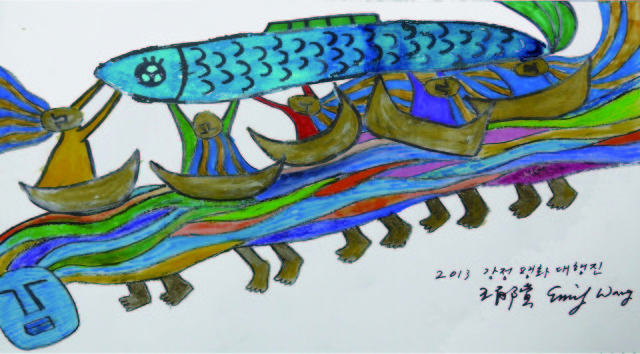
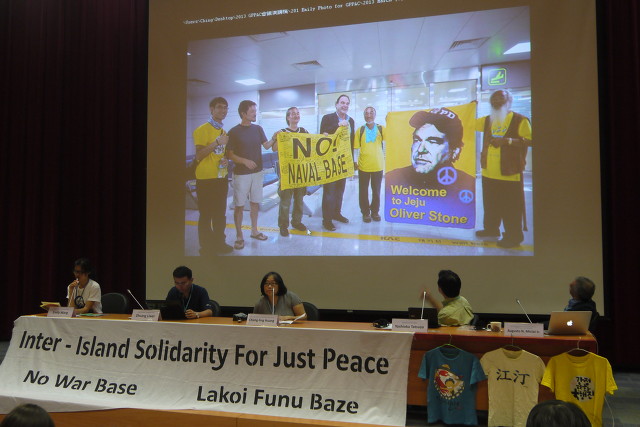
Dear Gangjeong people, This is Emily. I send my congratulations and my big hugs to you for your success on the Peace March and Human Chain. While you were in the march, I am also attending a oceanic peace forum to talk about Jeju base and working for the inter-island solidarity for just peace for our region. The awesome grand march photos were shown in my presentation as well. Peace is the way without boundary, so I believe we are walking together. You are not alone. This is a big solidarity from Taiwan. A solidarity t-shirt will arrive in Gangjeong soon. Good Job!
K. J. Noh, Oliver Stone and Bruce Gagnon were on KPFA radio in Berkeley, California on Aug. 22 talking about Jeju Island and the horrors of the Navy base. See here.
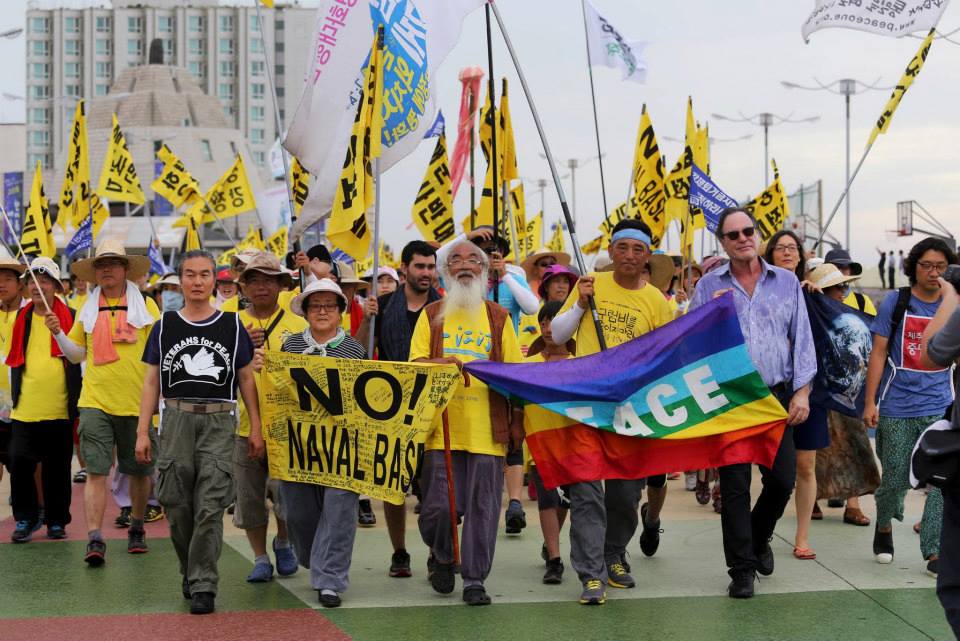
Oliver Stone marches with the leaders of the struggle on Aug. 3, 2013 (Photo by Lee Wooki)
Oliver Stone Visits Jeju Island
By K. J. Noh
In 1986, a young American director, burst out on the screens with a raw, charged, kinetic film. Depicting a country on the verge of popular revolution, it documents the rightwing terror and massacres that are instigated, aided and abetted by the US government. Beginning as the chronicle of a gonzo journalist on his last moral legs, the film starts out disjointed, chaotic, hyper-kinetic; the unmoored, fragmented consciousness of a hedonic drifter. As the events unfurl towards greater and greater violence, the clarity and steadiness of the camera increase, its moral vision clearer and fiercer, carrying the viewer through a journey of political awakening even as the story hurtles inexorably towards heartbreak, tragedy, and loss.
The name of the director was Oliver Stone. The film was “Salvador”. Opened to dismissal, derision and poor distribution, it nonetheless garnered two Oscar nominations , and is now lauded as one of the most important films of the period, acknowledged to have influenced the political debate, if not the policy, around Central America at the time.
27 years later, Oliver Stone is discussing this film with the renowned Korean Film Critic Yang Yoon Mo. Professor Yang mentions Salvador, and the powerful effect it had on his generation during the violent, brutal military dictatorships of his era. “We loved it. It was a big inspiration to people all over the world. We obtained bootleg copies of it and watched it. It inspired a whole generation of young Korean film makers—for the courage and clarity of its vision. It was a model for us of what ethical and political cinema could be.” Stone smiles gently, and then reciprocates with his appreciation of current Korean Cinema—cinema that he himself may have had a hand in shaping—as he mentions “The President’s Last Bang”—a wry, understated morality tale about the assassination of the Dictator Park Chung Hee, during a dinner party-cum-orgy procured by his own intelligence services.
The rapport between two is warm and genuine and they talk as if they are old friends, old film buffs. It’s almost possible to forget for a moment that this is taking place inside a Korean Prison on Jeju Island, where Professor Yang has been sentenced to 18 months as a political prisoner, that he has been 70 days on a hunger strike, and that there are 6 of us crammed into a closet-sized visiting room: Oliver Stone, Father Moon, several activists, and an violent-looking police officer, whose every gesture and look intimates a furious desire to pound us into submission. On the other side, behind dual paned Plexiglas, the gentle Professor Yang is with another police officer, who is furiously transcribing every word that is exchanged.
It’s almost possible to forget that minutes before, we had been stripped of all cameras and recording equipment, had our ID’s confiscated and recorded, and had been escorted by half a dozen policemen to “have tea” with the chief of police, so he could “chat” with us. The police chief is warm and congenial, as only someone with absolute mastery of the rhetoric and machinery of power can be: Pontius Pilate, surrounded by his centurions, speaking softly to send the just the right mixture of benevolence and imminent threat. Out the window, to the left, we are surrounded by a panorama of verdant trees and hills. To the right, inches away, a squadron of blue suited, glaring police. It’s clear that there is more than one director in the room.
Professor Yang is being held in this jail for 18 months, along with dozens of other protestors, for the non-violent protest of a deep water Naval Base that is being constructed in Gang Jeong village on the Island of Jeju. He has been imprisoned 4 times.
Jeju Island is a stunning subtropical island, 60 miles south of the Korean Peninsula, an ecological jewel that is home to UNESCO World Heritage sites, and biosphere reserves. World heritage sites are global treasures such as the Grand Canyon, Yellowstone Park, the Pyramids of Giza. Jeju has three of them. The shoreline of Gangjeong village, where the base is being built, is an absolute conservation area, made of soft coral, harboring many rare endangered species, and home to two thousand subsistence farmers and divers. The area called Gureombi is a site that is considered sacred to the villagers, a living, breathing landscape of tide pools, lava rock formations and stunning volcanic coastline irrigated with crystal clear springs:, the precious mineral kidneys of the island. Unfortunately, the Jeju base is also one of the centerpieces of Obama’s militaristic Pivot to Asia. Within easy striking distance—45 minutes by jet bomber, or 120 seconds as the missile flies–of Shanghai, Beijing, Tokyo, Taiwan, Vladivostok, it menaces all the major cities of East Asia. If we imagine the pacific table as a large family banquet, the military base is a loaded hair-trigger shotgun, and Jeju island is the rotating lazy susan platter in middle.
94% of the villagers are adamantly opposed to the construction. 140 National organizations, and 110 international organizations have called for its cessation. The Korean Parliament has demanded an investigation. The leaders of all the major religions in Korea have called for dialogue. The 5 opposition parties have challenged the legality of the construction. Yet construction has gone ahead, violating, subverting or ignoring every democratic process, every local, regional, national, international statute, charter and law. And so for 7 years, every single day, in one of the most disciplined non-violent struggles ever seen in the country, the villagers have been protesting the construction of this base with marches, prayers, petitions, art, masses, non-violent resistance . To date, 700 protestors have been arrested—including the largest mass arrest of Catholic Nuns in Korean History. Yang, along with other prominent intellectuals, civic and religious leaders, members of parliament, Buddhist nun, the Mayor of the village have all been “dragged like animals and beaten unconscious”, arrested, fined, sued, harassed by police, marines, and hired thugs; and received death threats. They have also been branded as Communists, opening them up to potential prosecution for Sedition under the draconian national security laws. It’s widely suspected Yang was singled out by the Korean National Intelligence Agency (the rebranded Korean CIA) in retaliation for drawing international attention to the issue. He is the longest serving prisoner to date.
Salvador is also an apt point of reference for Jeju: at the end of the war, Jeju itself experienced its own history akin to El Salvador, but on a scale—if such comparisons of human suffering are ever possible– that dwarfed the bloodbath in El Salvador: In El Salvador an estimated 75,000 were killed over 12 years, roughly 1-2% of the population, making it one of the bloodiest of the bloody, dirty wars in Central America. On the small island of Jeju, that number, or more, were killed in less than a year (10-30% of the population), making it the first, and bloodiest genocide of the post-war era, and the savage template for subsequent US interventions across the world.
The historical background is as follows: Korea had been a colony of Japan since 1910, suffering hideously under a brutal occupation. After the surrender of Japan in WWII, the US Military Government occupying South Korea was astonished to discover that there were thousands of functioning people’s collectives (worker’s committees)-forged from anti-colonial resistance– in the south, constituting a Defacto popular government, with strong nationalist and socialist leanings. In order to suppress this grassroots socialist government, the Korean People’s Republic,—American surveys show 80% of the population supported a socialist system—worker’s councils were outlawed, leaders imprisoned, a puppet dictator was rapidly installed, and the brutal apparatus of Japanese colonial rule was reconstituted in its entirety.
Jeju Island with its strong tradition of anti-colonial struggle was one of the strongholds of these indigenous collectives, leading it to be branded as a “red island” by the US Military Government. When popular protest against the division of the country, capitalist recolonization and the wholesale re-institution of the collaborator class and its police force became vocal, a scorched earth policy of genocidal proportions was unleashed. Using paramilitary death squads, strategic hamlets, free fire zones, mass rape, mass execution, torture, napalm, defoliation, entire villages were wiped out, 70-90% of all dwellings burned to the ground, and up to 80,000 massacred; these tactics were to foreshadow US policy across the rest of Korea, in South East Asia, Central and Latin America, Indonesia, Africa, and of course, El Salvador.
Members of Yang’s family were among the first killed in these massacres. For half a century in South Korea, it was a crime against National Security, punishable by imprisonment and torture, to breathe a word of this history. The island, a lush, beautiful subtropical paradise, with rich, volcanic soil, is strewn with unmarked mass graves, and haunted with unspeakable trauma. Those who survived these killing fields, fled in terror, some 40,000 or so. Those who remained were marked as subversives by family association, banned from civil employment, and driven into exile, poverty, suicide, madness. Even the massacres themselves were erased from history, leaving the survivors unable to mourn, grieve, or seek redress. After the slaughtered bodies were dumped into mass graves or caves, the facts vanished into an event horizon; even the memory of their obliteration was obliterated. Jeju Island, for all its beauty, is filled with ghosts—the unmourned dead, and the hushed, inconsolable pain of the survivors. In this context, a large portion of the population see the remilitarization of their Island—belatedly designated as an Island of Peace—as yet another desecration, the nightmarish continuation of an atrocity that has yet to end.
****************************
Oliver asks the Police Chief, about the conditions that prisoners like Yang are kept in: He asks whether they are able to exercise, read, receive and write letters. The Police chief, ever the congenial diplomat, answers, that he is extremely attentive to the health and well-being of his inmates, and that they are allowed all manner of comfort and recreation. He adds a comment about his concern about the hunger strike, and states with a worldly flourish, that “Esteemed Director Stone will find that the conditions of prisons in Korea are not that different from conditions in American prisons.” “Esteemed Director Stone”, does not seem assured, and without missing a beat, points out that “the conditions of US prisons are, according to the United Nations Rapporteur on Human Rights, some of the worst in the world. The systematic and routine use of prolonged isolation has been found tantamount to torture.” The police chief accedes than that perhaps there are differences, and with the hair-splitting skills of a trained bureaucrat, mentions that Korean inmates sleep on traditionally heated floors, whereas American prisoners must sleep on beds. There’s no easy conversion scale to weigh the tradition of intimidation, bastinado and torture of a Korean prison against the isolation, violence, racism of the American penal system. A beautiful police woman, impeccably coiffed, and immaculately made up,–a police geisha, if you will– passes around spring water in exquisite cut crystal glasses, with the terrifying precision of an assassin, moving, as if on cut-steel grooves. There is no need for ice. We gulp our water, thank the police chief, and Officer smash-your-face-in-if-you-so-much-as-blink-wrong then escorts us, with 5 other officers, down to the visiting rooms to meet with Professor Yang.
*************************
90 minutes earlier, Oliver had flown directly in from Barcelona, after 7 days non-stop night shooting of a commercial, and had landed in Jeju, exhausted and bleary eyed. “I don’t usually do commercials”, he says, “but this was soccer—it encourages people to exercise, get healthy, so I’m okay with this”. Oliver looks to be needing a bit of exercise himself: 10 time zones and 20 hours of non-stop flying and transit have left him exhausted and drained. He has wiped clear his schedule, and made a huge sacrifice to travel to Jeju, but as his exit from customs is delayed, the greeting team of local activists at the airport has become anxious that he will simply be denied entry into the country. The Korean government has already denied entry to several international peace activists at the airport—most notably Elliot Adams, Tarak Kauff and Mike Hastie from Veterans for Peace, and it is not inconceivable that they would do the same for any perceived rabble-rouser. Alternatively, they are not above a little “rough play”, and for the Korean Authorities, for whom a beatdown is just a friendly way of getting acquainted, a sound drubbing could be spun as just an over eager welcome or a misunderstood expression of solicitude. The burly men in suits and earpieces tailing the greeting team make this not an unlikely possibility. Finally, when Oliver is released from transit purgatory, all of us breathe a sigh of relief, although for some reason his luggage has gone AWOL. Over the next 48 hours, the luggage will be repeatedly located but yet somehow unrecoverable, claim documents will not be filed, others improvised, leading activists to wonder if this is part of the harassment: :disrupt morale by disrupting logistics, separate the “enemy” from their materiel—in this case, Oliver’s clothes, toiletries, medicines, and his colorfully subversive collection of bandannas.
After a frantic, truncated 30 minute lunch at a local restaurant—there are no power lunches in rural Korea, only hurried ones—the team belatedly shuttles to the prison, where Professor Yang is waiting. We submit to the mandarin ceremonies of power which permit us the short visit to professor Yang. Then, as Oliver and the professor are talking shop, Oliver mentions his new series, “The Untold History of the US”. As a director, he is known for his prolific output, sometimes making two or more films in a single year. “The Untold History”, however, is a 5 year labor of love, a meticulously researched ten hour documentary (and 700 page companion volume), unmasking and chronicling of the rise of US Imperialism. Howard Zinn’s “A People’s History of the United States” is most often mentioned in the same breath, but the other great chronicle of imperialism and its excess–Thucydides’ Peloponnesian War, is also an apt comparison: “The cause of all these evils was the lust for power, arising from greed and ambition, and from these passions, proceeded the violence”. Professor Yang seems intrigued, and although he has been incarcerated too long to have heard of it, he promises that he will try to find a way to see it. Oliver expresses his concerns for his well being, and inquires as to the depth of his support among other artists. Then all too quickly, visiting time is over, and we are reduced to silent gestures of good will and hope across the plexiglass. Professor Yang touches his palm to the glass, Oliver touches it, and then he slowly bows to each of the visiting team, hands together in traditional blessing. Professor Yang seems to have been deeply moved by the visit, but for us, it’s hard to avoid the sense of abandoning a comrade in prison. We stop as we are exiting the prison to do a quick interview with a wire agency, and Oliver fiercely denounces the detention of Professor Yang. “The courage of Professor Yang inspires me” he states, with fire in his voice. “I believe without a doubt that he is a prisoner of conscience and I call for him to bereleased immediately. I deplore the militarization of Jeju Island. I deplore the building of the base”. There is passion and heart in his voice. He will reprise this theme many times over the next few days, but like the other stories about Jeju, these statements will pass largely unreported in the mainstream press.
********************************************
Nothing in Korea happens in half measures, and the heat is no exception. The Jeju heat is swelteringly close to 100 F, the humidity is in the 80’s and although there is a march for peace against the military base that is happening—an epic two day march that will circle all the way around the island, then meet up in the north and come together for a mass rally at a civic plaza, followed on the next day, by a human chain around the base–we wonder if after the harassment, delays, power plays, exhaustion, the blast furnace of summer heat is too much. We ask Oliver if he is up to joining the march, as planned.
Oliver is still resolute. “Let’s do it” he says.
The following day, Koh Gil-Jun, a key protest organizer and artist–one of the key visionaries of the museum on the Jeju Massacre–will fall to the ground during the march, vomiting, paralyzed; done in from heat, stress, exhaustion, harassment, pain. He will be taken to emergency and diagnosed with a hemorrhaged vessel in his brain. But no one seems to be measuring risk against commitment.
“Haegun giji, gyolsa bandae!”
We arrive at the march—an ocean of yellow shirts and banners, youth, children, men and women, internationals—and a huge roar goes up, the tide of people surges and vibrates with energy. If, as it has been said, the true spiritual quest is not upward, or even inward, but forward, to march forward, surely this is one of its greater manifestations.
“Haegun giji, gyolsa bandae!”
A thousand banners flutter in the wind, and the crowd is abuzz with excitement and passion. Chants thunder through the streets, like an unstoppable heartbeat. Like the huge people’s marches that toppled the previous dictatorship, the winds of history, the breath of solidarity, the tide of inevitability, seem to propel the marchers upwards, onwards, forwards.
“Haegun giji, gyolsa bandae!”
Every dimension of human aspiration is present and alive.
Drenched in sweat, Oliver puts on a yellow T-shirt on top of his sweat-soaked shirt, and is invited to join the march at the front. He modestly declines to walk “point”, and falls into the ranks. Fabled director, Hollywood icon, decorated war veteran, becomes just another marcher in a sea of protestors, a forest of banners, marching, this time, against the Imperium.
“Haegun giji, gyolsa bandae!”
“Oppose to the Death, this Naval Base”
*******************************
.
“How do we stop this thing? How do we stop it? We have to stop this thing.” He asks, as we return later to his lodgings. We tell him that it already has stopped, –temporarily—construction that has been ongoing nonstop, 24 hour a day, Christmas, New Years, holidays, has suddenly tapered off, and the site is eerily silent, except for the occasional pile driver. “It’s gone silent in your honor”, we joke. “You should move here permanently”.
Oliver looks out at the coast line from the balcony of his modest B & B. From there, what was one of the most stunning vistas on the coast, you can see a shoreline littered with rubble, construction cranes, bull dozers and concrete jacks.
Earlier in the day, passing the lego-block apartment complexes that were sprouting near the main city, he had jokingly inquired if they were Soviet-inspired. “This is as cheesy as anything Donald Trump would build. Donald Trump would love it here. How does a country with such good film makers have such bad architects?” He had quipped.
But looking out over the construction, no one feels like joking.
It’s not just narcissistic bad taste.
It looks evil.
**************************
Afterwards, we head out to the docks, to take a boat tour of the coastline. Mindful of his reputation and activism, Korean news media has largely honored his visit by coordinated and conspicuous neglect, but Oliver has had the foresight to pull in a Japanese news crew. A camera crew from NHK meets us at the docks, and we get onto the boats, and start our own tour of the coast line. Out in the water, with the cool breezes, the heat abates, and it’s hard not to get a sense of the enormity of it all, the power, the endless beauty, the endless generosity and abundance of this area. The pacific Islanders have a term, Moana Nui, which sees all the pacific peoples living in a harmonious web of mutual co-existence and nourishment, connected by the benevolent ocean. Connect all, so we may all live. There’s enough for all of us: ocean, space, energy, love.
It’s hard to reconcile this with the realpolitik that is gridding off this area as a deadly chess game: control the center of the game board–Jeju Island–the king pawn/queen pawn squares, dominate the vectors and channels of lethal force, subjugate all enemies: Occupy so we may dominate and kill.
The gentle swaying and cool breezes allow us to wash off some of the day’s earlier struggles, and we find the tour both relaxing and exhilarating. The ocean is a deep, sparkling cobalt, and with its gentle billows and power, we feel again the enchanting power and beauty of the water and the island.
On the boat as our tour guide, is a Jeju local, a shaman, meditation teacher, and also, incidentally, the founder of the first and only battered woman’s shelter on the island. “Domestic violence is inseparable from State violence” she tells me. “Militarism and military violence filter down into the smallest recesses of family life. We can’t struggle against domestic violence without challenging this base.”
She tells us about the origin myths of the island, the goddess resting her head at the peak of Mt. Halla, the volcanic peak of the Island, with her feet pointing up to become the island. The creation myths of Jeju island are all goddess myths, what powers lie within and around this island are nourished and channelled from the energies of the feminine.
The feminine is most clearly represented by the Haenyo, the legendary women divers of Jeju Island. The shaman’s mother was such a Haenyo. Fable has it that some travelled to the Japanese Isles, millennia ago, taught the Ama diver women of Japan and then spread the skill spread across the pacific; whether this is true, is unconfirmable, but what’s clear is that this is one of the few places on the world where breath-holding subsistence divers still exist. If the Haenyo have survived to this day, it is clearly because these women are a force of nature: they start diving in childhood, and continue diving into their 80’s and 90’s. They have the courage, endurance, and diving skills to make sissy boys of the Navy Seals’ Underwater Demolition Teams, and during the 1930’s, they spearheaded the resistance to the Japanese Military Occupation on the island. They spend hours in the water, three minutes with each dive, through all seasons, surrendering their lives to the ocean. Their hemp or twilled cotton shirts have been replaced by modern wetsuits, but that is the only concession that they have made to technology. They steadfastly refuse to use scuba gear, or even snorkels, relying on traditional practices of breath control, prayer, and meditation, both as part of tradition, but also with the understanding that stripping the sea bed with technology is pointless stupidity. Their lifestyle is profoundly spiritual and ecological, and it is dying out in the area. The base construction will be the death blow.
Centered around the economy of the Haenyo, Jeju island has, for centuries, been a traditional matriarchal society. “No thieves, no beggars, no gates”, was a phrase commonly used to describe the society of Jeju island, cooperative, communal, matrifocal, an indigenous form of socialism that led itself naturally to the grassroots workers’ councils that flourished after the liberation from the Japanese. These worker’s councils were the basis of the “red island” designation by the US Military Government, and were the trigger for the genocide. Bases will finish off what death squads, napalm, free-fire zones, and killing fields could not. If and when the base is completed, the traditions of generations of powerful women will be replaced with bar girls, prostitutes and housemaids. A young girl who would have learned from her grandmother to read the tides, dive to a hundred feet with only the air in her lungs, and talk to the spirits of the ocean to face down death, will be servicing GI’s on her knees in back alleys. Cultural Genocide, if the term has any meaning, seems appropriate here.
Basalt Columns appear on the Island that we are passing. This is Beom Seom, “Tiger Island”, a Unesco Reserve, and at close range, you can see the entire island is formed from hexagonal basalt columns, like a dark, chiseled, striated jewel in the ocean. The top of the high cliffs is covered with pine trees, and there are wave-carved tunnels and archways around the island, an exalted, mystical architecture. Whether you believe the myth of the goddess’s feet poking out of the dark sea or some other supernatural explanation, you know that you are at the conjunction of extraordinary forces of nature. Underneath the billowing ocean, there is soft coral, and in front of us, the volcanic peak of Mt Halla, and all around us, the breeze and endless ocean.
Turning the corner of the island, we witness full on the devastation of the base construction.
We stop the boat.
From the ocean, we can see the entire scale of the violation. It is monstrous.
“F***” Stone blurts out. .
Do not touch a single pebble, a twig, a flower. All of it is sacred, the protestors have been shouting for years.
7 story, 10,000 ton, steel-bladed caissons, have been sunk into the soft coral below, exposing themselves above the waterline like the bared fangs of a mad predator. Construction has blasted, pulverized, and befouled the sacred Gureombi, the living kidneys of the island, paved it over with concrete, leaving it looking like a massive latrine. Pile drivers, bull dozers, cranes, high explosives have gashed the womb of the Goddess of Mt. Halla, leaving concrete and steel maggots writhing out of its innards, and bleeding dark silt and slurry into the pristine ocean.
Around the crime scene, a sanitary cordon of buoys and construction curtains.
It is the scene of a heinous rape-murder.
Oliver gets up on the edge of the boat. Part lecture, part possession, part jeremiad, he points to the shoreline and launches into a full blown soliloquy.
“This base will host US destroyers, aircraft carriers, Aegis missile batteries, nuclear submarines. It’s part of Obama’s pacific pivot, a chain of offensive bases from Myamar, Phillipines, Thailand, Korea, Okinawa, a necklace of bases to choke off the pacific. It’s being put in place to threaten China. Even as we speak, war materiel is being shifted from Iraq, Afghanistan to the pacific”.
“We have to stop this. All this is leading up to a war, and I’ve seen war in Asia.” His voice trembles. “I do not want another war here. I’ve seen war in Asia, and we cannot have another war here. We have to stop this thing”.
He turns to the Shaman, invites her to put a hex on the base, to invoke Gods higher than those of empire, profit and militarism. .
Oliver then gestures himself, hurling passion, heart, grief, onto the shoreline.
We all scatter our prayers, curses, tears, to the waves and the setting sun.
Everyone is silent, as we head back to the shore.
“It is a given that those who would struggle for peace, must first know the meaning of devastation”.
– By K. J. Noh who is a long-time activist and member of Veterans For Peace
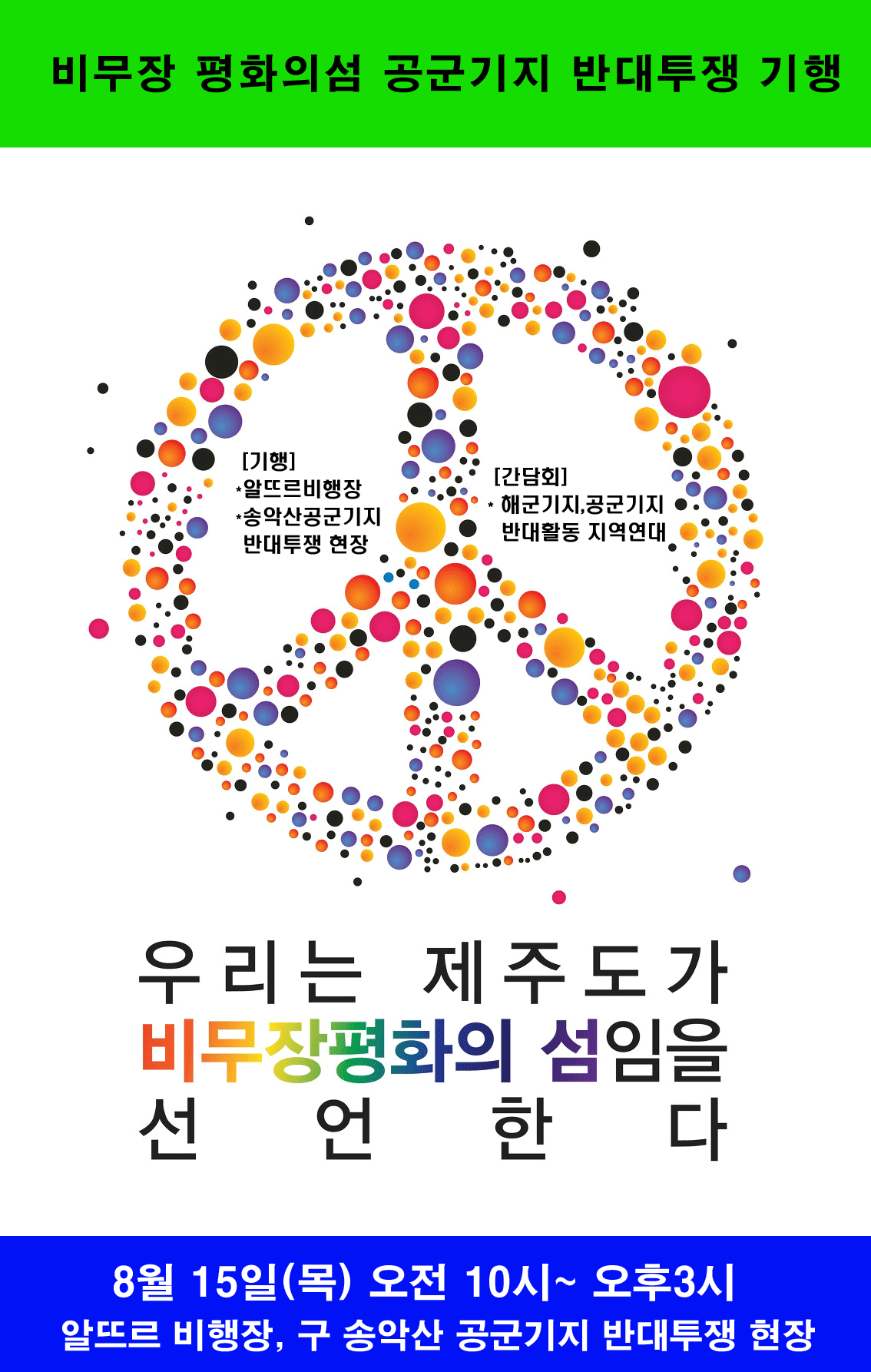
Tomorrow, August 15, 2013, the 3rd meeting of the movement to demilitarize Jeju “Jeju, the Demilitarized Peace Island” will meet. This meeting open to everyone will take place from 10 a.m. to 3 p.m. in Moseulpo, on the southwest cost of Jeju.
Moseulpo is an important place in the history of military and anti-militarist struggles on Jeju. During the Japanese colonization, the residents were forced to large caves out of the coastal cliffs of Mt. Songak to store torpedos to be used for attacks on allied forces in WW2, a part of Japans broader massive military build up of Jeju in anticipation of a stand off that fortunately never happened. Nearby is the abandoned Alddreu Airfield, also set up by the Japanese military for bombing China.
Caves along the cliff face of Mt. Songak.
Later during 4.3 and Korean War, Moseulpo, like most of Jeju was also the site to several massacres including the Massacre at Seotal Oreum. In 1950, The Moseulpo Police had arbitrarily detained 344 people in the police station, a fishing storage, and a potato storage. 211 of the detained were eventually slaughtered without any legal process and secretly buried. 20 people were killed on July 16 and 193 on August 20. 41 other people went missing.
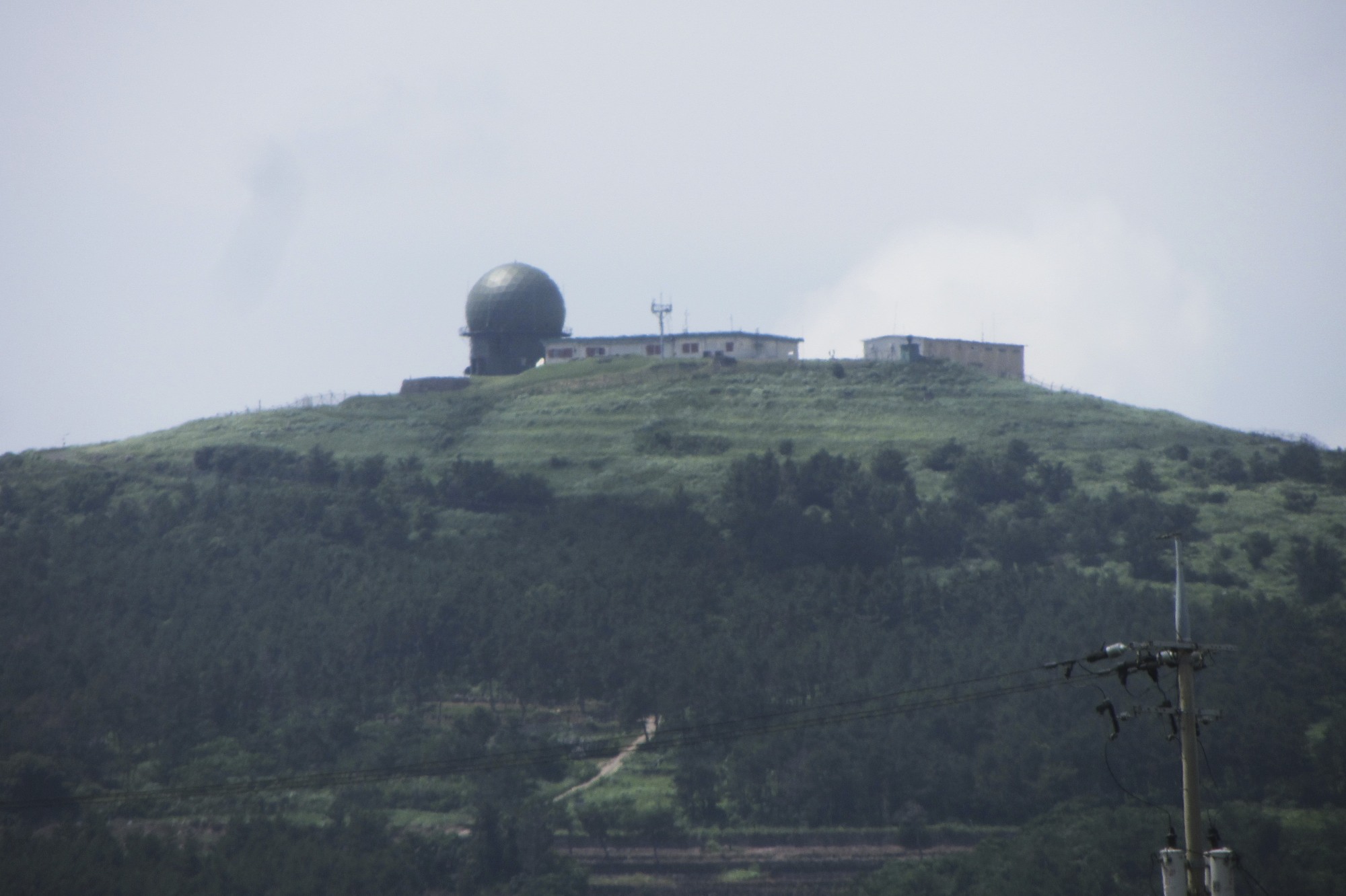
Later from 1987-1989, the Korean government attempted to build an air-force base on Mt. Songak, but strong local resistance won after a two year struggle and the plans were scrapped. However, the Korean Ministry of National Defense still owns land in the area and recently there was has been rumors that they again plan to build an airfare base there, perhaps on part of the old Alddreu Airfield (part of which has been declared a national heritage site). Meanwhile, the ROK MND has a small radar base in Moseulpo, formerly the U.S. owned Camp McNabb (for 53 years until it was taken over by Korean in 2005.
Moseulpo Radar Base, formerly U.S. Camp McNabb.
In light of this history of oppression and resistance, Moseulpo is a key location for the movement to demilitarize Jeju.
Peace loving people from across Jeju and Korea will come together to tour the historical sites, hear about the successful struggle against the air-force base and discuss and plan the demilitarization of Jeju. Join us!
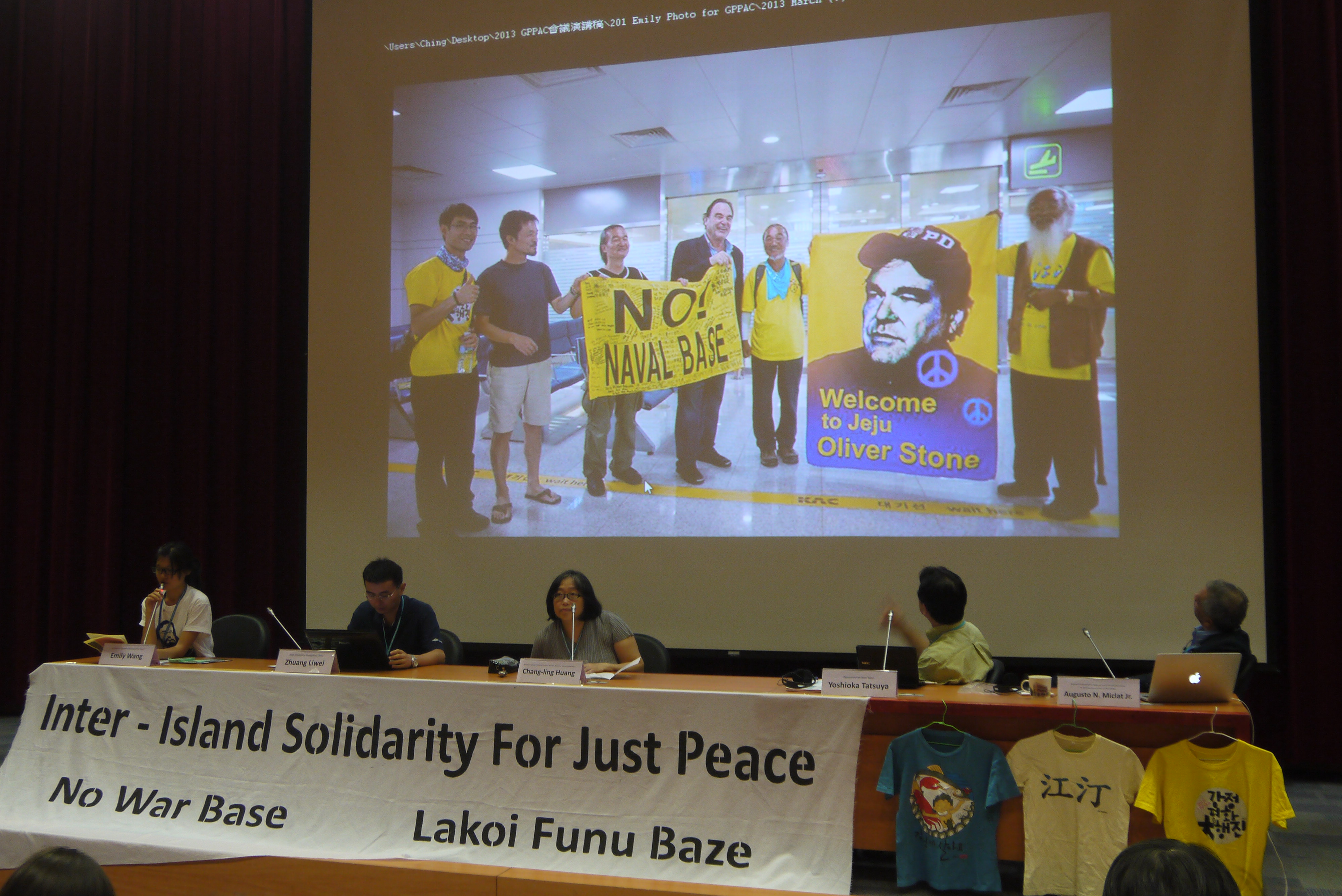
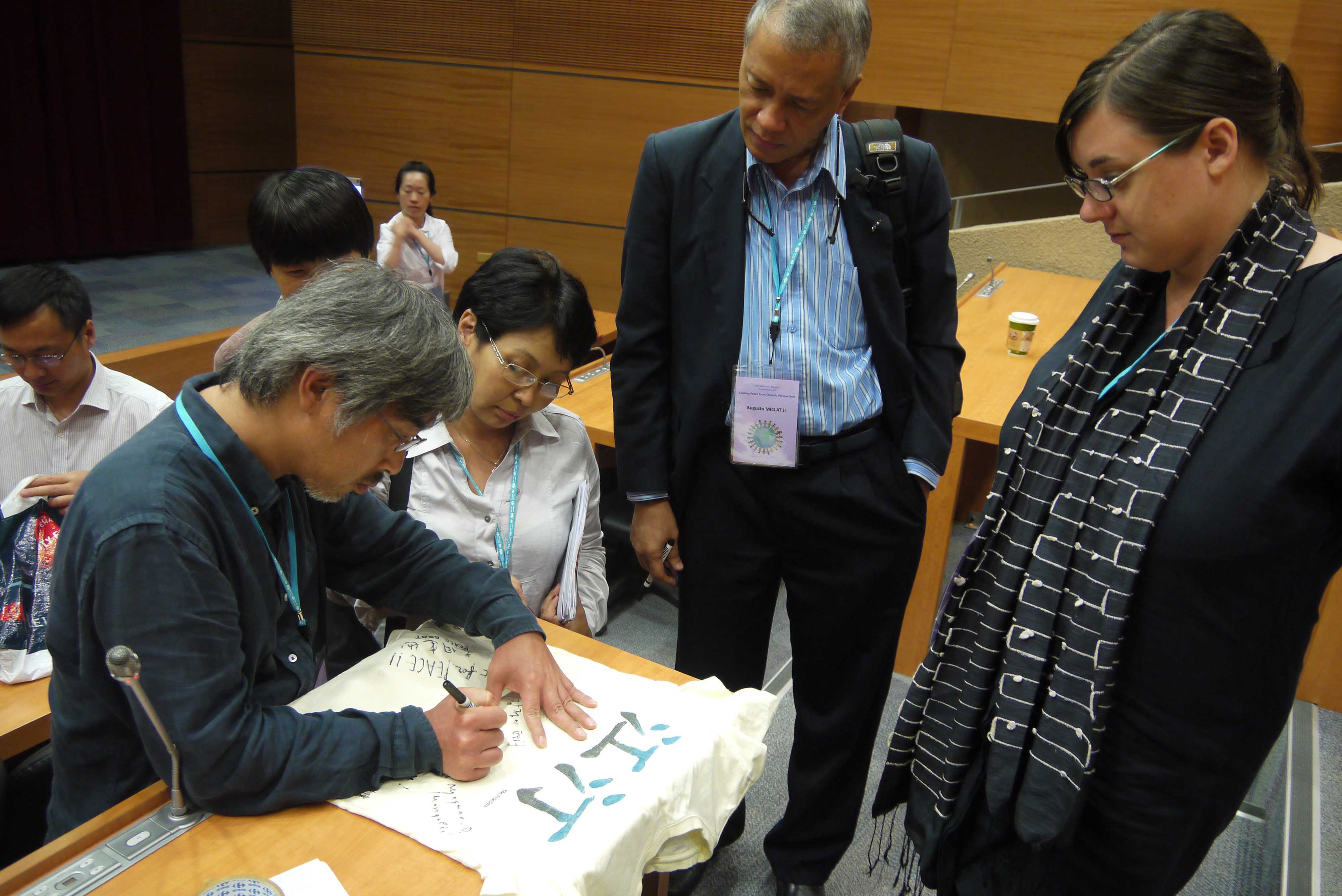
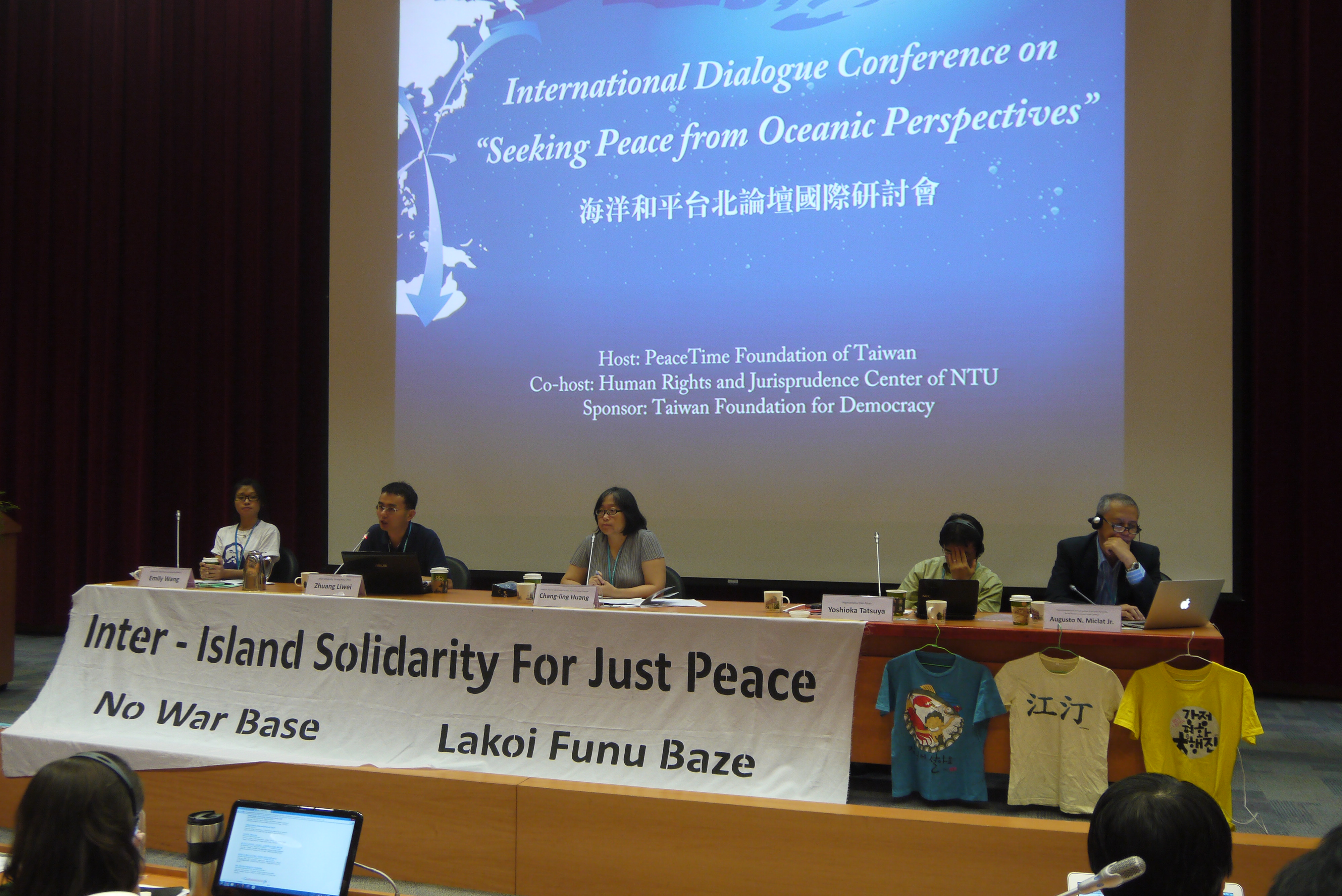
On August 3rd, the International Dialogue Conference on “Seeking Peace from Oceanic Perspectives” was held in Taipei, Taiwan. Emily Wang was one of the speaker in the secession of “An Oceanic Deconstruction of Geopolitics” to share about Gangjeong and the idea of Inter-Island Solidarity for Just Peace.
Distribute the Gangjeong NewspaperPeople were writing the messages to Gangjeong
The following is the speech draft of Emily Wang.
————–
By Emily Wang
My name is Emily Wang. I am an island peace activist from Taiwan Island and also I’ve ever lived and worked for peace on Timor Island for 1 year, and Jeju Island for almost 2 years, and I just got deported by the South Korea government in April 2013 due to my involvement in the Peace Movement in Gangjeong Village, Jeju Island where a major naval base is being built up. Thanks to the deportation, I got depressed for a while because I had to leave my friends and family. But also it gives me a chance to move forward in my next steps as an island peace activist.
Today’s topic is “An Oceanic Deconstruction of Geopolitics”. I would like to begin by sharing about “islands”, and I think the long suffering of many islands will provide an inspiring source to deconstruct geopolitics and for the peace in our region.
One of the crucial challenges of many peaceful and beautiful islands face is the trend of military expansion and militarization, largely by the U.S. Military. This has led to conflict, suffering, and environmental destruction in such places as Okinawa, Hawaii, Diego Garcia, Sprately Islands, Jeju (Korea), Guam, and others.
The situation which the islands face has been getting worse since the US launched the “Asia Pivot” strategy. Many islands are going to be further militarized, for example in North East Asia, Jeju and Okinawa. Besides Northeast Asia, there is other bad news to worry about. For example, The Philippines’ government now plans to invite back the US military they once kicked out to use their base again. The US is strengthening its partnership with these countries and following the strengthened partnership, these countries self-colonize themselves from the center to further marginalize and victimizes the small islands.
These islands are like “LilyPads” in the ocean used to allow military bases encircle the land to prepare for possible war in the future. Compared to a huge base, lots of small bases are spread across these lily pads, a strategy that is more flexible, attracts less attention, and allows for easier defeat of grass-roots resistance. In the past continuing until now, we have seen many islands face hardships in resistance due to the isolation of these small islands. Therefore, we need to develop inter-island solidarity for just peace among vulnerable islands and their peoples, for the protection of their lands, cultures, and traditions, as well as to find common strengths and resources for peace and just life. “Just peace” is our pursuit. We want to stop the current on-going militarization and while preparing other islands to prevent this possibility in advance. These struggles are not NIMBYs. One success shouldn’t come through another island being victimized.
I was a peace school teacher in Timor Island in the past, and recently I visited Timor again to share this idea of inter-island solidarity for just peace. During this visit, I heard that the US had a plan to use Timor-Leste’s Atauro Island for a base, while promising to build lots of infrastructure for this newly-independent country. So far, the government rejected, but this worry remains in my mind. Now, I am at the Northeast Asia GPPAC meeting, but I am also talking about another beloved island far away. These islands are too spread out, too small, and have so far mostly faced lonely struggles. I think especially for islands, we should not let national sovereignty divide the continuance of ocean.
In Northeast Asia, we dream of first starting with a Peace Island Triangle consisting of Okinawa, Jeju and Taiwan. What I mean by peace island is demilitarized peace islands. No bases, no militaries, no conscription, no state violence, and no domestic colonization or marginalization…
A long time ago, Jeju, Okinawa, and Taiwan were embraced by the ocean and developed unique cultures. Then influence and exchange came from the main lands or big islands. Mostly islands have been “marginal” places for the “center” of the main lands or big islands, but islands as their own center have gone on their own paths from generation to generation. Then western imperialism struck our region and most of the world. Still Islands often had distinct experiences from the main lands under imperialism.
Okinawa, Jeju, and Taiwan were colonized by Imperial Japan and become the stepping-stones for the expansion of Imperial Japan. In the final moments of World War Two, Imperial Japan further fortified these islands in expectation of invasion by the US Allied Forces, dragging these marginalized islands into the war as the frontline to protect the centers of power. It brought disastrous ground battles in Okinawa and air raids in Taiwan. Jeju was highly militarized through forced labor as well but following the battle in Okinawa, did not see war at that time. However they later faced the terrible extended 4.3 Massacre.
Due to the geographic location of the island, during Japanese colonization, perhaps 200,000 Jeju people at one time or another were moved back and forth between Jeju and Osaka, the foremost industrial city in Asia at the time. There they found jobs and, for some, better education than was allowed in Korea. Frequent ferries, some organized by Jeju transportation cooperatives, carried people to Osaka from eleven ports around Jeju. In Osaka, some Jeju residents were active in organized labor and Japanese socialist and communist organizations even in leadership positions. Some 60,000 people returned from Japan to Jeju within a short time of the Japanese surrender in August 1945. The experienced and educated returnees played an important leadership role in the emerging governmental structures on Jeju.
However, soon the division of the Korean Peninsula by the United States and the Soviet Union turned Jeju into a battlefield for subsequent cold war conflicts on the peninsula. In 1948, with U.S. and U.N. support, South Korea held elections that established a separate state in the south, thus solidifying Korea’s division. When the US tried to install a Pro-US government in the south with a separate election, the Jeju people bravely stand up to protest and boycott this election and the division of Korea. When U.S. backed leader Syngman Rhee took power following the elections, he initiated a massive “Red” cleansing campaign targeted the Jeju general population. Thousands of people were killed. It is estimated that 70 percent of entire island’s villages were razed to the ground and 30,000 people—ten percent of the island’s population—were murdered.
For years, any mention of the massacre could lead to imprisonment and torture. Relatives of those who had been labeled as Communists were prevented from taking public service positions or jobs in many companies. Many are still afraid to talk about what happened. For 50 years, successive governments in Seoul silenced the Korean people’s memories of systematic murder, rape and torture. It was not until 2006 that the late President Roh Moo-Hyun officially apologized for the massacre and designated Jeju “Island of World Peace”. As one exits the Official 4.3 Peace Park Museum, a sign reads: “The Jeju April 3rd Incident will be remembered as a symbol of the preciousness of peace, unity and human rights.” But the government’s memory is short. Plans for a major naval base on Jeju had been in the works since 2002 at different locations, but opposition from local residents’ halted construction several times. The struggling of the islanders to defend their lives, lands, community is again leading to them being painted as “Reds”.
This sad history once led the people to dream of making this island a Peace Island, but we realized that without continuous non-violent efforts to realize this goal and to carry on peace education, even the islanders themselves can erase these precious memories through public education and mainstream media. Also, we learned that without walking together with the international community, our peace cannot be a just peace.
I am an islander. I’ve talked much about the victimization of islands but it is not because I hate people from mainlands or big islands and I don’t deny the suffering of mainlanders as well. The reason that I promote island peace building is because I want to build peace as who I am. Actually, my island, I mean Taiwan, itself is also a “big island” which marginalizes and victimizes smaller islands like Lanyu, where our government shamefully secretly throwsaway nuclear waste. Unlike Okinawa, Jeju, and Taiwan which have relatively long histories through the storms of power-shifting between surrounding powers, Lanyu had long been a self-governed island without interruption from outside until its colonial encounter with Imperial Japan and the Chinese Nationalist government. Social activism on the Island began from the suffering of this small island. I expect Lanyu, the Chinese name, or Ponso no Tao, as its called by its indigenous islanders can become a light to connect Taiwan to the Peace Island Triangle.
Only if peace and justice become a common goal among us, can we break our current boring and rigid situation, and blossom our creativity through peace-building.
The suffering islands are our hope. We should hold hands together with these islands regardless if you are foreigners or mainlanders. I want to emphasize that talking about Islands and Islanders is not to make division. I just want to remind us that there are some people who are embraced by the ocean but sadly this embrace by the ocean turned into the isolation by the ocean. These are issues that we should face together. I hope that islands will not only again be embraced by the ocean but also be embraced by the surrounding big lands.
I truly hope we don’t make a stupid fake peace in our region by holding hands with the US while refusing to face the historical issues that caused our region to become one of the most militarized in the world. There are many things we islanders can do as we dig through the layers of our history and seek to find a common future peace across the ocean, between the islands within it.
At the end of 2013Gangjeong Grand March for Life and Peace (July 29 to Aug. 4), there is a huge and memorable human chain event for two hours in Gangeong village from noon to 2 pm on Aug. 4!
The human chain is a succession of people’s daily human chain in front of the Jeju naval base construction(destruction) gate after daily Catholic mass and Gangjeong dance in protest to stop the Jeju naval base construction.
Two more prisoners of Dr. Song Kang-Ho and Br. Park Do-Hyun! All four prisoners including Yang Yoon-Mo(the court added him fines of 2 million KRW on June 25, which means he would spend 39 days more of prison labor. Because of that, he would be released in May, 2014, not April, 2014) and Kim Young-Jae (the court dismissed people’s appeal for bailing on him on July 8) ! The daily struggle to stop the Jeju naval base project is being continued in Gangjeong.
Peace-loving internationals, even though you may not be able to physically join, please join our human chain in spirit! HOW?
_ You may hurry to mail us some souvenir such as your t-shirts or whatever that can represent you with your name/ messages put on those. We will put those in our human chain. Please see the photos and videos below. OR
_You may send us solidarity messages(up to 100 words)/ photos/ videos no later than July 20. Please see last year’s here.
_Contact: gangjeongintl@gmail.com
We especially encourageall the peace-loving internationals who have been forcefully deportedby ROK government orbeing threatened to be deportedto join us! (To see the status of deported internationals, see here)
All the names will be put at the ending credit of Director Cho Sung-Bong’s documentary, “Gureombi Wind blows.” Dir. Cho plans to take air shot of huge human chain event on the day.
Noon on Aug. 4, 2013
Jeju naval base main construction gate -naval base project committee building complex gate-Peace Center at the Sageori( four way intersection)-Gangjeong port
People in happy faces are to go ALL to Gangjeong to Join the HUMAN CHAIN to HUG GUREOMBI ROCK!
(translation of poster)
Photo fwd by Choi Hye-Young. people’s daily human chain in front of the Jeju naval base construction(destruction) gate. Let’s see all in Gangjeong on Aug. 4. All of you can join us in spirit!Photo by Kim Dong-Won/ Gangjeong is endangered. A peace keeper hung a photo of a villager in his childhood. We dream every life visible and invisible to join our grand human chain event on Aug. 4! For more photos, see here.Photo by Kim Dong-Won/ Every t-shirt or whatever souvenirs you mail to us can represent you. The t shirt is owned by a peace keeper who struggles daily. In that way, we want to represent all the prisoners, deported internationals whom we want to be together in our huge human chain event. For more photos, see here.
People’s promotion video: Please join our human chain to stop the Jeju naval base project on Aug. 4!
‘Independence FROM America’ 4th July at Menwith Hill, Yorkshire, England. This US military spy base is managed by the discredited NSA and linked to Missile ‘Defence’ and drone killings.
Peace flag photo from the Menwith Hill, UK “Flying every week at demo at Menwith Hill x” (Sent by Lindis Percy on June 18) . “The person in the photo is Martin Schweiger – a medical doctor who comes straight from work each week to the demo. He is also a Quaker, activist and….CAAB! The winter was hard with a lot of snow, then a lot of rain but now…summer time! It can be very rough up there.”
The below is a re-blogging from here and here. The statement includes a content on Gangjeong.
To see the report from High North Space Conference, see here.
To see ROK’s involvement on the Arctic development, see here.
For more details on the Kiruna conference, see here.
PROTECTING THE HIGH NORTH, DEMILITARISING OUTER SPACE AND REMOVING THE THREAT OF NUCLEAR ANNIHILATION
The International Conference on the High North and International Security was held in the city of Kiruna, Sweden, on 28-30th June 2013. Representatives from a wide spectrum of civil societies and public movements from a number of Scandinavian, European, Asian and Latin American countries, Russia and the United States of America attended and agreed the following:
Conference members recognize:
that we are facing major threats to our survival through the continued pretence that security can be obtained through aggressive foreign policies and military action;
that the ultimate consequences of these policies is the continued development and threatened use of nuclear weapons and the exploitation and militarization of environments that should be protected for the benefit of all humankind – such as the Arctic and outer space;
that the High North is being used by an expanding NATO as a military practice ground in which to rehearse future war fighting strategies and to test and develop new killing technologies;
that the US has established a satellite ground station in the Svalbard islands in Norway which is used by the military and therefore violates the Svalbard or Spitzbergen Treaty that requires that the archipelago is not used for military purposes;
the rapidly increasing deployment of space based military systems and the global network of ground based stations (including radars, downlink and surveillance facilities) that support and supplement them;
that the uncontrolled and irresponsible use of outer space has resulted in that environment being littered with debris that could eventually render it impenetrable;
the destabilizing effects that the deployment of space based, ground based and sea based missile defense systems have on undermining international stability and that they are risking the possibility of reaching further agreements on nuclear disarmament;
that all states who have signed the Nuclear Non-Proliferation Treaty should honour its Article VI and “pursue negotiations in good faith on effective measures relating to cessation of the nuclear arms race at an early date and to nuclear disarmament, and on a Treaty on general and complete disarmament under strict and effective international control”;
the negative consequences stemming from the stationing of US tactical nuclear weapons in a number of European nations;
that US President Obama’s focus on his “pivot to Asia”, the sending of missiles and warships to the region and the encouragement of the construction of support bases in the region (such as the one threatening the lives of the Gangjeong villagers on Jeju Island, South Korea), is aimed at containing China and is increasing international tension.
We therefore call on all governments, political parties, members of civil societies and public movements all over the world to share these concerns and urgently request them to call upon:
the leaders of the Permanent members of the United Nations Security Council to arrange an urgent meeting on the revival of stalled arms control processes and to embrace all key areas, including nuclear weapons, missile defense and conventional weapons stationed on the ground, at sea, in the air and in outer space;
the members of the United Nations to firmly work towards the adoption of a Nuclear Weapons Convention, leading to nuclear disarmament, and we call upon the nuclear weapon states not to obstruct the discussion of the Nuclear Weapons Convention in the General Assembly of the UN;
all nations possessing or about to possess missile defense components should recognize their destabilizing nature and seek instead, through diplomatic processes, to reduce international tensions and work towards a situation where cooperation, mutual trust and understanding;
all space-faring nations should engage immediately in high level talks on the Prevention of an Arms Race in Outer Space and the adoption of outer space as a de-militarized zone;
all states to respect and renew their commitment to protect the unique and vitally important regions of the Earth, such as the Arctic and Antarctic, and reconfirm that they are not the property of any one nation, and never should be, but are to be protected as a common heritage for all humankind and never used for military purposes.
The money and material assets that will be gained from the above steps and other arms control and disarmament measures should not then be redirected to other military projects but used instead to help convert our militarized societies to peaceful ones that work for the betterment of the social and economic well being of all people – for human rather than state security – and for dealing with our common problem of climate change.
Emily, the Deported Gangjeong Peace Activist, has just visited Timor-Leste to share (1) the Gangjeong’s struggling stories and through this sharing, she also talked about (2) the ideal of Inter-island Solidarity for Just Peace.
This video, Gangjeong in 2012, is translated into Tetun, the most popular language in Timor-Leste, and was used in the sharing in Timor-Leste.
Inter-Island Solidarity for Just Peace from Timor-Leste
From this visiting she also learned that the American navy has tried to take the Atauro Island of Timor-Leste to be its naval base, but so far, not yet succeeded to persuade the government of Timor-Leste. This is an alarm for the newly-independent country Timor-Leste in this trend of islands’ militarization.
Emily met the Human Right Group, Group of Women Peace and Leadership, and the university students and graduate students in the University of Timor Lorosae. These Timorese friends were really amazed by the ongoing struggle of Gangjeong and be more aware about the issue of the militarization in lots of islands.
The following is Emily’s speech especially on inter-island solidarity for just peace in Timor.
——————————————–
Dear friends of Timor,
I am Emily Wang, a peace worker from Taiwan but I have ever worked in Timor island, Jeju island and Taiwan island. Today I am especially happy to be in Timor-Leste again as Timor is where I started to dream to be a peace maker.
Among the places where I have ever stayed and worked for quite a while, there’s one obvious common element. Is there anyone noticing about it?
Yes, Jeju, Taiwan, Timor all of them are island! But today, I will more focus on the island in North East Asia, including Taiwan, my hometown, and Jeju where I’ve lived for almost 2 years, and Okinawa. Even though I haven’t got chance to visit Okinawa for deeper understanding, many Okinawa people have visited Gangjeong and shared their stories. These three islands are geographically close to each other, and thus when we review the island history by viewing the interaction or relation between these islands and other big powers, you may also get some clue about the reason why I and my co-workers are working to contribute for inter-island solidarity for just peace, and then hopefully, from my sharing, there will be some seeds to grow in the future among us.
Not until my life journey was trapped in Gangjeong, I have been forced to realize and learn lots of hidden stories in the history I used to learn. You know what I am so much surprised that I’ve never realized about Taiwan and Korea’s connected past and present, and I can say most people in Taiwan or Korea haven’t got chance to realize it. Actually, we don’t learn the Korea and Japan’s history in our compulsory school education. Only if the Korea or Japan appeared in the history of China, then the book may have some space for that incident. The history student learned in school in ROC (Taiwan), ROK, and Japan are written on the unnaturally isolated basis of state. Which means we are forced to view our history on the isolated basis of state, and unconsciously, we are divided unnecessarily. The stories which I should have noticed are stolen by an invisible hand.
For I started to realize that, I was motivated to study about the missing history from a missing angle, and I will bring you to a quick history journey in our region through the angle of Island.
For the presentation in Timor, I made the form to compare the history of islands. Thanks for you guys! Because the desire to share our history with you gives me a chance to learn again my history and I just realized a lot of parts of histories before I came to Timor!
Taiwan
Jeju
Okinawa
Timor
In the past, independent island with diverse indigenous people’s tribal culture. Some Han people immigrate to Taiwan.Colonization by Dutch, Spain, and then Chinese regime with lots of Han people’s immigration to Taiwan.
In the past, independent island regime until 12, 13 century, swallowed up by mainland.In the long time ago: battle ground of big countries (China, Japan, Korea, Mongolia…)
In the past, independent island regime. Tributary state to China. In 1609 Satsuma from Japan invaded Okinawa, then Okinawa deftly served both China and Japan.Diverse culture: local culture plus big influence from China and also Japan.
16th century, Portuguese came17th century, Dutch came. West Timor and other island colonized by Dutch between 17th-19th were known as the Dutch East Indies.
Japan imperialism’s colonization(1895-1945)
Japan imperialism’s colonization(1910-1945 ):
Japan imperialism’s colonization(1879-)
Japan imperialism’s colonization (1942-1945)
During war time: Kominka movement(Assimilation policy and a campaign to totally transform the Taiwanese, Okinawa people and Korean into loyal subjects of the Japanese Emperor between 1937 and 1945.)
Island colonies to be militarized, to be exploited for the war preparation and to be used as bases and then victimized
Towards the end of World War II, Taiwan as the colony of Japan became the target of Allied, for example, Taipei Air Raid. The number of deaths totaled more than 3,000, Tens of thousands of people were displaced or became homeless, and many buildings were destroyed either by the attacks or by the fire caused by the attacks. After the conclusion of World War II, because of its pro-American political stance, the government of Republic of Chinatoned down the attack and excluded it from the media and history textbooks.
Towards the end of World War II, the Japanese heavily fortified the island, deployed 70,000 soldiers, and forced the islanders to construct coastal defenses in anticipation of a U.S. invasion.
Towards the end of World War II, the Japanese fortified Okinawa in hopes of thwarting the Allied advance on mainland Japan. U.S. forces, prior to Hiroshima and Nagasaki, saw Okinawa as an ideal location from which to launch potential ground and air attacks against Japan.Okinawa experienced the only ground battle in Japan during World War II. Lots of Okinawa people died and dislocated, lot land…
The end of World War Two:- The end of Japanese colonization- Expectation to build up a new society but…
The end of World War Two:- The end of Japanese colonization in both Korea peninsula and Jeju.- Expectation to build up a new society but…
The end of World War Two:- expectation to build up a new society but…
The end of World War Two:- 1945, Portuguese Timor
– Civil War in China- KMT’s exploitation was like a second colonizer. – In 1947, 228 Massacre – 1948 KMT government launched martial law, Pro-US military dictatorship was establishe– 1949 KMT lost civil war and retreated to Taiwan._ 1950 Korea War broke out, and US Seventh Fleet was send to Taiwan Strait
– Soviet Union and US occupation of north and south Korea – North Korea government firstly built in 1945 but US dislike it. In 1948, with U.S. and U.N. support, South Korea held elections that established a separate Pro-US government in the south, thus solidifying Korea’s division. – In 1948, 43 Massacre
– Occupation by US military- Under the impact of Cold War, the budget for US base construction in Okinawa was passed.- The United States would administer Okinawa but its inhabitants would retain Japanese to svoid criticism of colonization which is good for Japan and US
Okinawa is excluded from the Peace constitution. The history in Okinawa after world war two is very different from the history in other region of Japan
– The Okinawa people started movement to be returned back to Japan
– ?
– Cold War
– Since middle of 1950’, all the military bases in Taiwan provided for US military to use, especially during Vietnam War (1965-1971), around 20,000 US soldiers stationed in Taiwan.- Since 1967, Taiwan was designated as a holiday place for US Army.- White Terror- Economic growth because of War
– Because of Cold War, lots of US army and base in Korea.- Korean army also sends to Vietnam war…- White Terror- Economic growth because of War
– Important US base during Cold War- 1972 US relinquish Okinawa to Japan but the base remains. It shows Okinawa’s victimized role in the US-Japan Security Relationship. Okinawa people realized returning back to Japan is not the point, but military base is the point to fight.- Impoverished by US military administration and started “Base economy” which means islanders relied on the base to survive as the original way of living was destroyed.
– In 1974, after the fall of Portuguese fascist regime, independence was encouraged by the new democratic Portuguese government.- legalise political parties in preparation for elections to a Constituent Assembly in 1976.- Fretilin was criticised by many in Australia and Indonesia as being Marxist. The United States had also expressed concerns over Portuguese Timor- 1975 Indonesia Invasion
China Growth or China Threat / How to face China and how to face each other in our region where the decolonization process was intervened through violence? By holding US’s military hand, we don’t need to face each other!
– 1971, ROC(Taiwan) was kicked out from UN- 1979, US Taiwan Relation Act (US continue to sell weapon to Taiwan and promise Taiwan that in Emergency situation to secure Taiwan)- Taiwan is in a weird situation… (for example: buy the weapons from US and support the US’s war even contributed to the killing in East Timor…)- China and US both cannot tolerate Taiwan to be militarily used by each other,
– US base in Korea’s function is not only for North Korea but largely for China.- Relocation of the base in Korea for the strategy flexibility (eg. Pyeongtaek base)- Jeju Naval Base
– US base in Okinawa’s function also for China
President Obama: Asia Pivot (Rebalance the US focus to the Asia pacific area)- Islands in Asia Pacific area will be more highly militarized- Missile Defense System – an important part of America’s first strike strategy. It serves as a shield for US to prevent the retaliatory action if the first strike were launched.- Who are the targets?# Russia owns the richest natural gas provision and a large portion of the petroleum# America is getting difficult to compete with China economically. How to control China’s economic engine? China imports over 60%’s petroleum through the shipping.- Korea, Taiwan, Japan are all part of the MD system, and the MD system’s Aegis Warship will be stationed in Australia, Japan, Guam, South Korea. Jeju island will be the naval base with Aegis Warship.
– How about Timor-Leste?- Are you safe?- Atauro’s future?
Before the world war two, many of the people in East Asia had been experiencing a common struggle against the imperialism. But after world war two, the common struggling against imperialism was split into two under the cold war. During the World War Two, Islands like Taiwan, Okinawa, and Jeju were unwillingly militarized as the colonies of Japan, but these victimized islands were attacked by America military, the Allied, for attacking the mainland of Japan.
After the World War Two, no time and no need to face peace and justice issue in our region as all of us have to face the cold war together with the US. During the cold war, dividing and dominance in our region was the strategy of US. North East Asia was divided into two sides, and to foster the side of the US partners in our region during Cold War, the Pro-US governments were demanded by the US. That’s why the US installed a new Pro-US government in South Korea and contributed to the division of Korea. And also for US’s interest, the partner countries of US had better to be stabilized to be the US side. Thus, the Pro-US government must have the ability to eliminate the different voices, so the US backed up the Pro-US government’s bloody dictatorship by supporting lots of weapons and military, and money!
Under that background, Pro-US military government in Taiwan and South Korea both suppressed the decolonization effort with the excuse of anti-communist, and the people in Taiwan and Korea both experienced the massacre, 228 massacre and 43 massacre in Taiwan and Jeju, which was both stigmatized as communist rebellion but long time later after both Korea and Taiwan ended the White Terror Era and went on democratization process, both truth of 228 and 43 incident were disclosed more and more.
For the effective social control, in South Korea, the US military and Korea dictatorship even worked together with the Korean vested interests who had served for Japanese colonizer to exploit the other poor Korean. So after world war two, these people back to their power again but this time, worked with US and Pro-US dictatorship to continue the strict social control for the reason of anti-communist.
In China, the KMT government lost the civil war in mainland China and retreated to Taiwan, Taiwan Strait between China and Taiwan become the Cold War dividing Line. One thing to notice is that the whole Taiwan island before the world war two was the colony of Japan, and after the war, Taiwan people experienced a very short cerebration and expectation of emancipation, and then got very much disappointed by KMT government as the Taiwan people were just again became the second citizen of government from mainland and the “self-governance movement” which has started since the Japanese colonization time got suppressed again by the KMT dictatorship government.
(One thing to notice is Korea and Jeju were all fell into the Japan’s colony together but Taiwan alone were given to Japan by Ching dynasty in 1895 after a lost of war between China and Japan, therefore during the World War two while China fought hardly against the Japan’s invading, Taiwan people were Japan’s colony second citizen, and Taiwan island was a land to be exploited for Japan’s imperialism war against China and other countries.)
At the moment when Taiwan’s people who settled down in Taiwan before the 1945 haven’t adapted themselves as “Chinese” yet, and then the Pro-US KMT dictatorship government made them feel they are not equal with “mainland Chinese” but second citizen again as “Taiwan Chinese”, and make Taiwan people thought that Japan and China are actually the same as colonizer. Some even hate KMT more.
There’s one more thing to notice here, when I mention “Taiwan people”, it means diverse group of people who live in Taiwan and other small island governed by Taiwan’s government now.
And the KMT’s lost of Civil War and retreating to Taiwan along with lots of immigration from mainland, due to the bad governance of KMT, these new immigrant people after World War Two had long been called as outsiders (people from other province, people who are not from Taiwan province), a discriminating calling mainly resulting from the dissatisfaction of decolonization and emancipation process. Except for the above-mentioned Han people, there’re indigenous people, the most discriminated group, became under the KMT’s governance. The indigenous people are not Japanese, not Chinese, so even in the emotional feeling, to be “returned” back to Chinese government is not a “returning” but simply just a new colonization by a dictatorship KMT government, for them, a worse colonizer than Japan.
In Japan, under the US military power, a pro-US and anti-communist government was built up too. Japan became US’s partner in cold war system, and it froze the Japan’s society to face the decolonization historical issues as an imperial colonizer and an invader in our region. This gave the militarism in Japan a big chance to be revitalized even after the disastrous war experience.
Okinawa, an originally independent kingdom having a diverse exchanging relationship with both China and Japan, became the imperial Japan’s territory in 19 century. And during the World War Two, due to Okinawa’s geo-graphical importance, Japan highly militarized Okinawa island, but still US military succeeded to take over Okinawa to make it an important jumping step to attack the mainland Japan. Thus, Okinawa being victimized by the powerful countries and experienced a bloody ground battle by US and Japan. After World War two, for its importance and convenience of military, Okinawa was continued to be occupied and directly governed by the US military but remained as Japanese citizen, a deal between US and Japan for their state interest. Okinawa, the only place experiencing the ground battle in world war two in Japan, again was sacrificing for the mainland Japan who enjoyed a peace constitution after world war two. During the US military governance period, Okinawa people never stopped struggling against the US military and US base, and thus the movement to return Okinawa back to Japan began in this background. Finally, Okinawa was “returned” back to Japan’s governance in 1972, but the US base remained, which made the movement to “return Okinawa to Japan” an ironical movement.
US intervention frustrated the decolonization process in our region, makes our common struggling history against imperialism to be forgotten, and also make our region still one of the most highly militarized regions in this world and unfortunately, I have to say our region is still invisibly governed or colonized by the US and imperialism but not so many people realized that.
After the introduction of the historical background, I would like to ask you to think of the history background I just shared, and put one more geographic factor- island-into your mind.
As islands, when we face the same big stream of the world, the same stream gives us, the islanders, and the mainlanders some different impact and experiences.
In the history, Taiwan, Jeju and Okinawa all had its own unique and independent culture. Even though the islands have certain degree of the cultural consistence extended from the Mainland, or Big Island due to the exchange and immigration, the unique island culture and geographic condition makes the islands the region distinct from the land but the difference was not often recognized or respect by the government from the mainland or super powers.
In many cases, for the mainland or the big island, the islanders are forced to sacrifice, to be abandoned or be treated differently as second citizen. In the past, each isolated islands faced this common fate but struggled individually and lonely with limited support from outside. In our region, all of us experienced the westerners’ imperialism and many of us experienced the westernized Japanese imperialism. However, as the islands, we usually faced double discrimination and were triple victimized by both the colonizer and from our culturally related mainland.
Actually for myself, to be an islander, to be given a chance to stay around the island, and to be a peace worker, I think the so-called isolation of island is not “isolation”, but the selfish imperialism state has given us the real feeling of isolation. In the past, the ocean embraces us but not isolated us. However the countries, the borders, the capitals, the imperialism isolated not only the islanders but also the mainlanders as we are all isolated from a possible way of peace.
Today, the growing tension surrounding lots of small islands related to the exploitation of natural resources in the sea brought the islands again to become a battle fields for the human’s greed. The government talked about “national security” but the militarization had brought the islanders a very in secure environment in the history. To talk about security in the way of militarization, the island will always be a jumping step of one super power to attack the mainland or another super power. The peace will never come through this way because the imperialism super power’s core value is not peace but national interest, and in fact, the vested interests’ interest. Peace obtained through force and violent means is not sustainable and in time will be forced to surrender to a larger force or power. The just peace can only be sustained through peaceful means and through our strong solidarity with each other. This kind of peace is the only way for the small islanders to survive and to preserve our island instead of relying on the militarized means which impoverished lots of islands already in the world.
Comparing to big mainland or big island, we are small islanders, very small, and very divided right now, so I strongly suggest that inside our own island, we should motivate people to foresee their possible future to be militarized or to be threaten by militarized states, by realizing this possibility, and by feeling the suffering of others, we should motivate people to demilitarized their island in advance and to make an international solidarity with other islands who are struggling to walk in front to be a Peace Island.
When I was in Gangjeong village, I met an international peace activist whose name is Angie Zelter. She came to Gangjeong shortly but did her best to support the Gangjeong peace movement. She joined to the SOS team’s action to go inside the seashore rock of Naval base, called Gureombi, and in front of lots of people and lots of police, she cut the barbed wire which prevent people from entering into the base. Finally, and not surprisingly, she was deported from Korea. There’re many internationals who got deported from Korea including me. But why do I especially mention Angie Zelter in this speech? Anyone knows the answer?
She has been contributed for lots of non-violent direct peace action and among them, there’s one peace action closely related to Timor Island. In 1996 she was part of a group that disarmed a BAE Hawk Jet, ZH955, causing £1.5million damage and preventing it from being exported to Indonesia where it would have been used to attack East Timor. I am really thankful for these inspiring people’s effort to make someone’s struggling in somewhere not alone. It inspires me.
I think as an island peace activist, when we struggle against the militarization which happened in our island, what we are doing is actually earn a chance to let the world peace begin from us. However, to be a more responsible island peace worker to realize the real world peace, we have no choice but contribute our best to the inter-island solidarity for just peace as we should not let any other island which has no tradition of fighting against militarism to receive the military base after our success. No matter the military base or other unjust thing which the mainland wants to dump to the islands should not just move from one island to another weaker island. If so, then, we cannot call it’s a victory of peace because our struggling is not NIMBY! Our struggling is for Just Peace. Not in my backyard and also not in your backyard because we are brothers and sisters!
Through encountering Gangjeong and experiencing deportation by the Korea government, the invisible imperialism and state violence appeared vividly in front of my life. When I faced Entry Denial in the incheon international airport in Korea, I remembered the immigration officer said to me: “Don’t blame us, if it’s Taiwan, the government will do just exactly the same thing to someone like you. Your government is the same.” Exactly, I agree with that immigration officer, so now the story should not just be about Gangjeong or Korea.
Not only Jeju island, but all the islands should not be victimized as part of the military chain to contain the big land, but the island can be an inspiration for the big land or big island of possible progress on world peace when we don’t leave each other alone on the way of peace. I believe People’s friendships are the most important and reliable basis of sustainable peace not a military base. So again, I am so happy to come back Timor, an island like a friend for me, to share my experiences. Since the Timor also face the danger to be militarized and to be semi-colonized again by the militarism after the hard struggle for independence, I hope my speech will help us to walk the way of Peace altogether. Thank you so much for listening my sharing.
Speech in the Peace Study class with Graduate Students in University of Timor LorosaeSharing of Gangjeong struggle with the group of Women Peace and Leadership
This speech was originally written and translated to be used by Mayor Kang at the 2013 Moana Nui conference, held in the beginning of June in Berkeley California. Upon the actual event, much of the speech was improvised, but some was based off the original speech found here. Special thanks to Fr. Pat for the translation from Korean to English.
Hello!
I am Dong-Kyun Kang, the Mayor of a small village called Gangjeong in Jeju. I am so grateful for this opportunity to speak to you. It’s very meaningful. So far, I’ve heard many stories from around the world which make very scared and worried for our descendents.
Given that fresh spring water is such a precious and scarce resource on Jeju island, the 450 year old village of Gangjeong situated in the southern part of the island was always the envy of other villages as its possession of an abundant spring water supply which always flowed freely ensured it was always ranked first among Jeju’s villages.
During the construction of the naval base, many international activists have visited Gangjeong and others in the process have been denied entry and deported. Other peace activists have been prevented from leaving the country. I’m keenly aware and saddened that many have suffered from many forms of repression and for their sacrifice I feel so grateful and promise to stand with you in solidarity.
You’ve now seen that in recent history there have been two major events in Korea – in 1948 and 1950. As you are aware there was the major upheaval of the 1950 Korean War which broke out in June 25- a tumultuous national tragedy. One could be forgiven for thinking that this was a family feud that led to the country being divided but the reality was that the war was the result of an ideological battle between the major powers at the time and Korea was its victim. This continues until the present time.
The April 3, 1948 Jeju uprising led to the brutal suppression of the population by state security forces which resulted in the massacre of the islanders of Jeju and behind the slaughter was the US government, the self proclaimed keeper of the peace! A conservative estimate puts the number who died from the mass killings at over 30,000 out of a population of 280,000 people at that time.
Fortunately, in 2005 President Roh apologized on behalf of the state to the people of Jeju and acknowledged for the very first time the states brutal suppression and massacre of the people of Jeju. He went on to declare Jeju as an ‘island of world peace’.
Peace can only be sustained through peaceful means. Peace obtained through force and violent means is not sustainable and in time will be forced to surrender to a larger force or power. However, I believe that dialogue and mutual understanding between people who work together in mutual respect to build a sustainable future is the key to a sustainable peace.
The location of Korea positioned in the middle of the Pacific Ocean and particularly the strategic location of Jeju Island is key to understanding its strategic importance to the world’s major powers. However, behind the construction of the naval base in Jeju is the US government. Will Jeju genuinely remain an island of peace or an island of military bases heightening tensions between the world’s major powers? This is a central question that needs addressing.
The naval base project is a national security project. I think one defines genuine national policy as seeking to put the interests of its citizens and their happiness and genuine well being first and foremost. Likewise national security is not only about the state’s administration and its military but should seek to ensure genuine human security for all its citizens. Genuine national policy and national security should seek to secure the confidence and trust of all its citizens which in turn forms the true pillar and foundation for its policies. Working together hand in hand with the people should be the central tenet of its policies.
Aside from the naval base construction creating the strong possibility of a situation of crisis for Korea and Jeju into the future, the village community of Gangjeong is being destroyed with its people being evicted. With the construction of the naval base the navy claims that the national security of the state is its primary objective followed by the economic development of the region and its third objective – the navy and residents coexisting in mutual cooperation and to the benefit of all. However, the construction of the naval base rather than enhancing and bolstering national security will have the opposite effect of increasing already existing tensions between global powers in the region resulting in Jeju being caught in the crosshairs of conflict in the future. How therefore can the building of a naval base bolster regional economic development in such a tense and dangerous environment?
The state in implementing its policies should first consult the people who will likely be impacted the most and endeavor to seek the consent of its citizens through due process which is the most important consideration and an important building block of any democratic society. Even with the project underway listening courteously to and reflecting on the opinions of the other is surely important in trying to achieve real cooperation. The need for transparency in implementing state projects is paramount. However, the naval base has been enforced from the beginning without any consultation on the decision making process and devoid of any semblance of transparency leaving the Gangjeong villagers in the dark about what was going on. Those villagers opposed to the base are in the process of having their lands expropriated without any dialogue or due process of consultation. The villagers are completely perplexed and dismayed by the conflict that has arisen in their village with the naval base decision having separated families and divided parents with siblings becoming enemies and yesterday’s friends becoming today’s enemies resulting in the collapse of the community.
Fully aware of the stark implications of proceeding with plans to build the base the central government and navy planned and designed the base together with the backing of the US government. As a means of promoting the base and quashing any form of dissent, protestors have been treated with great hostility and denounced as leftists and North Korean sympathizers by the military. The brutal enforcement of the base with complete disrespect and arrogance has resulted in the military losing whatever respect it may once have had.
Together with the mobilization of the police and state power is the major issue of the lack of due legal process and the arrests of over 700 activists, charges having been filed against 400 activists with 25 cases of activists having been imprisoned to date. There has to be a fair way to resolve such conflicts but the legal system and court process has failed to provide this.
With the full power of the police state brought to bear on villagers and activists alike it is undeniable that people will get hurt as they are literally being dragged away like animals battered and bruised. However the courageous and brave efforts of so many over the course of a 7 year long struggle are not in vain but are the source of a precious groundwork that is the basis for a bright future for Gangjeong and Korea alike. These continuing efforts will continue to bear fruit long into the future.
The majestic natural environment of Jeju is commonly referred to as beauty inherited from the gods and is home to the UNESCO Biosphere Reserve and three UNESCO World Natural Heritage sites. In 2012 The New Wonders Foundation voted Jeju Island as one of the 7 Natural Wonders of the World. In September 2012 the World Conservation Congress opened in Jeju where it was hoped that it would promote the international consensus of Jeju as a ‘World Environmental Capital City’. However, this ideal is being undermined by the destruction of the environment caused by the building of the naval base which is a grave threat to genuine national security.
Some concluding remarks.
The 7 year long struggle has left many exhausted and bruised after enduring much pain and suffering along the way. There have been moments of despair but the determination to struggle and defend our village and home and pass it on to future generations has been the enduring legacy and mainstay of the struggle and has been a sacred calling. A new hope springs from the end of despair. This new hope comes from people seeking their true human fulfillment as beings living in harmony with nature, living together in peace.
Instead of Jeju being designated an island of military installations we will work to ensure that it will be known as an island of peace, an island of natural beauty and conservation. Also, together with all the villagers of Gangjeong and the people of Jeju we truly desire that global citizens and true lovers of nature and world peace will have the freedom to gather in this beautiful place without the impediment of a ghastly and ugly military base which aggravates existing tensions between global powers. Therefore, what I truly wish is for everyone around the world to sing the peace song of Gangjeong and to keep it in their hearts. Ladies and Gentlemen, Please join together in solidarity and help us.