Save Jeju Now

No War Base on the Island of Peace

  • Home
  • About
    • History
    • 4 Dances of Gangjeong
    • 100 Bows
    • Appeal
    • Partners
    • Board
  • Blog
    • All Posts
    • Petitions
    • Arrests & Imprisonmentuse for all things related to arrests and imprisonment
    • IUCN WCC 2012
      • Appeals & Statements
      • Gangjeong-Related Schedule
      • International Action Week, Sept. 2-9
      • Motion
      • Special Edition Newsletter for the WCC 2012
  • Gallery
    • #7 (no title)
    • #8 (no title)
    • #6 (no title)
  • Press
  • Support
    • Act
    • Visit
  • Downloads
    • Monthly Newsletter
    • Environmental Assessments
    • Reports
  • Language switcher
  • Antimilitarism South Korean Style

    By Javier Gárate

    Originally Posted at War Resisters’ International

    During the first two weeks of October (2012), I visited South Korea, invited by the group World Without War to give a training for trainers in nonviolent action and to visit Gangjeong village, on Jeju Island, where people are resisting the construction of a naval base.

    It is well known that South Korea is a militarised country, with the protracted conflict with North Korea being a permanent reminder of this militarisation.

    For a decade WRI has been cooperating with South Korean antimilitarists. This began in 2001 when South Korean activists asked WRI for support in their work on conscientious objection. At that time there were hundreds of Jehovah’s Witness COs in prison for their refusal to military service. In early 2002 political COs started to organise themselves, and WRI played an important role in supporting their work. Initially their CO work came more from a Human Rights perspective but rapidly it took a more antimilitarist approach, with nonviolence being an important identity for them. As nonviolence and antimilitarism took a more prominent role in their work, they started expanding their work beyond CO support. That is how World Without War (2003) came to existence as a group resisting war by nonviolent means.

    As a direct consequence of the conflict with North Korea and a legacy from the Cold War, South Korea has around 70 US military bases in its territory. US Forces have been stationed in South Korea since 1950. Historically, their main role was to deter any possible war threat posed by North Korea. However, the USA’s Global Posture Review changes the role of US Forces in Korea from a stationary army on the Korean peninsula into a regional hub for rapid deployment and capable of pre-emptive strikes. The Land Partnership Plan of 2002, agreed by South Korea and the USA, has re-organised forces into fewer but bigger bases and training areas. Bases previous clustered on the Demarcation Line have been closed, but the expansion of bases further south increases the capacity to send highly trained troops to other Asian ‘theatres’, with the Jeju base playing a crucial role in it.

    Resistance to military bases has a long history in South Korea, with a wide variety of groups struggling against these bases. World Without War sees itself as taking the nonviolent direct action side of the resistance.

    Nonviolence Training

    World Without War has advocated and engaged in nonviolent action against the military bases and the different form of militarism in their country. This also includes their work against war profiteering, under their sister organisation, Weapon Zero. As part of this work they see nonviolence training as a key element in strengthening their commitment to nonviolence and helping to make their actions more effective. World Without War has been at the forefront of antimilitarist nonviolent actions in South Korea, carrying actions against military bases, war profiteering, military service, etc. Nonviolent direct action, however, is still a relative new concept within South Korean movements and there are strong criticism about it, but thanks to the strong commitment of World Without War and other sympathetic activists, slowly these perceptions are changing – nonviolence training has contributed to this change. Numerous World Without War members have participated in nonviolence trainings and some of them have carried out trainings.

    As part of the cooperation with WRI, we had the idea of having a training for trainers, for activists to empower themselves to go out and give their own trainings, and this year (2012) the plans finally materialised, with a training for trainers taking place in early October. The training for trainers was organised by World Without War, but was open to activists from other groups. Mostly of groups engaged in the struggle against the naval base in Gangjeong, Jeju Island. As part of the whole training for trainers process, five preparatory sessions where held before the training, with World Without War members doing the facilitation. These sessions used WRI’s Handbook for Nonviolent Campaigns as a guide for their sessions.

    The workshop was led by Denise Drake, of the UK nonviolence training organisation Turning the Tide, and myself. It was held on Ganghwa island. This island is very near the border with North Korea, actually from the island you could see North Korea. The island is a two hours drive from Seoul, and I recommend not to fall a sleep during the journey – as I did even though there was a big tv screen on the bus – if not you will definitely miss the moment you get on the island, as it is very close to the continent and joined by a bridge.

    Of North Korea I only saw some distant mountains, but just the feeling of being so close to this almost unaccessible country was special. I wished I had some binoculars to see more clearly. This excitement was shared by all participants, which goes to show how close but at the same time far is North Korea from South Korean people. The training was held at a beautiful complex, formed of a series of cosy cabins. Sleeping was Korean style, meaning good for your backs, on thin mats, which were a bit too exposed to the floor heating (useful in winter but this was autumn). Food was provided by a group from a Seoul Haebangchon Café Co-op under the name Bin-gagae and it was delicious, mostly rice and all forms of vegetable side dishes and with one night having Korean style Vietnamese wraps. Every evening we had a Peace Bar, with a good selection of beers and my favourite – soju. The Peace Bar raised funds to support the court cases of activists against the Gangjeong base.

    The training itself focused on the facilitation side of nonviolence training. At the end of each day we had a long session under the title Today’s Facilitation Points, which looked at what facilitation methodologies and tools we had used and how to adapt them to the South Korean context. After the first day we had to incorporate many more ice-breaking games as it was a common feedback from participants that South Koreans in general are shy when it comes to sharing in larger groups, and it is much easier for them to do the sharing in a more playful manner. Dancing is very important among South Korean activists, so we also learned some activist dances.

    During the training we used the struggle in Gangjeon against the naval base as well as the action at Samsung’s headquarters, where a group of activist poured red paint on them at the entrance of their offices – which is one of the main contractors of the naval base. If you still own a Samsung product, it is now time to get rid of it and join the boycott! This framework helped us to connect the training to actual struggles, for example an important discussion within the movement has been the phenomenon of shouting at police officers during the protests against the naval base. The point was not to agree if this is or not nonviolent, but what are the causes of it and what consequences this has. Another important issue was how to deal with people joining a direct action without being part of the preparation process, the pros and cons of this.

    An important session was what we called facilitation practice, where pairs practised facilitating a session. One of the pairs after doing their session came up to me all excited saying “it is tough but fun”.

    The training ended with a session on what’s next? The proposal is to form a South Korean network of nonviolence trainers, and several tasks were set up to help this process. As trainer, I saw myself mostly as an excuse to get different activists together to share their experiences and share some limited experience I have. Clearly the knowledge and experience is there and there is huge capacity to work in nonviolence training in South Korea.

    No to the Naval Base in Gangjeong Style

    As part of WRI’s work against war profiteering, and with the help of World Without War, WRI has repeatedly reported on the struggle against the naval base in Gangjeong, Jeju, mostly focusing on the role that Samsung is playing in the construction of the base. Also WRI’s close friend, Angie Zelter, who visited Gangjeong for a month earlier this year, wrote an article for The Broken Rifle on her experience.

    From the moment I knew I was going to go to South Korea I had in mind that I had to go to Jeju Island. I was still not familiarised with the name and even less with the pronunciation of Gangjeong. I have to say that before going to Gangjeong I knew little about Jeju Island, what I did know was that it is a beautiful island, with many natural wonders, including the highest mountain in South Korea – Halla Mountain – and that it is the place where they are constructing a naval base. When booking my flight to Jeju, I was surprised that there are flights from Seoul to Jeju every 15 minutes, which is more often than my local bus! Which goes to show that it is a highly popular destination mostly for Korean tourists, though there are more and more international visitors.

    Once you arrive at Jeju airport you get the bus number 600, which takes you through the centre of Jeju city. Once you get out of Jeju city you cross the island, which provides an incredible view of it. 15 minutes before you arrive to Gangjeong village, you are driven through several big tourist resorts, which is a bit of a shock. When we approached Gangjeong village, passengers told me “the next stop is Gangjeong, where people protest”, I guess knowing that I was getting off there. The bus drops you almost in front of Gangjeong’s Peace Centre, where you will always find someone to help you with information and it is the place where many meetings take place.

    Gangjeong is a village of around 2,000 inhabitants, where people live from fishing and agriculture, mostly of delicious tangerines. For both fishing and agriculture water is a vital resource, and the naval base will affect both, as already the construction of the base is affecting the soft coral and the sea biodiversity as well as the blasting of the precious Gureombi rock. This rock is not only environmentally sensitive but also an ancient place of prayer – it is the only smooth volcanic fresh water rock in Korea. The fresh-water springs underneath the rock are believed to be the source of the Gangjeong Stream that provides 70% of the drinking water for the southern half of the Island, this water is also what keeps the agriculture going.

    The naval base will be a South Korean base available for unlimited use by the US military, mostly to station aircraft carriers, nuclear submarines and other lethal weapon platforms. As Angie says in her article, when the plan to construct the base was announced, it was a huge shock for the people in Gangjeong as “the last time a military base was located on Jeju Island, in 1948, more than 30,000 people (a ninth of the population) were killed in a genocide that is known as Sasam. They were killed by the South Korean government under US military rule, 84 villages were razed to the ground and a scorched earth policy left thousands of refugees. People were not even allowed to openly talk about this trauma until 2006 when the late President Roh Moo-Hyun officially apologized for the massacre and designated Jeju an ‘Island of World Peace’. You can imagine how terrible the sense of betrayal was when only 2 years later he agreed to build a naval base on Jeju.”

    My hosts in Gangjeong were mostly people from the organisation The Frontiers, an organisation committed to peace building in conflict areas. In Gangjeong they do most of the international work as well as the sea direct actions. The founder of The Frontiers is Dr. Kang Ho Song, who a few days before I arrived had been freed from a six months prison sentence for his actions against the naval base. Members of The Frontiers share a house that a village person of Gangjeong lets them have for free, as a sign of support and appreciation for what they do. If you have come across the No Naval Base on Jeju facebook or twitter or the English newsletter, they are the main people behind them.

    At the time of my visit the construction of the naval base was around 13% completed, so there is still the chance to stop it! As I was in Gangjeong a 1 month march against the base was taking place in the main land, covering most of the country, and which will end with a huge rally at the Seoul Square on 3 November. This meant that many of the regular protesters in Gangjeon were away, but still there was an important presence in the village. The resistance against the naval base is formed mostly of villagers together with what they call supporters (Gikimi), mostly coming from the mainland. I would like to use Angie’s words here to say that “the resistance of the villagers and their supporters has been remarkable despite being repeatedly subject to arrest, imprisonment and heavy fines. The South Korean military claim that the base construction approval process was approved by a democratic vote was exposed as a lie. Only 87 people, some of whom were bribed (out of 1800 residents) had an opportunity to cast a vote, by applause only. When the village elected a new Mayor and held their own re-vote, that fairly included the entire community and was done by proper ballot, 94 percent of all villagers opposed the military base—yet the government and military refused to recognize these results.”

    The day protest in front of the gates from the very little I could see has a bit of a routine. It starts at 7 am, with people bowing 100 times in front of the naval base gate, then the blockaders take their places in front of the two access gates to block the entry and exit of lorries and cars from the construction site. Every few hours the police comes in hundreds and removes the blockaders, without arresting them. As soon as the police leave, the blockaders take back their position. At 11 am there is a Catholic mass in front of the gate. When a few months ago all forms of protest at the gates were banned, mass was the only action allowed and it symbolised the continuation of the protest. After mass it is time for lunch, which is provided by the activist restaurant supporting the resistance (Samgeori). The police – not officially – have agreed not to interrupt the mass and to also not remove the blockaders during lunch time. In the afternoon there is more blockading and police removal, the blockaders always getting some refreshments from the activist cafeteria (Halmangmul). The day ends at 8pm with a candle vigil in front of the gates, which is also a time to talk and share information and experiences. The candle vigil almost always ends with one or more of the several dances which have become a trademark of the resistance to the base. Dancing is a very important form of protest in South Korea, and this could not be more true in Gangjeong, with the latest hit Gangjeong Style soon topping the rankings as most watched video. I tried to learn a few dances, and I am still practising while looking at the video clips. Check them out!

    Throughout the five years of resistance against the construction of the base, villagers and supporters have inspired us with the resilience and courage to continue their struggle. This is one of the best examples of the importance of continuous resistance, as people are there everyday struggling against the base. Many activists have given up their life in the mainland to join the struggle, as Arundhati Roy argued “weekend demonstrations don’t stop wars”. One question is how well they can combine their local protest with pressure in Seoul. The month long march ending in Seoul is a step in that direction. The continuous pressure on Samsung is also crucial. Perhaps South Korea’s presidential elections in December will bring some renegotiation of the relationship with the USA, and Catholic bishops have petitioned that this should include cancelling Jeju. One of the most famous anti-militarist struggles – the decade-long resistance to a firing range on the Larzac in France – resulted in 1981 in the newly-elected French president, François Mitterrand, keeping his promise and cancelling the plan. Nothing like that is likely with Jeju, however, until the movement grows even stronger. Therefore the movement needs a longer term perspective – and could certainly benefit from the long-range support and encouragement of those far away who see the importance of this struggle. Boycott Samsung – share information on what’s happening in Gangjeong – write to or picket your nearest South Korean embassy. Join the Facebook cause if that’s your way. Let’s all find some way to say “No to the Naval base on Jeju Island!”

    More pictures available at WRI or Facebook

    October 22, 2012

  • Villagers state: Full of unlawful procedures, in approval to the navy on the reclamation license

    The Jeju naval base project is divided of the 1st and 2nd work areas
    The 1st and core work area is ordered to Samsung C & T: The outer blocks of the south breakwater, west breakwater, and dock for aircraft carrier and cruise.
    The 2nd work area is ordered to Daelim: East breakwater, east break water shore protection, mooring facility and west breakwater shore protection.
    (Source: P. 2 & 3 of the attached file to the villagers’ open statement/inquiry, on the violation on the directives on the maritime traffic safety, Oct. 22, 2012)


    On Oct. 18, the villagers raised a very important issue to the Island governor: The navy’s OMISSION on the ‘maritime traffic safety diagnosis report’ during the process of the government approval on the Jeju naval base project. See its original Korean script here. According to them:

    1. The Ministry of National Defense (MND)’s first approval on the defense/ military facility on Jan. 21, 2009 did not need the navy’s submission on the diagnosis report since the revised Maritime Traffic Safety Act became to be effective only from Nov. 28, 2009.
    2. HOWEVER, the MND’s alteration approval disposal on March 15, 2010 that even the Supreme Court acknowledged as a separate disposal needed the navy’s submission of the diagnosis report, which was NOT carried out: A violation of law.
    3. Also, since the reclamation license permitted on the navy on March 3, 2010 was DONE WITHOUT the submission of diagnosis report, it is unlawful, as well.

    Those exposures are very important since the Supreme Court has made a court decision that the Jeju naval base project is LEGAL on July 5, 2012. See here.

    On Oct. 22, the villagers developed the issue again with the below translated statement. The village Association attached the two proof documents not translated here but useful. You can see those two PDF files at the bottom of here. The villagers demanded the Island governor’s reply to their inquiries by Nov. 7.

    ……………………………………………………………………………………..


    [Gangjeong village statement, Oct. 22] All approval disposals related to the issue on the public water and its vicinity surface is violation of law in the Jeju naval base project (So called Civilian-Military Complex Port for Tour Beauty)


    Through the material resources collected upon the National Assembly inspection on the government offices, it has become clear that the Jeju naval base project has so many procedural violations of laws.

    On the first inspection, regarding the matter on the non-enforcement on the maritime traffic safety diagnosis following the Maritime Traffic Safety ACT (Enforcement Date 27, May, 2009), claimed [on Oct. 18], it reads in the maritime traffic safety diagnosis guidebook supplementary provisions that [only] research reports ‘on the projects whose research service works have been finished before Jan. 26, 2010,’ should be switched to ‘diagnosis document.’ [Please notice] the investigation and test report on the Jeju naval base project 1st work area (Samsung C & T) was issued in April, 2010.

    In other words, the Ministry of Land,  Transportation and Maritime Affairs (MLMT) did not demand the Chief of Naval Operations on the submission of diagnosis report even though it is clear that it is the project subject to maritime traffic safety diagnosis.

    Also, the Navy Headquarter got the reclamation license on the public water and its vicinity surface from the Busan Regional Maritime Port Affairs and Port Office, without submission of diagnosis report on the date of March 3rd, 2010. It is an act that the Office permitted the reclamation license for the law-violating project, which is also unlawful.

    Further, the Navy Headquarter applied for the approval on the reclamation execution plan on the public water and its vicinity surface on the date of March 5, 2010. Even though it was supposed that it should submit the construction specifications and execution layout books etc., it got approval on the execution plan without submission of specifications on the 1st work area and execution layout books on the date of April 6, 2010. Since the 1st work area (Samsung C & T) construction specifications and execution layout books were issued in May 2010, it could not present those [to the Office].

    In other words, it turned out that the Jeju naval base project is full of all the procedural violations, related to the matter on the public water and its surface, not to mention the violation of non-execution on the maritime traffic safety diagnosis following the Maritime Traffic Safety Act.

    Therefore, Woo Keun-Min, the Jeju Special-Self governing Island governor, who has all the authority on the reclamation license on the public water and its vicinity surface should be responsible for all the recovery of flaws and immediately cancel the approval on the execution on reclamation.

    As the Island governor Woo Keun-Min claims fair simulation, what he should do is to demand the navy maritime safety diagnosis, according to law. It is needless to say that verification process could be objectively and fairly done ONLY when the construction stop precedes it through cancellation of reclamation license.

    As clear proofs that there have been administrative procedural flaws in the Jeju naval base project beyond political arguments, we will proceed a process to strictly inquire on the responsibility on the illegality to the Chief of naval operations and Chief of Busan Regional Maritime Port Affairs and Port Office.

    Finally we make clear that we would inquire Woo the responsibility for civilian and criminal cases, if he does not make a cancellation disposal on the unlawful approval to the unlawful project. We also make clear that we would recall him as the Presidential election period finishes ( * You cannot do recalling movement during the Presidential election period in Korea)

    Oct. 22, 2012,

    The Gangjeong Village Association


    Original Korean script:  http://cafe.daum.net/peacekj/49kU/2045

    …………………………………………………………….


    Reference:


    http://www.headlinejeju.co.kr/news/articleView.html?idxno=162951

    “제주해군기지 건설, 공유수면 관련 모든 승인처분 위법”

    강정마을회, 제주도에 공문 전달…국토부엔 질의서

    2012.10.22  12:23:28

    October 22, 2012

  • March 17th day: ‘Strange dome’ of Gunsan US AFB

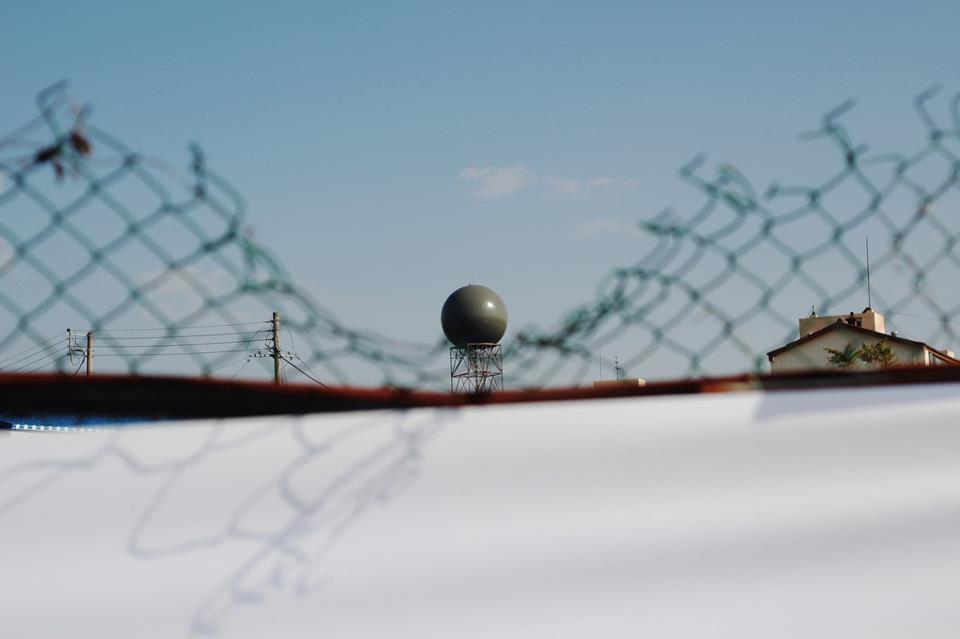
    A radar-‘strange ball’ in Gunsan. . . Photo by Wooki Lee . . .For more photos, see here.

    17th day of Grand March at Gunsan. . . After the meeting with renowned Buddhist monk Do-Beop…on the way to Gunsan, participants meet bus drivers who shows warm solidarity on the road. . .They did Sam-bo-il-bae (three steps and one full bow) on the street in solidarity with bus drivers’ struggle in Jeonju 3 days ago. . Arriving in Gunsan, participants looked around the US Air Base. . .had lunch at Peace Wind House where Fr. Mun’s actual house and office are located. In the afternoon had a solidarity demonstration at the air base gate and marched along the fence of US air base where villagers are suffering from the pollution, the noise of fighters and etc.. . .( from http://en.wikipedia.org/wiki/Kunsan_Air_Base : Kunsan Air Base is a United States Air Force

    The base is located on the west coast of the South Korean peninsula bordered by the Yellow Sea. It is at the town of Gunsan about 150 miles (240 km) south of Seoul. The town (군산시 in Korean) can be romanized as both Gunsan and Kunsan. The United States Air Force uses Gunsan to refer to the town, and Kunsan to refer to the base .

    Kunsan Air Base is the home of the 8th Fighter Wing, “The Wolfpack,” assigned to the Pacific Air Forces Seventh Air Force(*which uses most part of the base area) and the 38th Fighter Group of the Republic of Korea Air Force (*which uses only 10% of the base area). It is one of two major Air Force installations operated by the United States in Korea, the other being Osan Air Base. . . .)


    October 22, 2012

  • Thank you, Kristin. Love you, Kristin

    Kristin from Hawai’i has visited and stayed at the village for three months from mid-June to mid-Sept.,  dedicating her works on the solidarity with the villagers and peace keepers who are against the naval base and try to save the Peace Island.

    Kristin

    Recently, she has thankfully sent us gifts. In the mailed box, there were full of medical supplies that she wanted to send to the friends in the Halmangmool (meaning ‘Grandmother Water’) street café in front of the naval base construction gates. It must have been impressive for her that the friends in the cafe have always appeared in the field with their coffee service to people and quietly make effort to save the Gureombi Rock coast now being destroyed by the naval base construction (destruction).  Kristin has always been affectionate to think of Gangjeong despite language difference in the field. Thank you, Kristin, we all love you.

    Letter by Kristin
    Medical supplies sent by Kristin (Photo by Park Yune-Ae)
    Halmangmool cafe (Photo by Yi Norae): See the video on it by Dungree, here.
    Village international team members cheer for the mailed box: Wow~!


    ………………………………………………………………

    One, beautiful writing by Kristin

    The below  is a writing by Kristin, forwarded through Choe Soo Sun, Hawaii, on June 1, 2012. The name of writer was cautiously omitted then.  It was only later that we became to know that the writer was Kristin. At the time of May 24, there was a tearful hair-shaving ceremony in front of the Jeju Island government hall. Five villagers including Jung Young-Hee, Chairwoman of the Village Women’s Association, Kang Dong-Kyun, mayor of the Gangjeong village, Cho Kyung-Chul, co-vice mayor of the Gangjeong village, Go Gwon-Il, Chairman of the Gangjeong village, and uncle Kim Jong-Hwan, a villager shaved their hairs in protest to enforced naval base construction (destruction) in front of the Island government hall.

    ‘Went surfing this morning, hardly any people out… a lot of turtles… which is always special. I feel so peaceful when out on the ocean. But there is sadness there as well. So many of the beautiful sea turtles have white growths on their heads… a disease, thanks to us humans, which eventually blinds and kills them. It always makes me feel so sad that we have compromised their health, their beauty, and their right to live out their lives without being compromised by uncaring humans. Then, while sitting on my board and looking at the beautiful shoreline, I thought about how awful it would be if the military one day decides to build a naval base here amongst all this natural beauty. I thought about the horrible, horrible impact that would have on life as we now know it here on the north shore. I then thought about the people on Jeju and how hard they struggle and the sacrifices they are making in their effort to stop the destruction being caused by the building of the naval base on their coastline. Not to mention the drastic effect it is having on their village, their culture, and their way of life. I asked myself if I would shave my hair if that were to happen here. Yes, without hesitation. So while I was thinking about the people of Jeju who have sacrificed their hair, I wrote a short poem in their honor…

    With every strand of hair that falls

    A thousand tears will come to call

    Upon the earth that lies below

    To grow the seeds of change we sow.  

    It is not much, but perhaps you could send it to your friend who manages the newsletter… in honor of the people who have sacrificed their hair for the struggle. It has not gone unnoticed, and will never be forgotten.’

    ………………………………………………………………

    Two, beautiful writing by Kristin

    Gureombi


    Today I heard Gureombi call

    from just beyond the big white wall…

    Come sit with me for just the day

    I’ll tell you stories if you’ll stay.


    You cannot see me anymore

    but I am here beneath the shore.

    They may have broken me apart,

    but they will never break my heart.

    For it lives on, strong and old,

    I was once their rock, she said

    But now they are my rock instead.

    I’m sad for all they’ve done to us,

    but don’t give up, the fight is just.


    You cannot see me anymore

    but I am here, beneath the shore,

    And I’ll be here forever more.

    Today I heard Gureombi call

    From just beyond the big white wall.

    And when the day came to an end,

    I knew I’d always be her friend.

    (Village Monthly Newsletter: August, 2012)


    ………………………………………………………………

    Three, beautiful writing by Kristin

    Living in Hawaii has given me a first hand experience in how the US military claims, abuses, and ruins land and natural resources. And it does so at the expense of local culture, customs, agriculture, and marine life, The struggle to stop military expansion in Hawaii is ongoing. We stand in solidarity with the brave and principled struggle taking place in Gangjeong to stop the destruction being caused by the construction of the massive naval base that is ruining their coastline, village, way of life and natural resources. It is being built against their consent or will. This is not just a local struggle. It is a global concern as destruction of land, natural resources and marine eco structures is threatening the very existance of our planet. Military bases protect only the interests of those who build them. They do not make the world a safer place.
    In solidarity,
    Kristin
    Hawaii Peace and Justice
    Oahu, Hawaii

    Source: Click here


    Photo by Cho Sung-Bong, Kristin during the Great march for Peace of Gangjeong,


    See Kristin in photos and videos

    http://cafe.daum.net/peacekj/GdUL/227   Photo by Cho Sung-Bong

    http://cafe.daum.net/peacekj/JWOn/343     Video by Dungree

    Korean script: http://cafe.daum.net/peacekj/496a/641

    October 21, 2012

  • March 15th Day: Jiri Mt. Dam


    Photo by Lee Wooki

    “Insane people who attempt to build Dam in Jirisan mountain”. . .On the 15th day of Grand Life and Peace march on October 19, participants visited Yong-yu-dam, one of the most beautiful and historical places in Jirisan mountain, but also people are protesting for a long time. . . If the dam is being built, the area will be destroyed like Gureombi rock and will be submerged. A poet and activist living in the mountain is reciting his poem against the dam building. As the grand march is passing the two weeks, had a relaxed time climbing the mountain enjoying the autumn colors and came to Silsangsa buddhist temple for accommodation. For two days on October 19 evening and October 20, will have people’s assembly here to listen to the voice of voiceless. And the second people’s assembly is planned to be held in Pyongtaek on October 27 a week later. Final place of this grand march is Seoul on November 3. . . Film by Dunguree 박성수. . .

    (Jirisan is a mountain in the southern region of South Korea. It is often considered one of the three most important mountains in South Korea along with Hallasan mountain in Jeju island.
    The mountain is 1915 high and is located in a designated national park of the same name. Jirisan National Park spans three provinces: North, South Jeolla and South Gyeongsang and is the largest in Korea.)

    http://tvpot.daum.net/v/vdc2b65Ox6uKnRK4RB5E4uO

    October 21, 2012

  • March 16th day: The return of Dr. Song Kang-Ho and People’s Assembly at Silsangsa temple in Jirisan mountain.

    Photo by Lee Wooki. See also here.


    The return of Dr. Song Kang-Ho and People’s Assembly at Silsangsa temple in Jirisan mountain. . .Br. Song has returned after about 6 months imprisonment. . .About 500 people we have met during the march: the evicted, dispossessed, dismissed grassroot people gathered to talk about “Our Life, Our Priority(Option) and Our Solution” in the name of People’s Assembly. . .from Gangjeong, Yongsan, Ssangyong, Four major rivers. nuclear power plant and power transmission tower, super-supermarket victims and irregular workers. Film by Dunguree 박성수


    http://www.youtube.com/watch?v=jpSe9jP7WNE&feature=share

    October 21, 2012

  • Warm solidarity greetings from the CHN lawyer couple

    Sept. 22, 2012
    Dear Gangjeong Villagers,
    Our brief visit with you renew our faith that the people of Earth can learn to live in peace, that we can respect the beauty of all Earth’s creatures, our dependence upon them, and their right to flourish.
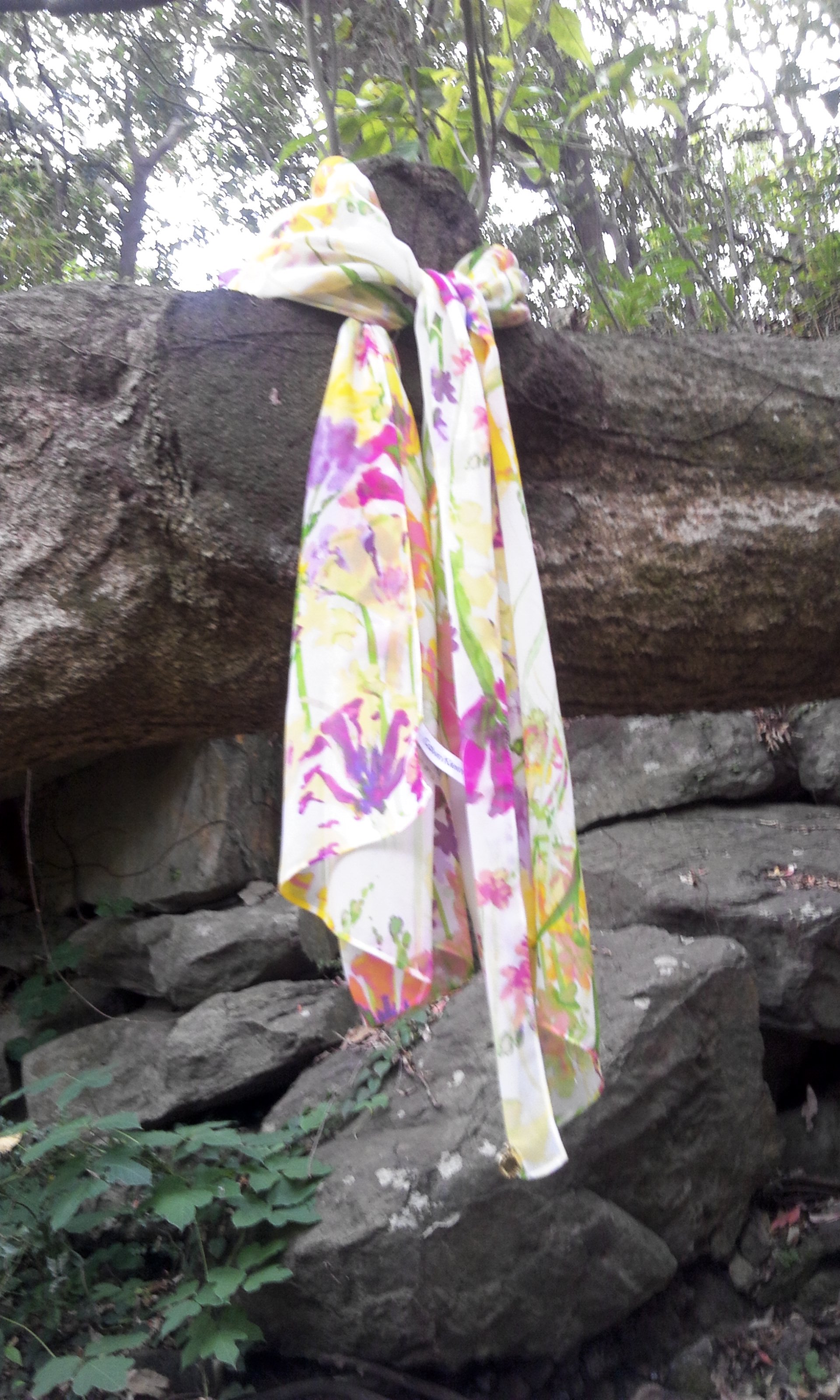
    We cannot thank you enough for your courage, determination, generosity, and uplifting expressions of joy, perhaps led by Mi-Kyoung, would ass this scarf to the ones on the Great Tree, and say a prayer to the four winds for your village and for ours, for the children of Earth and for Earth itself.
    In love.
    Joan and Ron


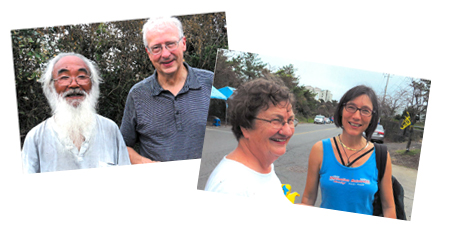
    Ron and Joan Engel is a couple member of the Center for Human and Nature (CHN), a member group of the IUCN (International Union for Conservation of Nature), who have often visited the Gangjeong village during the period of the 2012 WCC (World Conservation Congress) Jeju, Sept. 6 to 15 and passionately supported the Gangjeong villagers’ struggle against the Jeju naval base. Ron Engel, a respected lawyer from  many members of the IUCN has made a touching speech on why the CHN has initiated a Motion 181: Protection of the People, Nature, Culture and Heritage of Gangjeong Village on the last day of the WCC. Please see here.

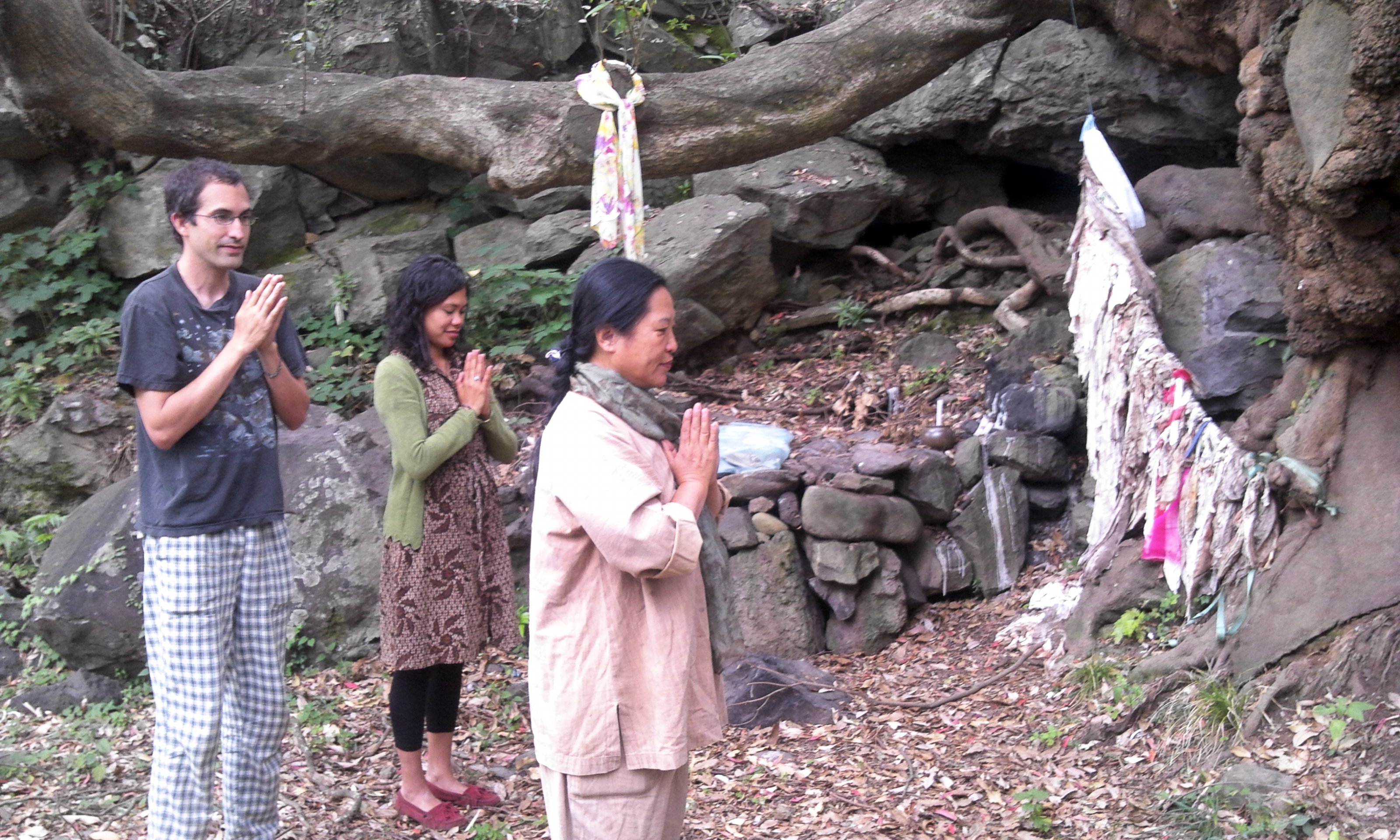
     About three weeks ago, we have received a grateful gift from them. The content was to ask us to let Ms. Kang Mi-Kyung and villagers to specially hang a scarf that Joan has enclosed on a more than 1,000 years sacred tree (a giant Elaeocarpus sylvestris var. ellipticus, probably the 2nd oldest tree in Korea) in the Netgiriso shrine and pray for the peace of the village and world. The above are the cards, writings and photos what they sent.

    On Oct. 13, last Saturday, though we could not have chance to tell villagers who were busy for preparation for the nationwide march and farming, we visiting the Netgiriso with Ms. Kang Mi-Kyung (a spiritual meditation leader) and friends in the world and hung Joan’s scarf, bowed under her lead, toward four directions of east, west, south and north and prayed for peace. Please understand a late post.

    Even though invisible, we don’t forget that there are always grateful people in the world who always greatly support us.

    Korean script: Click here

    October 21, 2012

  • Gangjeong Sea is moaning by dredging ships and excavators


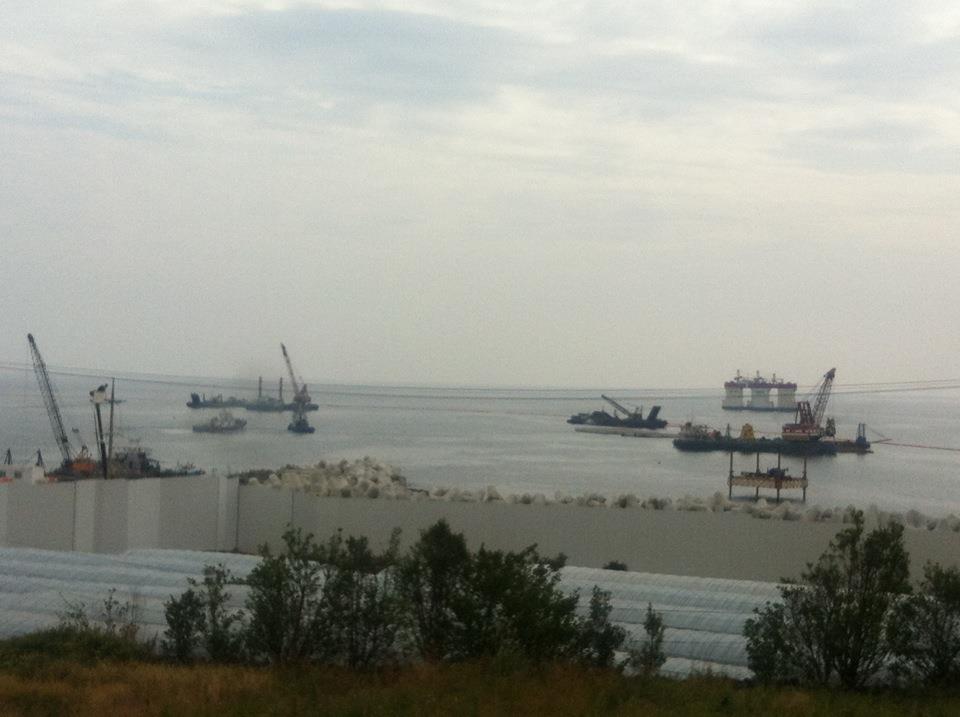
    Gangjeong sea is literally at the state of disturbances and war. . . in addition with the sounds of engines of 6 barges (from the photo essay of Cho Sung-bong. For more photos, click here)


    From the photo essay of Cho Sung-bong.


    They are destroying Gangjeong sea insanely ahead of the full scale sea destruction work. . . as if evacuating the front village just before war. . .Gangjeong sea is moaning by a number of dredging ships and excavators. At the front gate, activists are struggling. (Post by Bae Kee-chol)

    Gangjeong Sea suffering by naval base construction(destruction)


    Video:  Caisson factory forcefully being built on Gureombi Rock coast (by Novie Na)


    October 20, 2012

  • Jeju naval base-Marine corps-Air Force Base: Militarization of Jeju? National Assembly man raises the issue.

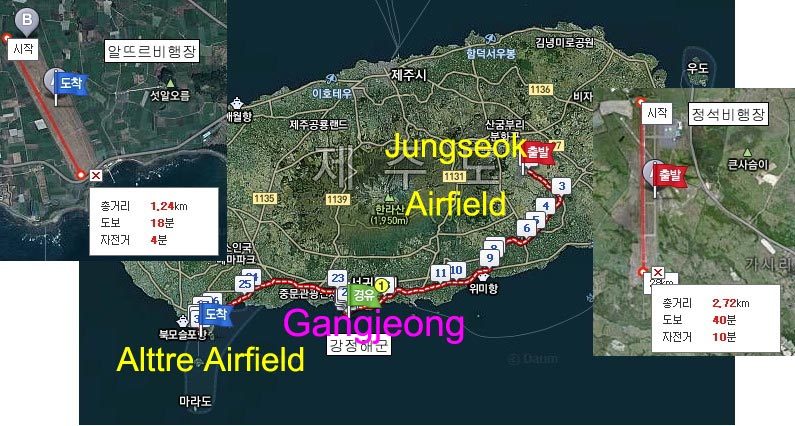
    A, F, G: Planned areas for a new airport that the Jeju Island has made public (* It is told that it was around 1997 that those were mentioned as the planned airports). One of them will have a high possibility to have an air force base along with a new airport.

    B: Alttre Air field, Moseulpo. The ROK air force has wanted to use it as the base for the South zone search and rescue corps unit. Very close to Daejeong eup, the planned area for a new air field

    C. In case the Jeju Marine Corps are established, field artillery and armored forces might enter. In the Hwasoon port, there is a coast guard-only dock and caissons are being made. The caissons are used for the building of the Jeju naval base project in the Gangjeong village.

    D. Gangjoeng village where the Jeju naval base project is being enforced.

    E. Seogwipo City. Even now, the Marine Corps’ warships are being moored. If the Jeju marine corps unit is established, headquarter might enter, too,

    (Source: Lee Jubin and Kim Do-Kyun, Ohmynews, Sept. 3, 2012, translated)


    On Oct. 18, the issue raised in the National Assembly inspection on the ROK air force was on the ‘South zone search and rescue corps’ that is being discussed to be installed in the old but currently unused Alttre air field, Moseulpo.

    Kim Jae-Yoon, Democratic United Party, a member of the Defense Committee of the National assembly claimed that it is a tactic ultimately to build an air force base.  He claimed that the Jeju, Island of peace is at the risk to be degraded as the ‘Island of military base.’

    Saying that “when I demanded the air force on the material on the ‘South zone rescue and search corps unit, the air force replied me that it is planning a creation of it for national security and people’s safety,” Kim interpreted that “However, given that rescue and search corps unit is a non-combat corps that is in charge of search and rescue, its words that it creates it for the securing of national security connote that the rescue and search corps unit is, after all, a combat corps.”

    He pointed out that “the South Zone Rescue and Search Unit is roundabout tactic to prepare for the bridgehead for an air force base. It is like the Jeju naval base has been faked as the civilian-military complex for tour beauty.”

    It is told that Sung Il-Hwan, the Chief of the General Staff of the Air Force replied him that “Currently, there is no plan to build the air force base.’ Regarding the location for the South Zone Search and Rescue Corps, he stated that “Since the location has not clearly been decided, we plan to arrange it connected to the Jeju new air port, if it is built.”

    Kim’s claim is not new but has constantly been raised by many observers. According to Ohmynews on Sept. 3, 2012, Roh Hoe-Chan, Progressive United Party, has made a remarkable claim in the National Assembly inspection session in May 2007, that “the Ministry of National Defense and Jeju Island have agreed that the Island provides 300,000 pyeong (about 99 ha) to an air force in case the 2nd new air port is built on the condition that the air force concedes the Island old Alttre air field of about 600,000 pyeong (about 198 ha). It meant the Air Force is ready to use the Alttre Air field as an area for the South zone search and rescue corps unit unless the Jeju provides an alternative area to the Air force. (* For reference the Jeju naval base project is of about 48 ha.)

    The Alttre airfield (1.2 km runway), constructed during the Japanese imperialism is currently unused. But it used to be utilized for the Japanese attack to Nanjing, China, 700 km away, during Chinese-Japanese war in 1937 and is currently owned by the Ministry of National Defense. See here.

    It is not only an Alttre Air Field.  According to Ohmynews, there is a concern that the Hwasooon area and Seogwipo in the both sides of Gangjeong might be utilized as military fortress as well. It is because the navy plans to reorganize the Jeju Defense headquarter to the Jeju Marine corps (brigade level) in 2015. The Ministry of National Defense has issued the Basic Plan of Defense Reform (2012~2030) on Aug. 29, 2012.

    Since Roh Moo Hyun, ex-President declared the Jeju, as the peace Island on Jan. 27, 2005, the Alttre Air Filed has been mentioned for the Jeju Peace Park. But there has been only a small progress on it because of the demand mentioned above by the MND.

    Realization of the Jeju, as true Peace Island is ongoing supreme task for the people.

    ……………………………………………..

    Reference:


    http://www.headlinejeju.co.kr/news/articleView.html?idxno=162733

    “이번엔 제주 공군기지?”…군사기지의 섬 전락 의혹

    김재윤 의원, 국감서 ‘남부탐색구조부대’ 의혹 제기

    2012.10.19  09:38:49


    http://www.rispark.org/bbs/view.php?id=mun&page=1&sn1=&divpage=1&sn=off&ss=on&sc=on&select_arrange=headnum&desc=asc&no=54&PHPSESSID=44f5788322bd33d546742f73c7d479e6

    ‘국방개혁 기본계획 2011~2030’의 문제점과 대안

    http://www.ohmynews.com/NWS_Web/View/at_pg.aspx?CNTN_CD=A0001774446

    “제주도, ‘평화의 섬’ 아닌 ‘군사 요새화’ 된다”

    [구럼비 봉쇄 1년] ① 모슬포-화순-강정마을-서귀포 군사벨트화?

    12.09.03 15:22l최종 업데이트 12.09.03 21:09


    http://blog.daum.net/kkp2032/1192266

    남부탐색구조부대 양해각서 공개 파문

    김경필 2007.05.09 14:30


    http://www.eurasiareview.com/18102012-south-koreas-defence-reform-plan-a-case-of-bad-timing-analysis/

    South Korea’s Defence Reform Plan: A Case Of Bad Timing? – Analysis

    October 18, 2012


    http://www.vop.co.kr/A00000280358.html

    제주, ‘알뜨르비행장’에 평화공원 조성

    2010-01-27 20:46:23 l 수정 2010-01-27 21:00:03


    …………………………………………………………………….

    See also

    http://www.space4peace.blogspot.kr/2012/10/more-bases-on-jeju.html

    More Bases on Jeju?

    ‘Speaking at a Pentagon news briefing last June, Pacific Command commander Admiral Samuel J. Locklear said: “We’re not really interested in building any more U.S. bases in the Asia-Pacific.”  “We shouldn’t have to at this point in time. We have reliable partners and reliable allies, and together we should be able to find ways to—not only bilaterally, but in some cases to multilaterally—to be able to find these locations where we can put security forces that respond to a broad range of security issues.”
     Translation: The U.S. is having the South Korean government build the Navy base on Jeju Island for us.  A couple nights ago I was watching the local Congressional debate on TV and our Maine Congresswoman Chellie Pingree (Democrat) was asked where we can cut the federal budget.  Her answer was that we can cut back on some of the money we spend on foreign bases by getting our allies to build them for us.  She didn’t say we shouldn’t have or use the bases for our military empire.  This “liberal” instead said we should get others to pay the costs for us.
    In the meantime the dredging of the ocean, just offshore from Gangjeong village continues.  The protests at the Navy base destruction gates continue as well.’
    October 20, 2012

  • Another entry denial against an international peace activist

    A Japanese peace activist has been denied entry at the Gimpo Airport, Seoul, on Oct. 16 when he was to visit his sick friend. Mr. Koto Shoji has visited Gangjeong last year and has written an article on it in the magazine named “Power of People’ (Informed by Ms. Lee Kil-Joo)

    With his forcefully denied entry, the total numbers of people who have been denied entry, related to the Jeju naval base project have become at least 20. 3 of them have been repeatedly denied entries.

    You can see the summary report on the unjust entry denial against internationals as of  Oct. 3, here.

    October 19, 2012

←Previous Page
1 … 34 35 36 37 38 39 40 41 42 43 44 … 48
Next Page→

© 2025

Save Jeju Now