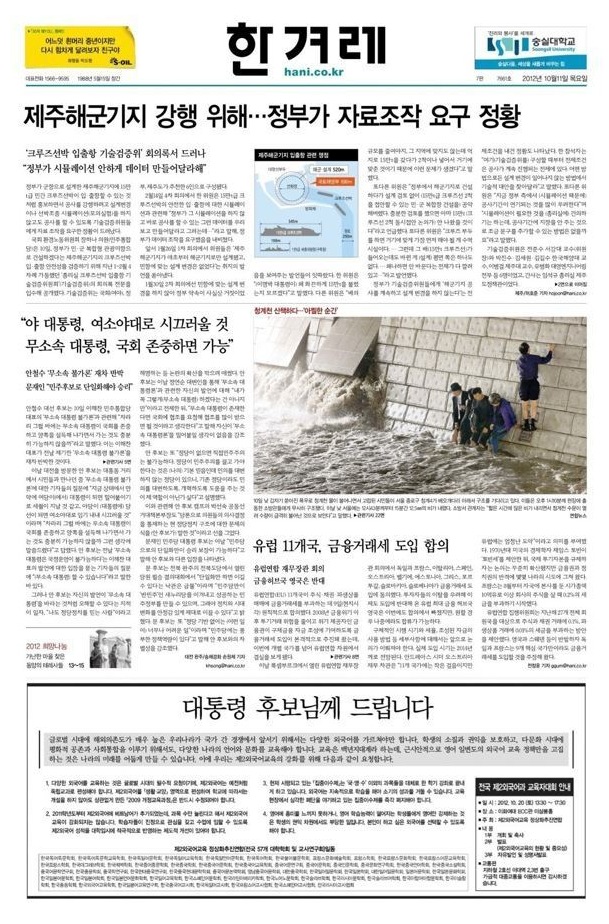
Base opponents now have concrete and irrefutable evidence to back up what they have suspected and declared for a long time. Assembly Woman Chang Ha-na has found and disclosed the full record of the meetings between the Prime Minister’s office and the Technical Committee, revealing publicly the complete lie of the so-called “civilian military dual use port”, as well as the general deception, and poor and hurried planning behind the Jeju Naval Base Project.
Evidence Shows Government Ordered Data Doctored on Jeju Naval Base; Committee recommended simulation tests, but construction was rushed ahead
By Heo Ho-joon, Hankyoreh Jeju correspondent
Evidence suggests that the government ordered data to be doctored to allow for the construction of a controversial naval base on Jeju Island without conducting simulation safety tests for cruise ships entering and exiting the base.
Accounts from members of the technical committee examining the base, ostensibly a joint civilian-military “tourism harbor,” suggest it was designed as a military port, with the simulations planned only to give the appearance that it would also be accessible to 150,000-ton cruise ships.
Democratic United Party Rep. Chang Ha-na, who sits on the National Assembly’s Environment and Labor Committee, disclosed full records on Oct. 10 from four meetings of a technical committee under the Office of the Prime Minister that convened in January and February to examine the port’s suitability cruise ship entry and departure. The six-member committee had six members recommended by the ruling New Frontier Party, the opposition, the administration, and the province of Jeju.
At the fourth meeting on Feb. 14, one committee member hinted at government doctoring of the data for a simulation on the port’s safety for 150,000-ton cruise ships.
“The government’s telling us to come up with data that would allow construction to begin right away without a simulation,” read the records of the technical committee’s meetings.
Also, at the first meeting on Jan. 26, members of the committee made statements to suggest that the port was originally designed as a naval base, with no design changes to make it suitable for use as a civilian harbor.
Statements made at the second meeting on Jan. 30 indicate that the design changes in question were not made, showing the government’s pledge to have been false.
One committee member said, “I have no idea why [President Lee Myung-bak] gave that wild figure of 150,000 tons.”
“You would need to make the boats smaller,” a second responded. “It doesn’t work for that region. The problem is that they had to go claim it could accommodate two 150,000-ton boats and design it around that.”
A third said, “So the government was building a naval base and it went ahead and made the pledge [for a civil-military harbor capable of accommodating two 150,000-ton cruise ships] without examining the design at all. If they’d looked closely enough, then maybe this 150,000-ton stuff would never have been said.”
A fourth said, “If you’re building a cruise dock, the first thing you need is harbor facilities. . . . They’ve got boats that size [150,000 tons] coming in here, and nothing’s changed with the surface. . . . And the reason is there’s an underlying assumption nothing’s going to be changed.”
The committee was chaired by Sogang University professor Jeon Joon-soo and included Korea Maritime University professors Park Jin-soo, Kim Se-won, and Kim Gil-soo, Cheju (Jeju) National University professor Lee Byung-gul, and DY Engineering executive director Yu Byeong-hwa. The secretary was Im Seok-gyu, Jeju policy officer for the Office of the Prime Minister.
After four meetings, the committee concluded with the recommendation that a vessel simulation was needed to take into account the repositioning of harbor structures and placement of tugboats without major changes to the existing harbor design, and was then disbanded.
Since the committee’s fruitless discussions and non-binding conclusion, the government and Navy have pushed ahead with the construction, conducting no simulations and making no design changes to date. The project is currently 22% complete, according to the Navy.
Other evidence surfaced to suggest the committee members were told that the construction would continue and there would be no design changes.
One member said, “Ever since they set this [committee up], there has been the assumption that the construction would be going ahead all the while. They’re asking us to find some kind of technical alternative that wouldn’t require any design change.”
Another member responded, “Right now, the government’s worried that the construction is going to be delayed” by a simulation.
The same member said, “We advised [the Office of the Prime Minister] that a simulation was needed, and they said, ‘Can’t you just put a little phrase in there or something without messing up the construction timetable?’”
Chang declared that the meeting records bore out suspicions that the government and military planned the harbor as a military port and looked for a way around the 150,000-ton cruise ship issue after the President made his remarks.
“They need to halt the naval base construction and reexamine [the port] from square one,” she added.
Please direct questions or comments to [english@hani.co.kr]
Front Page of the Korean Print Edition of Hankyoreh.
Jang Hana, a National Assembly woman has stated on Sept. 7 that “The Jeju naval base layout has been based on the nuclear-powered aircraft carrier that the South Korean military does not retain and the layout application has been planned with the water depth that satisfies the demand by the CNFK (Commander, U. S. Naval Forces, Korea).” See here.
Mr. Koh Yound-Dae, Executive research member of the Research Institute for Peace And Reunification of Korea, has written an article on Oct. 4 that is translated as the below (translator’s arbitrary translation) . He says, ‘it is righteous to consider that the [projected] Jeju naval base is a US base in the sense that its main facilities of the water depth inside the breakwater where US aircraft carrier or cruise would moor, the water depth of mooring dock for submarine, and turning basin are designed and being constructed following the demands by the US military and fit to the vessels that the US military retains.
His writing is helpful as he explains in detail that the matter is not only for the US nuclear aircraft carrier but for the US submarines, too.
On Oct. 10, Jang (Chang) Hana, and her office has exposed a very important proof of the technical committee’s meeting note that the committee members have known that the port design is never for 150,000 ton cruises, which makes clear that the central and Jeju Island government have falsely asserted as if the port is a complex civilian-military harbor primarily for the 150,00 ton cruises. See here.
[Opinion] The base layout, including the water depth in the inner side of breakwater, is designed to fit the US warships
By Koh Young-Dae, Executive research member of the Research Institute for Peace And Reunification of Korea
The ROK (Republic of Korea) Ministry of National Defense has been consistent to deny people’s claims that the Jeju naval base enforced in the Gangjeong village is, in fact, a US base. However, clear proofs that support the fact that the Jeju naval base is ultimately the US base is being exposed one after another.
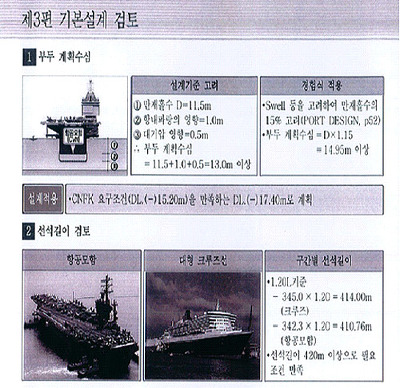
One of the critical strongholds is the fact that the Jeju naval base has been designed according to the standard demanded by the Commander of the US Navy Forces, Korea (CNFK). For example, the water depth of the inner side of its breakwater is designed as 17.40m, which is to follow the standard demanded by the CNFK (15.20m) and to secure the safe mooring of the US nuclear aircraft carrier ( P. 180, 1 Water depth of dock plan, 1-7-3: Plan on mooring facility. chapter 1 of Part 3: Basic layout, 07 Report on investigation and test, 08-301-1 Facility construction, ROK Navy)
▲ The planned water depth of the south break water: The standard of the south breakwater is designed on the premise of coming alongside/ exiting of the pier by nuclear aircraft carrier. According to the layout of the facility construction 08-301-1, published by the navy headquarter in 2010, the planned water depth of the south breakwater is read as ‘a plan of DL(-) 17.40 m that satisfies the demand by the CNFK (Commander, U.S. Naval Forces Korea)
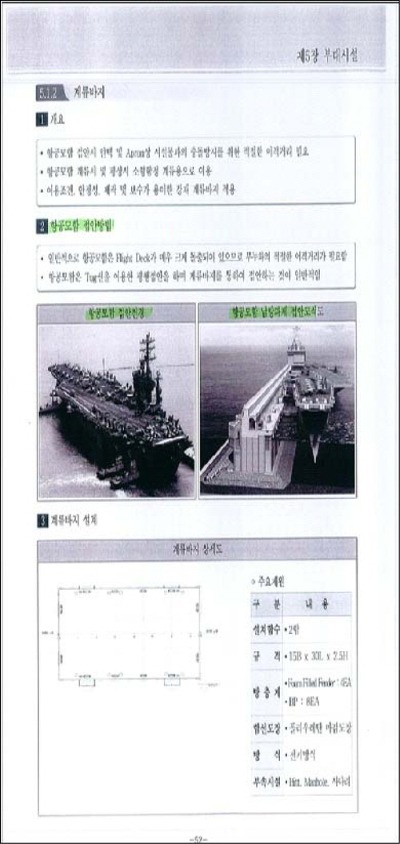
Another strongholds that the Jeju naval base is a US base is that the ROK navy has conducted simulation on the coming & exiting alongside the pier and entry & exit of port, in which the USS Enterprise (CVN–65 level), a US nuclear aircraft carrier, was an object ship. It also directs that mooring barge is to be equipped so that the coming & exiting alongside the pier is easy for aircraft carrier of which flight deck is projected. It even directs a blueprint on it in details.(P. 52, 2. Method for aircraft carrier to come alongside the pier, 5-1-2 mooring barge, Chapter 5. Accessory facilities, 09 Summary report on the execution design, Facility construction, 08-301-1, ROK navy)
▲ Another proof that the port design is centered on aircraft carrier: Mooring barge According to the chapter 5 on Accessory Facility, Specifications on the Facility Construction 08-301-1, published by the navy headquarter, it is stipulated that “The aircraft carrier needs mooring barge to safely coming alongside/ exiting out of the pier because its flight deck is very largely projected out. The aircraft carrier does a flat coming alongside the pier using [tugs] and it is general that it comes alongside the pier through mooring barge.”
The ROK navy currently does not retain any aircraft carrier and it has no plan to do it in the future, as well. Despite that fact, it has secured water depth for the US nuclear aircraft carrier following the demand by the CNFK. It is nothing but a clear proof that the Jeju naval base is for the benefit of the US navy that the navy has conducted even the simulation on coming & exiting alongside the pier following the demand by the CNFK.
Another stronghold that one cannot but suspect the Jeju naval base as the US navy base is the water depth of the mooring dock for submarine.
Unusually, in the Jeju naval base project, while the water depth of the dock for large ship is 11.5m, the water depth of small/middle ship and submarine dock is 12m, deeper than former. In case of draft for submarine that the ROK navy retains, it is 5.5 m for the 209 class (1,200 ton) and 6m for the 214 class(1,800 ton). Even with the introduction of 3,000 ton class mid-size submarine, the draft is 7m therefore it can be safely moored in the water depth of 9m when the minimum spare water depth (1.2m) and spare safety water depth are put together, according to the ‘layout standard for defense facility.’ Despite that, the ROK navy is to secure the water depth of as much as 12m, which is considered for the large US nuclear aircraft carrier (of which the draft is more or less 9.5 m) to safely moor. In the sense that the ‘Report on the basic plan’ (2009. 1) of the Jeju naval base reads that securing of 12m water depth is by the demand of ordering subject (navy)’, it is inferred that the water depth of the mooring dock for submarine has been directed to design company by the ROK navy, following the demand by the CNFK, as well as in case of aircraft carrier.
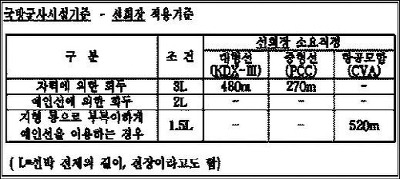
▲ Turning basin layout: The size of the turning basin of the Jeju naval base project is fit to the size of aircraft carrier (CVA) turning basin. (‘Standard of defense/ military facility’)
Otherwise, the size (diameter) of the turning basin (turning water area for the ships in the inner port) of the Jeju naval base project has been designed with 1.5 times of the length of the US CVN-65 class (342.3m), which is 520m, in case tugging boat is forced to be used due to topographical limitation (‘Standard for the defense/ military facility, Ministry of National Defense and P. 41, layout directive on the harbor & bay facility). The Dokdo, the largest vessel the ROK navy retains is of 200 meter length, for which the turning basin diameter is 300 m when 1.5 times of length is applied as in case of aircraft carrier and merely 400 meter even when twice of its length is applied (turning head by tugging boat).
Otherwise, for the 150,000 ton cruise ( about 345 m length) to safely enter in and exit out, following the demand by the self-governing institute of the Jeju Island, the size of turning basin should satisfy 1,035 m(three times of ship length, when it is turned by its own exertion) or 690 m (twice of ship length, in case of using tug boat or thrust). ( ‘Standard for harbor & bay layout’ Ministry of Land, Transportation and Maritime Affairs, P. 696 in part 6 on ‘Water area facility and dredging/ reclamation)
The current size of turning basin in the Jeju naval base project does not fit for the 150,000 cruise to safely passing by inside the port and coming alongside/ exiting the pier. Even though the navy asserts that it has applied 1.5 times even to the 150,000 ton cruise, the regulation of 1.5 times is not stipulated in the ‘Standard on the Layout for port & bay/ Fishing port,’ different from the ‘Standard for the defense/ military facility.’
Likewise, it is righteous to consider that the [projected] Jeju naval base is a US base in the sense that its main facilities of the water depth inside the breakwater where US aircraft carrier or cruise would moor, the water depth of mooring dock for submarine, and turning basin is designed and being constructed following the demands by the US military and fitting to the vessels that the US military retains.
Currently, territorial conflicts are daily being intensified among China, Japan, Philippine and Vietnam in the East South Sea surface. Riding on it, the United States is stepping forward to strengthen her maritime domination in the East Asia. To secure additional bases for it, the United States is returning to the naval bases such as in Subic Bay, Philippine, Cam Ranh Bay in Vietnam, and U-Tapao, Thailand where she has stationed in the past. For the US navy to station in those bases again, it should pay rental fee for them in applicable nations.
The Jeju naval base that could be the best outpost against China is being constructed wholly by our budget (including additional costs that are being increased as the base is constructed as the US base) and shall be provided free to the US military. Whereas the only price for us is that the Jeju Island and Republic of Korea would be the target for the mid/long range missile attacks by China.
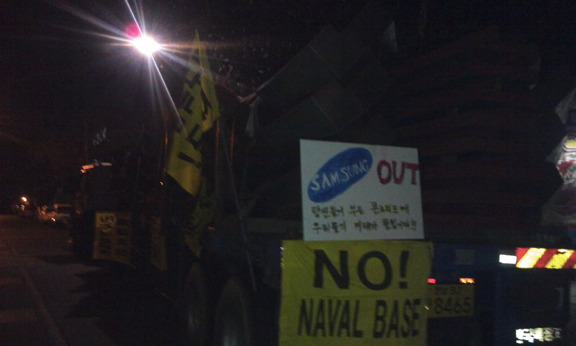
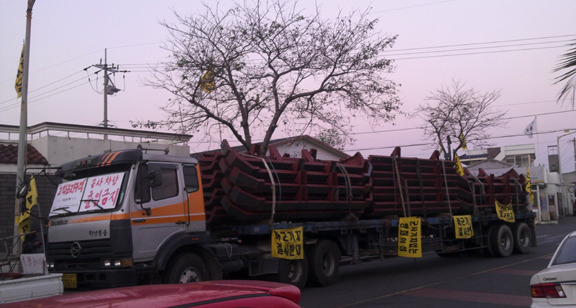
In the cold night of October, people slept on the street to block a giant truck with their bodies. Please look at the letter that reads, “children,’ on the street, which means the street is never for giant trucks and speedy cars.
On the night of October 6 into the morning of October 7, villagers and activists from Gangjeong slept on the street due to an illegal giant truck of Daelim construction company.
Around 9 pm, Sept. 6 when people were working on making pickets, a giant truck was to enter the construction (destruction) site, passing the Kosa mart four-way intersection, the center of the village. While people were sorry to hear that there was already another truck before it, people, capturing the 2nd truck, kept it all night, daring to sleep on the street of cold October night.
Daelim memo in Nov., 2011: It reads its vehicles would never illegally pass the four-way intersection where there is an elementary school and the road is narrow.
Before that, villagers burst out with fury. Daelim, one of the main construction companies has written a memo to them in November, last year that it would not send construction trucks through the four-way intersection where car size and speed is greatly limited. However, the truck driver who introduced himself to be from Gwangyang, Jeolla province and it was his first visit to Gangjeong, was to pass the street last night, without having been informed on it.
Looking at the materials loaded in the truck, they were giant frames that might be used in the caisson productions. The villagers have already been infuriated to hear that construction (destruction) has been ongoing even in the night and dawn, after the fall harvest holidays. Still the police pretending to hear their righteous protest words, stealthily took photos of them. Because of that, there were shuffles.
From the port, news was sent that the construction companies were noisly working on barge and caisson dock on the Gangjeong Sea. It was a Saturday night again.
Despite cold weather and tiredness, many people kept the field of street. Many people brought blankets for the people sleeping on the street.
The truck is being covered with people’s pickets and flags.
Please understand for bad qualities of photos.
An improvisational fire stovePickets that been made timely were mobilized to cover the captured truck: ‘No zone for construction vehicles,’ ‘no zone for police roughing out,’ ‘ no zone for police and construction vehicles.’‘Your concrete buries our future.’
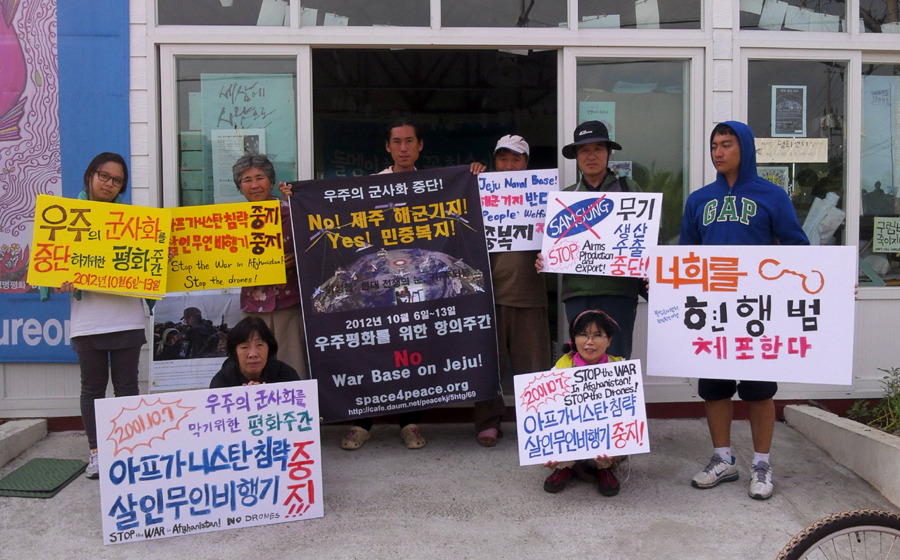
October 7th, 2001 was the day the U.S. invaded Afghanistan. For Keep Space for Peace Week, October 6-13, Gangjeong activists made signs in solidarity with Afghanistan and those against the continued war and occupation.
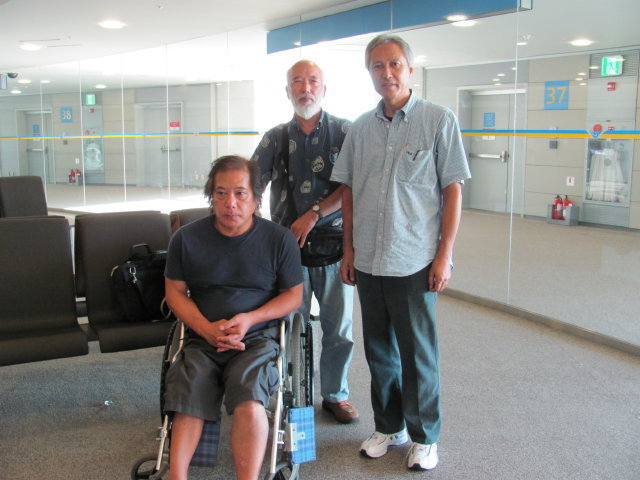
Photo sent by Toshio Takahashi (For more photos, click here) ‘In the afternoon on the 5th of September 2012, I and two of my friends, Mr. Masahiro Tomiyama and Mr. Eiji Tomita, were prohibited entry into Republic of Korea (ROK) at the Incheon International Airport.’ (source)
Update: April 24, 2013, Wang Yu-Hsuan (Taiwan), 21st subject to be denied entry to Korea, in relation to the Jeju naval base project. Since the inauguration of Park Geun-Hye government, she is the 2nd human rights defender to be deported after Ban Hideyuki, Citizens’ Nuclear Information Center, Japan, on April 19, 2013.(see here)
Update: [IUCN letter to Dr. Imok Cha, Nov. 13, 2012] IUCN so regrets the decision for The ROK governmentnot not to allow Dr. Imok Cha (Fwd) : CLICK HERE
Update: A Japanese peace activist has been denied entry at the Gimpo Airport, Seoul, on Oct. 16, 2012 when he was to visit his sick friend. Mr. Koto Shoji has visited Gangjeong last year and has written an article on it in the magazine named “Power of People’.With his forcefully denied entry, the total numbers of people who have been denied entry, related to the Jeju naval base project have become at least 20. 3 of them have been repeatedly denied entries.
………………………………………………………………
The below summary is primarily based on the Korean summaries here and here. Please come by later for any fix, revision or update. ( See the original post here)
Summary on the matter of entry denial against internationals, Regarding the issue of the Jeju naval base project
: Report as of Oct. 3, 2012
(1) Preface
On Sept. 25, 2012, PSPD (People’s Solidarity for Peace and Democracy) issued a press release that the ROK government denied to make public the reasons of entry denial against the targeted internationals. See the Korean document here and summary of it in No. (2).
The numbers of international activists who were denied entry to Korea, related to the Jeju naval base project have been at least 15 from Aug. 26, 2011 to June 29, 2012. See the Korean document here.
However, it was not precedent that as many as 9 people were denied entry to Korea and deported during the WCC period (Sept. 6 to 15, 2012), beginning with Dr. Cha Imok on Sept. 3. Therefore the numbers of entry denial related to the Jeju naval base project have become at least 24. See the Korean document here.
Please see No. (5) for the details of list of the internationals who were denied entry from Aug. 26, 2011 to Sept. 6, 2012.
Among 24, it is still uncertain whether two Nigerians who were denied entry on Sept. 6 had the will against the naval base. 3 of 9 people had to go through repeated entry denials (Yagi Ryuji, a Japanese peace activist, Tomiyama Masahiro, an Okinawa peace activist and Umisedo Yutaka, an Okinawa musician)
During the period of the WCC co-sponsored by the IUCN, at least two people were official IUCN nation representative or member and four people carried the invitation letters and identity certification letter from a ROK National Assembly woman.
Even though excluded of two Nigerians and repeated entry denial numbers, the international personnel who have been denied entry to Korea then deported, related to the Jeju naval base project currently enforced in the Gangjeong village, despite the opposition by the majority of villagers, have become at least 19 from Aug. 26, 2011 to Sept. 6, 2012 (One Korean American, three from the United States and 15 from Japan and Okinawa)
It should be noted that it is a matter of serious human rights violation internationally committed by the current Lee Myung-Bak government, Republic of Korea, which disrespects the UN human rights chapter and other international agreements, as well as domestic laws and regulations. Above all, it was confirmed that the government has made and is operating a black list against some internationals. The suspicion on the police’s illegal information collection on the foreigners in the Gangjeong village is also being raised. (See (4)-14).
Further international investigation should be earnestly looked for regarding this matter so that constructive and positive measures should come out.
This report is merely a summary and we hope any concerned Korean associated groups or international institutes pay attention to this matter and work on it.
Any corrections and added facts will be updated here.
Gangjeong village international team
……………………………………………………………………………
(2) PSPD Press Release on Sept. 25, 2012
According to the PSPD press release on Sept. 25, titled, the “Government being consistent not to make public the reasons of entry denial on international activists,” the Ministry of Justice has sent one page reply on Sept. 18 to the 7 page open inquiry letter by the PSPD on the entry denial of international activists on Sept. 6. See here.
In summary, the PSPD press release reads that: 1.The basis of information collection to prohibit the entry of overseas activists for the reasoning of “past works” is opaque, 2. The ambiguous basis to prohibit the entry of the overseas activists does not fit to the international human rights standard.
The Ministry of National Justice saying that “the foreigners who have been denied entry to Korea were judged to ‘deem likely to commit any act detrimental to national interests of the Republic of Korea or public safety, in the reflection of their past works,” totally refused replies to the inquires. It said “The entry denial measure to specific foreigners is the nation’s sovereign discretionary act and in case when its detailed contents are to be known, there is concern that there might occur foreign diplomatic matter or trouble in the government institutes’ activities to protect the national interest.”
The PSPD Press release reads that:
“To prohibit the entry of overseas activists without clear basis is a violation of the UN Human Rights statement that states that ‘everyone has the right individually or in association with others, to promote and to strive for the protection and realization of human rights and fundamental freedoms at the national and international levels’ ( *article 1 of the Right and Responsibility of Individuals, Groups, and Organs of Society to Promote and Protect Universally Recognized Human Rights and Fundamental Freedoms, UN) and of the agreement on the civic political rights that prohibits dealing with citizens as potential criminals.
Claiming that the Lee Myung Bak government is infringing the freedom on the peaceful rally and assembly by the international human rights defenders who take opposing opinion against the government, the PSPD says it will make public opinion on the issue of oppression on the international activists through the examination on the Universal Periodic Review on human rights in coming October.
……………………………………………………………………………
(3) Noticeable points of the human rights violation by the South Korean immigration office
1. The Korean Immigration Office’s entry denial of some internationals regarding the Jeju naval base project has been earnestly practiced since August, 2011.
Case: On Aug. 26, 2011, when an entry-denied Japanese peace activist asked when she has become the subject of entry denial to Korea, a Korean immigration office replied her it was since August, [2011]. See AWC (Asian Wide Campagn)_Japan statement on Aug. 28, here.
2. Internationals are denied entries merely for the fact that they have visited the Gangjeong village ‘for tour,’ in the past or merely for the Immigration Office’s ‘presumption’ that they might visit the village.
Case 1: Nakamura Sugae who was denied entry along with her college student daughter on March 26, 2012, says, “Regarding my visit to the Gangjeong village, Jeju, I have dropped by a village and talked with villagers for a short time on my way of group tour last August, which was guided by my daughter who was an exchange student in a Korean traditional medical college in Daeku then. That was all. I haven’t joined protest but wanted to learn one another there. [The entry denial] is totally nonsense. [..] Further the visit this time was to drop by the Daejeon-Choongchung nam-do province, nothing to do with the Jeju.” She has applied the visa to the Korean Consulate in Japan again on July 31 to visit the Independence Museum, Cheonan in Choongchung nam-do on Aug. 22. However, despite her appeal to cancel the entry prohibition measure against her, she saying that she ‘would never visit the Jeju Island, she did not receive any reply from the Consulate even after 9 days. It was found later that she had been labeled as the ‘[Korea]-entry-prohibited,’ by the Lee Myung-Bak government.
Case 2: On June 15, Arime Yuuri (25), an Okinawa peace activist, was denied entry. She had visited Gnagjeong with an Okinawa Broadcasting Co. for a short time. But it is told that she had not planned to include the visit to Gangjeong this time. She just wanted to watch the Korean baseball game and to meet her friends in Korea. (See here)
3. The Korean Immigration Office openly expresses that it denies their entry for the reason that they have visited the Gangjeong village in the past. The reasoning is nothing to do with their visit purpose at their entry-denied time.
Case: Nakamura Sugae stated on March 29, 2012, through her phone interview with the Ohmynews, a Korean independent media, that “an immigration officer in the entry-checking desk of the Busan International Terminal said that I, [Nakamura], cannot enter Korea since I had visited the village last August therefore violated the Korean law.” It should be noted that there is no legal basis that visiting the village is the violation of Korean laws. Further Nakamura had no purpose to visit the village in the Jeju Island but to visit the Choongchung South Province for tour and forum purpose on March 27, 2012 when she was denied entry to Korea, along with her college student daughter. (Please see here.)
4. Some of the entry denied internationals were labeled from the outset as the ‘entry-prohibited,’ by the Korean government.
Case 1: On its July 2, 2012 statement, AWC_Japan stated that as many as 7 of its members and their family members seem to have been labeled as the ‘entry-prohibited’ to Korea by the Korean government. See here.
Case 2: On Sept. 5, Toshio Takahashi got the words from the Korean Immigration Officer that “you are applicable to the entry-prohibition. I don’t know the reason. The Ministry of Justice has just contacted us so you should exit out of the country, when he was denied entry in the Incheon airport on the day.’ (Toshio Takahashi’s letter to the Hankyoreh, Sept. 9, 2012) See here.
5. The entry-denial is being suspected to be practiced under the international mutual cooperation by the individual government institutes.
Case 1: The AWC_Japan statement on July 2 reads that the Japanese and South Korea police have exchanged information on the targeted subjects for the entry-denial before an international conference. See here.
Case 2: When Tarak Kauff, Eliott Adams, and Mike Hastie were met by South Korean authorities when they landed on Jeju Island [or in the departure airplane to it], the ‘South Korean authorities had a photo of each of them in their hands and told them they would not be allowed to enter Jeju Island.’ See here.
6. Sometimes the visa procedures are intentionally delayed to the obstruction of entry.
Case: On Jan. 28, a representative of BAYAN, Philippine was frustrated to enter Korea since the Korean Immigration Office had prolonged the issuing of visa for him and had not eventually issued the visa until the planned day. See AWC_Japan’s Jan. 30 statement, here.
7. There is neither a reasonable explanation, nor a letter-form notice but irresponsible answer that the entry-denied internationals should hear the reasons in the overseas Korean Embassy or Consulates.
Case 1: On Jan. 27, 2012, an immigration officer said to Ikeda Takane, Secretary of AWC_Japan, that “you have become the subject of entry-prohibition since you oppose the Korean government policy.” (See here)
Case 2: On March 31, 2012, a colleague of Yagi Ryuji, a Japanese peace activist inquired to the Immigration office why Yagi was denied entry on the day. The only reply he got was that “You know well.” (See here)
8. Lie is used for the reasoning of entry denial.
Case: The Korean immigration office denied entry of Dr. Cha Imok on Sept. 3, 2012. One of the main reasons that the Office took was that Dr. Cha had joined rally in the Washington D. C. However, it was confirmed that Dr. Cha has never joined it. Her home is in California, far from the Washington D. C. ( See the Commentary by the National Organizing Committee for Opposing the Jeju Naval Base Project, on Sept. 7 (here) and Ohmynews interview with Dr. Cha on Sept. 12 (here)
9. The Korean Immigration Office denies the subject of the chance to file for a different opinion. Further it lies to the subject that there is no such chance.
Case: The AWC_Japan statement on Aug. 28, 2011 reads: ‘When two members of AWC-Japan, who were denied entry on Aug. 26, 2011 asked the ROK Immigration workers, “Please let us informed of the way since we want to file a different opinion to the ROK Minister of Justice,” the workers replied to them that, “there is no such way. You cannot but return back to your country,” and “ask to the ROK embassy or Consulate in Japan after your return.” However it was a big lie. During the talk with them, one of the two members had a chance to talk with a lawyer of the KCTU (Korean Confederation of Trade Unions) who said the two can report on different opinion. It means the ROK, Republic of Korea, the democratic country, robs of even a chance for opposing opinion, hides and even lies on it. Isn’t it an infringement on human rights done by the workers of the Japanese Immigration Office as well?”
10. The Korean Immigration Office demanded signs to the entry-denied internationals that they should return back to their countries with their own money according to the immigration law.
Case: On Aug. 26, 2012, the Korean Immigration Office demanded Sakoda Hideumi(46), his son(6) and Yamaguchi Yukiko(56, woman), coordinator of west regional branch of AWC, that they should do such signs. The two AWC-Japan members refused to sign it. (See here)
11. The Korean Immigration Office brought in a private airplane company worker as a translator.
Case: The AWC_Japan and Korea, Jeju Regional branch of the Korean Confederation of Trade Unions and Pan-Island Committee for the Stop of Military Base and for Realization of Peace Island say in its Aug. 28 statement regarding the entry denial of two AWC_Japan members on Aug. 26 that “the conversation between the two members and Immigration Office workers were processed through a Korean translator. The Immigration Office employed K, an Asiana airplane co. worker as a Japanese translator, since there was no person who could speak Japanese among the Immigration Office workers. K did not precisely deliver but summarized the two members’ words. Sometimes K mixed one’s own subjective viewpoint or opinion in doing that. It was a clear example of how the Korean government considers the human rights of international people.’ (See here)
12. The Korean Immigration Office dared to commit detention and forceful repatriation.
Case1: According to a report by Heo Young-Ku, representative of the AWC_Korea, Ikeda Takae, Secretary of International dept., AWC_Japan who was denied entry on Jan. 27 , 2012, stated as the below:
When I was in the waiting room (around 5:50pm), two men who self-claimed ‘Korean Airline workers,’ came to me. One spoke Japanese well. Even though they used polite words in the beginning, saying, ‘you might return back to Japan by a 7pm airplane,’ their words gradually became oppressive. That is why I became to know they are NOT the Korean airline workers. They looked like the airport police. When I said to them, “I will not return back to Japan, allow me to enter Korea,” they and Immigration Office workers tried to cheat me, saying, “There is a room where you can sleep in the upper floor so let’s move to there.” When I rejected them, Immigration Office worker(s) were trying to drag me. It was very forcing. I resisted hanging to chair. Later, so called a ‘Korean Airline worker’ who speak Japanese threatened me saying, ‘You should return back to Japan. If you persist, we should call the police.” It repeated many times then around 6:30pm, four more workers joined the ‘Korean Airline worker,’ therefore total six people grabbing my two arms, two legs and two armpits, forcibly dragged me from the office. Even though I protested in loud voice, very strongly resisting, they rook me toward a bus to an airplane, with my body being lifted in the air (except for the elevator time). Finally they forcefully boarded me in an airplane KE 721 around 7pm then took me a forced deportation. (See here)
Case 2: It is told that Yamaguchi Yukiko has been under detention in the Jeju airport when she made a sit-in in protest for 3 days since she was denied entry on Aug. 26, 2011. She was forcefully deported on Aug. 28. She was also demanded to pay her own meals during the sit-in (See here)
Case 3: It is told that Mike Hastie, a member of the Veterans for Peace, United States, was forcefully dragged out from a plane to Jeju in 10 minutes he boarded in and detained in the room of the Korean Immigration Office.
# On the same day, Benjamin Monnet (32), a French citizen who had been falsely charged for his activities opposing the naval base project was forcefully relocated to the detention center for foreigners in Hwaseong, Gyunggi province (He was forcefully and inhumanly deported soon under the injunction order) and Angie Zelter(61), a UK citizen and a Nobel Peace laureate has also gotten order of exit from the Korean Immigration Office for her activities to stop the base project.
Case 4: Toshio Takahashi who was denied entry along with two others on Sept. 5, 2012: ‘Officials from the immigration and Asiana Airlines ordered me and my friends to get on the Asiana OZ-136 plane departing at 5.20pm for Fukuoka. We were forcefully dragged out of the immigration office by six or seven male officials. Our passports were returned once they confirmed our identifications on board.’ (See here)
13. A series of infringement on human rights violation and inhuman deeds have been done. One of them is finger print, taking photos of faces etc.
Case 1: On the 5th of September, three of us left the Naha International Airport by Asiana Airline OZ-171 at 12.40pm, and arrived at the Incheon International Airport around 2.45pm. We showed our passports for a visa approval in front of immigration window. However, the immigration official turned his head, looked at the computer screen, and then asked us to go to the immigration office while handing us back passports. Two female officials were at the immigration office, and one of them asked again for passports from each of us, collected finger-prints from hands, and took photo of faces. (See here )
Case 2: For Dr. Cha Imok, it has not even been allowed to meet her elderly parents(90 and 88 years old)
See the note on Sept. 3 here.
Case 3: Japanese peace activists who entered the Incheon airport at 2:40 pm, Sept. 5, were carrying the invitation letter and identity certification issued by Jang Hana, member of the Democratic United Party. They demanded the related authority to explain them persuasive reasons for their entry denial and expressed their opinions that they would stay in the airport until the next day morning since Jang’s Office was looking for the solution. However, they were forcefully deported via an airplane to Japan at 5:20pm.
(Commentary by the National Organizing Committee, Sept. 7. See here.)
One of them was Toshio Takahashi from Okinawa who said he cannot accept that the Korean Immigration Office would send him to a site apart from Okinawa and demanded that he want to hear the entry-denial reason from the ROK Ministry of Justice. He says, “I insisted that being deported back to cities far from my original departure is not acceptable. Also, I added that the Ministry of Justice should inform us in a letter explaining the reason of forbidding our entry into the country and demanded for Japanese interpreter. But the employee from Asiana Airlines simply dismissed my requests and said this is the “Korean system”, which was by no means convincing answer.’ (See here.)
Jang Hana, the National Assembly woman complained later. ‘I contacted an Immigration Officer in the airport to see one of those denied entries, saying that ‘I invited them and I want to apologize them.’ But [the Immigration Office] intentionally moved up his air plane schedule at 6:05pm while it was possible that he could return back by 7:30pm airplane. (Jang’s interview on Sept. 10)
14: It was confirmed that the government black list exists. Suspicion is also raised that there is an illegal investigation against the foreigners.
Case 1: The fact of visiting Gangjeong village is merely a personal activity and it does not even remain in the official record. Still the thing that the Korean authority denies entry against the foreigners for the reason of “visiting to the Gangjeong village,’ is a certain proof that illegal investigation on the foreigners by government institute is being done. (Jang Hana’s commentary on Sept. 6)
Case 2: Jang Hana, a member of the Democratic United Party said that persons who have never visited the village are included among the entry-denied international activists. It means that not only routine investigation on the international activists by the Lee Myung Bak government is being done but also a black list exists.[..] It is an example of infringement on human rights that the government ignored the recommendation of the nation human rights committee that says it to positively protect the human rights of the foreigners who were denied entries. (Commentary by the National Organizing committee on Sept. 7)
Case 3: A person of the Ministry of Justice stated that it ‘is making and operating a list of foreigners who violates national interest or are threat to safety.” But he/she did not tell at all on the specific standards on the prohibition of entry denial. (Hankyoreh article, Sept. 10, that introduced a letter by Toshio Takahashi)
Case 4: ‘There is a common point of people who were denied entries. They are the people who have made solidarity with the Gangjeong village, with personal or group purpose. A suspicion is raised that illegal information collection by the police has even been applied to the foreigners in the Gangjeong village, given that personnel who came personally are in the government list for entry control.’ ( Kim Mi-Hwa’s interview with Jang Hana, National Assembly woman, on Sept. 10)
Case 5: ‘The immigration office workers openly say that “we know that you have worked in the Gangjeong village. We know what you have done entering Korea. And you are in the black list.” Here, the official name of black list is ‘the name list on the entry-controlled people,’ managed by the Ministry of Justice. However, the list is originally on the terrorists, people who have committed crimes in Korea, or people who have joined an international crimes such as smuggling. The government should make an official explanation on why the NGO activists are being dealt with like criminals for the reason that they have done peace activities and should make apology to them.’ (Kim Mi-Hwa’s interview with Jang Hana, National Assembly woman, on Sept. 10.See here.)
15. Suspicion on domestic email hacking is being raised.
Case: ‘Given that four speakers for the symposium [ on the environmental matter due to the US bases in the East Asia] have been denied entries and the symposium-hosting Korean groups are of the anti-war/ peace movement, we even think that emails exchanged by people might have been hacked.’ (Kim Mi-Hwa’s interview with Jang Hana, National Assembly woman, on Sept. 10. See here.)
16. The victims of the denied entry do not have protection measures from their own governments. Not only domestic pressure but international measure on the infringement of such human rights is urgent.
Case: ‘I called the Japanese embassy in Seoul (the respondent was named Mr. Shinsaka) around 15:14pm. I told him that my entry was being prevented, I was not noticed with reasons, and I was carrying an invitation letter and identity certificate. But he hanged off my phone, saying, “If you are in the stage before receiving the notice on the entry denial, please call again once you receive the notice.”
Since it was clear that the ROK Ministry of Justice was clearly denying my entry, I called him again around 16:05pm and told him process, asking him whether he working in the embassy can take any measures since it was an infringement on human rights that I was to be forcefully deported without a proper document from the ROK Ministry of Justice and explanation of reason for denial. However, Mr. Shinsaka replied me that the entry denial is by the judgment and authority of the ROK government, there was nothing the Japanese government can do.” ( A letter by Toshio Takahashi, Sept. 6, 2012)
15. Even the request by a National Assembly member for the resource material to the Ministry of Justice is being shunned.
Case: ‘Regarding [Sept. 6] incident, we (* Office of Jang Hana, a member of Environment and Labor committee, National Assembly) made a request for resource material to the Ministry of Justice. But the Ministry was not cooperative. Instead it said that we should request it after we get the stamp by Park Young-Sun, Democratic United Party, and a Chairwoman of the Legal Affairs committee, National Assembly, which was totally nonsense. It seems the Ministry must very strongly hide something. I hope that the members of the legal affairs committee clearly make public on that matter. (Kim Mi-Hwa’s interview with Jang Hana, National Assembly woman, on Sept. 10)
16. The ROK government’s serious infringement on human rights of the internationals is considered as its fear for the international exposure of the oppression on human rights being placed in the Gangjeong village (See here)
Case : ‘[ToshioTakahashi] said, “ It was for the first time for me. I have visited Korea more than 10 times by now.” He was suspecting whether his visit this February when the opposition activities against the Jeju naval base was at the peak caused him to be denied entry. He said, “It is an oppression being done by the ROK government since it feels burden that infringement on human rights being placed in the Gangjeong village is to be internationally exposed.” (Toshio Takahashi’s letter to the Hankyoreh, Sept. 9. See here. )
17. It was not only in cases related to the Gangjeong village. There have been about 463 people who were denied for unknown reasons, according to an article (May 28, 2012). Even the high ranking members of Green peace, and a Japanese activist who was invited by the Seoul Metropolitan government were denied entries.
Case1: [On April 2, 2012] Three of [four high-ranking members of Greenpeace] – its Korean manager and East Asia leaders – were denied entry and ordered to return to Hong Kong. Only Greenpeace International executive director Kumi Naidoo was admitted to the country. They were not told why they were banned. They guessed the reason may be the group’s anti-nuclear campaign, running counter the Korean government’s plan to expand atomic power generation. “But Greenpeace has not conducted a single activity yet except for a campaign (against nuclear power). Korea is the only country that has banned Greenpeacers though no activity has been launched,” Rashid Kang, manager for Greenpeace Seoul, said.
Case 2: The Ministry of Justice has denied a total of 8,203 people entry to Korea from October to April 2. The lion’s share of cases involved false-name passports, uncertain purpose of stay or those without places to stay.What observers find problematic are the 463 people who were denied for reasons unknown. They claim that the authorities are abusing the law to screen out civic or labor activists from holding campaigns against the government.
Case 3: In 2011, the authorities banned entrance of Japanese civic activist, Matsumoto Hajime, who was invited by the Seoul Metropolitan Government. Hajime shot to the fame for starting several nonviolent protests against the government. But since he was invited by a city government, many called the decision bizarre. “We have asked the ministry to figure out why Hajime could not get into the event but we were told nothing,” said a member of Haja center, a youth job training facility operated by Seoul City. “We are concerned that there is no clear guideline to the regulation. Simply opposing government policies does not constitute denial or prohibition,” an official of the Center for Freedom of Information and Transparent Society said. None were clearly informed of the reason why they were denied entry into Korea.
(See the article at http://www.asiaone.com/News/AsiaOne+News/Asia/Story/A1Story20120528-348805.html )
18. Victims as well as their colleagues who have accompanied them appeal for mental shock after their colleagues being denied entries.
Case1: [On March 14, 2012], two US veterans, both members of Veterans For feace, were asked to come by the people [in Gangjeong village]. Elliott Adams and Tarak Kauff responded to the request by traveling for 2 days from New York to Shanghai to Jeju, including 19 hours in the air. But when they got off the plane they were rudely told by the Korean government (not the Jeju government) that they must leave. Tarak Kauff says, “they were waiting for us, they had our photos as we arrived on the plane.” The veterans were left with little money, just tickets home that would not be good for a week. “This is gratitude. I served in Korea with the 2nd Infantry Division defending the people from North Korea, I come back to again defend the people and I am pushed off into no-man’s-land,” said Elliott Adams . (See here)-
Case 2: Nakamura Sugae who was denied entry along with her college student daughter on March 27, 2012, later appealed to the Omynews. “Further it was a visit to Daejeon and Choongnam province, nothing to do with Jeju. “I cannot understand the ROK government measure of entry denial, and I can hardly forgive it because I am so infuriated. I was shocked because I couldn’t imagine it. If I could, I want to appeal not only to Korea but also to the whole world.” (See Ohmynews, March 29, here)
Case 3: Nakamura Sugae’s colleague, Hasegawa, who was left alone for the entry denial of two could not but visit Daejeon alone in the afternoon of March 29. Hasegawa said, “All the programs have been prepared for by Nakamura who was denied entry. I got tremendous shock since I became to be left alone.” Hasegawa even had tears, saying that “It was for the first time for me to land on Korea. I could not read Koreans and could not figure out directions.” (See Ohmynews, March 29, here)
19. In conclusion, it is a clear infringement on human rights.
Case: The AWC_Japan has stated in its statement on Jan. 30, 2012
1.The ROK Korean Immigration Office does not make public entry denial reason(s) 2. It does not acknowledge the entry-denied people’s right to file on different opinion. 3. It repeats threat to the victims, saying lots of lies for forceful deportation of those. 4. Finally, it boards the subject(s) on planes with violent methods and forcefully deports. Those are clearly infringement on human rights.’ (See here)
20. The ROK Ministry of Justice is consistent in its arrogant and arbitrary position.
Case 1: The Ministry of Justice admitted that the rules can be ambiguous. “We cannot specify all the details about who cannot come and who can. We are capable of discerning detrimental figures,” a ministry official said. “We don’t need to disclose our criteria either, even to the person him or herself. There is no rule forcing us to. We are abiding by the rules. Besides, they all know why Korea does not want them anyway.” (See here.)
Case 2: The Korean Immigration Office having a call with the Bupyung Shinmoon on April 20 said that “The decision on the entry denial is registered not only by us but also by the Minister of the Ministry of Justice who decides that [the subject(s)] are detrimental to the national interest of ROK,” and “[The subjects] could be denied entry not only by us but if prosecutor, police and taxation office request. If their activities are not exact, it is possible to deny their entries. The entry-denial is established according to the demand(s) by the related department(s), if something is seen against the national interest of ROK.” (See here)
(4) Measures Taken
1. The AWC_Japan has driven the Korea-Japan joint statement, along with the AWC_Korea, to demand the withdrawal of entry-prohibition measure in August, 2011.
2. On Jan. 18, 2012, the both above filed a suit to the National Human Rights Commission of ROK, adding the signs by 394 civic activists from the both countries of ROK and Japan who demanded the withdrawal of unjust entry-prohibition measure (See AWC_Japan statement on Jan. 30, 2012, here)
3. The Center for Freedom of Information ( http://www.opengirok.or.kr/ ) has requested the Ministry of Justice, detailed contents including the nationality and entry denial reason of the targeted foreigners from Oct. 2011 to April 2, 2012. However, the Ministry of Justice has not made public those, reasoning that it would impede the diplomatic relationships. (See here.)
4. The village stated in its March 15 statement that denounces the ROK government’s entry denial of three members of Veterans for U.S., as well as its’ injunction of Benjamin Monnet, France and deportation of Angie Zelter, UK, saying that: “The oppression on the international activists is a mean and barbarous oppression to break down the chains of struggle against the Jeju naval base project against which international solidarity has been vital. In its statement on March 15, as well as on April 2 when a Japanese peace activist was denied entry on March 31, it claimed that the ROK government should make clear on what legal basis, it has taken measures on the prohibition of entry denial and on injunction order against them. It also claimed that the ROK government should make apology to the related groups and overseas civic societies, not to mention the victimized international peace activists, while taking measure for compensation and prevention on repetition. (See here)
5. On July 2, 2012, the AWC_Japan has demanded the both governments of ROK and Japan to make public all the lists of unjust entry prohibition and strongly demanded making public of all the information and officially withdrawing of the lists. It also demanded to stop construction, saying the scheme of the Jeju naval base project is to destroy environment, community, as well as to heighten the military tension in the North East Asia. The AWC_Japan has been carrying out regular protest in front of the Korean Consulate in Osaka.
6. As mentioned in (2), PSPD issues a press release on Sept. 25, titled, the “Government being consistent not to make public the reasons of entry denial of international activists,” the Ministry of Justice has sent one page reply on Sept. 18 to the 7 page open inquiry letter by the PSPD on the entry denial of international activists on Sept. 6. See here.
(5) Detailed records of the international activists who have been denied entries by the Korean government
Dr. member of the Emergency Action to Save Jeju Island. A consultant to the Center for Human and Nature, IUCN member group, a speaker for a Knowledge Cafe program, Sept. 7, WCC participant
Update: [IUCN letter to Dr. Imok Cha, Nov. 13] IUCN so regrets the decision for The ROK governmentnot not to allow Dr. Imok Cha (Fwd) : Click HERE
[2] Sept. 5, 2012
_Yagi Ryuji, a Japanese peace activist, Jeju airport, arriving Incheon airport at 2:40pm.
A speaker for the international symposium on the environment matters by the US bases in the East Asia, Incheon airport. He was carrying invitation letters and identification certification issued by Jang Hana, a National Assembly woman
_Tomita Eiiji, Takahashi Toshio, Tomiyama Masahiro, three Okinawa peace activists, arriving Incheon airport at 2:40pm.
Three speakers for the international symposium on the environment matters by the US bases in the East Asia, Incheon Airport. They were carrying invitation letters and identification certification issued by Jang Hana, a National Assembly woman
[3] Sept. 6, 2012: 4
-Umisedo Yutaka, Okinawa, Japanese representative of the IUCN
Okinawa musician, a member of Hallasan Association and Save Dugong Campaign, a member group of the IUCN
– Matsushima Yuske, Japan, a member of the Save Dugong Campaign, a member group of the IUCN group
– Unidentified two Nigerians, WCC participants
– It is still uncertain whether they had the will to oppose the Jeju naval base project.
……………………………………………….
Reference
A Summary of United Nations Agreements on Human Rights
http://cafe.daum.net/peacekj/I51g/628
[Toshio Takahashi] A report on the South Korean govt’s refusal to allow entry of 3 Okinawa Peace Activists (delegates to the IUCN WCC)
Thurs. Sept. 6, 2012
http://space4peace.blogspot.kr/2012/09/push-turns-to-shove.html
Sept. 14, 2012
PUSH TURNS TO SHOVE
World’s largest environmental organization in ethical quandary:
Should it answer to conference sponsors Samsung and Korean government, or it to its historical mission to protect environment and social justice?
http://cafe.daum.net/peacekj/I51g/753
[IUCN letter to Dr. Imok Cha, Nov. 13] IUCN so regrets the decision for The ROK governmentnot not to allow Dr. Imok Cha (Fwd)
A big smile from Dr. Song on his release from prison. Image: Jung Da-Woo-Ri
On September 28, in the late morning it was suddenly and unexpected announced that after 181 days of imprisonment, Dr. Song Kang-Ho would be released from Jeju Prison on bail. Dr. Song was originally very violently arrested on April 1st, his birthday and held ever since then in Jeju Prison, about an hour from Gangjeong village. Dr. Song had been refusing bail in protest of his unjust imprisonment and show trial and was only two weeks away from the legal prison limit without being convicted of a crime (Oct. 13 was his expected release date).
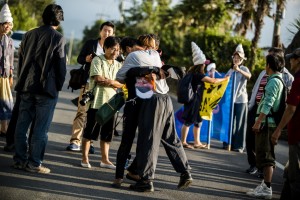
Father Moon and Dr. Song embrace. Image: Jung Da-Woo-Ri
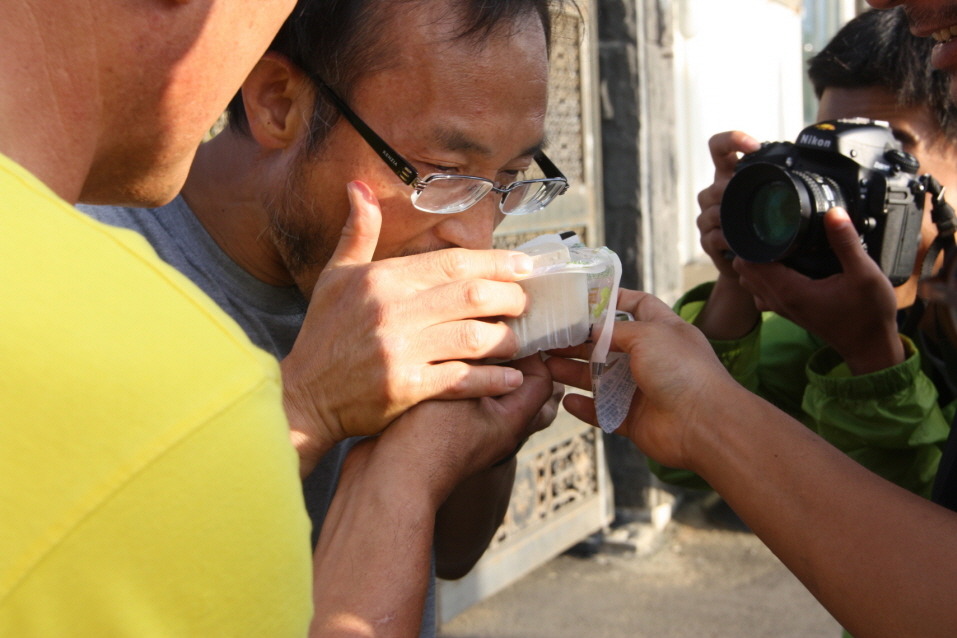
Despite this, to everyone’s surprise, he was suddenly released in the late afternoon. Although many people were not in Gangjeong village because of the Chuseok Harvest Holiday, a small group of friends and supporters from Gangjeong gathered in front of the prison to greet him and celebrate his release. Upon his release he was embraced by Father Moon Jung Hyeon and then ate tofu, as is customary, and then greeted those that had eagerly gathered to celebrate.
Brother Song is free at last! Hurray!
Dancing while waiting for Dr. Song’s release. Image: Jang Hyun-WooMayor Kang helps Dr. Song eat the customary Tofu. Image: Jang Hyun-WooDr. Song embraces supporters and friends outside the prison. Image: Jung Da-Woo-Ri
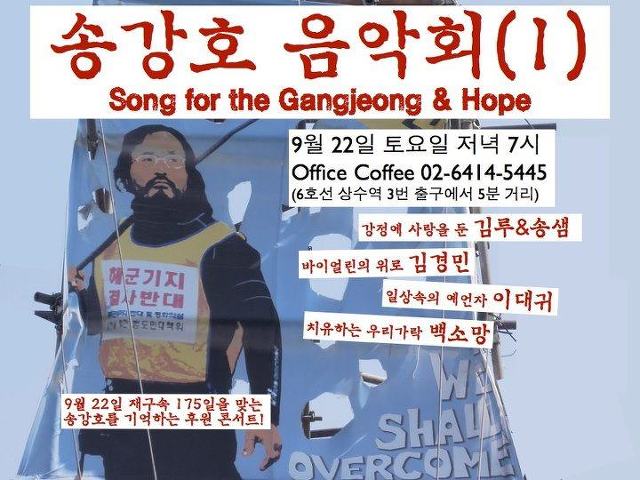
On September 22nd, a benefit concert was held for Dr. Song Kang-Ho, who was violently arrested on his birthday, April 1. September 22nd was the 175th day of his imprisonment. The concert title was ‘A Song for Gangjeong and Hope.’
Dr. Song sent a lengthy letter from Jeju Prison where he is being held, to be read at the concert, briefly excerpted here:
The hope of Gangjeong is the hope for justice and peace. The people have sung a song of hope for more than six years. Your concert is to spread the song of hope. I think your concert is beautiful. It is because the most beautiful song is the song of peace.
[…]
The prison that confines me is what jails our church and nation. You are jailed with me, too. Please sing a song for freedom. Please call for justice. And please sing a song for peace. Please sing the most beautiful song in the world, which defeats the evil spirits of violence and war that bind us.
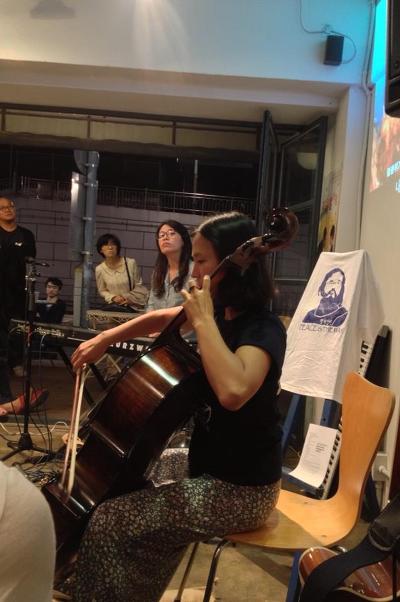
Song Saem, Dr. Song’s daughter plays cello at the concert. (Image: Lee Daegwi)
A book by Dr. Song, titled, “Peace, walking on hope from far-off: Song Kang-Ho’s Stories of Peace from Rwanda to Gangjeong” will be published by the Intervarsity Press Korea on Oct. 8, 2012.
(Information and pictures provided by Choi Hye-Young, Lim Ho-Young, and Abigail Yoo)
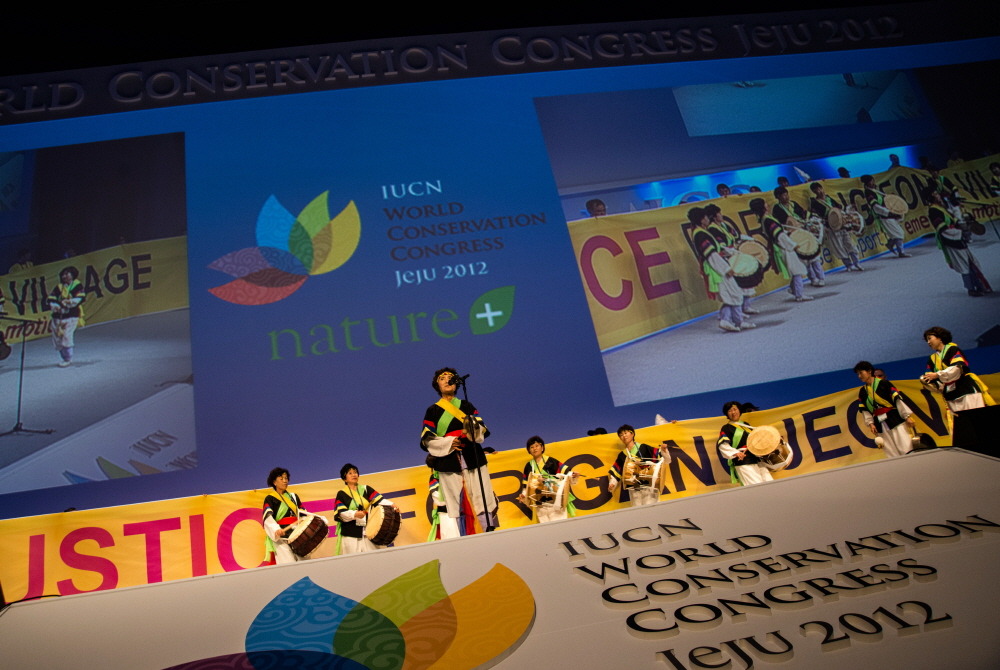
(17 September 2012, Gangjeong) The issue of Jeju naval base construction was one of the most important agendas during the World Conservation Congress (WCC). Only 7 km away from the WCC venue, environment has been seriously destroyed by the naval base construction. Unfortunately, the Motion 181: Protection of the People, Nature, Culture and Heritage of Gangjeong Village was not passed at the WCC Assembly despite full support from many Korean and foreign NGOs. We are deeply concerned by unjustifiable interruption of the International Union for Conservation of Nature (IUCN) and the IUCN Korean National Committee during the whole process of discussing and voting the Motion 181.
Open New Stage of International Solidarity Movement of No Jeju Naval Base Campaign!
During the WCC, a number of new information was revealed on the Jeju naval base construction. We found that the change of sea route turning angle to 30° interrupts four preservation zones including the UNESCO Biosphere Reserve and the Natural Memorial Site. The National Assembly disclosed that the standard for designing Jeju naval base was based on the U.S. Naval Forces’ request on the entry of aircraft carrier. Independent Environmental Impact Assessment (EIA) which was conducted together with the Greenpeace East Asia proved that soft coral beds which need to be preserved are existing around the naval base construction site.
Also, the Special Rapporteur on the promotion and protection of the right to freedom of opinion and expression (Frank La Rue), Special Rapporteur on the rights to freedom of peaceful assembly and of associations (Maina Kia), and Special Rapporteur on the Situation of Human Rights Defenders (Margaret Sekaggya) sent an allegation letter to the South Korean government on alleged acts of harassment, intimidation and ill-treatment of peaceful protesters against naval base construction in Gangjeong village. However, the South Korean government has not yet sent their response or explanation to the Special Rapporteurs for more than 100 days while the Government is requested to submit their response within 60 days.
Since these facts were widely covered by national and international media, we raised awareness of the problems of Jeju naval base construction nationally and internationally.
Unjustifiable Intervention by the South Korean Government and the IUCN Secretariat
First, exhibition booth applied by Gangjeong Village Association to the WCC was rejected without any reasonable grounds. Local people’s right to environment is one of IUCN’s focus issues. Moreover, Gangjeong village, where the Jeju naval base is now constructed, is a buffer zone of the UNESCO Biosphere Reserve and major habitats of the Indo-Pacific bottlenose dolphins which is on the IUCN Red List. In this regards, we are appalled by the fact that the exhibition booth application by Gangjeong Village Association was rejected while we have serious concerns on the environmental destruction by the Jeju naval base construction
Moreover, South Korean government denied entry of foreign human rights defenders and environmental activists who have been critical towards Jeju naval base construction without any reasonable explanation. Even though these people who were denied entry were registered WCC participants, the IUCN Secretariat did not take any firm stand against the Government but only explaining the Government’s formal response on their website.
In this regards, we have sent an open letter to Mme. Julia Marton-Lefevre, IUCN Director-General, request for a meeting to discuss rejection of exhibition booth application, environmental destruction caused by the naval base construction and denial entry of foreign WCC participants. However, the IUCN notified us that she cannot have a meeting with us due to her busy schedule. Instead of having a constructive dialogue with villagers, the IUCN Secretariat disturbed passage of the Motion 181 by making comments that are supportive to Korean government during major meetings. The IUCN was criticized by participants and members of the IUCN due to their biased position towards the Motion 181 which called for ending Jeju naval base construction and conducting independent environmental impact assessment.
Also, the IUCN Secretariat did not even notify the Center for Humans and Nature (CHN), a main sponsor of the Motion 181, and changed time and scope of the contact group meeting. On 14 September 2012, on the day and time that 2nd contact group was scheduled, the Korean National Committee urgently brought an agenda to the Assembly to drop the motion, rather than sincerely focusing on the contact group. Since the IUCN members voted against the Korean National Committee’s suggestion to drop the motion, the 3rd contact group was scheduled on the last day morning. However, both sides could not reach an agreement and the IUCN introduced the motion that was revised by the Motion Working Group, whose urging point was different from the original draft. We were surprised that the IUCN posted only a revised version of the Motion Working Group on their website. As a result, the original draft of the motion and suggested revisions during the contact group did not even have a chance to be presented during the Assembly.
The IUCN Secretariat was also biased while moderating the session. While giving two chances to speak to the Korean government, the Chair only gave one chance to sponsor groups and did not even give a chance to speak to Gangjeong Village Association President. The President of the IUCN, Mr. Ashok Khosla, made comments on the Motion 181 sponsor groups, implying the motion cannot be justified since most sponsor groups were not Korean. In response to this, Gangjeong Village Association, Jeju Pan-Island Committee for Stop of Military Base and for Realization of Peace Island (26 Jeju based NGOs), Korea Environment NGO Network (36 environmental NGOs), National Network of Korean Civil Society for Opposing to the Naval Base in Jeju Island (125 Korean civil society organizations) sent an open letter supporting the Motion 181 which was drafted by CHN.
Result of the WCC Motion 181: Protection of the People, Nature, Culture and Heritage of Gangjeong Village
Despite unjustifiable intervention and pressure by the Korean government and the IUCN Secretariat, the Motion 181 gained a lot of support from IUCN members. NGO members voted For 269(52%)/Against 120(23%)/Abstain 128(25%) while Government members voted For 20(13.5%)/Against 68(46%)/Abstain 60(40.5%).
At the WCC Assembly, it is required to get more than 51% of votes from both NGO and Government members to pass the resolution. According to this rule, the Motion did not pass because it did not get enough votes from Government members. However, almost 40% of Government members abstained the Motion which is similar number to those who were against the motion. In total, combining both NGO and Government members’ vote, members who voted For are 289 while Against are 188 only.
Meanwhile, the IUCN Secretariat’s biased and undemocratic decision making process and its dependency on hosting country and sponsor companies were heavily criticized during the WCC. The IUCN member organizations strongly criticised the Secretariat as it did not actively deal with Jeju naval base construction issue and limited speaking opportunities during the WCC. This is a serious violation of principles and values of the WCC and the IUCN. This behaviour will continue to bring internal and external controversies on the standing principle of the IUCN.
The South Korean government expected to use the WCC as a platform to unilaterally publish government’s ‘green growth’ policy. Instead, their anti-environmental policy was published as they used undemocratic, anti-human rights, and oppressive methods to suppress voices against Jeju naval base construction. During the contact group where both sides suppose to discuss environmental and scientific impact of Jeju naval base construction, the Government addressed issues of ‘national security’ and prevented rational discussion. It created doubts on their Environmental Impact Assessment which they proudly show off as an independent and scientific assessment.
Future Steps
We will consolidate our solidarity and cooperation by using international networks that we established from this WCC.
We will continue to raise our concerns on newly discovered negative environmental impact of Jeju naval base construction and the Government’s anti-environmental and anti-human rights strategies at the WCC during the Parliamentary Inspection of the Administration, deliberation on the 2013 budget and the Presidential Election period.
We sincerely appreciate to 35 sponsor groups of the Motion, especially Center for Humans and Nature, around 150 civil society organizations in Korea, members of environmental groups and 111 organisations around the world who endorsed our statements, and peace keepers in Gangjeong village.
For further questions or media inquiries, please contact: Ms. Gayoon Baek , Coordinator, People’s Solidarity for Participatory Democracy, +82 (0)2 723-4250 or peace@pspd.org
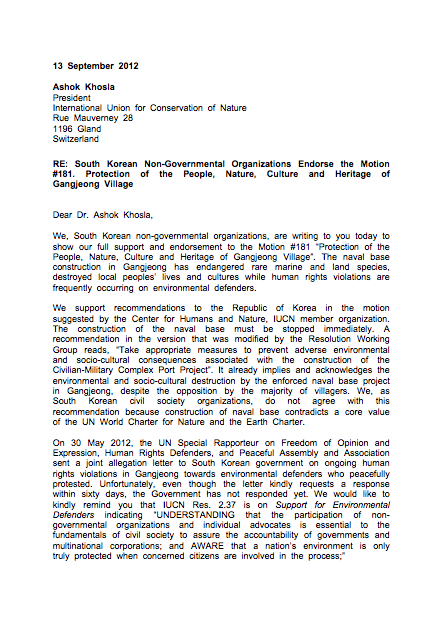
To: Ashok Khosla
President
International Union for Conservation of Nature
Rue Mauverney 28
1196 Gland
Switzerland
RE: South Korean Non-Governmental Organizations Endorse the Motion #181. Protection of the People, Nature, Culture and Heritage of Gangjeong Village
Dear Dr. Ashok Khosla,
We, South Korean non-governmental organizations, are writing to you today to show our full support and endorsement to the Motion #181 “Protection of the People, Nature, Culture and Heritage of Gangjeong Village”. The naval base construction in Gangjeong has endangered rare marine and land species, destroyed local peoples’ lives and cultures while human rights violations are frequently occurring on environmental defenders.
We support recommendations to the Republic of Korea in the motion suggested by the Center for Humans and Nature, IUCN member organization. The construction of the naval base must be stopped immediately. A recommendation in the version that was modified by the Resolution Working Group reads, “Take appropriate measures to prevent adverse environmental and socio-cultural consequences associated with the construction of the Civilian-Military Complex Port Project”. It already implies and acknowledges the environmental and socio-cultural destruction by the enforced naval base project in Gangjeong, despite the opposition by the majority of villagers. We, as South Korean civil society organizations, do not agree with this recommendation because construction of naval base contradicts a core value of the UN World Charter for Nature and the Earth Charter.
On 30 May 2012, the UN Special Rapporteur on Freedom of Opinion and Expression, Human Rights Defenders, and Peaceful Assembly and Association sent a joint allegation letter to South Korean government on ongoing human rights violations in Gangjeong towards environmental defenders who peacefully protested. Unfortunately, even though the letter kindly requests a response within sixty days, the Government has not responded yet. We would like to kindly remind you that IUCN Res. 2.37 is on Support for Environmental Defenders indicating “UNDERSTANDING that the participation of non- governmental organizations and individual advocates is essential to the fundamentals of civil society to assure the accountability of governments and multinational corporations; and AWARE that a nation’s environment is only truly protected when concerned citizens are involved in the process;”
In this vein, we, as South Korean non-governmental organizations, firmly stand in solidarity with the Motion #181 “Protection of the People, Nature, Culture and Heritage of Gangjeong Village” as originally suggested by the Center for Humans and Nature. If you have any questions or need a clarification, please do not hesitate to contact us at peace@pspd.org or +82-2-723-4250.
Yours Sincerely,
Mr. Dong-kyun Kang Village Mayor Gangjeong Village Association
Mr. Gi-ryong Hong Co-convenor Jeju Pan-Island Committee for Stop of Military Base and for Realization of Peace Island
(26 Jeju based NGOs: 곶자왈사람들, 노래패청춘, 서귀포시민연대, 서귀포여성회,양용찬열사추모사업회, 전국공무원노조 제주지역본부, 전국교직원노동조합 제주 지부, 전국농민회총연맹 제주도연맹, 전국민주노동조합총연맹 제주본부, 전국여성 농민회총연합 제주도연합, 제주 4.3 도민연대, 제주 4.3 연구소, 제주민족예술인 총연합, 제주여민회, 제주여성인권연대, 제주주민자치연대, 제주참여환경연대, 제 주통일청년회, 제주평화인권센터, 제주환경운동연합, 참교육을 위한 전국학부모회 제주지부, 천주교 제주교구 평화의섬 실현을 위한 특별위원회, 탐라자치연대, 평 화를 위한 그리스도인 모임, 한국기독교장로회 제주노회 정의평화위원회, 한국장 애인연맹 제주 DPI)