Save Jeju Now

No War Base on the Island of Peace

  • Home
  • About
    • History
    • 4 Dances of Gangjeong
    • 100 Bows
    • Appeal
    • Partners
    • Board
  • Blog
    • All Posts
    • Petitions
    • Arrests & Imprisonmentuse for all things related to arrests and imprisonment
    • IUCN WCC 2012
      • Appeals & Statements
      • Gangjeong-Related Schedule
      • International Action Week, Sept. 2-9
      • Motion
      • Special Edition Newsletter for the WCC 2012
  • Gallery
    • #7 (no title)
    • #8 (no title)
    • #6 (no title)
  • Press
  • Support
    • Act
    • Visit
  • Downloads
    • Monthly Newsletter
    • Environmental Assessments
    • Reports
  • Language switcher
  • Hawaii: Head of the Tentacled Beast by Jon Lentman

    ‘Wright, who resigned in protest of the 2003 invasion of Iraq, points to the South Korean naval base on Jeju which, when finished, will house AEGIS-equipped destroyers linked to U.S. missile defense as an example of how the United States pressures its allies to follow certain paths.

    Speaking at a Pentagon news briefing last June, PACOM commander Admiral Samuel J. Locklear basically said the same thing: “We’re not really interested in building any more U.S. bases in the Asia-Pacific,” he said. “We shouldn’t have to at this point in time. We have reliable partners and reliable allies, and together we should be able to find ways to—not only bilaterally, but in some cases to multilaterally—to be able to find these locations where we can put security forces that respond to a broad range of security issues.”

    …………………………………………………………….

    Foreign Policy in Focus

    Hawaii: Head of the Tentacled Beast

    By Jon Letman, October 18, 2012

    RIMPAC 2008 (Photo courtesy of Jon Letman)

    This article is part of a weekly FPIF series on the Obama administration’s “Pacific Pivot,” which examines the implications of the U.S. military buildup in the Asia-Pacific—both for regional politics and for the so-called “host” communities. You can read Joseph Gerson’s introduction to the series here.


    Fresh from hosting the Asia-Pacific Economic Cooperation (APEC) summit in Honolulu last autumn, U.S. President Barack Obama recently told members of the Australian Parliament that America’s defense posture across the Asia-Pacific would be “more broadly distributed…more flexible—with new capabilities to ensure that our forces can operate freely.”

    The announcement of America’s “Asia-Pacific pivot” by its first Hawaiia-born president was highly fitting, since the Hawaiian Islands are at the piko (“navel” in Hawaiian) of this vast region.

    A less flattering metaphor for Hawaii’s role in the Pacific is what Maui educator and native Hawaiian activist Kaleikoa Kaeo has called a giant octopus whose tentacles reach across the ocean clutching Japan, Okinawa, South Korea, Jeju island, Guam—and, at times, the Philippines, American Samoa, Wake Island, Bikini Atoll, and Kwajalein Atoll in the Marshall Islands.

    The head of this beast is in Hawaii, which is home to U.S. Pacific Command (PACOM), with sonar, radar, and optical tracking stations as its eyes and ears. Its brain consists of the supercomputers on Maui and the command center on Oahu that connects PACOM to distant bases. This octopus excretes waste as toxic land, polluted waters, abandoned poisons, blown-up and sunken ships, and depleted uranium (DU). Like a real octopus that can regenerate severed limbs, the military in the Pacific grows in new locations (Thailand, Australia) and returns to old ones (Philippines, Vietnam).

    PACOM headquarters at Camp H.M. Smith on Oahu is a short drive from Waikiki Beach, but it’s unlikely many tourists pause to consider that tensions between the United States and Russia over missile defense, the war in Afghanistan, the destruction of Iraq, the use of drones in Libya, Somalia, Yemen, Pakistan, and the Philippines—as well as growing opposition to military bases in Okinawa, Guam and Jeju—are all linked to Hawaii.

    Thirty-six nations— and over half the world’s population—live in PACOM’s “Area of Responsibility” which spans from the Bering Strait to New Zealand, as far west as Pakistan and Siberia and east to the Galapagos. This behemoth’s self-proclaimed duty is to defend “the territory of the United States, its people, and its interests,” and to “enhance stability in the Asia-Pacific,” “promote security cooperation, encourage peaceful development, respond to contingencies, deter aggression and, when necessary, fight to win.”

    Sovereignty violated

    Hawaii’s relationship with the U.S. military was cemented on January 16, 1893, when U.S. Marines overthrew what had been a sovereign kingdom recognized by the United States and dozens of countries around the world. Encouraged by Anglo-American subjects of the Hawaiian kingdom seeking tariff-free access to American markets for their sugar cane, the U.S. military—pursuing what was then already a mission of expansion in the Pacific—toppled Queen Liliuokalani, making way for the 1898 U.S. declaration of the Territory of Hawaii and, in 1959, statehood.

    In 1900, President Theodore Roosevelt said, “I wish to see the United States the dominant power on the shores of the Pacific Ocean.” He and every president since have understood the importance of Hawaii in fulfilling that goal. “Our future history will be more determined by our position on the Pacific facing China than by our position on the Atlantic facing Europe,” Roosevelt said.

    Since even before World War II, but especially since the 1947 establishment of PACOM, Hawaii has been at the center of testing, training, and deployment of U.S. military hardware and personnel around the region. Today Hawaii is home to118 military sites, from the Pacific Missile Range Facility on Kauai to Kaena Point Satellite Tracking Station on Oahu, from the Air Force Maui Optical and Supercomputing observatory to the Pohakuloa Training Area on the Big Island (Hawaii Island).

    Besides Hawaii’s four largest islands, the military has used smaller Hawaiian islands and offshore islets for live-fire testing for decades. Best known isKahoolawe, which was a bombing range from 1941 until 1990 when, after more than a dozen years of protests and legal challenges, President George H.W. Bush ordered a cessation to bombing and the removal of unexploded ordnances. Yet as of 2004, one-quarter of Kahoolawe still had unexploded ordnances and was considered “unsafe.”

    On Hawaii Island, at 133,000 acres, Pohakuloa Training Area (PTA) is over four times the size of Kahoolawe. The high-altitude site between the volcanoes Mauna Loa and Mauna Kea has been used by all branches of the military for small arms training, mortar firing, and other live-fire tests.

    In addition to being shelled with millions of rounds of ammunition annually—and on the receiving end of 2,000-pound inert bombs dropped from B-2 bombers—PTA is contaminated with an undetermined amount of depleted uranium (DU). In 2008, the Hawaii County Council voted 8-1 for a resolution calling for a halt to live-fire training until further assessments and clean-up can be conducted. The military, however, continues to exploit the site, according to Jim Albertini with the Malu Aina Center for Non-violent Education & Action.

    Below PTA, in the sleepy town of Hilo, community advocate Lori Buchanan describes Pohakuloa today: “It’s so disheartening to drive past and see the degradation to the land. What I see will bring tears to your eyes—not only animals with no place to go, but dust storms reminiscent of Kahoolawe because of the erosion and impact of military training.” She says the bombing doesn’t make sense. “Why would you bomb the hell out of the land when it’s so limited? We live on an island…and they’re bombing a huge area, making it a wasteland.”

    Although a native Hawaiian, Buchanan says she isn’t instinctively anti-military. “It’s the whole patriotic [thing]. It’s ingrained in us. We understand the importance of defense—no one is challenging that, but is all this really necessary? You cannot kill your own resources when you live on an island and have nowhere to go once you’ve killed everything off.”

    “It isn’t just Pohakuloa. It’s Kahoolawe, Makua, Barking Sands, the proposed training on Maui and it’s Kalaupapa,” says Buchanan, talking about Kalaupapa peninsula, on the island of Molokai. Kalaupapa is a quiet place, best known for its 19th-century leprosy colony at the bottom of Hawaii’s highest sea cliffs. Less well known is that Kalaupapa and “topside” (upper) Molokai are used by the Navy for confined area and field carrier landing “touch-and-go” training by CH-53Dhelicopters, the type used in Afghanistan. In July 2012, activists on Molokai helped thwart plans to increase night training exercises for the controversial MV-22 Osprey and Huey attack helicopters from 112 takeoff and landings per year to 1,388.

    The Navy plans to base two squadrons (12 aircraft each) of Osprey and one squadron of light attack H-1 Cobra and Huey attack helicopters in Hawaii. The Osprey, which takes off like a helicopter but can fly like an airplane, has been heavily criticized over safety concerns following at least seven fatal crashes—including two this year, in Florida and Morocco. Osprey helicopters have been used in Afghanistan, Iraq, and Libya, and they’re being deployed in Japan and Okinawa despite fervent protests.

    In addition to concerns about some 2,000 new active-duty personnel and their dependents being transferred to Oahu, civic and cultural groups are worried about the impacts of the aircraft on local communities, wildlife, and historically and culturally sensitive areas on Kalaupapa, which is designated a U.S. National Historic Park. The military has said the increased training will have “no significant impact on noise levels for most communities,” but local groups wedged between high cliffs, mountains, and the sea fear otherwise.

    Under my thumb

    An Asia-Pacific pivot will increase testing and training beyond what has taken place in Hawaii for years—from live-fire testing in Makua Valley on Oahu to missile defense, rocket, and drone testing at the Pacific Missile Range Facility on Kauai. Additionally, every two years, the U.S. military holds its Rim of the Pacific (RIMPAC) training—the “world’s largest international maritime exercise,” which was most recently held this summer across the islands.

    RIMPAC 2012 included 22 regional allies (including Canada, Japan, Australia, South Korea) and more distant nations like Colombia, Netherlands, Tonga, India, and Russia. Notably absent was China, but in September 2012, U.S. Secretary of Defense Leon Panetta announced that Beijing would be invited to participate in a limited capacity in the 2014 exercise.

    Retired U.S. Army Colonel Ann Wright sees RIMPAC and the growing number of multi-national joint military “exercises and engagements” in the region as an opportunity for the United States to test (and show off) its next generation of weaponry: laser-fueled, computerized, and submarine-launched drones. It’s also a chance to closely assess regional capabilities while positioning the United States to more effectively “push around” other countries and persuade them to do the foreign policy and military operational bidding of the United States, Wright says.

    Wright, who resigned in protest of the 2003 invasion of Iraq, points to the South Korean naval base on Jeju which, when finished, will house AEGIS-equipped destroyers linked to U.S. missile defense as an example of how the United States pressures its allies to follow certain paths.

    Speaking at a Pentagon news briefing last June, PACOM commander Admiral Samuel J. Locklear basically said the same thing: “We’re not really interested in building any more U.S. bases in the Asia-Pacific,” he said. “We shouldn’t have to at this point in time. We have reliable partners and reliable allies, and together we should be able to find ways to—not only bilaterally, but in some cases to multilaterally—to be able to find these locations where we can put security forces that respond to a broad range of security issues.”

    “It’s complicated”

    Much has been made of the Asia-Pacific pivot, but Oahu activist Kyle Kajihiro ofHawaii Peace & Justice says this is just the most recent wave in a series of endless waves.

    “Every pivot needs a fulcrum in order to turn. Hawaii was the first fulcrum for U.S. in the Pacific and has allowed it to leverage their power to greater effect,” he says. Kajihiro points out that questions of land use and the military’s social, cultural, and environmental impacts on Hawaii are frequently overlooked or sidelined by the notion that seemingly endless infusions of money and military-based employment always trump the needs of people and the environment.

    For decades the military has enjoyed solid backing from Hawaii’s congressional delegation in Washington, the Hawaii Chamber of Commerce, and unions with construction interests. Hawaii’s own population, which overwhelmingly votes Democratic, has largely accepted what Kajihiro calls “the dominant myth” that a large military presence is organic, inevitable, and naturally beneficial. He refers to events like “Military Appreciation” month and the USS Arizona Memorial at Pearl Harbor, where he says militarism and war are monumentalized as forms of “redemptive violence”—that is, as a source of goodness, honor, and valor from which the United States always emerges “stronger and better.”

    In Hawaii, the military has widespread local support, even from some native Hawaiians (whose kingdom was overthrown), people of Japanese descent (who have suffered discrimination and internment) and others whose ancestral homelands have born the brunt of the U.S. military (Koreans, Okinawans, Chamorro, Pacific Islanders).

    “When you’re severely addicted to something like the military,” asks Kajihiro, “how do you transition away without causing trauma?” He says Hawaii would face serious economic hemorrhaging if it turned away from the military cold turkey. “How do we plan for and invest in an alternate course that will take us off an addictive substance that deteriorates the body to a more diversified, healthy economic sustenance?”

    Hawaii is a remote archipelago almost wholly dependent on imported oil, commodities and manufactured goods, but increasingly its people are recognizing the need to become more self-reliant, especially in terms of local food production.

    In the last decade Hawaii has seen a mushrooming of businesses and educational efforts to pursue alternative energy based on sun, wind, waves and waste. Author Richard Heinberg, a senior fellow in residence at the Post Carbon Institute, has suggested Hawaii should move in a direction like New Zealand, which places very little emphasis on military strength but has become a global leader in environmental conservation.

    Under the banner of an “Asia-Pacific pivot,” the United States is positioning its military to secure access to remaining resources and drive the economic and political winds of the region, but it also demonstrates that it understands the importance of finding alternatives to building large, new bases that rely on increasingly hard-to-obtain money and oil.

    In order to successfully secure a place for its people in a more crowded, resource-strained world, Hawaii would do well to pursue its own pivot away from militarism and instead shift its efforts to food and energy self-reliance, environmental protection, and planning for survival in a world beset by climate change.

    The sooner Hawaii recognizes that it would be better off with a drastically reduced dependency on the military, the sooner it can begin to move toward a healthier, safer, and more secure future.


    October 19, 2012

  • [Notice] Assault on Jeju: Video Presentation, Nov.18 Brunswick, Maine


    October 19, 2012

  • ‘No verification on cruise, no budget,’ ‘no function for operational water area,’ National Assembly man claims

    Image source: Jeju Sori, Oct. 18, 2012 (translated)

    In the National Assembly Inspection on the navy headquarter on Oct. 18,  Kim Jae-Yoon (Democratic United Party, Seogwipo City), member of the Defense Committee of the National Assembly raised primarily on two issues. While the 1st issue has been constantly raised by many observers, the 2nd is something new and important. Anyway, here is the summary based on the Jeju Domin Ilbo, Oct. 18.


    1.   Regarding the harbor and bay layout of the Jeju naval base:

    ‘If simulation verification on the control of 150,000 ton cruise is not correctly carried out, all the budgets related to the Jeju naval base project for next year should be cut.’


    Kim pointed out that:

    (1)  Because of the reduced size of turning basin, cruise navigation is dangerous.

    (2)  Because of sea route change, dredging at the bottom of sea is inevitable, which raises concern on the intrusion on the ecology system protection area.

    (3)  Because of arbitrary standard on wave height, there is the risk of accidents during ships’ mooring or unloading.

    (4) Because of no design on emergency exit that should be prepared, according to the layout standard on the defense/ military facilities, for the cases when vessel is being attacked or running aground so the port entry is blockaded, it is difficult for vessels to move out if emergency occurs.


    He claimed that:

    Even though the flaws on the harbor and bay layout of the Jeju Civilian-Military Complex for Tour Beauty (* In fact, a pure military base) are very serious, the navy has attempted to hide those with false explanations. It should be verified through objective and fair simulation whether turning basin and sea route have been designed according to the legal standard and the base plan is appropriate. The Government should accept the simulation cases demanded by the Jeju Island government (* which, itself, does not trust simulations by the central government but constantly makes false propaganda on the dual complex port). And the whole budget on the naval base project should be cut for the next year, unless simulation verification, the core of 5 items recommended to the Government by the National assembly is properly carried out.


    2.   Regarding the government assertion on sea security


    ‘The base would take little role in the protection on the southern sea area and maritime traffic route. The navy cause of  [so-called ‘security’] for building the naval base is only appearance.’


    Kim pointed out that:

    While the Korea Air Defense Identification Zone( KADIZ) is set close to the Jeju island, the Japanese Air Defense Identification Zone (JADIZ) is set below the south sea of the Jeju and the Ieodo (* a submerged rock, not the Island) in the south of the Marado(the southernmost Island in Korea) also belongs to the JADIZ.

    Therefore in case the ROK navy mooring in the Jeju naval base and patrolling in the southern sea area of the Jeju, carries out operations with helicopters or aircraft embarked on vessels within the ADIZ, it should make a prior consultation with Japan and its activities could be limited by the Japanese Maritime Self-Defense Force(JMSDF).


    Therefore Kim emphasized that:

    ‘Even though the navy asserts on the expansion of its influential power in the southern sea area through the building of the Jeju naval base, in reality, it is questionable to which points it can assert on its operation scope in the southern sea area. Then the role of the naval base as an outpost that guards the southern sea area is very limited. The cause to enforce the base project with tremendous budget and social costs then goes down.’

    ……………………………………….

     Reference


    http://www.jejudomin.co.kr/news/articleView.html?idxno=35945

    “크루즈선 안전성 검증 안되면 예산 전액삭감”

    김재윤 의원, 국감서 해군기지 설계 오류 집중 추궁

    2012.10.18


    http://www.jejusori.net/news/articleView.html?idxno=121434

    “제주해군기지, 남방해역 보호? 매우 제한적”

    2012.10.18

    October 18, 2012

  • Grand March for Life and Peace 2012: Gangjeong to Seoul

    The motto “We are the Sky” comes from the motto of the Sky Act, a joint solidarity campaign of three struggles in Korea: (S)Ssang Yong autoworkers layoff struggle, (K)Gureombi Rock/anti-Gangjeong naval base struggle, and the (Y)Yongsan Tradegy struggle.

    More info coming soon!

    October 18, 2012

  • Navy report: Jeju Naval Base to Accommodate US Nuclear Submarine

    A US nuclear-powered SSN-776 submarine, at Pearl Harbor, Hawaii

    Hankyoreh, Oct. 18, 2012

    Navy report: Jeju naval base to accommodate US nuclear submarine

    Recently acquired documents raise questions about Gangjeong Village as a joint civil-military harbor

    By Ha Eo-young, staff reporter

    A Navy report from 2009 states that the water depth for a naval base currently under construction on Jeju Island was designed to accommodate a US nuclear submarine.

    This latest revelation comes on the heels of allegations that the base was designed to allow a US nuclear-powered aircraft carrier to make port.

    Document 06-520, titled “Basic Plan and Examination Request Basic Plan Report” was acquired from naval headquarters by Democratic United Party lawmaker Kim Kwang-jin. It states in its harbor facility requirement standards section that the “overall depth of the submarine dock was set at 12 meters at the request of the orderer.”

    This design depth suggests the base was planned to accommodate the US nuclear-powered SSN-776 submarine, since a depth of 9.3 meters would be adequate for South Korean submarines. This means that the base was designed around a vessel that the South Korean Navy does not current possess, and has no plans to possess.

    “The Ministry of National Defense said there were no demands from CNFK [the Commander of US Naval Forces Korea], but from this design it appears that the South Korean government took it upon itself to make [the harbor] big enough for a US warship that might never dock there, without even being asked to,” said Kim.

    “If it is built this way, we can’t even guarantee that it will be a South Korean military base, let alone a civil harbor,” he added. The South Korean government previously said the base was being designed as a joint civil-military harbor.

    “Suppose the US military comes to Jeju with a nuclear-power aircraft carrier,” Kim continued. “How can we reasonably guarantee that civilians can freely use it for ‘tourism’?”

    This is not the first accusation that the Jeju base is being built to US military standards. Previously, observers pointed to phrasing about “water depth meeting the 15.2 m standards of CFNK” in facility construction specifications published by naval headquarters in 2010 as evidence that the base was being tailored to CFNK demands.

    “The report was a pamphlet based on documents submitted by the company that performed the study,” said a Navy official. “The client in it is obviously the Navy.”

    “The design is a preemptive step to allow all submarines above a certain size to make port, not just a US nuclear-powered submarine,” the official added.

    Please direct questions or comments to [english@hani.co.kr]


    ……………………………………………………………………………….

    # Save Jeju Now adds….

    Mr. Go Gwon-Il, chairman of the villagers’ Committee to Stop the Naval Base has done in-depth research about the issue on the submarines that may moor in the Jeju naval base. According to him, it is possible to station total 80 trident nuclear missiles in the coast, which is enough number to annihilate China.

    According to his research, it is possible that total 4 submarines, including maximum two nuclear-propelled submarines that loads 24 numbers of 8,000km range nuclear missiles each and two nuclear submarines each that loads 16 nuclear missiles, and more than two multipurpose attack type submarines can be moored and equipped.

    In detail,

    The length of the submarine dock, 365m is enough for the simultaneous mooring of the US nuclear submarines of the Ohio(the biggest) and George Washington class loaded with ballistic missiles.

    The dock for the mid-size ship/ submarine is for a combination of diverse US nuclear submarines. Submarines of attack type or ballistic missile submarines can be moored.

    Among the US nuclear submarines, the submarine with the deepest draft is the Sea Wolf class, which is multipurpose attack ship and draft is 10.66m. That is why the water depth of 12m has been demanded for the submarine dock, by the Commander, US Navy Forces of Korea (CNFK).

    For the photos and tables, see http://cafe.daum.net/peacekj/49kU/2039

    October 18, 2012

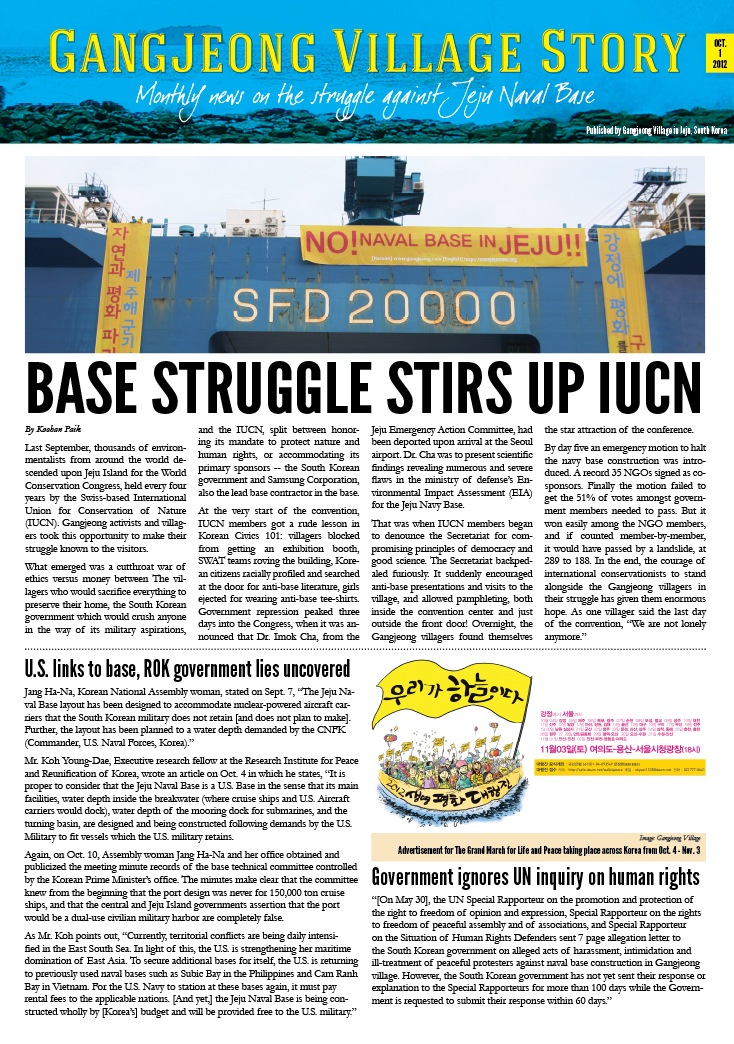
  • Gangjeong Village Story: Monthly News from the Struggle | October Issue

    In this month’s issue:

    Gangjeong and the Naval Base Issue stir up the IUCN’s WCC 2012, New U.S. Links to the Naval Base found, ROK Government ignores the UN on Gangjeong, Interviews with Prisoner Kim Bok-Chul and a WCC participant, Articles from several Veterans for Peace visitors to Gangjeong, and more!

    Download PDF

    October 18, 2012

  • Struggle to Keep the Gates from Construction Trucks Continues at Night

    Image: Cho Sung-Bong

    On Oct. 16, police roughed out people 12 times to the exhaustion of people who have kept the two gates from the endless construction trucks from early morning.  It has usually been about 7 times. Many young activists got bruise and scratched wounds as the policewomen even use their nails. The navy is accelerating construction (destruction) from the anxiety that it may not get the construction budget for next year.  The navy has been building caisson production area in the west part of the Gureombi Rock, for which and shipment site in the east part of the Gureombi Rock, it has blasted about 10 % of it this March and April.

    Last year, the National Assembly has cut about 96% of about 130 billion won in proposed budget related to the Jeju naval base construction. Many problems including unreliable base design had been exposed through the National Assembly inspection last year. Instead, about 107 billion won budget unused in 2011 due to people’s protests was transferred to 2012 and the navy has been consuming that transferred budget for 2012. Still the navy could not even use half of that as of this October because of fierce struggles by the dedicated people who daily keep the construction gate from the construction trucks, from morning to late evening, sometimes, overnight.

    As the end of this year is approaching amidst the National Assembly inspection (The National assembly inspection on the government offices related to the Jeju naval base project is from Oct. 5 to 24) and there will be a Presidential election in December, the navy and conservatives are anxious to finish their job as much as they can do. The growing criticism on the current Lee Myung Bak government is an another factor. The People here have been organizing the nationwide march from Oct. 4 to Nov. 3, which contributes to organize people’s will to change the government and to revoke the Jeju naval base project.

    The Headline Jeju on Oct. 9 reported that about 200 billion won was appropriated to the ROK National Assembly in the 2013 budget for the construction cost related to the Jeju naval base concerned by the Ministry of National Defense and DAPA(Defense Acquisition Program Administration).

    The cost includes about 108 billion won for the caisson production & deferment in the 1st work area and basic formation for the breakwaters; and 49 billion won for the caisson production & deferment in the 2nd work area and the basic formation of dock.  It is also known that about 22 billion won was estimated for land construction.

    However, people’s will to stop the Jeju naval base construction will be accomplished. One should not forget the people who daily keep the gates. They are the people who are saving us as well.

    Please pressure the ROK National Assembly members to cut all budgets on the Jeju naval base project .( *The government says that the total cost for the Jeju navy base project is about 1.7 trillion won) For example, ENGLISH@ASSEMBLY.GO.KR or Moon Jae-In, Permanent Advisor, Democratic United party, Presidential candidate: moonriver365@gmail.com.

    …………………………………..

    Reference

    http://www.headlinejeju.co.kr/news/articleView.html?idxno=161923

    내년 제주해군기지 공사비 2000억원 편성…항만공사 본격화

    국회 제출 예산서, 항만공사비 등 대거 편성

    2012.10.09  11:57:38

     …………………………………..

    See also

    http://savejejunow.org/daily-struggle-budget/

    Daily struggle has delayed 28 billion won. Help to cut all the budgets on base! (Oct. 23)

    October 18, 2012

  • The National Police Agency reply to the UN was without consultation to the Jeju Police Agency

    [Oct. 15] The National Police Agency replied to the UN human rights inquiry on oppression on Gangjeong without consultation to the Jeju Police Agency.

    According to the National Assembly inspection resource material that Park Nam Choon (Democratic United party), a member of the Administrative Security Committee of the National assembly, has gotten from the Jeju Police Agency, the agency has not gotten any consultation from the National Police Agency regarding the reply letter to the UN human rights special rapporteurs’ joint inquiry on human rights violation in Gangjeong [on May 30.]

    It means the National Agency has made the reply letter in the way of the arbitrary.

    It was also exposed that the Jeju Police Agency has recognized on the existence of joint letter only through media and it has only become to know that there is the Gangjeong-related contents only by the preparation process on the National Assembly inspection at the end of September.


    …………………………………………….

    Reference

    http://www.headlinejeju.co.kr/news/articleView.html?idxno=162350

    “UN무시, 인권 위에 존재하는 경찰청은 소설가?”

    ‘UN인권이사회 강정 인권침해 질의서’ 경찰청 맘대로 작성

    제주청은 허수아비, 공동서한 내용과 답변여부 전혀 몰라?”

    2012.10.15  10:03:46

    October 17, 2012

  • Nearly 130,000 Mainland Police have been stationed in Gangjeong since August 2011

    Original Korean Image: Yu Dong-Su, Voice of the People/English Version: Gangjeong Village Story

    Pak Nam-Choon (Democratic United Party), member of the Administration and Security Committee of the National Assembly, has compiled and released data received from the Police Office, as part of the National inspection on the Police Office on Oct. 15:

    Approximately  a total of 130,000 mainland police persons have been stationed in Gangjeong village between August of 2011 and the present. A budget of 4.2 billion Won (about $3.5 million USD) was spent for primarily for food, accommodations and transportation by ferry.

    According to documents submitted by the police for the parliamentary inspection on October 15, a total of 194 police units have been mobilized and an average of 352 police officers per day have stationed in Gangjeong village, reaching a total of 128,402 officers

    At the same time, [during the period between Jan. 2010 to Aug. 2012] , a total of 586 villagers and activists have been arrested, and among them 493 have been taken to court or put on trial.


    Reference:

    Jeju Sori: 지난 1년 강정에 투입된 경찰 13만명-42억원

    2012.10.15  11:29:33


    October 16, 2012

  • People’s statement upon the National Assembly inspection on the Island government

    On Oct. 15 when there was the National Assembly Administration and Security committee inspection on the Jeju Island government at the Island government hall, many people including village elders gathered in its yard to show their determination against the naval base project and to demand the Assembly thorough inspection on the Island government and revocation of the Jeju naval base project, from 9am to 5pm. Beside anti-base groups, there was also protest by a pro-base group in much small numbers. No physical conflict between them. Still the Island government bullying on the anti-base group people, did not even allow them to put a banner on the ground of yard in the beginning. However, people persisted to carry on peaceful 300 bows there. Picketing, songs, dances, and grafting went all day.

    The below is an excerpt translation of people’s press conference statement read in front of the Jeju Island government hall  upon the start of the National Assembly inspection on the Jeju Island government on Oct. 15.  Original Korean statement can be seen here.


    Photo by Cho Sung-Bong

    [People’s press conference statement on Oct. 15] ‘CNFK intervention, false civilian-military dual complex harbor, human rights violation: Revoke the Jeju naval base project that destroys the future of the Jeju!’


    Since the Gangjeong village has been decided as the Jeju naval base project-targeted area five years six months ago, the ROK navy is enforcing construction (destruction) inputting project cost of more than 200 billion won.  [..]


    Two biggest issues have been disclosed in the National Assembly inspection on the government offices this time.


    The one is on a clear proof that the US military has intervened in the Jeju naval base construction. As seen in the construction specifications, the CNFK (Commander of the US Navy Forces, Korea) has demanded [the ROK navy] a base design in which [US] nuclear-powered aircraft carrier and nuclear-powered submarine can enter. (*See here or here)


    Not to mention that the construction cost is added with about 150 billion won due to dredging and mooring facility to fit the water depth for nuclear-powered aircraft carrier and nuclear submarine, we reconfirmed the will of the United States that wants to aggressively intervene in the conflict on the maritime order in the Northeast Asia. Our concern that the Jeju Island would be the scapegoat of the supremacy competition between China and the United States turned out to be more and more realistic.


    The other point is that it has come in evidence with that the Government has glossed over as if it would build a beautiful tourism port while it builds the port, in fact, only as a military port.


    Scandal is being raised with the public exposure of the meeting minutes by the technical verification committee under the Prime Minister Office, in which even a government officer’s self-scorning remark was even made public, that ‘the [government] has [originally] made the base design as a military port then is to forcibly put cruises, that is why [the committee cannot prove that that cruise works in the projected base through its simulation test]. Still the remarks by the government side that intends to enforce construction by all means without the change of base design flowed in the meeting minutes. Further it turned out that the government has enforced only construction (destruction), glossing over as if the simulation report that is not the government official but has been done by the ROK Maritime University to which the Samsung C & T has privately requested and that was done even before the formation of the technical verification committee is the report that is considered of all of the claims by the Jeju Island government (* which has constantly demanded to the central government on the Jeju civilian-military complex tour beauty where two 150,000 ton cruises are supposedly to enter, The people not only oppose the idea but think it is a nonsense) [..]


    Even though the navy has stated that it would use the southern sea and large size maritime shooting range nearby the Chuja Island as a shooting training by maneuvering flotilla, the maritime and fisheries bureau of the Jeju Island government is not raising any inquiry on it. The arms that are used by maneuvering flotilla have much different quality level from the machine gun–level arms that are currently used by the Jeju Defense Headquarter. Also, what will happen in the maritime ecology of that areas called ‘golden fish bank’ in case there are torpedo and anti submarine bomb training not to mention naval bombardment training in that maritime shooting training?  [..]


    Also the air force is openly stating that it would drive for search and rescue air force base with the development of the new Jeju airport. [..]


    Woo Keun-Min, the Island governor should have no more fantasy on the local development with the naval base construction that has been full of expedient method, law-evasiveness and illegality. [..]


    The navy should not extort the sacrifice of the Jeju Island people with its concession project under the mask of so called security. It should return back to its duty for true security placing the management on the southern sea transportation route and Ieodo (Rock not island) water area to the coast guard, the proper group for such duty.


    Oct. 15, 2012


    The Gangjeong village Association

    The Jeju Pan-Island Committee for Sop of Military Base and for Realization of Peace Island

    The National Network of Korean Civil Society for Opposing to the Naval Base in Jeju Island


    …………………………………………………………….

    Reference

    http://www.headlinejeju.co.kr/news/articlePhotoView.html?idxno=162359

    국회 국정감사장 앞 제주해군기지 반대 시위 전개

    “국감 통해 해군기지 문제점 낱낱이 밝혀내야”
    제주도청 앞 100배 시위…청원경찰과 한때 실랑이

    2012.10.15  11:05:21


    http://www.jejudomin.co.kr/news/articleView.html?idxno=35865

    해군기지 공사중지 결단 촉구

    강정마을회 등 반대단체 국감장앞 집회

    2012.10.15  15:47:06


    October 16, 2012

←Previous Page
1 … 35 36 37 38 39 40 41 42 43 44 45 … 48
Next Page→

© 2025

Save Jeju Now