Save Jeju Now

No War Base on the Island of Peace

  • Home
  • About
    • History
    • 4 Dances of Gangjeong
    • 100 Bows
    • Appeal
    • Partners
    • Board
  • Blog
    • All Posts
    • Petitions
    • Arrests & Imprisonmentuse for all things related to arrests and imprisonment
    • IUCN WCC 2012
      • Appeals & Statements
      • Gangjeong-Related Schedule
      • International Action Week, Sept. 2-9
      • Motion
      • Special Edition Newsletter for the WCC 2012
  • Gallery
    • #7 (no title)
    • #8 (no title)
    • #6 (no title)
  • Press
  • Support
    • Act
    • Visit
  • Downloads
    • Monthly Newsletter
    • Environmental Assessments
    • Reports
  • Language switcher

Category: Featured


  • Sydney Harbour: an unlikely exemplar of military/civilian cooperation

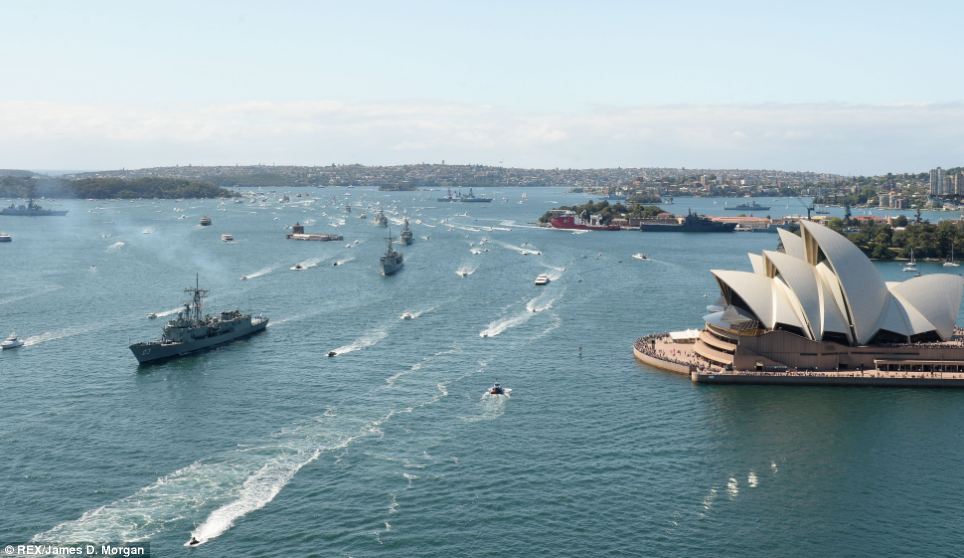
    Prince-Harry-arrives-in-Sydney-Harbour-Oct-20131
    Prince Harry arrives in Sydney Harbour. (Credit: AB Jake Badior, Navy Imagery Unit – East Copyright: © Commonwealth of Australia). Click source here.


    The Gangjeong international team has requested to Australian Anti-Bases Campaign Coalition for an article in June 2014 newsletter. The excerpts from the long version was put in the 2nd page of it.  We put the whole article here as it provides much information. Thanks to Julie Marlow and friends in the Australian Anti-Bases Campaign to take time on the article.

    Won Hee-Ryong, a conservative and right wing, and a new Island governor(who was elected on June 4 and started his term on July 1)has written a reply to the Gangjeong Village Association’s question on the possibility of realization of civilian-military complex port  on May 24 that he thinks co-existence of civilian and military port is possible, making examples of Sydney, San Diego, Manhattan, and Rome. His whole short answer was:

    “As I know, there are examples of  big ports such as Sydney, San Diego, Manhattan, Rome etc  that use dock facilities where civilian and military are located next to each other. Especially, in case of Sydneyy, I heard that there is an example of using navy-only dock pier facility when 150,000 ton cruise ship enters[..]If there is any part that civilian-military port is not properly working, it should be fixed.”
     
    His answer is very much in line with the South Korean governments and navy propaganda that  deceives people. The navy used to make sugar-coat words on the Jeju naval base project (A so called ‘Civilian-Military Complex  port for Tour Beauty’  in another title), projecting false illusion on the ecological conservation and economic development with  the base project)
     
     The truth is that 95% of the base-building budget comes from the ROK Ministry of National Defense (which makes the port, in fact, a pure military port); that many UNESCO soft corals have been dying with the base building; that the construction will only benefit big corporations like Samsung; and that the port will be a home to US Nuclear aircraft carriers and Aegis Destroyer etc…, let alone  two 150,000 cruises that the gov. has advertised for the future prospect of the base use (It has been already disclosed that the base layout fits to the US nuclear aircraft carriers.. and the layout will never properly work for such big cruise. Yet. the Gov. still pretends and lies as if it would work)


    Sydney Harbour: an unlikely exemplar of military/civilian cooperation

    By Julie Marlow, Australian Anti-Bases Campaign Coalition 

    Won Hee-ryong, Jeju’s new Governor, has stated that Sydney Harbour is an example of a port comfortably combining civilian and military uses. This is highly debatable, particularly on past and present environmental evidence.

    The new Governor also has suggested that the big cruise lines enjoy an accommodating relationship with Sydney Harbour’s naval base. This is simply wrong. The Royal Australian Navy (RAN) has made clear that guaranteed access to its terminals by cruise ships is incompatible with the ‘primacy’ of naval operations.

    Sydney Harbour has been a naval base since 1788, when Britain’s Royal Navy first arrived and hoisted the British flag. The harbour’s colonial history is tragic, with its Indigenous people largely displaced within a few generations, many murdered or dead of introduced diseases.

    A more recent disaster—Sydney Harbour’s dioxin contamination— also has a strong military component. Australian-produced Agent Orange, manufactured by Union Carbide at a site on the western reaches of the harbour, was sold to the US and Australian armed forces for chemical warfare during the Vietnam-America War. Carcinogenic and teratogenic dioxins, originating from the Union Carbide site, now extensively contaminate the harbour’s marine life and sediment, and will continue to do so for decades. Since 2006, commercial fishing in the harbour has been banned and recreational fishers are warned not to eat fish caught in its western waters, and to strictly limit what they eat of their catches in other areas.

    Sydney Harbour’s sad history belies the claim made by Won Hee-ryong. So does the nature of Australia’s current military build-up. Most of the build-up is in the north of the country and along the west coast, following recommendations of the government’s 2012 Force Posture Review, developed in sympathy with the USA’s Global Force Posture Review. Nonetheless, Sydney and the east coast are not being spared. Naval activities in the harbour are increasing and these activities are resource-greedy and polluting. It is hard to see how such activities can easily dovetail with civilian uses of the port.

    Military activities are among the most environmentally risky of all human activities, yet, here in Australia, assessment of defence environmental impacts is neither independent nor transparent. The Department of Defence has exceptionalist status in regard to environmental legislation, as set out in EPBC Act Policy Statement 1.2 Significant Impact Guidelines May 2006http://www.environment.gov.au/resource/significant-impact-guidelines-12-actions-or-impacting-upon-commonwealth-land-and-actions.

    Sydney Harbour, home port for Australia’s newest and biggest warships


    The most conspicuous military presence in Sydney Harbour is the Garden Island defence precinct, comprising the RAN’s Fleet East Base and facilities of arms corporations, Thales Australia in particular. Fleet East Base is Australia’s principle east coast naval base. Thales, providing extensive maintenance and other services to the base, operates Australia’s largest dry dock, which artificially connects Garden Island to the mainland. Other corporations have a presence on the base, such as the Naval Ship Management (Australia) Pty Ltd, a joint venture between UGL and Babcock.

    Fleet East Base is the home port for at least 12 of Australia’s larger warshipshttps://www.navy.gov.au/establishments/fleet-base-east. The latest to arrive is Australia’s biggest ever warship, the 27, 000-tonne, 230-meter long ‘Nuship Canberra’, an amphibious assault ship called a Landing Helicopter Dock (LHD).

    Under strong pressure from the US military, with which Australian armed forces are becoming ever more deeply integrated, the RAN is rapidly expanding. Garden Island’s share in the expansion is a substantial revamp to accommodate more large vessels, including a second LHD and three Air Warfare Destroyers (AWDs) equipped with Aegis Combat Systems (sister ships to the US AWDs to be docked at Jeju). Sydney’s AWD and LHD training and sustainment facilities are costing $170.2 million. Favoured status of Defence means legislative environmental approval for this work is not required.

    The navy is also considering using Fleet Base East as a supplementary home port for the planned expanded submarine fleet.

    Foreign, especially allied, warships are frequent visitors to Sydney, and given the US military’s so-called re-balance to the Asia-Pacific, likely to become more frequent. These vessels require berthing and servicing at Garden Island, adding to its environmental footprint. Further, despite the City of Sydney’s status as a nuclear-free zone, nuclear-powered and unconfirmed nuclear armed US Navy ships arrive without compunction. Years of protest by peace, anti-nuclear and green groups has been of no avail.

    Increased naval operations at Garden Island as well as infrastructure upgrades inevitably add to existing pollution and disturbance of contaminated sediment. The NSW Government’s recent $21-million harbour decontamination project included attempts to clean up sediment around Garden Island. However, “heavy metal contamination in soils and shallow sediments around the [Garden Island] precinct” continues to be reported

    http://www.defence.gov.au/id/_Master/docs/ncrp/nsw/1022,%20Garden%20Island%20Precinct,%20NSW.pdf)


    Commercial/military clash over use of ship terminals


    Berths at the Garden Island naval base are among the most accessible in the port, and the RAN keeps a jealous grip on them. Contrary to the suggestion by Jeju’s new Governor, RAN shares its berths with the commercial sector very reluctantly and on an ad hoc, temporary basis.

    Today’s huge cruise ships are too tall to pass under Sydney Harbour Bridge. Since 2007, the cruise industry, the fastest growing segment of Australian tourism (and admittedly an environmentally undesirable industry), has been calling for guaranteed access to the navy’s terminals. In 2012, the Australian Government directed the navy to make available three berths to passenger ships per year, but this arrangement does not meet demand and is bound to stop as soon as the next procurement of naval vessels arrives.

    In its April 2013 review of cruise ship access to Garden Island, the Department of Defence concluded: “The current and future naval capability requirements at Garden Island are essentially incompatible over the longer term except on the existing ad hoc arrangements that we are following. The provision of the guaranteed shared access sought by the cruise industry would impact on the primacy of the naval operations from Fleet Base East.”http://www.aph.gov.au/parliamentary_business/committees/house_of_representatives_committees.html?url=pwc/cpofitout/report%202/chapter5.htm

    Conclusion

    Sydney and eastern Australia is a climate change hotspot. Sea levels are rising and the East Australian Current is strengthening. Larger storm surges are predicted, as is the possibility of a southward shift of tropical cyclones.

    Such hotspots are proliferating throughout the Asia-Pacific. Climate change is the outstanding security risk of the region, indeed the world. The environmental destructiveness that is caused by the construction of the Jeju Naval Base and, to a lesser extent by naval upgrades in Sydney, demonstrates that the military expansionism of the US and its allies ROK and Australia, can only compound the crisis that is facing our planet.
    July 18, 2014

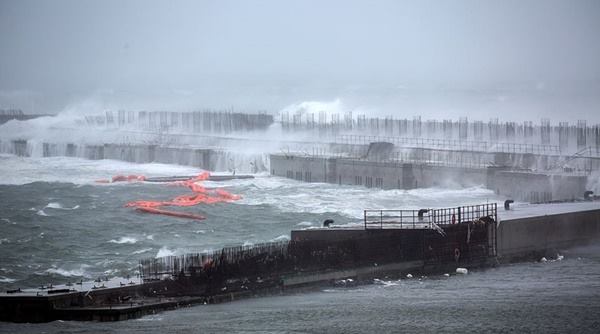
  • 10,000 Ton Samsung C&T Caisson Broken By Even A Medium Typhoon

    1
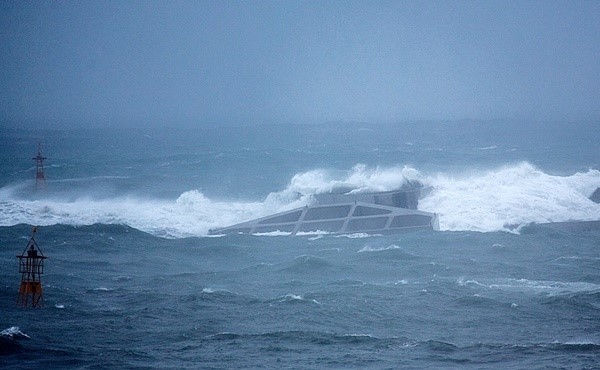
    Photo by Dir Cho Sung-Bong , which is told to be taken around 6 pm on July 9. For more photos, see here.
    2
    Photo by Dir Cho Sung-Bong (1, 2) , which is told to be taken around 6 pm on July 9. For more photos, see here.

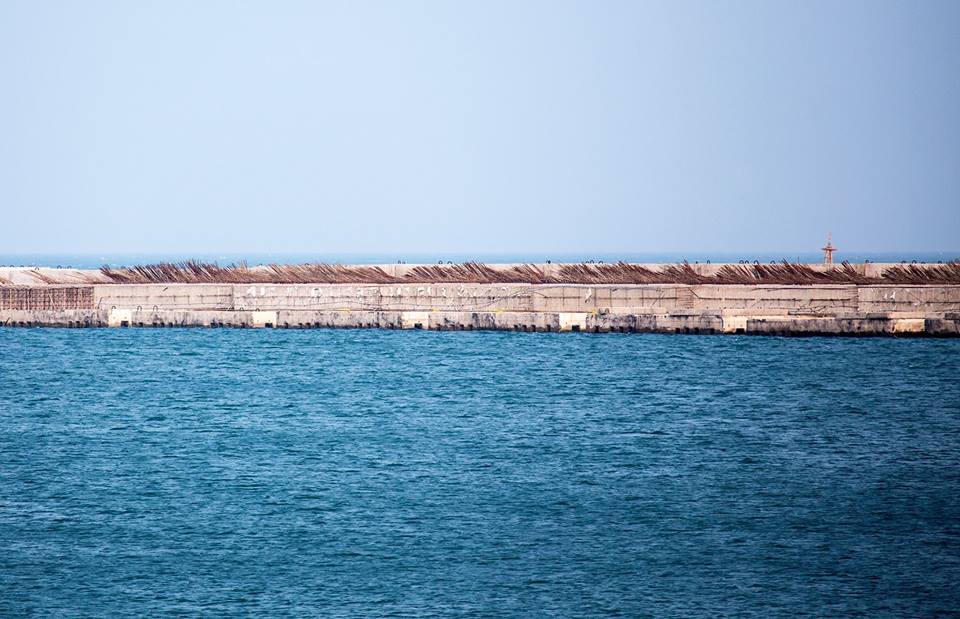
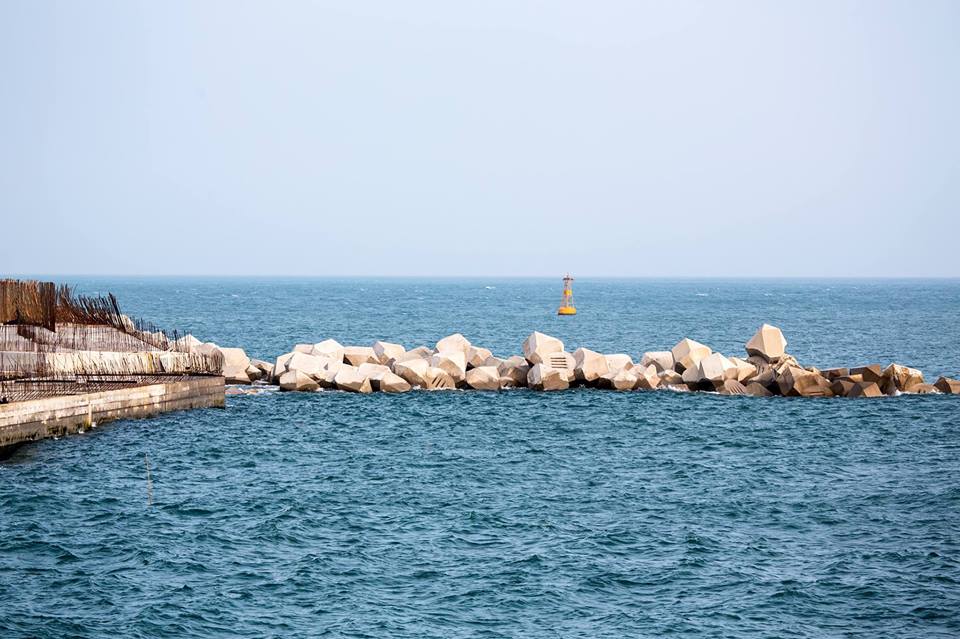
    If you remember the seven destroyed caissons (*a caisson is a huge concrete structure for building breakwater) by the big typhoons in 2012, you will also remember how unreliable the caisson construction has been; how wrong the base location is as the village is located on the very way of typhoon; how dumbfounding is waste of people’s tax for war base; and how the sea has been polluted by the navy who has illegally destroyed those seven without any environmental concern… Here are a few words (excerpted) by some witness who are observing another damage on caissons by a medium typhoon that hit Jeju on July 9…

    …………………………………………

    ‘It is the 1st typhoon since the [navy’s] caisson construction in the area of South breakwater, an area operated by the Samsung C & T.’ (By Kim Kook Nam, peace keeper, July 9)

    ‘Neoguri, the 1st level typhoon in Okinawa has become weaken into the 2nd level when it affected the Jeju Island. [..]’ (By Go Gwon-Il, co-vice mayor, July 9)

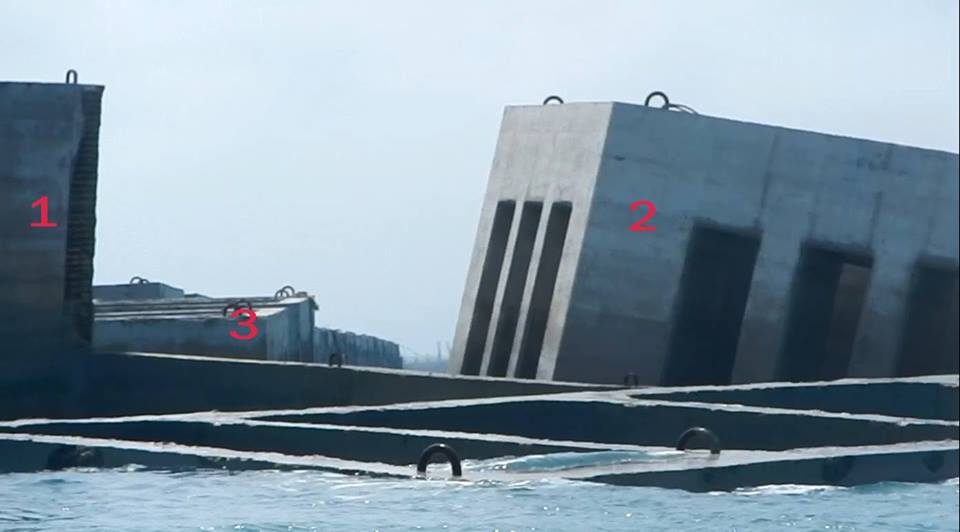
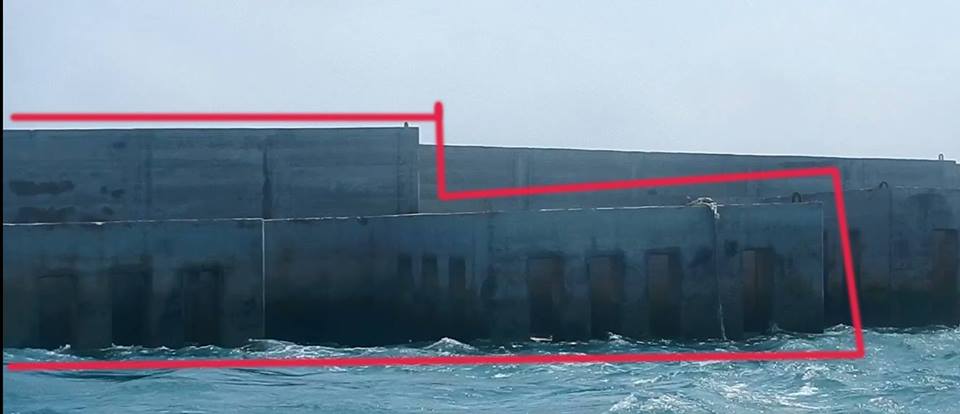
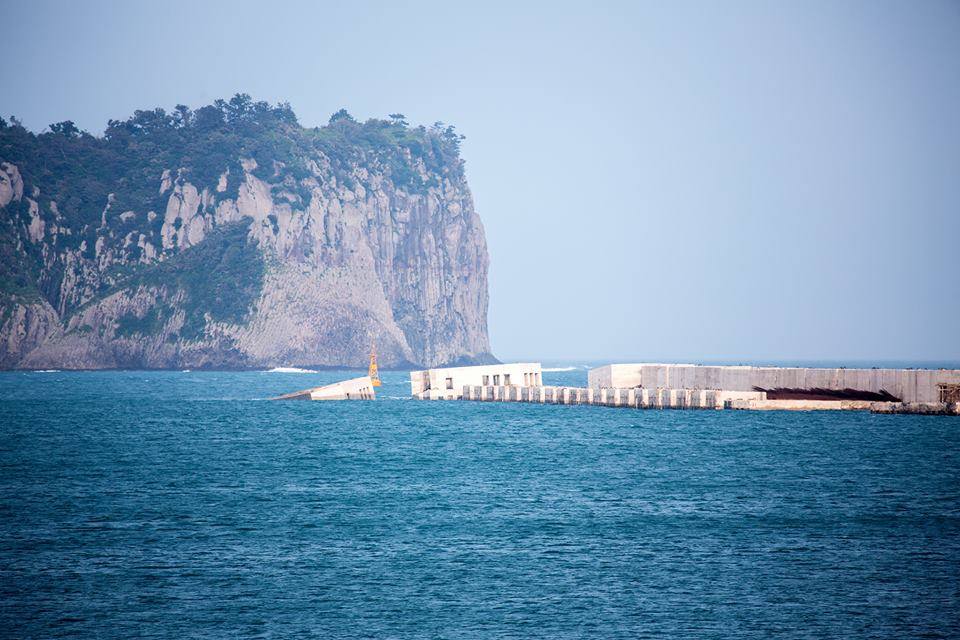
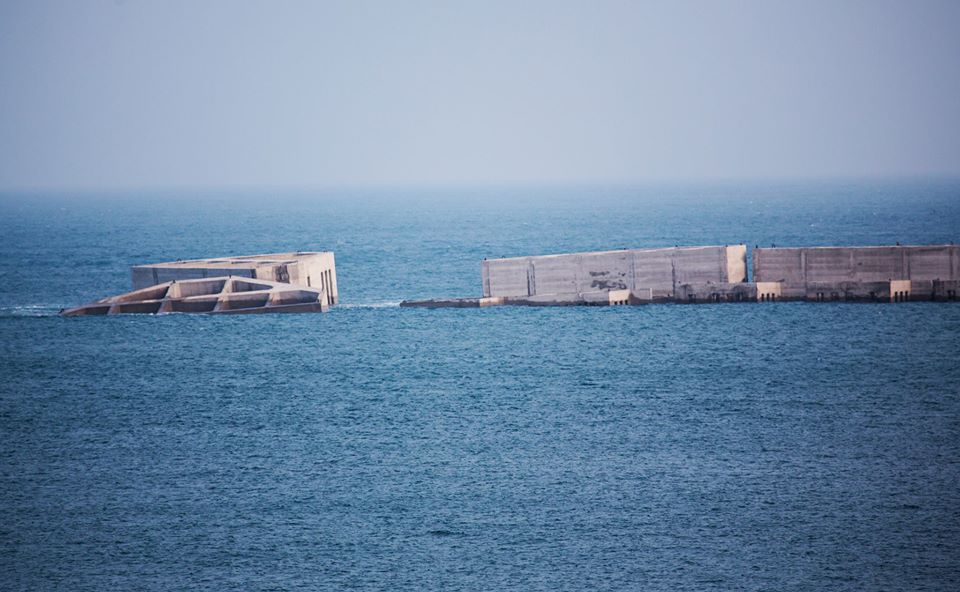
    ‘Due to the typhoon Neoguri influence, two caissons at the end of the naval base (currently built) south breakwater were completely separated. A one-story caisson at the end of south breakwater, which is barely exposed on the sea surface, is slant, as well, while the two caissons next to it become separated from the existing ones with the great gap from those and looking slant, too. It is likely to take lots of time for those to be restored..” (By Fr. Kim Sung-Hwan, July 10, 8:30am)

    ‘According to Koh Sung-Shik, Yonhap news reporter who inquired to the naval base project committee, the 1st caisson has been filled with about 40% inside while the 2nd with 100%[..] There seems no way except for smashing those. Steel rods in those became all crooked with the concern of getting rusty in the sea water.. (By Go Gwon-Il, co-vice mayor, in the morning of July 10)

    The naval base project committee got tens of billions of damage by total destruction of seven caissons when the typhoon Denvin and Bolaben hit the Jeju in 2012. At the time, the navy said, “The naval base caisson is laid out to stand against big typhoon every 50 years.” (Jeju Sori, July 9)


    ”The damaged caissons shown from the land is No. 1 and 2. But when I accessed to the site, today, the No. 3, following 1, 2, became slant, too, toward the Beom Island(Tiger Island) about 15 degree. The last picture is the front of No. 3.  ( Writing and photos By Kim Kook Nam, Peace Keeper, on July 10)’ (See also Yonhap News, July 10)


    b


    b

    c


    ‘1. Three caissons in the south breakwater were damaged and distorted. Though the size is different, each costs from 1.5 to 3 billion KRW. It is our tax.

    Ka

    2. The same scene with No. 1, taken from the Moetppuri,[ the eastern tip of the base project]

    Na

    3. All steel rods along the south breakwater became to be laid

    Da

    4. Same with tetra pods that have been piled up at the end of the east breakwater.

    La

    The villagers used to say,

    “The Gangjeong Sea will settle what we cannot do with our struggle.”

    (Writing and photos by Cho Sung-Bong, July 10. For more photos by Dir. Cho, see here. )

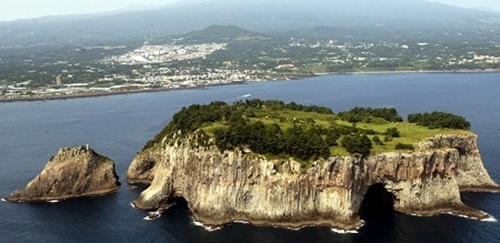
    A Jeju media reminds the words of Yang Hong-Chan, the chairman of the villagers’ anti-base commitee in the earliest period of the struggle: “Do you know why there is no tree in the sunny south side on the top of the Beom Island? It is because the sea wave even over rides the top of it during big typhoons. How there can a base be built up in such location? ( Jeju Internet News, July 10)

    (Á¦ÁÖ)¹ü¼¶ÀÇ À§¿ë
    Beon Island, Source: Jeju Internet News, July 10

    Typhoon Neoguri  from cho sung bong on Vimeo. (For the photos, see here)


    July 17, 2014

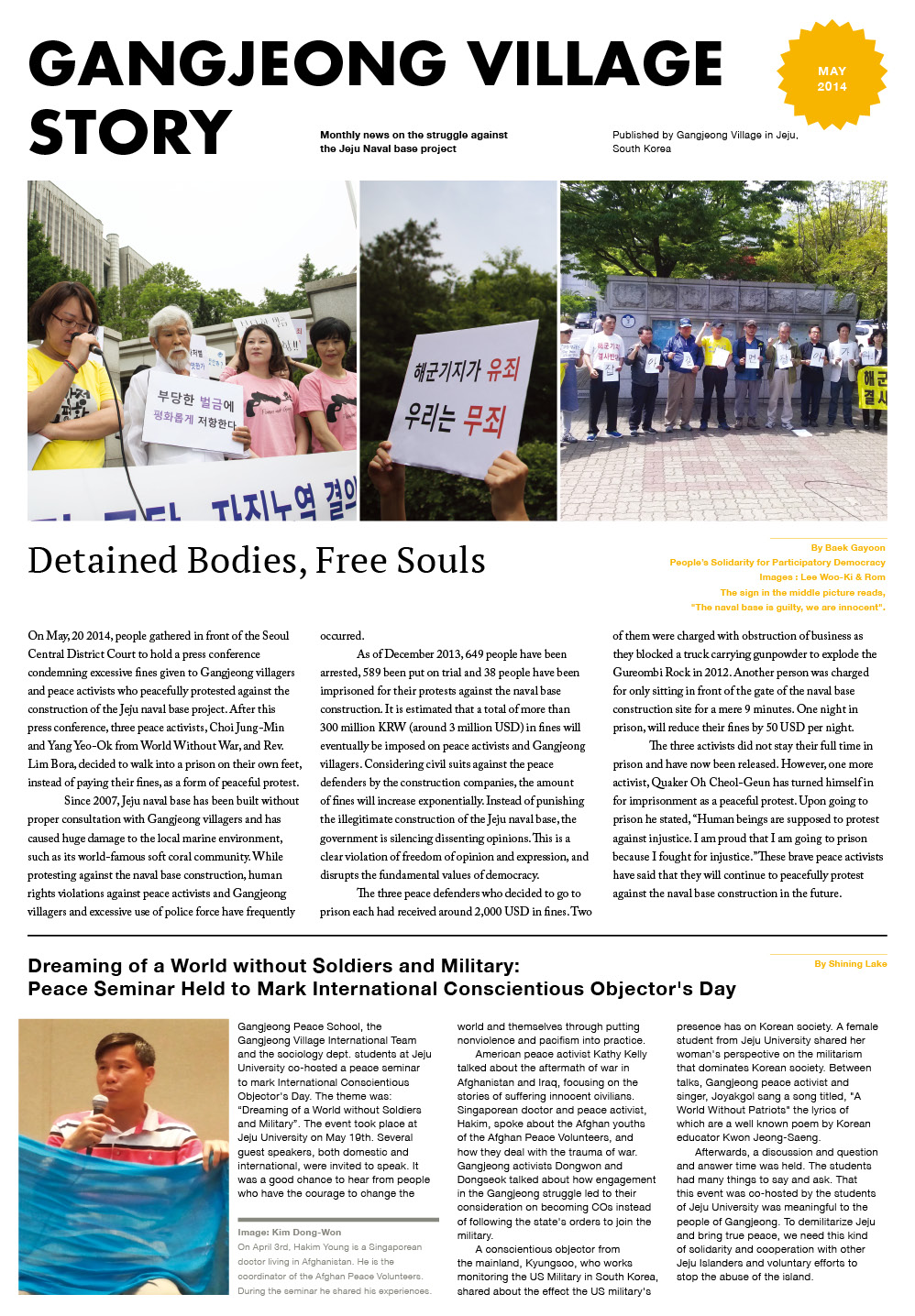
  • Gangjeong Village Story: Monthly Newsletter | June 2014 Issue

    In this month’s issue:
    Soft corals of Gangjeong dying, Jeju after the elections, Sydney Harbor, Solidarity with Okinawa for the Battle of Okinawa, police disturb Catholic mass, village bus gets painted, nonviolent direct action workshop in Gangjeong, remembering the Korean war, noisy construction, prison updates, trial updates, international solidarity, and more!

    Download PDF

    July 16, 2014

  • Solidarity message to Okinawa 623 anti-war peace gathering

    Dear Brother and Sisters in Okinawa

    We, people who fight against naval base construction in Gangjeong village, Jeju Island, South Korea, want to stand together with Okinawa people on June 23rd to memorize, to reflect and to feel the pain and shame together that how we humans allowed ourselves to walk on the way of war preparation and to dehumanize each other under the war.

    We don’t want this kind of tragedies to be repeated. However, we recognize that now the atmosphere in East Asia is very similar with that before WW2. Under the US strategy of Asia pivot, our island, Jeju, is also being further militarized, which means the value of Island of World Peace gained over the pain of 43 has been reversed by the nationalism, US militarism, and a long tradition of difficulties as the border islands. Your island, Okinawa, not to mention the long struggle against the US bases, is also facing the new tide of militarization even by the Japan Self-Defense Force, which indicates the painful lessons which supposed to be learned from the WW2 and battle of Okinawa have been diluted by the nationalism, US militarism, and a long tradition of difficulties as the border islands too.

    We recognize your effort to stand up against war in the memorable day on June 23rd as here in Jeju, we also don’t want our historical lessons to be twisted. If we Jeju islanders choose the way of development with military base and feel the necessity for national security, we are alarmed that we might already be on the way which led to the experiences of Battle of Okinawa.

    Some argue that Jeju Naval Base is not US Base, but we are aware that US militarism trickily makes a use on the nationalism as we couldn’t yet overcome lots of disputed islands in our region. Under both US militarism and our nationalism, our islands, Jeju and Okinawa, are overwhelmed by double centers, US and our own center governments, to defend for. We are alarmed that could lead to the result of another present experience of Battle of Okinawa, a more complex mode with double centers. We appreciate your continuous effort to remind the war memory on the date of 6/23. The peace wind today already blow to our village, and we want to blow this peace wind to all the coner of our island.

    Base is Base. There’s no difference between your base and our base because there’s no difference between your peace and our peace. The peaceful lives which we want to sustain in our island is the same with yours. That’s why we are in solidarity with your peace action, and we also want to actively invite you to come to our beautiful Gangjeong village, Jeju Island anytime, especially on this August 3-6 to join to the Peace for the Sea International Peace Camp building not only solidarity but also action plan for peace in our region.


    Gangjeong International Team

    Inter-Peace Islands Solidarity Team

    _MG_3043
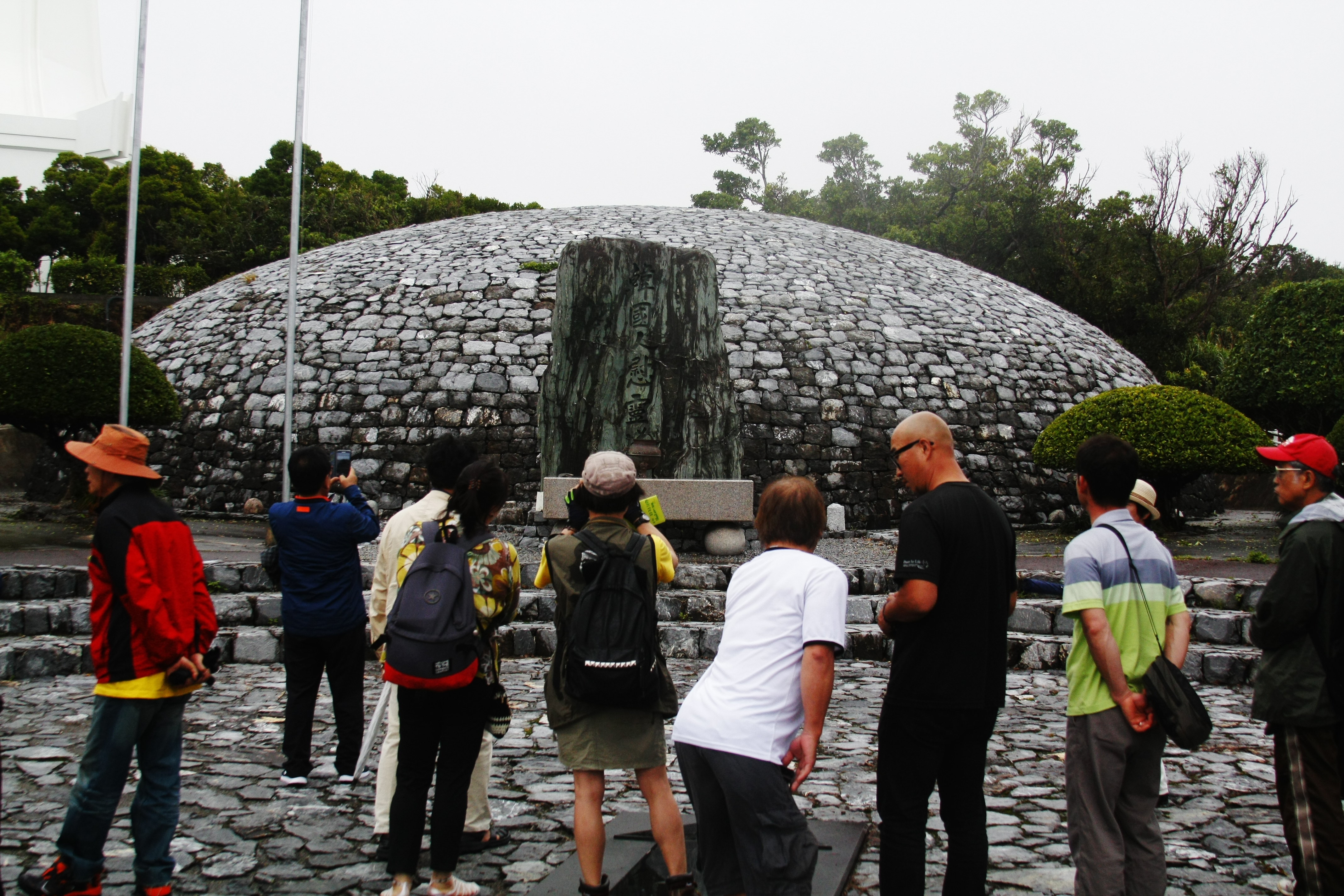
    Gangjeong people visited Okinawa Peace Memorial Park to learn about the War-experience and history of Okinawa
    June 27, 2014

  • 2014 Gangjeong Grand March for Life and Peace

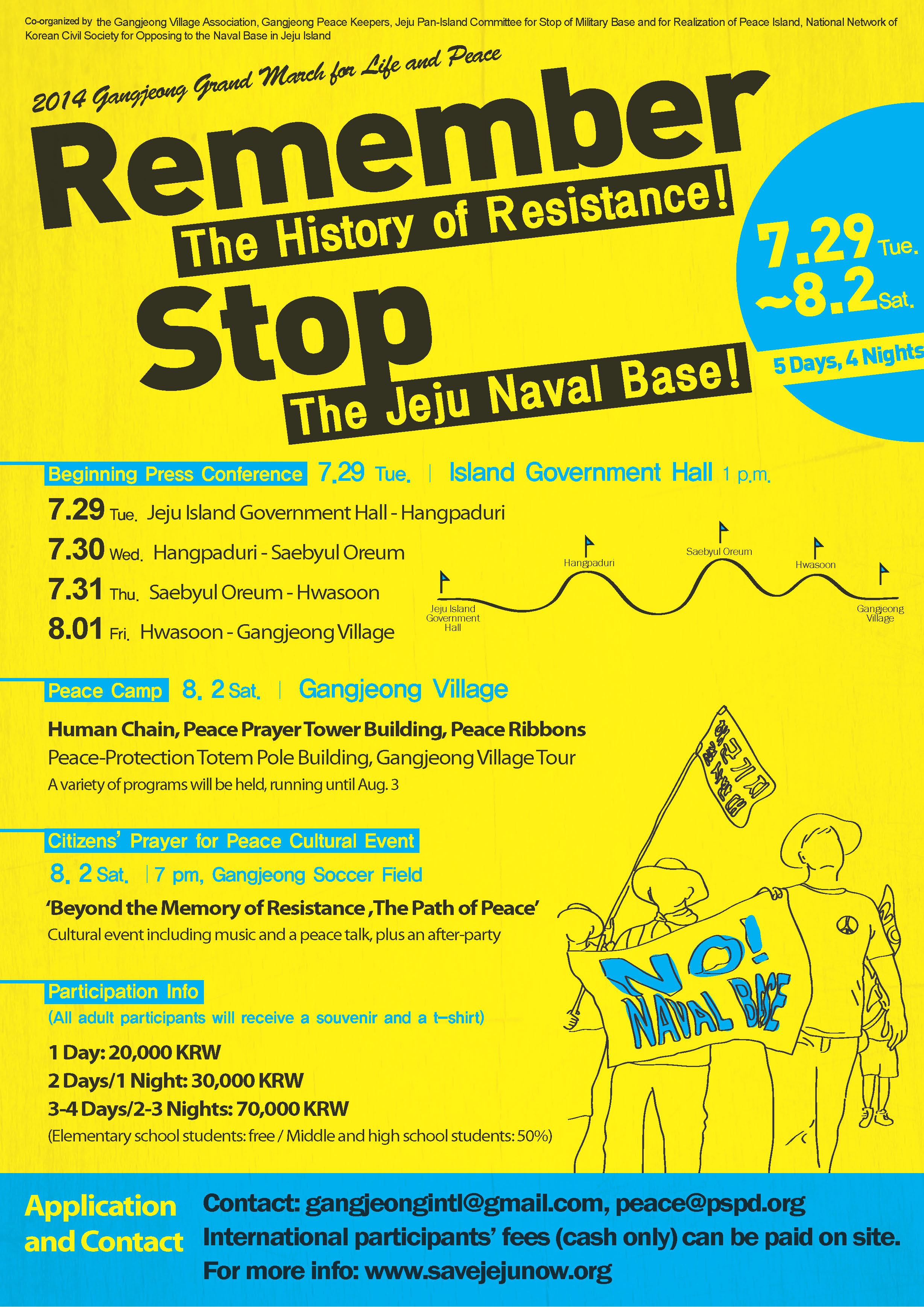
    The official English poster for the 2014 Grand March for Life and Peace
    The official English poster for the 2014 Grand March for Life and Peace


    The time for the annual Gangjeong Grand March for Life and Peace is almost here! From July 29 to August 2, Gangjeong friends and supporters will march across Jeju from Jeju City to Gangjeong. Then in Gangjeong there will be a festival and celebration.

    The Grand March is one of the highlights of the year here in Gangjeong. Watch a video from the 2013 Grand March or the human chain around Gureombi following the march. And here are some pictures from the 2012 Grand March.

    Join us! Internationals are welcome! See the poster above for details and contact us at gangjeongintl@gmail.com & peace@pspd.org for info! It will be very helpful if you inform your participation to us through email in advance for the logistics purpose though your participation fee can be paid in the march site.  


    For the international friends who can physically join the march: For more concrete guide, please see the below. Any peace flags and talents that you may bring and share with the marchers would surely encourage the villagers and activists here. Thanks for joining us in march!

    For the international friends who cannot physically join the march:  Even though you may not be able to physically join the 2014 Gangjeong Grand March for Life and Peace, you may join us by sending us international solidarity messages(up to 100 words)/photos/videos through gangjeongintl@gmail.com by no later than July 23.  As in 2012 and 2013, the village international team thankfully receives solidarity messages from the friends in the world upon the 2014 Grand March for Life and Peace  which is followed by the Peace for the Sea International Peace Camp(Aug. 3 to 6), and boosted by other campaigns like writing a letter to Pope campaign . All the messages you send will be publicly shared. Please check the solidarity messages collected in 2012 (Click here) and 2013(Click here) .  We want to let you know how Kang Dong-Kyun, ex-mayor of the Gangjeong village, has much appreciated all your messages, sitting and reading all the translated messages printed in 20 pages, with awe and gratitude, without moving for a while. None of your messages will go in vain. We also want to display some of your messages with translation in the Village Peace Center where many villagers and activists always gather. Thanks for encouraging us.


    ………………………………. Guide to 2014 March ………………………………. 


    1.     Accommodation and meal:

    Tent and food are provided during march but you may bring your personal tent and/or sleeping bag(s). Please bring your personal washing tool (tooth brush, tooth paste, shampoo, towel etc) , You may also bring jacket, umbrella etc.


    2.     Brief schedule   July 29 (Tues.):

    Please gather across the main gate of the Jeju Island government hall by noon. If you join march in the middle of it, please contact Jungjoo (English,010-8560-3734), Emily (Chinese, 010-6469-9413 ), and  Dongseok(Japanese, 010-9334-0933) for information.


    Aug. 1 (Fri.):

    There will be a Peace Bus in the Jeju airport at 2 pm. The bus directly goes to the village where there will be events (see the below)   Once arrived in the village around 5 pm, there will be a Great gathering for people’s talk in the Gangjeong soccer field from 8 to 9 pm. Then movie night after it.

    (* 6-7 pm: dinner 7-9 pm:  Great gathering for people’s talks (Maningongdonghoe)

    9:30 pm ~ : Movie night with Yang Yoon-Mo and Grace)


    Aug. 2 (Sat.):

      In the morning, there will be various program such as peace mass and human chain. From 7 pm, there will be a Cultural Event for the Stop of the Jeju Naval Base Project and Citizens’ Prayer for Peace in the Gangjeong Soccer Field.

    (* 9-11 am:  Gangjeong village tour

    11 am -12 pm:  Life and peace mass

    12-1 pm:  Human chain, Peace ribbons

    1-2 pm: Lunch

    2-6 pm:  Peace prayer tower building, Peace-Protection Totemic Pole building, Writing wishes, peace prayer ceremony, Ieodo-ro Peace Market, Treasure-search (peace book village team), water play in the Gangjeong stream(watermelon party)

    6-7 pm dinner

    7-9 pm  Cultural Event for the Stop of the Jeju Naval Base Project and for Peace Prayer )  


    Aug. 3 (Sun.):

       Breakfast together at 8 am. You may join Seeding Flowers, Wish tower-building. The official events end on Aug. 2.  Therefore Aug. 3 program is optional.  


    3.     Schedule in detail  


    July 29(Tues.): Jeju Island Government Hall-A small park in the Halla University four way intersection- A Funeral House, Hagwi Agricultural Cooperative(Nonghyup)-Youngmowon-Gosungri Sports Field-Hangpaduri   July 30(Wed.): Hangpaduri-Yusooamri Small Park-Saemangreu Research and Training Institute-Saebyul Oreum(Oreum-climbing. Please notice that there is no bathroom here)

    July 31(Thur.): Saebyul Oreum-Dongkwangri Welfare Hall-Seogwang Elementary School-Deoksou Elementary School-Sanbang Mt. Resting Place-Hwasoon Beach  

    Aug. 1 (Fri.): Hwasoon Beach-Andeok Valley-A Small Park-Cheonje Fall-International Convention Center-Yakcheon Temple-Gangjeong Soccer Field (Arriving around 5 pm)  


    4.      Guide on the Peace Bus (At 2 pm, Aug. 1, Jeju Airport): The bus directly goes to the village to join the events that start 7 pm on the day. If you need to use this bus, Please contact gangjeongintl@gmail.com andpeace@pspd.org in advance for the reservation of the bus seats! It is mandatory!  


    5.  Elementary school students For the elementary school students, participation fee is free but a t-shirt should be purchased at the price of 10,000 KRW. Please contact  gangjeongintl@gmail.com and peace@pspd.org   in advance.          


    6.   Support for the participation fee For the participants who come from the outside of the Jeju and join more than three nights four days, 20,000 KRW of participation fee will be supported.

    June 25, 2014

  • Peace Concert for Marking the 64th Korean War

    KakaoTalk_20140616_081004637


    Peace Concert to mark the 64th anniversary of the Korean War

    “Presents from The Remembrance of War”

    We hope to encounter the past of One Korea through remembering the Korean War, reflect on the current problems that our society has and dream of a peaceful future of two Koreas that have been divided for many years through this concert.

    Stories of Peace:
    ‘At the time, Jeju Islanders were quite conscious people who made a right decision and acted for right cause to oppose the divided, two Koreas. However, the government massacred them by ideology, who were not ideological at all.” – Jeong Seon-nyo

    Songs of Peace:
    “Yes, the long memory is the most radical idea in this country. It is the loss of that long memory which deprives our people of that connective flow of thoughts and events that clarifies our vision, not of where we’re going, but where we want to go.” Utah Phillips (a Korean war veteran, folk musician and peace activist)


    June 16, 2014

  • Aug 3rd-6th Peace for the Sea International Peace Camp recruit for International Peace Volunteers

    국제캠프-English


    Dear Sisters and brothers who work for peace


    Hello,

    In contrast to our dream of a peaceful world without war, the reality we face causes us continuous suffering with more war bases and weapons being built and sold, and more and more soldiers being trained. In order to save Jeju, the island of peace, villagers and peace activists in Gangjeong, Jeju Island have been resisting the construction of the naval base and militarism for 8 years.

    Islands in East Asia are facing increasing challenges of militarism and political tensions. Not very far from Jeju, Okinawa has suffered under the presence of the US army bases for 70 years. People in Okinawa have long suffered due to the United States’ military base camp. Additionally, Economic and military expansion of China are certainly challenging to Taiwan’s peaceful future and the conflict between Japan and China have with the territorial sovereignty over Senkaku/Diaoyu Dao and also Korea and Japan’s Dokdo/Takeshima problems. Furthermore, Korea and China have different views on the Ieo-do (or Socotra Rock) under the surface of the water which is located in the southern ocean area from Jeju Island. All these conflicts and tensions should act as a call for action for peace in the region.

    The United States government has promoted the Pivot to Asia project and strengthened the Missile Defense System with its military alliance in East Asia. We would like to protect the seas of East Asia surrounding the islands. However, it is impossible to achieve our goal with only a few participants from one or two islands. Rather the people of the whole islands of East Asia should stand with one another in solidarity and cooperation. For this purpose, we plan to host the international Peace Camp, Sea for Peace in Gangjeong, Jeju Island of South Korea from the 3rd till the 6th of August 2014. Please come join us and share the difficulties and harmful effects caused by the militarization that your islands have gone through. In addition, please inspire us for sustaining our hope for Islands of Peace.

    The program will include an exchange of knowledge and resources related to the reality of the destruction of oceanic ecologies and the US military expansion. Also, we will offer a variety of outdoor activities including kayaking and scuba diving. We will also set a time for participants to get to know one another by introducing their own cultures in a culture night and a peace concert.

    We would like to invite you all to the Sea of Peace. Through this Peace Camp, we wish to create a wind of hope for peace that can blow into the seas and islands across East Asia, which are shadowed with clouds of soaring military tensions.

    Here’s Each Session’s Objective:

    1. War Bases Caused Environmental Destruction

    Our ocean’s ecosystem has been destroyed by many different causes. In this session, we will examine several cases of environmental destructions caused by wars, military training and expansion of war bases. There will be presentations to report first the current situation of Jeju Gangjeong Sea where the naval base is being built, then to report the long struggle against the US bases on Okinawa Sea and finally the destruction of Taiwanese islanders’ marine culture and ecosystem.

    2. Struggle Stories from Okinawa, Taiwan and Jeju

    Three Islands have similar experiences in being victimized by the state power in their history. At the same time, there were also peace activists who courageously resisted the unjust state power. In this session, we will share stories of peace movements that have taken place in the three islands against militarism in order to create a shared understanding for continuous cooperation and solidarity.

    3. US Militarism

    In this session, we will identify the newly reoriented map of the military strategy for East Asia which has been affected by the changes of the US military policies such as the promotion of the pivot to Asia. In addition, we will discuss the threats to national securities of the countries in East Asia by the US militarism.

    4. Inter Island Solidarity for Just Peace

    Participants will discuss long term plans for our next gatherings in order to develop and sustain the solidarity with the islands of East Asia. It will entail further discussions to think of practical ways to promote the movement for solidarity of the demilitarized islands.

    For more information, please visit this website: https://sites.google.com/site/peaceforthesea/

    or directly contact to peaceforsea@gmail.com

    Host Organizations: Gangjeong Peace School Team, The Frontiers, Gangjeong Village Association, Gangjeong International Team, HotPinkDolphins, Jeju Federation of Environmental Movements, Inter-Island Solidarity for Peace Team


    June 16, 2014

  • Gangjeong Village Story: Monthly Newsletter | May 2014 Issue

    In this month’s issue:
    Protesters refuse fines; go to prison, article by Kathy Kelly, updates on the Pope’s visit, reports from Okinawa and Yonaguni, Tour of Gangjeong’s sacred sites, ocean protest, trial updates, international solidarity, and more!

    Download PDF

    June 16, 2014

  • Okinawa visit for “Inter-Island Solidarity for Peace”

    From May 12th- 19th, Gangjeong people visited Okinawa  in the solidarity with Okinawa people against the US base and learned about the tragic war experiences of Okinawa. Also, Gangjeong team brought the documentary ” Gureombi-The Wind is Browing” made by Director Cho, SungBo to show in Okinawa as one of the main program in the “2014 Peace March and Okinawa-Korea solidarity Assembly”. After showing the movie, Movie Critic Yang, YunMo and other Gangjeong peace activists had presentation about Gangjeong.

    _MG_3209 _MG_3333


    The following is the presentation draft of Taiwanese Peace activist Emily on the Inter-island solidarity for peace including the advertisement of the August Peace Camp in Jeju island.

    —

    Inter-Island Solidarity for Peace

    May 17th, 2014

    My name is Emily. I am from Taiwan. As the international peace activist, since 2011, I have been living in Gangjeong and struggling together against the naval base project in Gangjeong, Jeju Island. Through the Gangjeong struggle, I got to learn the painful history of Jeju and also got to realize the suffering reality of Okinawa. These experiences have given me a lot of big question marks on my island Taiwan where I born and grow up, and that drives me to study more about Taiwan, and that’s how I began to know that Jeju, Okinawa and Taiwan are actually under the same flowing of history tide. Finally it provided a background to dream the peace making with all these islands involved.

    Jeju and Okinawa are both struggling against US base and militarism.

    Now the naval base is under construction in Jeju island, and in the future, we worry the airbase will soon be settled up and Jeju might be more and more militarized like Okinawa. ( Alttre airbase was built by Japanese colonizer and now the land ownership still remain under the Ministry of Defense of Korea, which means anytime, the Korea government can use that land to rebuild the airbase again. )

    ppt3
    US bases in Okinawa/ Image Source: http://www.globalresearch.ca/video-us-marine-training-on-okinawa-birds-eye-view-of-bases-from-the-air/19421

    ppt4

    When we look at the Okinawa and think of the Jeju’s situation, it’s easier to think that these two islands and probably other islands which suffer from the US base should build up solidarity for each other to kick out the US military. Sure, I agree with that too.

    But the situation in Taiwan is a bit different that there’s no more US base in Taiwan. Actually in the past during the cold war, there were lots of US bases in Taiwan too since ROK government in Taiwan was the US’s partners. While Okinawa transformed its times from US military colonization into the governance of Japanese government in 1972, Okinawa didn’t get rid of US bases but was being loaded with more US bases, and in Taiwan, that the US troops left didn’t mean the end of the cold war.

    未命名

    With the theory of China Threat, Taiwan is still under the umbrella of US military. We altogether just went on from the times of cold war to the new cold war. Under the competition and balance of the military power between China and US, Taiwan is pathetically enjoyed the peace of suffering. Our suffering has been resulted under the same structure though it looks different.

    ppt5
    Source: Info from the Forum of “Facing the US base in East Asia, Listen to the Takae’s voice” After the “Taiwan Relations Act /TRA” Republic of China on Taiwan’s survival is relied on the subtle relationships with the US. If there were no Korea War, if China didn’t have participated into the Korea War, the US would have given up the Chiang Kai-Shek KMT government who retreated to Taiwan. While the normalization of relationships between the US and People’s Republic of China in 1972, ROC (Taiwan) was kicked out from the UN and faced the crisis of perishing. Thus, in 1979, due to the lobby of the theory of “China Threat” by the Taiwan group in the US, the Taiwan Relations Act was enacted. The economic and military relationships with the US haven’t been broken and continued until now. The military relationship here means that the US provides weapons to Taiwan (Sale), and the verbal promise that, in need, the US will defend Taiwan. In the War on Terror, ROC expressed its position to support the US. In Afghanistan War and Iraq War, the ROC government also provided the economic assistance and logistic help like rice.


    ppt7
    Disputed territory. We are really living in the conflict area.
    ppt 8 Socotra_Rock
    Disputed territory. We are really living in the conflict area.


    In the region of North East Asia, these three islands are all at the same corner of conflicts which has its historical dimension and the resource-driven economic dimension. As we are existing in the same region, I think Taiwan, Okinawa, and Jeju should realize the ‘DMZ Peace Islands movement’ together.

    The history already told us that our fates are connected. We can never make the DMZ Peace Island alone, and we can never enjoy the peace alone. I think the peace realized through the victimization of another island is a shame, and finally we can only sink one after one under the militarization tide.

    국제캠프-English

    <Website of Peace for Sea International Peace Camp: https://sites.google.com/site/peaceforthesea/>

    We need the strong will and creativity to overcome the conflict in our region. So that, in this August, in Jeju, we prepared the program called “Peace for Sea International Peace Camp”. We want to invite many people especially from Okinawa and Taiwan to participate as one of the small step to develop the “Inter-island Solidarity for Peace”

    To recognize the destruction brought by the war base, to learn and exchange an oceanic view of the islanders’ stories and to grow up the oceanic peace actions under the concept of Inter-island solidarity for peace are our goals. This year Jeju will be the host island, and we would like to see this activity under the concept of inter-island solidarity for peace take turn to be held in Okinawa(2015) and Taiwan(2016) too.

    _MG_3003
    The blueprint of landuse after the return of Futenma Base.

    Jeju, Okinawa, and Taiwan are not the border islands of Korea, Japan, and China. They are simply our beloved hometown. Yesterday, I saw this sign when we climb up a tower to watch the whole Futenma base. Here, the people are not just fight for the returning of the base land, here people are already dreaming the plans how they will use these base land to be returned.

    Peace Triangle Area

    I think we three islands need to draw the plans together how we will make our islands the DMZ peace islands. For this, in this August, please come to Jeju Island!

    Let’s sail in the sea of peace.

    OLYMPUS DIGITAL CAMERA

    May 27, 2014

  • Gangjeong Village Story: Monthly Newsletter | April 2014 Issue

    It’s that time again!

    In this month’s issue:
    Yang Yoon-Mo Free at last, April 3rd Remembrances, 4 catholics arrested, letter from David Hartsough, Trial Updates, Peace for the Sea Camp, Peace Book Cafe anniversary, international solidarity, and more!

    Download PDF

    May 15, 2014

←Previous Page
1 … 9 10 11 12 13 14 15 16 17 18 19 … 22
Next Page→

© 2025

Save Jeju Now