Yang Yoon-Mo was released at midnight (00:00 am of April 12th) after 435 days in prison, which is his 4th time imprisonment on the way opposing to the Jeju naval base.
“It was a really great and joyful celebration. Although he was released after midnight, many people from around Jeju and Korea came as early as 9 p.m. to begin waiting and also having a small party. By the time he was released there were more than 100 people even though it was late at night and the Jeju Prison is not really easy to get too. It was an amazing time and we are so happy he was released.”… by Paco Booyah
Poster of the welcoming event for Yang Yoon-Mo who will be freed after 435 days in prison April 11, 11pm, in front of the Jeju Prison, Jeju City April 12, 8 pm, Peace Center, village Design by Haku Fwded by Hye-Young, Peace Co-Op, Village association, Fr. Mun Jeong-Hyeon, Fr. Kim Sung-Hwan
Gangjeong People held a welcome party for Yang yoon-Mo at the Gangjeong village association hall.
Ms. Kil-joo Lee writes, ” The cake was presented by Kim Jin-Suk (the legendary Hanjin union woman leader who has made more than 200 days’ sit-in on a high tower years ago to protest the company’s unjust lay-off of workers) . Yang was so happy like a child. Photo by Kil-joo Lee, Fwd by SungHee ChoiThe cake presented by Kim Jin-Suk to Yang YoonMo Photo by Kil-joo Lee, Fwd by SungHee ChoiWelcome party for Yang Yoon Mo in Gangjeong village. Photo by HosuFr. Kim Sung-Hwan writes, “The name of Yang Yoon-Mo’s sit-in tent on the Gureombi Rock was ‘Joongdeoksa (Joongdeok temple, naming after the coast of the village, Joongdeok, in which the Gureombi Rock belongs to). The name wood tablet now returned back to Yang again.” Photo by Emily Wang
“Video of Yang Yoon-Mo’s speech in front of Jeju Prison after 435 days in prison, which is his 4th time imprisonment on the way opposing to the Jeju naval base : He declares his will on 10 million people’s petition campaign for the legislation on ‘Demilitarized Life and Peace Island,
As soon as Yang Yoon-Mo made an exit out of the Jeju Prison, he warmly hugged with each person who came to the site for welcoming him. The 1st words he shouted in his speech were “Absolutely no naval base!”He also thanked many people naming each of them including Bishop Kang U-Il.
“It is thanks to your sharing spirit in which you have daily given your core ability for me who is insufficient, despite your keeping desperate struggle field while each of you maintains individual pride. That is how I can return back to you with healthy and stronger struggle will after the life of warm sunlight inside the prison.”
“ I had once thought from ignorance that our struggle is disadvantageous as time goes but I realized in prison that it would be rather advantageous with the time.”
“ I became to bear a dream to make this struggle trustworthy. I will start 10 million people’s petition campaign in which all the nationwide citizens join to set the Jeju to be Demilitarized Life and Peace Island. The petition also aims to get signature from 200,000 people of Jeju, one third of the Jeju population. And the petition is to build a legislative campaign for the Jeju to be the demilitarized peace Island in 2017, the next Presidential election.”
Yang Uoon-Mo said that there have been encouragement letters to him from about 30 countries. He appealed to people to build Gangjeong as the global life and peace village by not stopping our struggle. ”
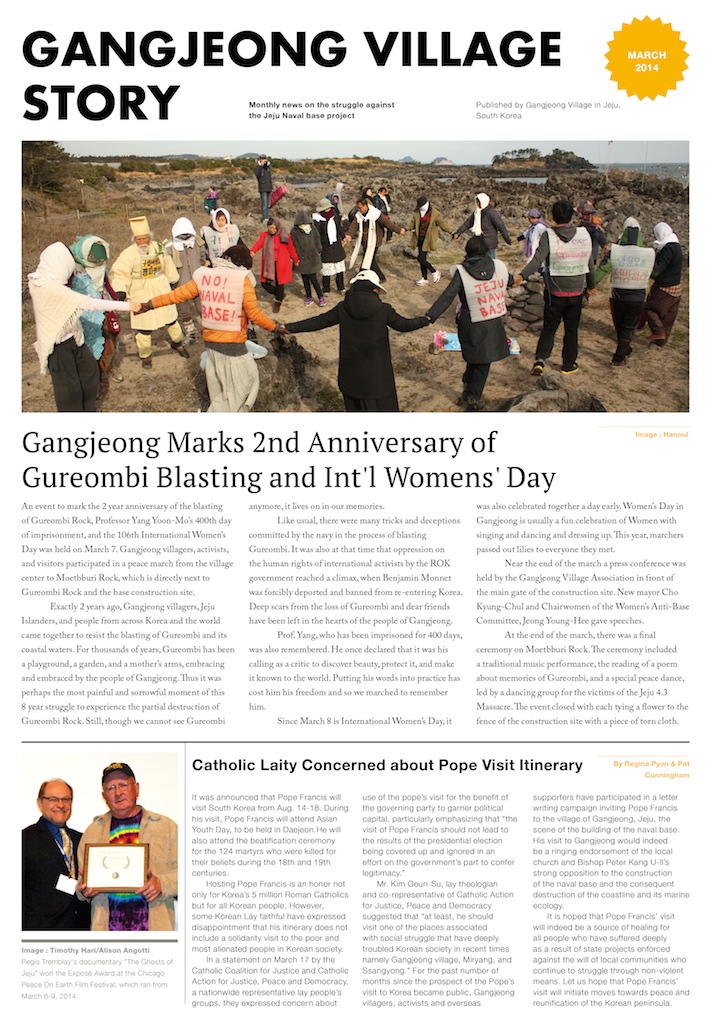
In this month’s issue:
Government’s “development” plan, Catholics concerend about Pope’s Korea visit, Anniversary of Gureombi blasting, Solidarity from Benj and Global Network, Visting dancers, a play about Gangjeong, environmental destruction reports, another Gangjeong wedding, and more!
Head over to Pope2Jeju.org now to send a message to Pope Francis, urging him to come to Jeju and Gangjeong to join the daily Peace and Life Mass at the construction site gates!
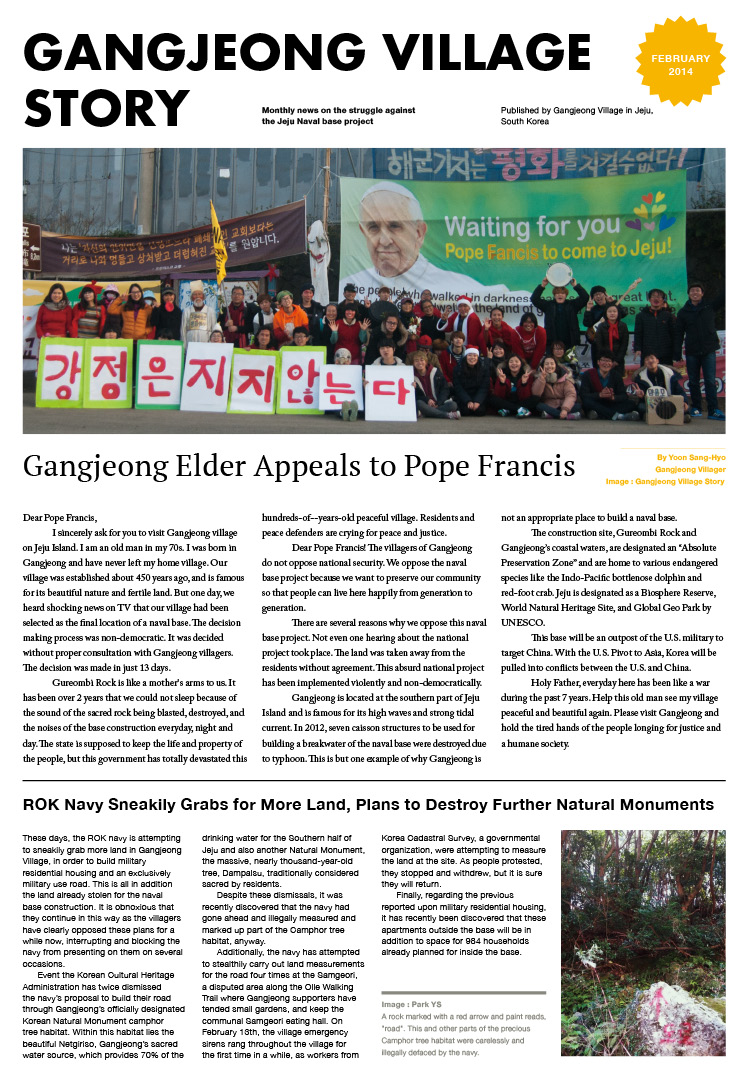
In this month’s issue:
Village elder’s letter to the pope, Navy steals more land, solidarity from John Pilger and AWC Japan, Solidarity with Ssangyong workers, Trial updates, Yang Yoon-Mo, Peace School, War Exercises, and more!
Well, after almost two weeks of down time, we are back online!
In early, February, we suddenly found that Google had blacklisted our site. Our site had a scary red warning and was blocking people from entering! After digging in we found that our site had indeed been hacked.
The good news was that this did not appear to be aimed at us specifically or a particularly malicious attack or an attack by government agents. Rather it seems that it was a regular, boring, spam/virus attack, probably done by bots programed to look for weaknesses and out of date plugins and installations.
After a lot of research and struggling around to figure out what to do, we worked with our web host to fix the problem. Finally, just as it seemed we were about done, and we were about to request Google to scan the site again to clear the blacklist warning, We found that Google had already done so. And our site was accessible and clean!
Now we’ve deleted some of the outdated things that were used with this site and increased the security. Hopefully, this won’t happen again. In any case, we are now back, so be sure to visit us again regularly for updates on Gangjeong, Jeju, and the struggle against the unjust, terrible, environmentally disastrous, fundamentally unsound, Jeju naval base project.
The Gangjeong Village Story monthly newsletter has undergone a redesign for 2014! Thanks to the help of the designers at Everyday Practice for their great assistance. In addition to the fresh new look, the online PDF version available here is now easier to read. The old version was designed only for print but this new version is designed for both! Enjoy!
In this month’s issue:
Gangjeong elects a new mayor, letter writing campaign to Pope Francis starts, Solidarity updates from Henoko/Okinawa and Odisha/India, Solidarity from Hawaii, Gangjeong Peace School, Entry Ban Lifted, Letter to Yang Yoon-Mo, trial updates, and more!
In this month’s issue:
City of Berkeley passes Gangjeong Resolution, 2014 base budget issues, Love letter from Afghanistan, Milyang solidarity, Gangjeong Crochet Project, Solidarity from Germany, trial updates, and more!
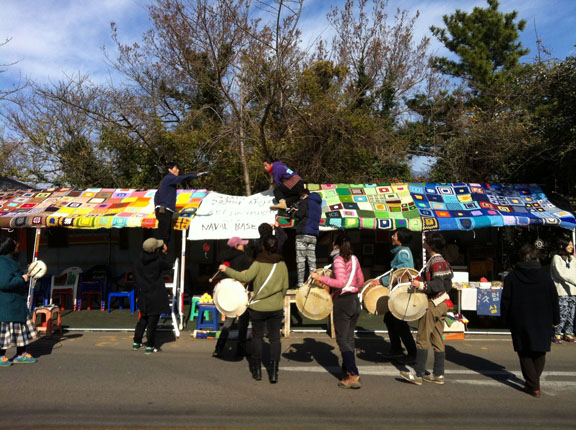
Gangjeong villagers and activists decorate the streets with colorful woolen squares knitted by supporters of the anti-base struggle. Traditional drummers play in the foreground.
I recently spoke with two members of Veterans for Peace, who had become involved with Korea issues in only the past few years. Each of them came to know Korea through their support for the Gangjeong villagers who have been battling, for nearly eight years straight, construction of a huge, high-tech navy base being built on their Jeju-Island coastline. Both men said that before Jeju, their work with northeast Asia was Japan-centered, and that “no one ever talked about Korea.” But through their engagement with Gangjeong, they have learned about the April 3 massacre, about the unending Korean War, about the unprecedented tonnage of bombs that the U.S. levied upon the Korean people in the early 1950s, and about modern Korean history, in general. Today, they recognize that the Korean War was certainly as consequential in U.S. history as the war in Vietnam. It now perplexes them that Korea had been effectively erased from the books.
The sad truth is, the vast majority of even the most progressive Americans know very little about Korea, let alone that the U.S. has been at war with it for the past 60 years. Many don’t even know where Korea is. This absurd knowledge void presents a challenge so daunting for those working toward unification, that nothing short of alchemy would seem to hold any promise for peace on the peninsula.
On the other hand, it appears that the tragedy unfolding at Gangjeong village might offer just the sort of alchemy that could conjure Korea into the wider consciousness. Ecumenical groups, environmental groups, artists, lawyers, social workers, peace-studies groups, student groups, indigenous-rights groups, and food-sovereignty groups have all passed through the tiny village whose fame is now of global proportion. Numerous articles on the villagers’ plight have been published in Europe, South America, the Asia-Pacific and the U.S. Last summer, I was at the San Francisco airport with Gangjeong’s charismatic Mayor Kang Dong-kyun on his first foray outside of northeast Asia, when a woman behind him in line said, “Aren’t you Mayor Kang? From Gangjeong village?” It turned out she had studied Gangjeong as part of a peace-studies program in Virginia, and recognized him from internet videos. Little Gangjeong has put Korea “on the map” and affirms that the Korean War is indeed alive and well.
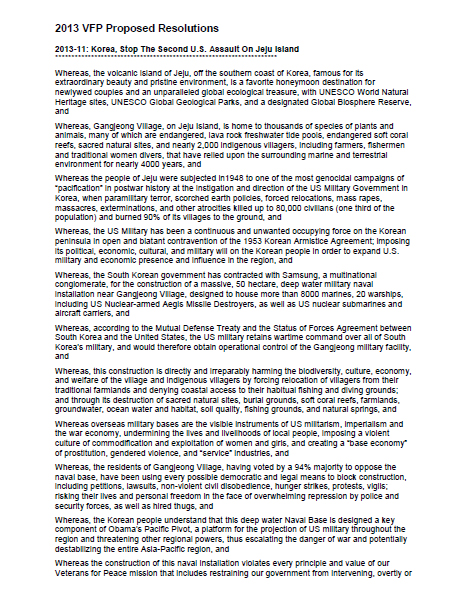
Then, in fall of 2013, the City of Berkeley, California, was the first city in the world to formally declare its support of the Gangjeong villagers in the form of a resolution opposing the navy base. Shortly thereafter, in Madison, Wisconsin, the National Board of Veterans for Peace passed a similar resolution to “Stop the Second U.S. Assault on Jeju Island.” The document not only describes what is at stake if the base project is allowed to proceed, but also gives historical context, such as the 1948 genocide on Jeju and how the ever-increasing militarization of Korea violates the 1953 Armistice. It reads like an overview of modern Korean history vis a vis the United States.
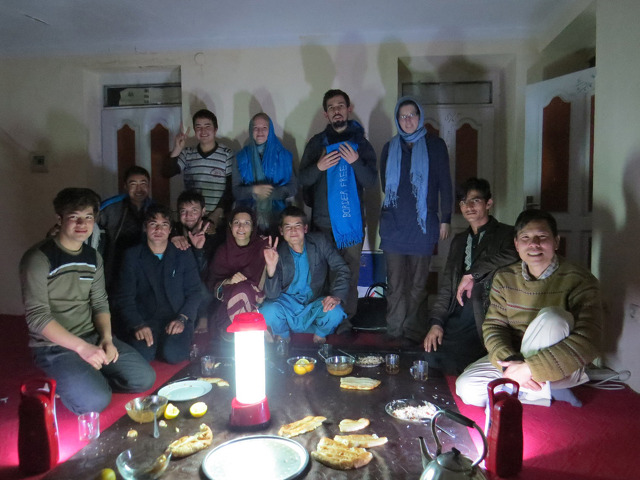
One of the most poetic declarations in support of the Jeju struggle was made by a group of Afghani peace activists based in Kabul who have established a Skype relationship with their counterparts in Gangjeong. They write: “We are confident that if ordinary Chinese or North Koreans ever gave you trouble, you would have tea with them, using your imagination and citizen diplomacy to calm the troubles, non-violent paths which are far more effective and kind, and a far better use of tax-payer money (it takes no tax-payer money to drink tea!) than the multi-million premises, personnel and war equipment.”
The global draw of the Gangjeong village struggle owes much to the fact that the land, water, heritage and culture at stake have already garnered international recognition. Gangjeong’s culture and environment have earned UNESCO designations. It is one of Korea’s few remaining traditional, indigenous villages; it contains some of Korea’s best farms and richest soil, its purest water and its haenyo diver tradition; its coast was home to Korea’s only pod of dolphins and one of the world’s finest, soft-coral forests (now being dredged); and its 1,900 residents practice authentic local democracy.
True, all these elements attract an international crowd. But the most enduring appeal of the humble village sits squarely in its remarkable community spirit. The community is comprised of an eclectic mix of villagers, clergy and Seoul activists, who strategize and carry out campaign after campaign. There are cooks, videographers, and kayakers who monitor environmental violations by construction crews. There are people setting up for “Hundred Bows” every morning, or for a music concert in the evening. There are people manning the Peace Center, ready to welcome new arrivals disembarked off the public bus steps away. There are people printing up information pamphlets to disseminate at any one of the big, international conventions that regularly take place on Jeju. It is no exaggeration to say that the village is as fueled on dynamic love as it is by donation.
Most recently, there have been scores of knitters – yes, knitters! – sitting crosslegged in the Peace Center for hours at a time, lashing together enormous woolen quilts in rainbow hues, out of over a thousand knitted squares sent to them by supporters from all over Korea. December 2013 in Gangjeong saw the streets festooned with the quilts, and even the skeletal trees were given cheery, colorful “sweaters” that fit snugly over their trunks and branches. The sight of this whimsical riot of color splashed across winter’s dreary landscape, in contrast with the phalanxes of stern and smooth-faced cops who robotically pull away every protestor from blocking cement trucks, is indeed chilling — yet somehow, transcendent. Even an atheist once commented that life in Gangjeong was the closest one could come to living with God. Maybe that’s why, when visitors return to their own countries, either voluntarily or through deportation, they are compelled, almost evangelically, to “spread the word” through events, writing articles, and making films. Something special is going on in Gangjeong.
But it wasn’t always this way. Initially, the villagers were highly suspicious of outsiders, particularly those from the Korean mainland. They carried the trauma of the April 3, 1948 massacre in living memory, when the South Korean army, under U.S. orders, unleashed wholesale terror on the island and murdered at least a third of the population. Understandably, the South Korean government’s announcement that their village would be the site for a navy base only reinforced their mistrust of outsiders. In those beginning years, the Gangjeong villagers battled alone, in total obscurity. But at a certain point, with everything at stake, they had no choice but to embrace the support of mainlanders who seemed authentically sincere. One such mainlander was artist Sung-hee Choi, board member of the Global Network Against Weapons and Nuclear Power in Space and the pivotal person in exposing the struggle internationally. She started a blog, No base stories of Korea, in December 2008 which first introduced Gangjeong outside of Korea in 2009. Choi moved to Gangjeong in 2010 and has been there ever since.
Today, almost eight years since the announcement of the base project, the Gangjeong coastline is unrecognizable, carpeted with enormous stacked cement forms of varying shapes and sizes that resemble a giant’s erector set. The 86 species of seaweed and over 500 species of mollusks – once food for the village – have all but perished. The sea is no longer a clear dark blue, but grayish brown. Gargantuan concrete cubes called “caissons,” 10 stories high apiece, sit on the ocean floor where biodiverse coral habitats once thrived. On land, an enormous rebar mold for manufacturing the caissons looms hideously over the horizon. The rumbling and scraping sounds of construction fill the air night and day. The base is slated to start operation in 2015.
To add insult to injury, resistance leaders are jailed for months on end, often caught in a revolving door of multiple prison sentences. Currently, three beloved individuals languish unjustly behind bars: 22-year-old Kim Eun-hye, Brother Park Do-hyun, and film critic Yang Yoon-mo, who has been incarcerated for about a year.
Depression and suicidal tendencies have skyrocketed in Gangjeong, according to the Jeju media. Women weep in the streets. Often, there are scant visitors to boost morale (and the visitors really do make a positive difference). During the winter when it’s off-season for tourists, they feel alone and helpless against the cranes, dredges and cops of the transnational defense industry’s destructive juggernaut.
Community Creativity
Someone once asked Gangjeong Mayor Kang Dong-kyun, “What keeps you going?” He said, “Knowing that this is not just for me, not just for my children, or my children’s children, or for my ancestors. It is for world peace.” But Mayor Kang left out a key component as to how the villagers have maintained their resilience for as long as they have: through dance. As silly as it may sound, a series of four wacky dances that celebrate Gangjeong has served as an indispensable catharsis ritual that ends each day. The villagers will also spontaneously break out into the Gangjeong dances when times get tough, such as what happened upon the tearful announcement at the IUCN convention that a resolution to stop base construction had been defeated. It’s how they let off steam so they can keep going.
In a certain sense, Gangjeong uses creativity as a weapon in psychic self-defense. Once the villagers mounted a film festival of anti-war videos directly in the gaze of a row of riot cops surrounding the base. It is as if, for every harsh blow, every broken bone, every dead dolphin, every prison sentence, and every fine levied upon them, they emerge with a surprising rejoinder of equal, positive force. Recently they lined the village streets with six-foot high stacks of books, 30,000 in all, creating both political art and a library al fresco — a stunning visual juxtaposition against the squadrons of police.
The Gandhi-esque villagers seem to have captured the hearts and imaginations of the world. When a former attorney with the Clinton administration came to Gangjeong, he marveled, “In the face of brutal opposition, they display only grace and persistence.” When a German IUCN bioethicist spent several days in the village, he remarked, “their joy is infectious.” When a Hollywood film director was asked what he liked best about his visit to Gangjeong, he said, “The dancing.” At the core of such astonishing creativity is – again — the community. Perhaps this is the alchemy that can heal all of Korea.
One could say that the villagers have metamorphosed Gangjeong into a premiere destination for political tourism. Gangjeong is an excellent place for foreigners starting at a zero knowledge base, to learn about Korea’s place in history and in the region. And the benefits are reciprocal; while visitors learn about Korea, they invariably take their lessons home and spread the information, which, in turn, supports the movement. Professor Rob Fletcher gave a seminar at Costa Rica’s University for Peace on the base struggle. Victoria Tauli-Corpuz, one of the original drafters of the United Nations Declaration on the Rights of Indigenous People, has been in communication with villagers about staking out their identities as indigenous Tamna (which could lead to advantages through processes at the UN). British attorney Harry Jonas wrote a case history of Gangjeong as an example of how legal constructs violate what he calls “natural justice.” Such developments have given new hope to villagers who have lost all faith in their own government.
As a result of such exchanges, villagers have become extraordinarily sophisticated about other Asia-Pacific islands also under assault by militarization and the Pentagon’s “Pacific Pivot.” Solidarity has been built with Taiwan, Okinawa, Guam, Hawaii, and elsewhere. Now, when President Park Geun-hye echoes her father’s dream of turning Jeju into “Korea’s Hawaii,” a tourist mecca complete with navy base, the villagers steadfastly oppose. They do not want to see militarization kill all life in their sea, as it did in Pearl Harbor, which is now a toxic Superfund site. Like all indigenous people, they know that without their natural resources, they die — economically, culturally, spiritually.
Recently, an American pragmatist looked out at the machines bulldozing the coast and said to me, in a defeated tone, “You’re not going to stop the base.” He’s likely right. But maybe I’m not looking only for linear cause-and-effect results – like I used to. The way of life here has connected me with my own humanity and the humanity of others. Just as its residents have transformed this physically disfigured place into a village of spiritual beauty, I, too, have been transformed. And I know many others who have been similarly changed. Gangjeong is like the Chinese character that means not only “crisis,” but also “opportunity.”
Koohan Paik, who was raised in Korea during the Park Chung-Hee era, is a journalist, media educator, and Campaign Director of the Asia-Pacific program at the International Forum on Globalization. In 2011 and 2013, she helped to organize the Moana Nui conference in Honolulu, which brought together international activists, scholars, politicians and artists to consolidate Asia-Pacific discourse as it relates to geopolitics, resource depletion, human rights and global trade. She is the co-author of “The Superferry Chronicles: Hawaii’s Uprising Against Militarism, Commercialism and the Desecration of the Earth,” and has written on militarism in the Asia-Pacific for The Nation, Progressive, and other publications.
*Reblogged posts do not necessarily reflect the opinions or views of Save Jeju Now
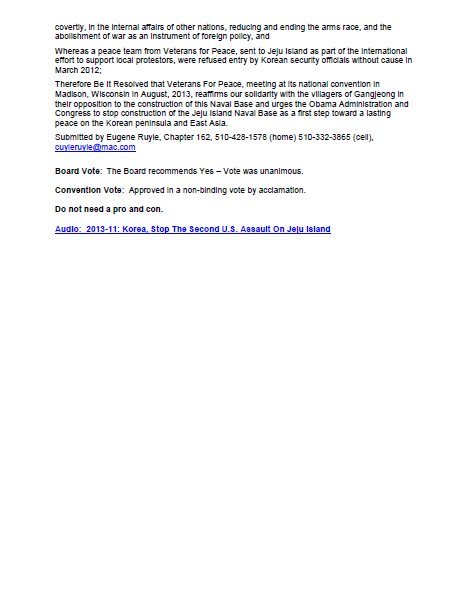
The motion to Stop The Second U.S. Assault On Jeju Island, Korea passed unanimously in the VfP local chapter. It was then sent to our national office. The National Board unanimously recommended a “Yes” vote, and put it on the agenda for the VfP national meeting in Madison, Wisconsin, in August 2013. The Conventions approved in in a non-binding vote by acclamation. It was then sent out for the mail vote and passed overwhelmingly, 714 Yes to 16 No.
To our dear friends on Jeju Island who have involved in your noble struggle at South Korea’s Gangjeong Village,
For seven years I lived in a gorgeous agricultural village in Afghanistan’s Bamiyan Province and like yourselves on Jeju Island, I woke every morning to a window scene of ‘heaven’.
No one with eyes to see such a view would believe that the hell of wars has been occupying this land.
My friends, I imagine you walking the simple yet unpolluted pathways of Gangjeong Village and, should you take a moment’s rest, being caressed and cared for by the tree shadows dappled with sunlight, the chatty play of the neighbourhood children, and the wafts of floral perfume dancing by.
I cannot believe that you, any more than the villagers I lived among in Bamiyan Province, would want to lose such a beautiful and sky-kissed aviary home to the ravages of hatred and greed.
The Afghan Peace Volunteers and I celebrate the love and dedication which has compelled so many of you to stop the construction trucks with your young and old bodies, trucks used to build the military base on your island – we thank you for demonstrating once again that the human spirit can speak to heavy, metallic machines.
Those ‘doing their jobs’ to establish the U.S./South Korea naval base have forgotten their duty to their fellow human beings. Hopefully, they are amenable to the persuasion of your love.
How else can we strengthen ourselves against what seems so massive a force, against the largest and most powerful military in history, except by love?
My 74 year old mother advises, “Don’t be naive or idealistic.”
But I ask myself, “Isn’t it naive or idealistic to think that the peace of Jeju can be promoted by a U.S. /South Korea naval base?”
Naive, idealistic presumptions have to be made in order to support a naval base on Jeju Island. That the U.S. and South Korean governments are ‘good and noble’. That the people of Jeju Island are so ignorant and troublesome they need heavily armed forces to civilize them. That China and North Korea are so ‘evil’ that a base at Jeju is needed to ‘contain’ them.
How wonderful to find these presumptions being dismissed upon examination, to hear the people of Gangjeong Village say, “We don’t want a base in our heavenly home!“
We are confident that if ordinary Chinese or North Koreans ever gave you trouble, you would have tea with them, using your imagination and citizen diplomacy to calm the troubles, non-violent paths which are far more effective and kind, and a far better use of tax-payer money (it takes no tax-payer money to drink tea!) than the multi-million premises, personnel and war equipment.
Such is the priceless power of humane relationships!
In 2003, I lived in Quetta, Pakistan and did medical humanitarian work among Afghan refugees. There were many suspicious characters in alleyways using satellite phones to arrange their smuggling operations, and there were those said to be the ‘Taliban’.
One day, I was invited by a student whose brother was a Talib. Yes, presumptions did flash through my mind, about the Talib brother ‘finishing the infidel off’. The opposite was true. I was hosted to a sumptuous meal, “shlombe” which is a milk-yoghurt drink, and a warm conversation. Would this human-to-human interaction have been possible over a machine-gun, under the visor of an army helmet.
This everyday truth, reaffirmed daily by Afghan friends who have loved me through their hospitality and protection, has convinced me that if the 99% of every country would befriend the 99% of every other country, we would be well on the way to discarding all weapons, including nuclear weapons. How’s that for a Global Disarmament Treaty?
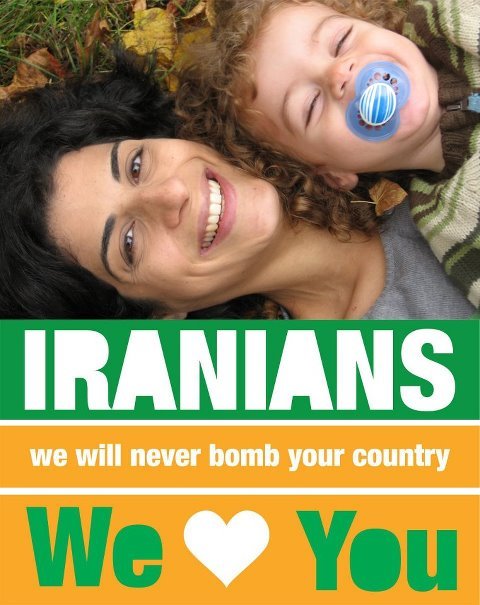
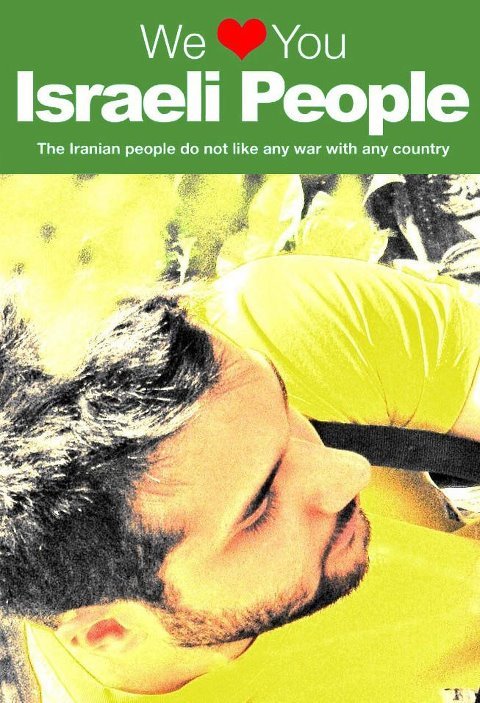
On a small but significant scale, this happens among those of the North and South Korean 99% who cross the U.S.-drawn 38th parallel to reunite with one another in tears. It has happened between ordinary Iranians and Israelis during the Love and Peace Campaign.
Love and Peace Campaign, from Israelis
Osama Bin Laden cited opposition to U.S. military bases in Saudi Arabia as a main motive behind his group’s attacks on September 11th. So,another thought, for thoughts are merely dreams yet unfulfilled. If those people staying around the U.S.’ 750 overseas military bases said, peacefully, “No!” and compelled the Pentagon to close the bases, how many future tragedies might be averted?
All of these sights make it so socially essential for us to remain friends, to stand and struggle together for a while or for a lifetime, free in our minds and hearts from borders, and free from the scourge of fear. That’s why the Afghan Peace Volunteers are petitioning for 2 Million Voices.
Beyond the U.S. military’s hopes of completing Jeju’s one naval base and Afghanistan’s nine are struggles by people in Okinawa, in Diego Garcia and on and on, people we commit to befriending across borders, persisting in building those person-to-person and community-to-community relationships so necessary to saving our world from militarism, from life as machines, from fear.
Gangjeong villagers and peace keepers including the international team
The Afghan Peace Volunteers with guests, and without electricity in Kabul